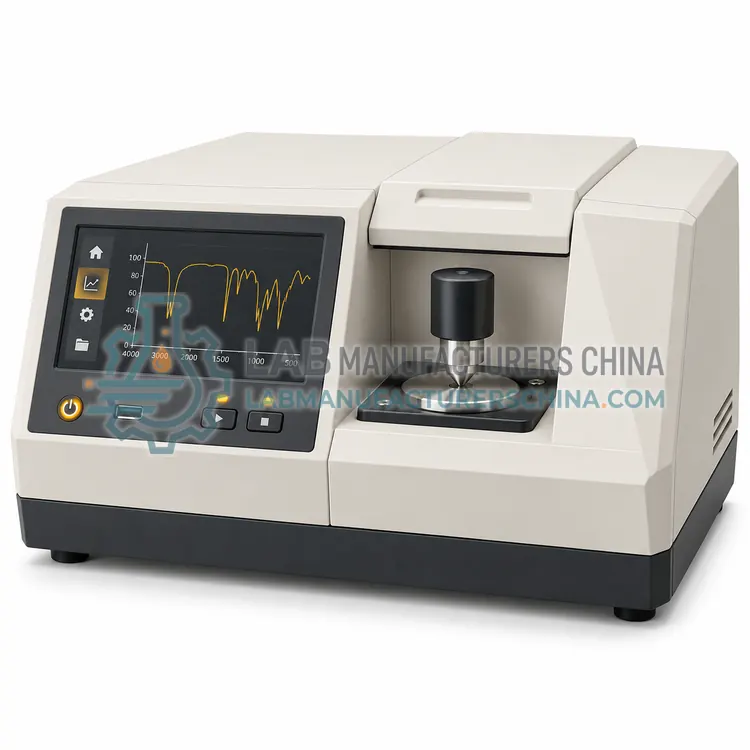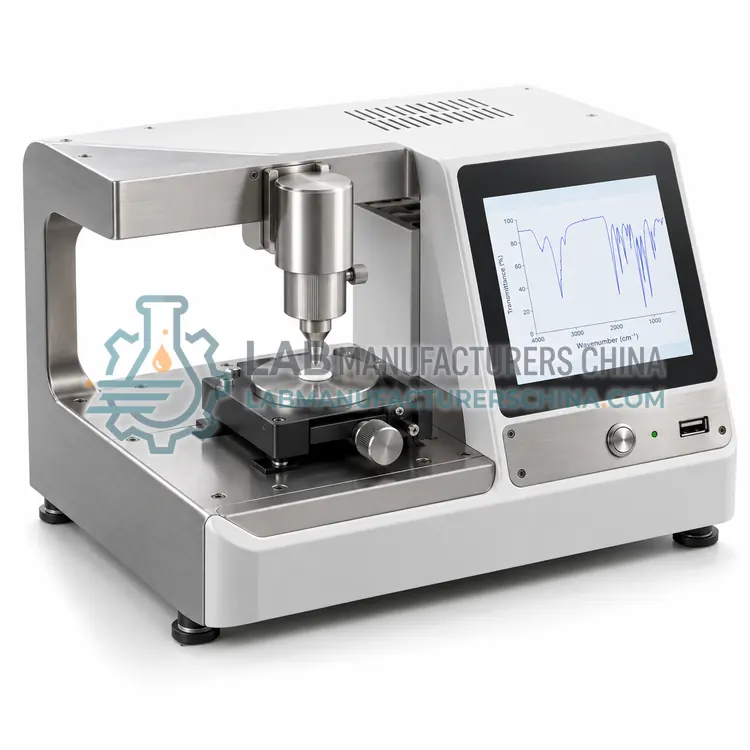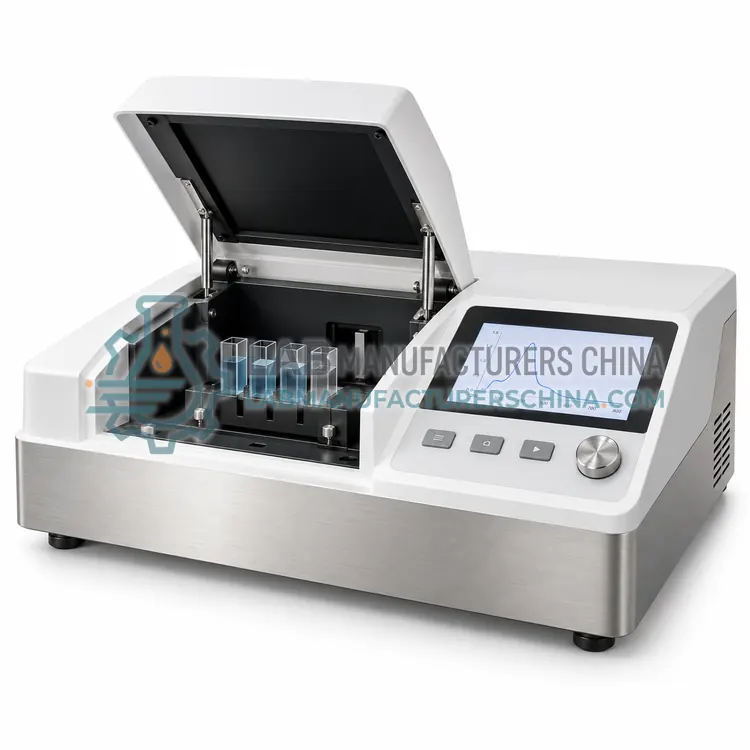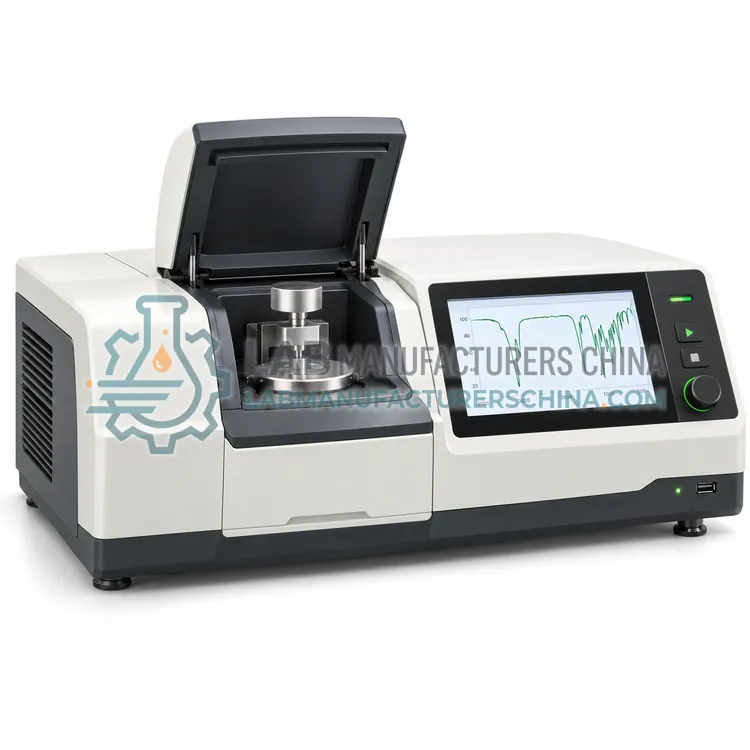
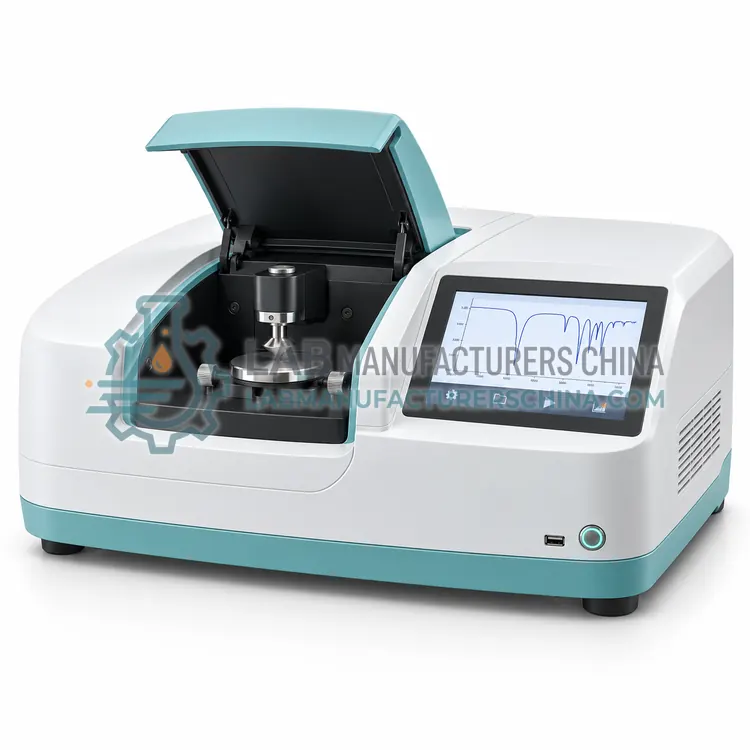
ATR-FTIR Spectrometer for Pharmaceutical Analysis
药品分析衰减全反射红外光谱仪
- SKU FTR-0003
- FTIR
- CE (to be confirmed)
- IEC 61010-1 compliance (to be confirmed)
- ISO 13485 manufacturing (to be confirmed)
Price on request — FOB / CIF quoted per order
Prices depend on configuration, quantity and destination port.
Key specifications
| Spectral range | 4000–400 cm-1 |
|---|---|
| Resolution | 2–4 cm-1 |
| Crystal material | Diamond, ZnSe or germanium |
| Effective path length | 0.5–2 µm depending on crystal |
| Reflectance geometry | Single or multiple bounce |
| Contact pressure | Adjustable clamp |
Request a quote Download brochure · to be provided
By Lab Manufacturers China Technical TeamLast reviewed Standards: USP <854>, USP <197>, USP <197M>
What is the ATR-FTIR Spectrometer for Pharmaceutical Analysis?
An ATR-FTIR spectrometer measures samples in contact with a high-refractive-index crystal, needing little or no preparation. It is chosen for rapid identity testing of powders, pastes, liquids and viscous formulations without pellet pressing or solvents.
What is the ATR-FTIR Spectrometer for Pharmaceutical Analysis?
An ATR-FTIR spectrometer measures samples in contact with a high-refractive-index crystal, needing little or no preparation. It is chosen for rapid identity testing of powders, pastes, liquids and viscous formulations without pellet pressing or solvents.
Overview
Attenuated total reflectance places the sample in contact with a crystal such as diamond, zinc selenide, germanium or silicon. Infrared light is totally internally reflected within the crystal, and the evanescent wave that extends a few micrometres into the sample produces the absorption spectrum of the surface layer. This makes ATR the most convenient sampling technique for pharmaceutical work, since tablets, creams, gels, powders and liquids can be measured directly with cleaning between samples and no pellet pressing or solvent. Diamond is hard and chemically resistant, which suits high-throughput use, while germanium gives a shallower sampling depth and higher spectral contrast for strongly absorbing samples. Contact pressure must be consistent, and the crystal must be clean, because residues alter the spectrum.
How does it work?
An FTIR spectrometer shines broadband infrared light through an interferometer, usually a Michelson type with a moving mirror, and then through or onto the sample. The detector records an interferogram, which a Fourier transform converts into an absorption spectrum from about 4000 to 400 cm-1. Molecular bonds absorb at characteristic frequencies, so the spectrum acts as a fingerprint of the material. Sampling accessories determine how the sample is presented: transmission through a potassium bromide pellet or a liquid cell, attenuated total reflectance for solids and pastes, diffuse reflectance for powders, or a microscope for small particles. Resolution, signal-to-noise ratio, wavenumber accuracy and the condition of the sampling accessory determine whether a spectrum matches the reference.
What are the key features?
- Sample measured in contact with a crystal
- Nearly no sample preparation required
- Suitable for tablets, creams, gels and liquids
- Diamond or ZnSe crystal options
- Clean between samples without a pellet press
- Consistent contact pressure for reproducibility
What are the technical specifications?
A typical atr-ftir spectrometer for pharmaceutical analysis configuration offers spectral range of 4000–400 cm-1, resolution of 2–4 cm-1, crystal material of Diamond, ZnSe or germanium, effective path length of 0.5–2 µm depending on crystal, reflectance geometry of Single or multiple bounce and contact pressure of Adjustable clamp. Values are indicative of the product class; the exact figures for each configuration are confirmed on the quotation and the calibration documents supplied with the instrument.
Which applications is it used for?
The ATR-FTIR Spectrometer for Pharmaceutical Analysis is used in rapid identity testing, creams, gels and semi-solid analysis, liquid formulation testing and high-throughput goods-in checks. Across the wider FTIR class, laboratories also deploy it for raw material identification at goods-in, excipient identity confirmation and polymorph and crystal form screening.
Which standards and certifications apply?
Relevant standards and methods include USP <854>, USP <197>, USP <197M>, EP 2.2.24, ICH Q2(R2) and IEC 61010-1. Certification candidates for this model are CE, IEC 61010-1 compliance and ISO 13485 manufacturing; each is to be confirmed for the specific configuration before shipment, and certificates are supplied only where they have been issued.
Keep the instrument in a room with stable temperature and low humidity, and keep desiccant fresh, because water vapour and carbon dioxide produce sharp absorption bands that can obscure the fingerprint region. Align the interferometer and check wavenumber accuracy with a polystyrene film or other standard at defined intervals, and record the results. Clean ATR crystals carefully, since scratches and residues change the spectrum, and use a background scan at the same settings as the sample. Handle potassium bromide with a dry atmosphere because it is hygroscopic. Maintain the library and re-verify performance after any accessory or detector change, and retain raw spectra for inspection.
How do I select the right ATR-FTIR Spectrometer for Pharmaceutical Analysis?
Choose ATR-FTIR when samples are difficult to prepare as pellets or films and rapid turnaround is important. Confirm crystal material for your samples and cleaning solvents, sampling depth, contact pressure control and spectral range. Diamond suits general use; germanium is chosen for strongly absorbing or aqueous samples.
How does it compare with other FTIR variants?
Choose an FTIR system from the sample form and the test required. For raw material identity, an ATR accessory with a diamond or zinc selenide crystal is convenient because powders and pastes can be measured with minimal preparation, and a benchtop unit with a validated spectral library suits goods-in testing. For polymorph screening and structural confirmation, higher resolution and careful control of sample preparation are needed, and comparisons should use the same accessory and conditions as the reference. Portable or handheld FTIR instruments allow identification through packaging or at the point of sampling. FTIR microscopy is used for particle and contaminant identification. Compare spectral range, resolution, signal-to-noise ratio, accessory options and library software with audit trails.
Full specifications
| Spectral range | 4000–400 cm-1 |
|---|---|
| Resolution | 2–4 cm-1 |
| Crystal material | Diamond, ZnSe or germanium |
| Effective path length | 0.5–2 µm depending on crystal |
| Reflectance geometry | Single or multiple bounce |
| Contact pressure | Adjustable clamp |
| Cleaning | Solvent wipe between samples |
| Power supply | 220 V, 50 Hz, about 0.2 kW |
Indicative values for this product class. Final specifications are confirmed on the quotation and in the calibration documents supplied with the instrument.
Applications
- Rapid identity testing
- Creams, gels and semi-solid analysis
- Liquid formulation testing
- High-throughput goods-in checks
Key features
- Sample measured in contact with a crystal
- Nearly no sample preparation required
- Suitable for tablets, creams, gels and liquids
- Diamond or ZnSe crystal options
- Clean between samples without a pellet press
- Consistent contact pressure for reproducibility
Frequently asked questions about ATR-FTIR Spectrometer for Pharmaceutical Analysis
Diamond is durable and inert, so it suits routine high-throughput testing of many sample types. Germanium has a higher refractive index and shallower penetration, which improves contrast for strongly absorbing samples and aqueous solutions but is softer and more easily damaged.
The spectrum depends on how well the sample contacts the crystal. Too little pressure gives a weak or noisy spectrum, while too much can deform soft samples or damage the crystal. A consistent clamp setting improves reproducibility.
Wipe with a soft tissue and a solvent that dissolves the sample, then dry and take a fresh background if any residue remains. Abrasive materials and strong scratching should be avoided, because surface damage changes the internal reflection and the resulting spectrum.
The infrared spectrum of the sample is compared with a reference spectrum, a pharmacopoeial reference standard or a library entry. A match across the characteristic absorption bands confirms the molecular identity of the material under the defined sampling conditions.
ATR uses a crystal of high refractive index that the sample contacts. Infrared light undergoes total internal reflection inside the crystal and the evanescent wave probes a thin surface layer, so solids, pastes and liquids can be measured with little or no preparation.
Water and carbon dioxide absorb strongly in the infrared and create sharp rotational bands that can overlap the analyte spectrum, especially in the fingerprint region. Stable humidity, fresh desiccant and an appropriate background scan reduce this interference.
Related models