

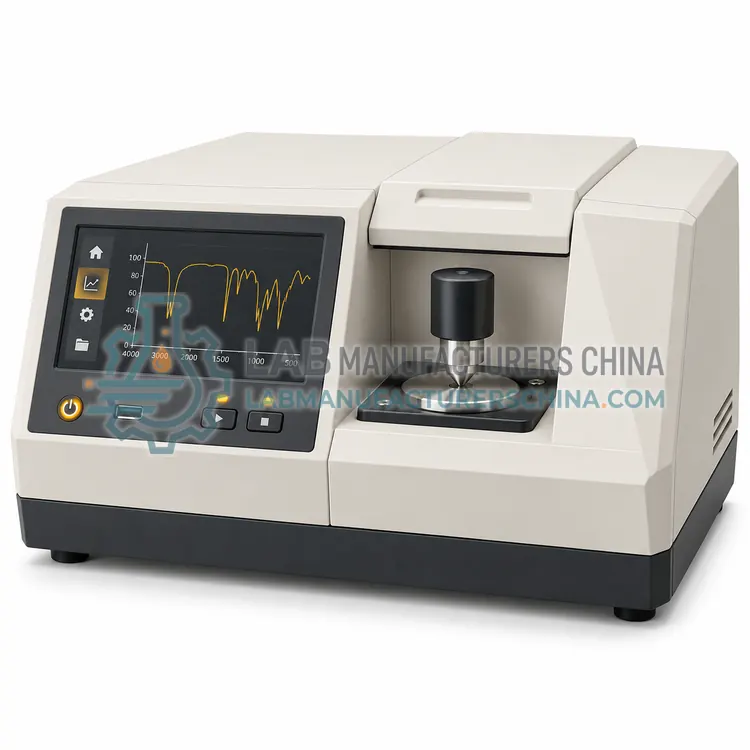
FTIR Spectrometer for Pharmaceutical Quality Control
制药质量控制红外光谱仪
- SKU FTR-0002
- FTIR
- CE (to be confirmed)
- IEC 61010-1 compliance (to be confirmed)
- ISO 13485 manufacturing (to be confirmed)
Price on request — FOB / CIF quoted per order
Prices depend on configuration, quantity and destination port.
Key specifications
| Spectral range | 4000–400 cm-1 |
|---|---|
| Resolution | 1–4 cm-1 selectable |
| Wavenumber accuracy | about 0.01 cm-1 at 1900 cm-1 |
| Signal-to-noise ratio | about 40000:1 or better |
| Sampling accessories | ATR, transmission, diffuse reflectance |
| Software | Method control, audit trail, LIMS export |
Request a quote Download brochure · to be provided
By Lab Manufacturers China Technical TeamLast reviewed Standards: USP <854>, USP <197>, USP <197M>
What is the FTIR Spectrometer for Pharmaceutical Quality Control?
An FTIR spectrometer for pharmaceutical quality control provides spectral confirmation of identity and form within a GMP workflow. It is chosen when spectra, methods and audit trails must be managed under data integrity requirements.
What is the FTIR Spectrometer for Pharmaceutical Quality Control?
An FTIR spectrometer for pharmaceutical quality control provides spectral confirmation of identity and form within a GMP workflow. It is chosen when spectra, methods and audit trails must be managed under data integrity requirements.
Overview
In quality control the FTIR spectrometer becomes part of a regulated system. Spectra are acquired with defined parameters, compared with standards or libraries, and the results, method name, operator, date and instrument status are stored with an audit trail. The instrument may be connected to a laboratory information management system, and user access is controlled so that methods cannot be changed without authorisation. Performance is verified at set intervals, and the verification is a documented activity rather than an informal check. A quality control system typically combines a durable benchtop spectrometer, a versatile sampling accessory and software that supports method control, electronic records and reporting. Consistency of sampling conditions between reference and sample is essential.
How does it work?
An FTIR spectrometer shines broadband infrared light through an interferometer, usually a Michelson type with a moving mirror, and then through or onto the sample. The detector records an interferogram, which a Fourier transform converts into an absorption spectrum from about 4000 to 400 cm-1. Molecular bonds absorb at characteristic frequencies, so the spectrum acts as a fingerprint of the material. Sampling accessories determine how the sample is presented: transmission through a potassium bromide pellet or a liquid cell, attenuated total reflectance for solids and pastes, diffuse reflectance for powders, or a microscope for small particles. Resolution, signal-to-noise ratio, wavenumber accuracy and the condition of the sampling accessory determine whether a spectrum matches the reference.
What are the key features?
- Defined acquisition parameters per method
- Comparison with standards and libraries
- Audit trail with user and method control
- LIMS connectivity options
- Documented periodic performance verification
- Consistent sampling conditions for reference and sample
What are the technical specifications?
A typical ftir spectrometer for pharmaceutical quality control configuration offers spectral range of 4000–400 cm-1, resolution of 1–4 cm-1 selectable, wavenumber accuracy of about 0.01 cm-1 at 1900 cm-1, signal-to-noise ratio of about 40000:1 or better, sampling accessories of ATR, transmission, diffuse reflectance and software of Method control, audit trail, LIMS export. Values are indicative of the product class; the exact figures for each configuration are confirmed on the quotation and the calibration documents supplied with the instrument.
Which applications is it used for?
The FTIR Spectrometer for Pharmaceutical Quality Control is used in GMP identity testing, material qualification, packaging material confirmation and batch record support. Across the wider FTIR class, laboratories also deploy it for raw material identification at goods-in, excipient identity confirmation and polymorph and crystal form screening.
Which standards and certifications apply?
Relevant standards and methods include USP <854>, USP <197>, USP <197M>, EP 2.2.24, ICH Q2(R2) and IEC 61010-1. Certification candidates for this model are CE, IEC 61010-1 compliance and ISO 13485 manufacturing; each is to be confirmed for the specific configuration before shipment, and certificates are supplied only where they have been issued.
Keep the instrument in a room with stable temperature and low humidity, and keep desiccant fresh, because water vapour and carbon dioxide produce sharp absorption bands that can obscure the fingerprint region. Align the interferometer and check wavenumber accuracy with a polystyrene film or other standard at defined intervals, and record the results. Clean ATR crystals carefully, since scratches and residues change the spectrum, and use a background scan at the same settings as the sample. Handle potassium bromide with a dry atmosphere because it is hygroscopic. Maintain the library and re-verify performance after any accessory or detector change, and retain raw spectra for inspection.
How do I select the right FTIR Spectrometer for Pharmaceutical Quality Control?
Specify a quality control FTIR system when spectra must be traceable and methods controlled under GMP. Confirm software data integrity features, LIMS connectivity, verification standards and accessory versatility. Ask for qualification documentation and software validation support.
How does it compare with other FTIR variants?
Choose an FTIR system from the sample form and the test required. For raw material identity, an ATR accessory with a diamond or zinc selenide crystal is convenient because powders and pastes can be measured with minimal preparation, and a benchtop unit with a validated spectral library suits goods-in testing. For polymorph screening and structural confirmation, higher resolution and careful control of sample preparation are needed, and comparisons should use the same accessory and conditions as the reference. Portable or handheld FTIR instruments allow identification through packaging or at the point of sampling. FTIR microscopy is used for particle and contaminant identification. Compare spectral range, resolution, signal-to-noise ratio, accessory options and library software with audit trails.
Full specifications
| Spectral range | 4000–400 cm-1 |
|---|---|
| Resolution | 1–4 cm-1 selectable |
| Wavenumber accuracy | about 0.01 cm-1 at 1900 cm-1 |
| Signal-to-noise ratio | about 40000:1 or better |
| Sampling accessories | ATR, transmission, diffuse reflectance |
| Software | Method control, audit trail, LIMS export |
| Verification standard | Polystyrene film |
| Power supply | 220 V, 50 Hz, about 0.2 kW |
Indicative values for this product class. Final specifications are confirmed on the quotation and in the calibration documents supplied with the instrument.
Applications
- GMP identity testing
- Material qualification
- Packaging material confirmation
- Batch record support
Key features
- Defined acquisition parameters per method
- Comparison with standards and libraries
- Audit trail with user and method control
- LIMS connectivity options
- Documented periodic performance verification
- Consistent sampling conditions for reference and sample
Frequently asked questions about FTIR Spectrometer for Pharmaceutical Quality Control
User access levels, an audit trail that records method changes and acquisitions with time stamps, electronic signatures where used, and the ability to export raw spectra and results in a readable format for review and archival.
At defined intervals, commonly before use or daily for critical identity testing, and after any service, accessory change or relocation. Verification uses a polystyrene film and defined noise and resolution tests, and the result is recorded.
Spectra depend on how the sample is presented: contact pressure on an ATR crystal, particle size and packing in a diffuse reflectance cup, or film thickness in transmission. Reference and sample must be measured the same way or the comparison is not valid.
The infrared spectrum of the sample is compared with a reference spectrum, a pharmacopoeial reference standard or a library entry. A match across the characteristic absorption bands confirms the molecular identity of the material under the defined sampling conditions.
ATR uses a crystal of high refractive index that the sample contacts. Infrared light undergoes total internal reflection inside the crystal and the evanescent wave probes a thin surface layer, so solids, pastes and liquids can be measured with little or no preparation.
Water and carbon dioxide absorb strongly in the infrared and create sharp rotational bands that can overlap the analyte spectrum, especially in the fingerprint region. Stable humidity, fresh desiccant and an appropriate background scan reduce this interference.
Related models
Double-Beam UV-Vis Spectrophotometer for Pharmaceutical Quality Control
制药质量控制双光束紫外可见分光光度计
- CE (to be confirmed)
- +2