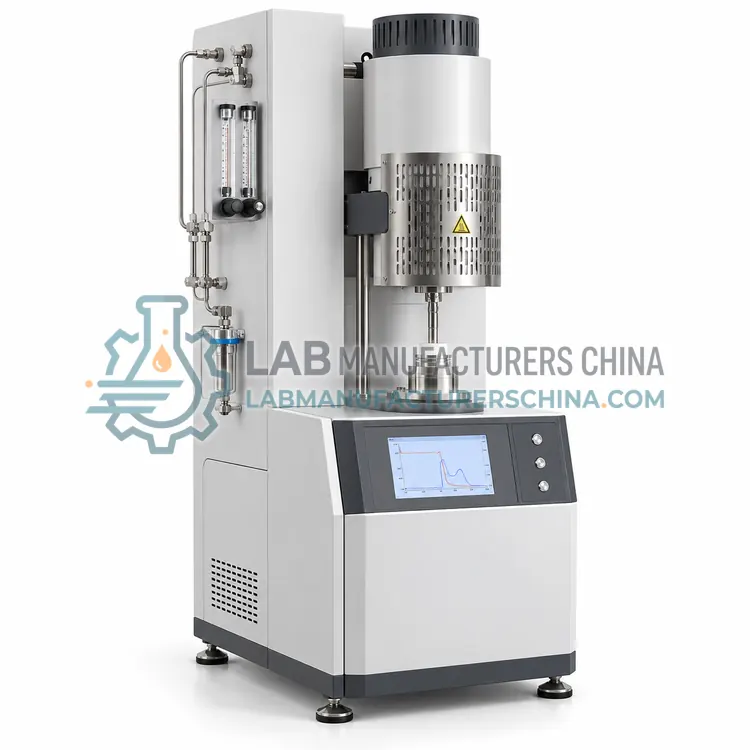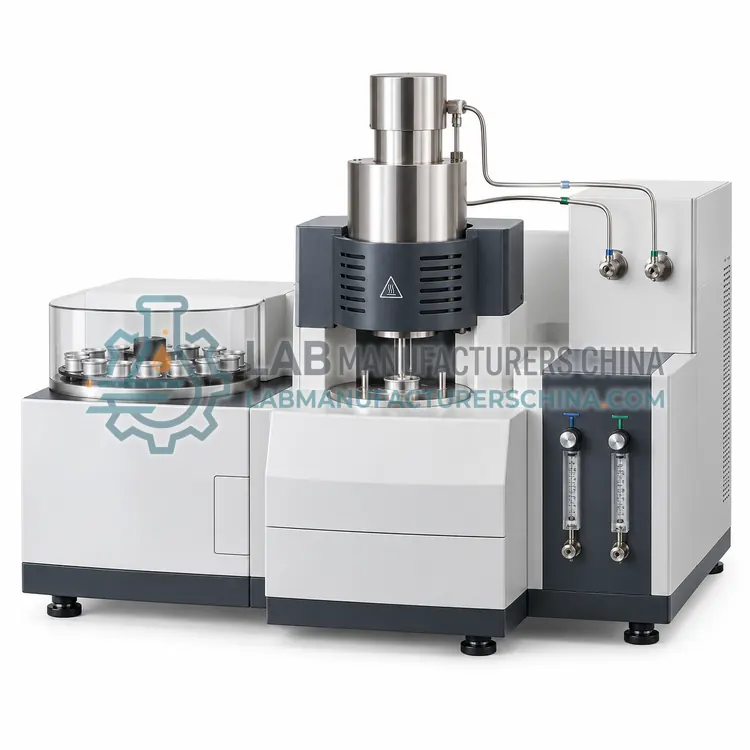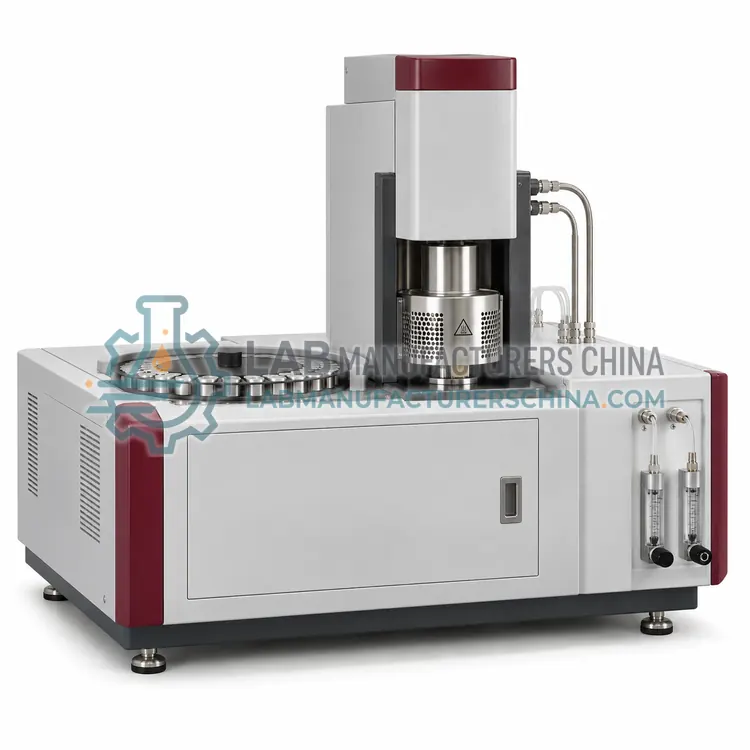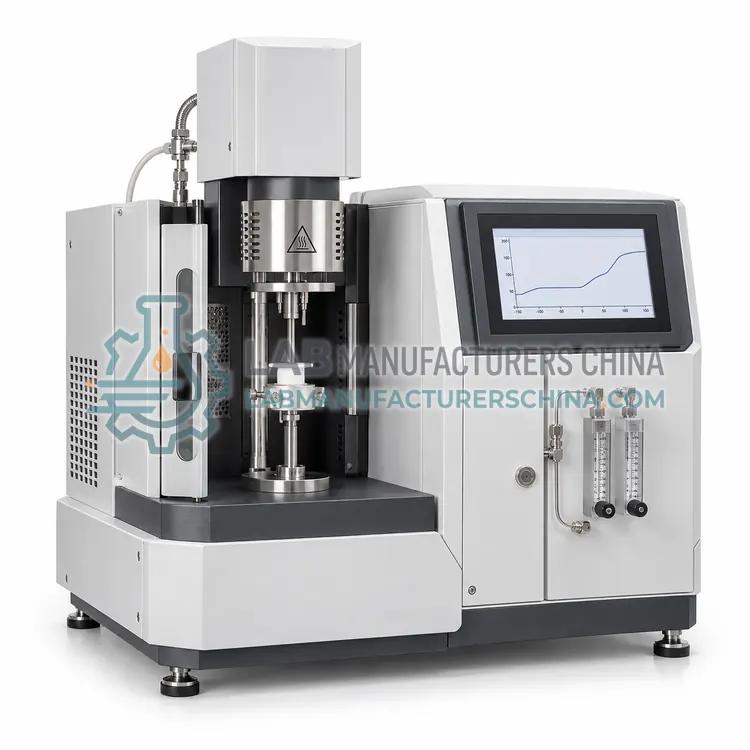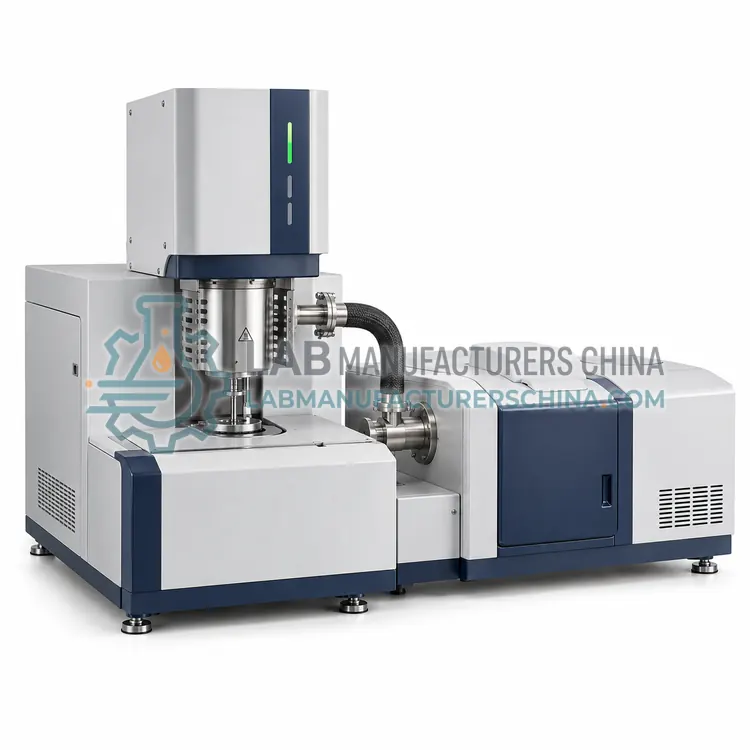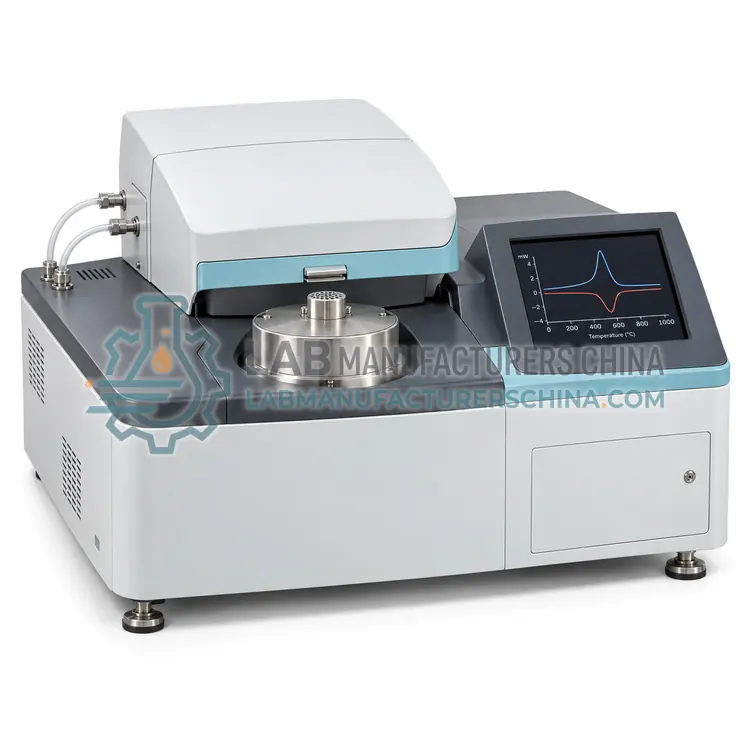
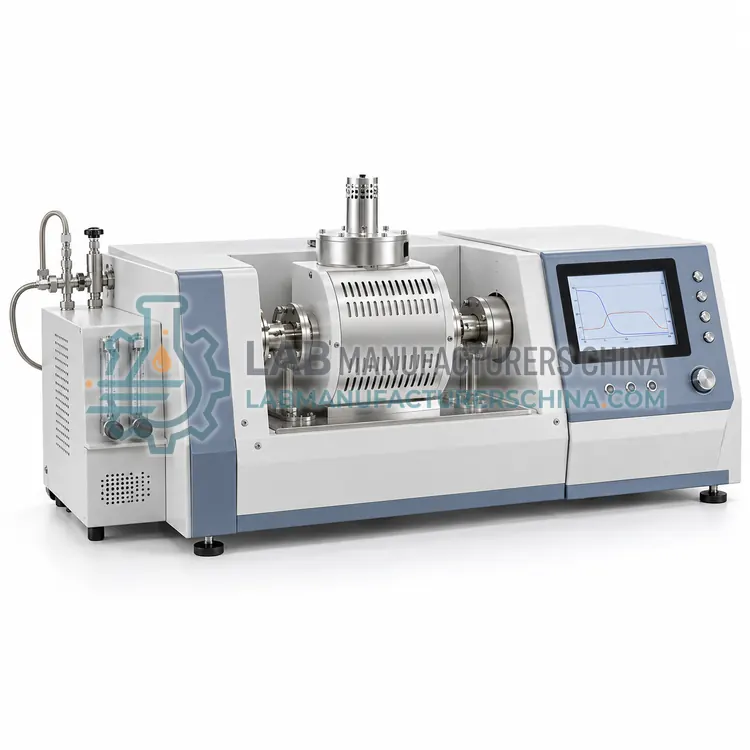
Ultra-High-Temperature Differential Thermal Analyzer
超高温差热分析仪
- SKU DTA-0003
- DTA
- CE (to be confirmed)
- IEC 61010-1 safety (to be confirmed)
- ISO 9001 manufacturing (to be confirmed)
Price on request — FOB / CIF quoted per order
Prices depend on configuration, quantity and destination port.
Key specifications
| Temperature range | Ambient–2400 °C |
|---|---|
| Heating rate | 2–30 °C/min |
| Temperature accuracy | ±5–10 °C at 2000 °C |
| Temperature sensing | W-Re thermocouple and optical pyrometer |
| Atmosphere | Argon or helium, < 10 ppm O₂ |
| Sample mass | 100–500 mg |
Request a quote Download brochure · to be provided
By Lab Manufacturers China Technical TeamLast reviewed Standards: ASTM E967, ASTM E794, ASTM D3418
What is the Ultra-High-Temperature Differential Thermal Analyzer?
An ultra-high-temperature differential thermal analyzer uses a graphite furnace and tungsten-rhenium thermocouples or optical pyrometry to reach 2000 to 2400 degrees Celsius. It supports slags, refractory oxides, alloys and nuclear or metallurgical materials research.
What is the Ultra-High-Temperature Differential Thermal Analyzer?
An ultra-high-temperature differential thermal analyzer uses a graphite furnace and tungsten-rhenium thermocouples or optical pyrometry to reach 2000 to 2400 degrees Celsius. It supports slags, refractory oxides, alloys and nuclear or metallurgical materials research.
Overview
At these temperatures only graphite, tungsten and certain ceramics remain usable, so the furnace is a graphite resistance or induction heated cell operated under argon or helium, with oxygen controlled to very low levels to protect the elements. Temperature is measured with tungsten-rhenium thermocouples up to about 2300 degrees Celsius, and optical pyrometry or a black-body cavity is used above that, with the measurement point calibrated against certified melting standards such as gold, palladium and alumina. Samples are held in graphite, tungsten or zirconia crucibles and are typically 100 to 500 milligrams because reaction heats are often small relative to the large heat capacity of the cell. Typical performance includes heating rates of 2 to 30 degrees Celsius per minute, temperature accuracy of 5 to 10 degrees Celsius at the upper limit and a controlled cooling program. Applications include melting and solidification of slags, dissolution of alumina in cryolite, alloy phase diagrams and nuclear fuel behaviour studies.
How does it work?
The sample and a thermally inert reference, usually calcined alumina, sit in the same furnace and are heated on the same program. A differential thermocouple or two matched thermocouples measure the temperature difference between them, recorded as microvolts against temperature or time, alongside the sample temperature. When the sample undergoes a transition that absorbs heat, its temperature lags the reference and produces an endothermic peak; exothermic reactions such as crystallization or oxidation give a peak in the opposite direction. The peak position identifies the transition temperature and the peak area is roughly proportional to the enthalpy change, although DTA is less quantitative than DSC because the heat path is not calibrated in absolute terms. Sensitivity depends on sample mass, packing density, thermocouple position and atmosphere. Typical samples are 10 to 100 milligrams, and inert, oxidising, reducing or vacuum atmospheres are selectable.
What are the key features?
- Graphite resistance or induction furnace to 2000–2400 °C
- Tungsten-rhenium thermocouples with optical pyrometry above 2300 °C
- Argon or helium atmosphere with oxygen control below 10 ppm
- Graphite, tungsten or zirconia crucibles for reactive melts
- Temperature calibration against certified high-purity melting standards
- Controlled cooling programs for solidification studies
What are the technical specifications?
A typical ultra-high-temperature differential thermal analyzer configuration offers temperature range of Ambient–2400 °C, heating rate of 2–30 °C/min, temperature accuracy of ±5–10 °C at 2000 °C, temperature sensing of W-Re thermocouple and optical pyrometer, atmosphere of Argon or helium, < 10 ppm O₂ and sample mass of 100–500 mg. Values are indicative of the product class; the exact figures for each configuration are confirmed on the quotation and the calibration documents supplied with the instrument.
Which applications is it used for?
The Ultra-High-Temperature Differential Thermal Analyzer is used in slag melting and solidification studies, refractory oxide phase behaviour, alloy and intermetallic phase diagrams, nuclear and metallurgical materials research and cryolite and molten salt investigations. Across the wider DTA class, laboratories also deploy it for clay and mineral phase identification, cement and gypsum dehydration studies and ceramic and refractory development.
Which standards and certifications apply?
Relevant standards and methods include ASTM E967, ASTM E794, ASTM D3418, ISO 11357-1, IEC 61010-1 and GB/T 13464. Certification candidates for this model are CE, IEC 61010-1 safety and ISO 9001 manufacturing; each is to be confirmed for the specific configuration before shipment, and certificates are supplied only where they have been issued.
Package the sample uniformly and keep mass and packing the same as the reference to avoid baseline distortion, and dilute reactive samples with alumina when necessary. Select crucible and thermocouple materials that do not react with the sample at the working temperature, and use a platinum or alumina holder for oxidising conditions. Purge the furnace with the intended gas at a stable flow, and verify the thermocouple pair against melting point standards such as indium, tin, aluminium, silver or gold depending on range. Record the crucible type, sample mass, gas, flow rate and heating rate with every curve. Thermal analysis of minerals often shows overlapping peaks that require a consistent, documented heating rate and reference material to be compared between laboratories, so method details should be exchanged with results.
How do I select the right Ultra-High-Temperature Differential Thermal Analyzer?
Specify an ultra-high-temperature instrument only when reactions occur above about 1600 degrees Celsius, since the furnace requires strict atmosphere control, graphite consumables and slower cycles. For work up to 1600 degrees Celsius, a standard high-temperature DTA is cheaper and simpler to operate.
How does it compare with other DTA variants?
The decisive parameter is the temperature range, because DTA is chosen mainly when transitions lie above the working range of a DSC: minerals, clays, cements, refractories and glasses often require 1500 to 1600 degrees Celsius, and some slags and alloys need graphite furnaces above 2000 degrees Celsius. Below 700 degrees Celsius a DSC is usually a better choice because it also gives enthalpies. After range, consider the thermocouple type and hence the maximum temperature, the crucible and thermocouple materials compatible with the sample, atmosphere and vacuum control, sensitivity to small transitions, and whether automation is required. Peak resolution depends on the heat path, so sample packing and mass must be matched between runs. For routine quality control, an automated instrument with a sample changer reduces operator time, and calibration with melting point and phase transition references should be part of the method.
Full specifications
| Temperature range | Ambient–2400 °C |
|---|---|
| Heating rate | 2–30 °C/min |
| Temperature accuracy | ±5–10 °C at 2000 °C |
| Temperature sensing | W-Re thermocouple and optical pyrometer |
| Atmosphere | Argon or helium, < 10 ppm O₂ |
| Sample mass | 100–500 mg |
| Crucible materials | Graphite, tungsten, zirconia |
| Furnace type | Graphite resistance or induction |
| Cooling | Programmed, 2–20 °C/min |
| Safety features | Gas interlocks, over-temperature cut-off |
Indicative values for this product class. Final specifications are confirmed on the quotation and in the calibration documents supplied with the instrument.
Applications
- Slag melting and solidification studies
- Refractory oxide phase behaviour
- Alloy and intermetallic phase diagrams
- Nuclear and metallurgical materials research
- Cryolite and molten salt investigations
Key features
- Graphite resistance or induction furnace to 2000–2400 °C
- Tungsten-rhenium thermocouples with optical pyrometry above 2300 °C
- Argon or helium atmosphere with oxygen control below 10 ppm
- Graphite, tungsten or zirconia crucibles for reactive melts
- Temperature calibration against certified high-purity melting standards
- Controlled cooling programs for solidification studies
Frequently asked questions about Ultra-High-Temperature Differential Thermal Analyzer
Tungsten-rhenium thermocouples become unreliable above roughly 2300 degrees Celsius, so optical pyrometry is used, sighting either the crucible surface or a black-body cavity. The pyrometer is calibrated with certified melting point standards such as gold at 1064 degrees Celsius or palladium at 1555 degrees Celsius, extended with alumina or other high-temperature references.
The cell has a large heat capacity and radiation losses are significant, so a small sample produces a signal barely above noise. Masses of 100 to 500 milligrams give detectable peaks, at the cost of some peak broadening and thermal gradients inside the sample.
Argon and helium are standard because they are inert and available in high purity; helium improves heat transfer. Nitrogen can react with some metals and graphite at high temperature, and any oxidising gas is excluded because it would destroy the elements and crucibles.
DTA records the temperature difference between sample and reference and is mainly qualitative, while DSC measures heat flow and can be calibrated to give transition enthalpies. DTA is usually preferred at very high temperatures where DSC cells are difficult to build.
Clay minerals show characteristic dehydration, dehydroxylation and recrystallization events at defined temperatures, giving a fingerprint pattern. Kaolinite, for example, loses hydroxyl groups near 500 degrees Celsius and recrystallizes near 980 degrees Celsius, which helps identify the clay type.
Temperature is calibrated with high-purity melting point standards spanning the working range, in contrast to DSC where enthalpies are also calibrated. Peak onset rather than peak maximum is commonly used as the transition temperature, and the same heating rate must be used for standards and samples.
Related models