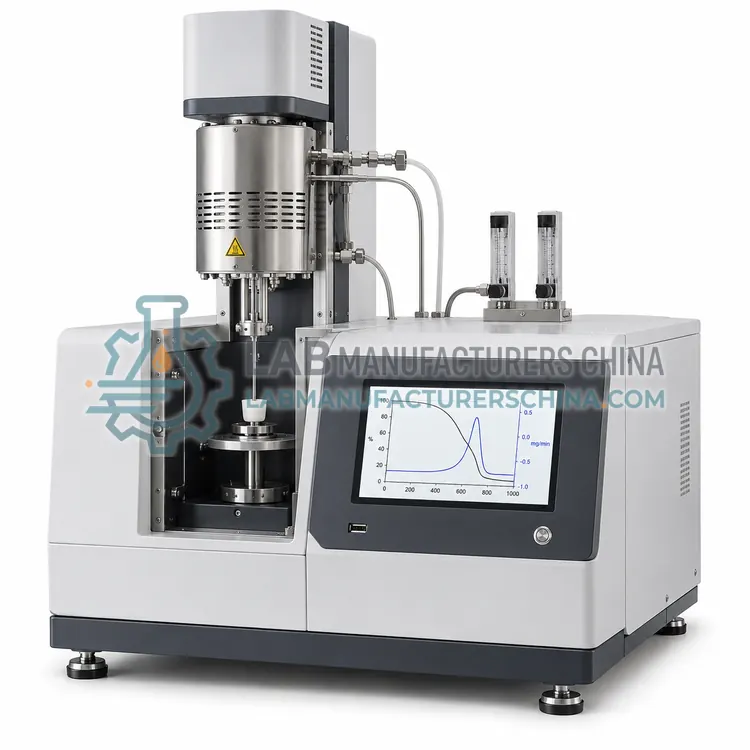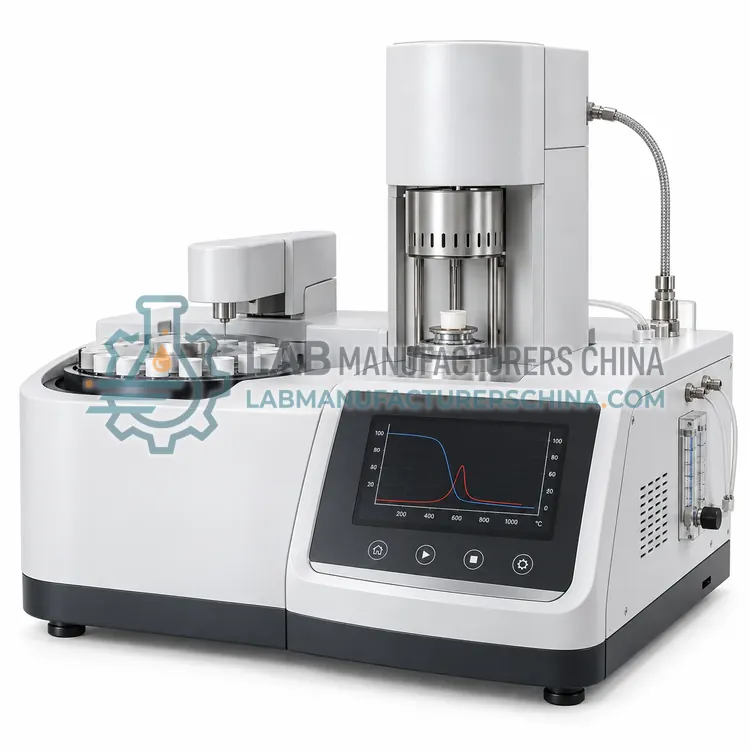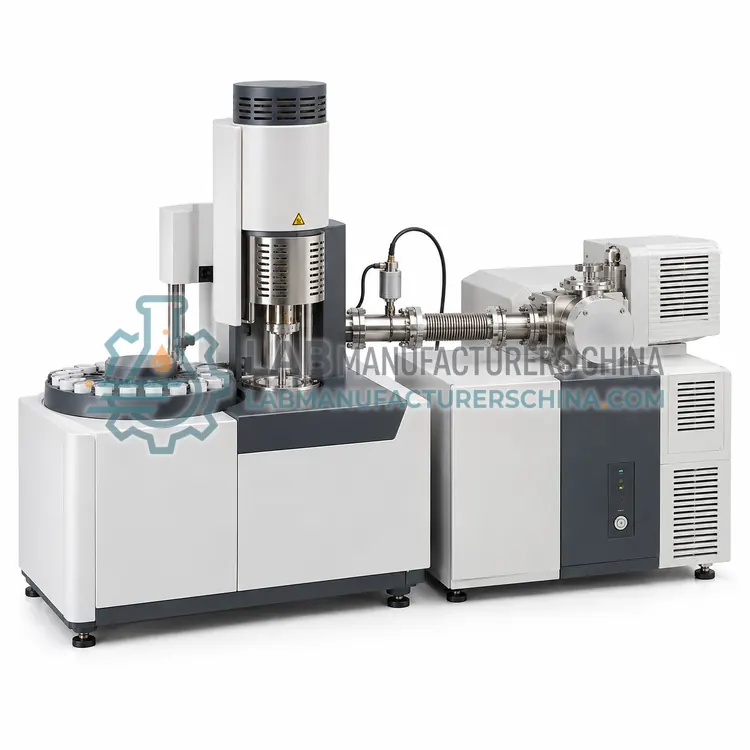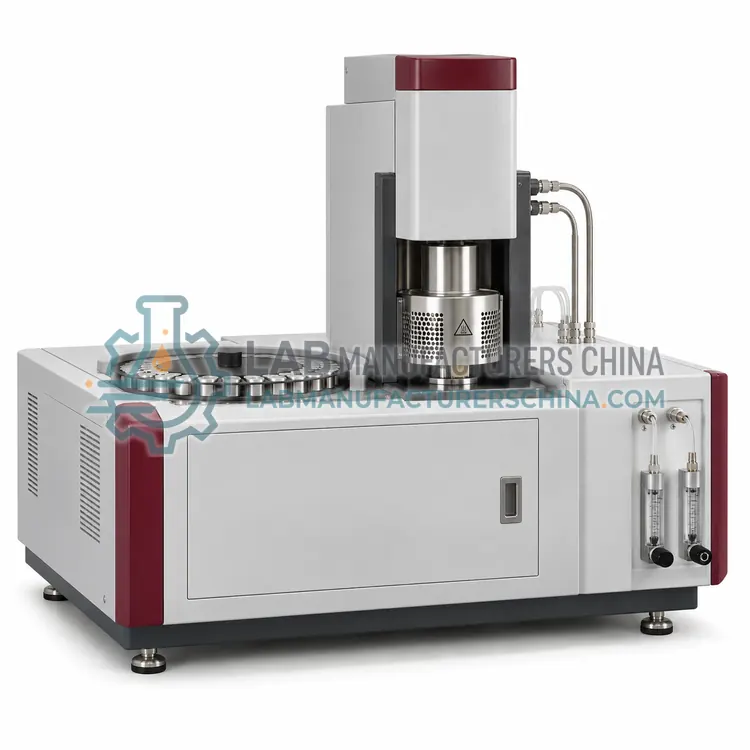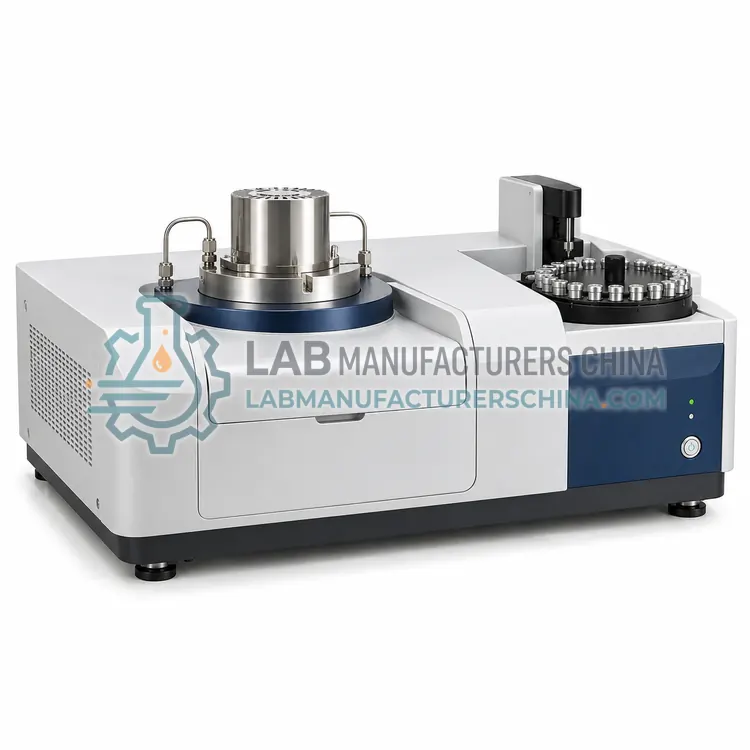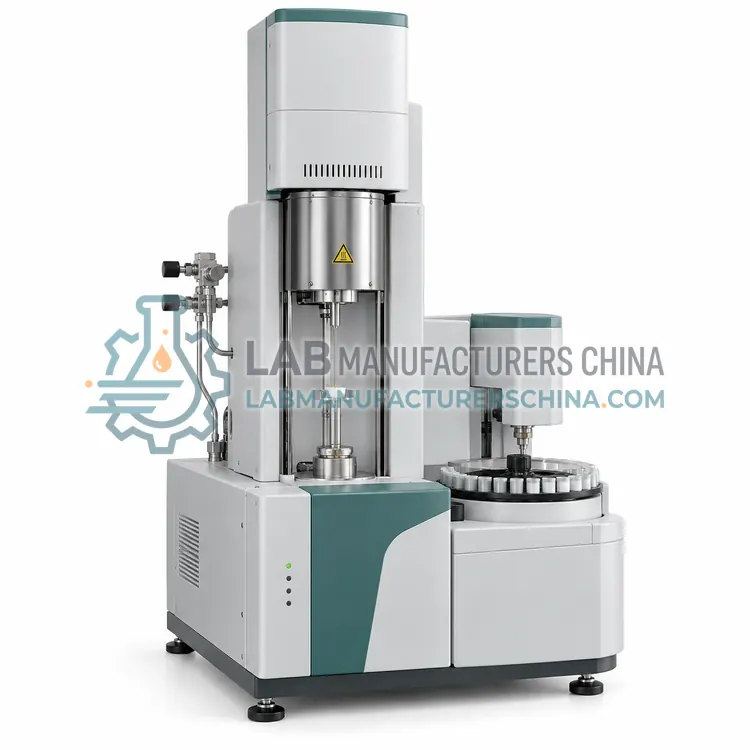
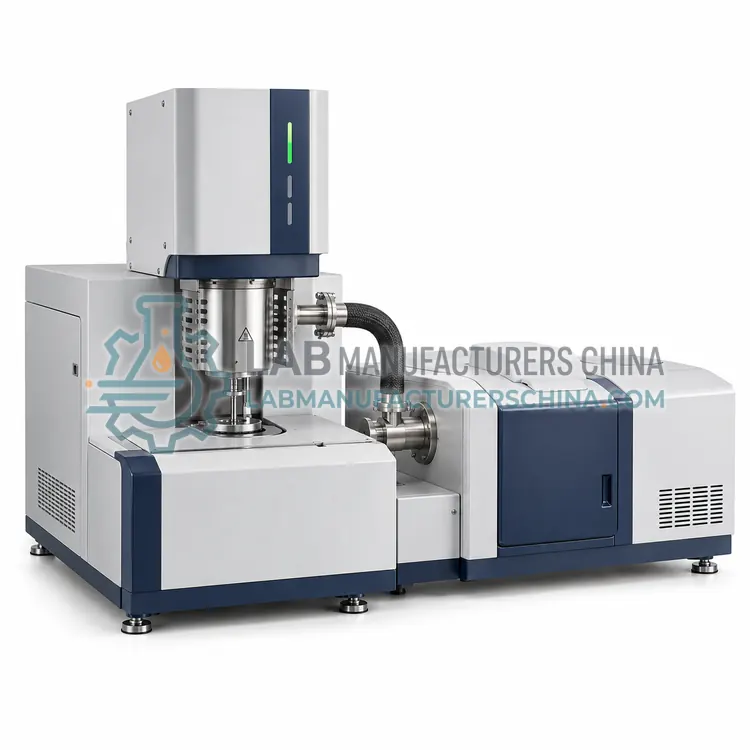
TGA-FTIR Coupled Thermogravimetric Analyzer
热重-红外联用分析仪
- SKU TGA-0004
- TGA
- CE (to be confirmed)
- IEC 61010-1 safety (to be confirmed)
- ISO 9001 manufacturing (to be confirmed)
Price on request — FOB / CIF quoted per order
Prices depend on configuration, quantity and destination port.
Key specifications
| Temperature range | Ambient–1000 °C (TGA) |
|---|---|
| Balance resolution | 0.1 µg |
| Transfer line temperature | 180–250 °C |
| Gas cell temperature | 200–250 °C |
| IR spectral range | 4000–600 cm⁻¹ |
| Spectral resolution | 4 cm⁻¹ typical |
Request a quote Download brochure · to be provided
By Lab Manufacturers China Technical TeamLast reviewed Standards: ASTM E1131, ASTM E2550, ASTM D3850
What is the TGA-FTIR Coupled Thermogravimetric Analyzer?
A TGA-FTIR coupled analyzer passes the gases evolved from a thermogravimetric run through a heated infrared gas cell, identifying functional groups such as water, carbon dioxide, carbonyls and hydrocarbons as they are released. It links mass loss directly to evolved species.
What is the TGA-FTIR Coupled Thermogravimetric Analyzer?
A TGA-FTIR coupled analyzer passes the gases evolved from a thermogravimetric run through a heated infrared gas cell, identifying functional groups such as water, carbon dioxide, carbonyls and hydrocarbons as they are released. It links mass loss directly to evolved species.
Overview
The thermogravimetric analyzer is connected to a Fourier transform infrared spectrometer by a heated transfer line, usually kept at 180 to 250 degrees Celsius, and a heated gas cell with a path length of a few centimetres to several metres. Gases flow through the cell continuously, so infrared spectra are recorded every few seconds and can be shown as a Gram-Schmidt or chemigram trace alongside the mass curve. Library searching identifies functional groups and, in favourable cases, individual compounds, which makes it possible to assign each mass loss step to a chemical process such as dehydration, decarboxylation or dehydrochlorination. Water, carbon dioxide and carbon monoxide are detected, while homonuclear diatomics such as nitrogen and oxygen are invisible to infrared. Sensitivity depends on cell path length and purge dilution, so the balance purge and coupling flow must be optimised together and documented with the method.
How does it work?
A sensitive balance holds the sample in a furnace whose temperature follows a program, usually from ambient to 1000 or 1600 degrees Celsius, at rates of 1 to 50 degrees Celsius per minute. The balance beam is purged to protect it from heat and condensable vapours, and a separate purge gas flows over the sample to set the atmosphere: inert nitrogen or argon for decomposition studies, air or oxygen for oxidative tests, or a reactant gas for specific reactions. The instrument records mass against temperature or time, and the derivative curve is used to locate the onset of each mass loss step. Buoyancy and gas-flow effects are corrected with a blank run. Calibration uses certified mass standards and Curie-point or melting-point references for temperature. Typical balance resolution is 0.1 microgram with a sample of a few milligrams, giving a measurement precision of about 0.1 percent by mass.
What are the key features?
- Heated transfer line at 180–250 °C to prevent condensation
- Heated infrared gas cell with selectable path length
- Spectra recorded every few seconds during the mass loss
- Spectral library search for functional groups and compounds
- Gram-Schmidt or chemigram trace aligned with the mass curve
- Method control linking both instruments in one software interface
What are the technical specifications?
A typical tga-ftir coupled thermogravimetric analyzer configuration offers temperature range of Ambient–1000 °C (TGA), balance resolution of 0.1 µg, transfer line temperature of 180–250 °C, gas cell temperature of 200–250 °C, IR spectral range of 4000–600 cm⁻¹ and spectral resolution of 4 cm⁻¹ typical. Values are indicative of the product class; the exact figures for each configuration are confirmed on the quotation and the calibration documents supplied with the instrument.
Which applications is it used for?
The TGA-FTIR Coupled Thermogravimetric Analyzer is used in polymer decomposition mechanism studies, pharmaceutical excipient compatibility, waste and biomass pyrolysis analysis, coating and adhesive formulation and material failure investigation. Across the wider TGA class, laboratories also deploy it for polymer composition and filler content, pharmaceutical hydrate and solvate studies and coal, biomass and fuel analysis.
Which standards and certifications apply?
Relevant standards and methods include ASTM E1131, ASTM E2550, ASTM D3850, ISO 11358-1, ISO 11358-2 and USP <891>. Certification candidates for this model are CE, IEC 61010-1 safety and ISO 9001 manufacturing; each is to be confirmed for the specific configuration before shipment, and certificates are supplied only where they have been issued.
Choose crucibles that do not react with the sample or the gas: alumina for most work, platinum for oxidative tests or when high thermal conductivity helps, and quartz or ceramic for high-temperature inert runs. Keep sample mass between 5 and 20 milligrams so the gas flow is not restricted and heat transfer is even. Run a blank to correct buoyancy and purge effects before starting a series, and verify mass with a calibration weight periodically. Condensable decomposition products must be kept out of the balance chamber, usually by a trap or by a higher balance purge flow. Temperature calibration should be repeated after a furnace or sensor change, and every run should record crucible type, gas, flow rate, heating rate and sample mass so results can be reproduced. Compliance laboratories should keep the raw curves, not just the calculated numbers.
How do I select the right TGA-FTIR Coupled Thermogravimetric Analyzer?
Choose the FTIR coupling when the identity of evolved species matters, for example in decomposition mechanism or failure investigations. If only the amount of volatile material is needed, a standalone TGA is sufficient. In an RFQ, specify cell path length, transfer line temperature, spectral resolution and library requirements.
How does it compare with other TGA variants?
Decide the maximum temperature you need, because it drives the furnace design: 1000 degrees Celsius covers most polymers and pharmaceuticals, 1500 to 1600 degrees Celsius is needed for ceramics, metal oxides and slags. Then define the atmosphere and whether evolved gases must be identified, which determines whether an FTIR or mass spectrometer coupling is required. Consider the balance resolution you need: routine filler and moisture determinations work with microgram resolution, while thin films or residues need sub-microgram sensitivity. Automatic sample changers pay back quickly in quality control laboratories that run many samples. Check baseline stability, buoyancy correction, purge gas control, crucible material and the maximum heating rate, and confirm that the instrument's calibration procedures match the method you must follow, such as ASTM E1131 or ISO 11358.
Full specifications
| Temperature range | Ambient–1000 °C (TGA) |
|---|---|
| Balance resolution | 0.1 µg |
| Transfer line temperature | 180–250 °C |
| Gas cell temperature | 200–250 °C |
| IR spectral range | 4000–600 cm⁻¹ |
| Spectral resolution | 4 cm⁻¹ typical |
| Time resolution | 2–10 s per spectrum |
| Heating rate | 0.1–30 °C/min |
| Purge gas | Nitrogen, argon, air |
| Data output | Coupled mass and IR data files |
Indicative values for this product class. Final specifications are confirmed on the quotation and in the calibration documents supplied with the instrument.
Applications
- Polymer decomposition mechanism studies
- Pharmaceutical excipient compatibility
- Waste and biomass pyrolysis analysis
- Coating and adhesive formulation
- Material failure investigation
Key features
- Heated transfer line at 180–250 °C to prevent condensation
- Heated infrared gas cell with selectable path length
- Spectra recorded every few seconds during the mass loss
- Spectral library search for functional groups and compounds
- Gram-Schmidt or chemigram trace aligned with the mass curve
- Method control linking both instruments in one software interface
Frequently asked questions about TGA-FTIR Coupled Thermogravimetric Analyzer
Homonuclear diatomic molecules such as nitrogen, oxygen and hydrogen have no permanent dipole and are infrared inactive, so they cannot be measured directly. Water, carbon dioxide, carbon monoxide, hydrocarbons, carbonyls and hydrogen chloride are all detectable.
Decomposition products include water and higher-boiling organics that would condense in an unheated line, causing memory effects, tailing and false identification in later samples. Keeping the line and cell at 180 to 250 degrees Celsius prevents condensation without decomposing the analytes.
The flow must be high enough to sweep evolved gases quickly from the furnace and low enough to keep concentrations measurable in the cell. Typical coupling flows are 20 to 100 millilitres per minute, and the chosen value is recorded because it affects the apparent step temperatures.
It measures sample mass as a function of temperature or time in a controlled atmosphere. The mass loss steps indicate moisture and volatiles, polymer or additive decomposition, filler and ash content, while the residue shows the non-volatile fraction at the final temperature.
Decomposition products can condense on the balance mechanism and change its calibration, so a protective gas flow keeps hot sample gases out of the balance chamber. The purge rate must be stable, because changes in flow alter apparent mass through buoyancy and drag effects.
Use nitrogen or argon for pyrolysis and composition analysis, because inert gas gives defined decomposition steps. Use air or oxygen when oxidation stability or oxidative decomposition temperature is required, and note that the same material can show very different curves in the two atmospheres.
Related models