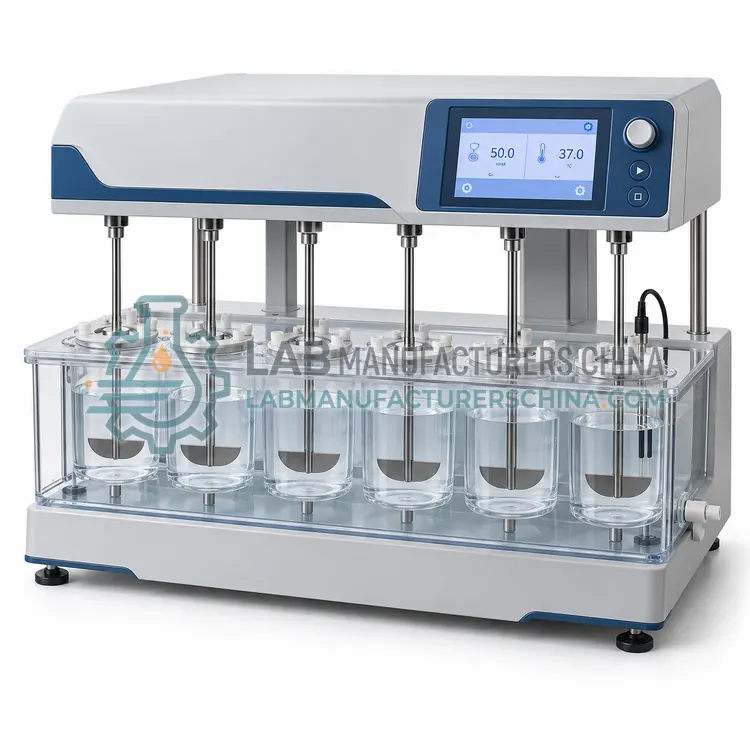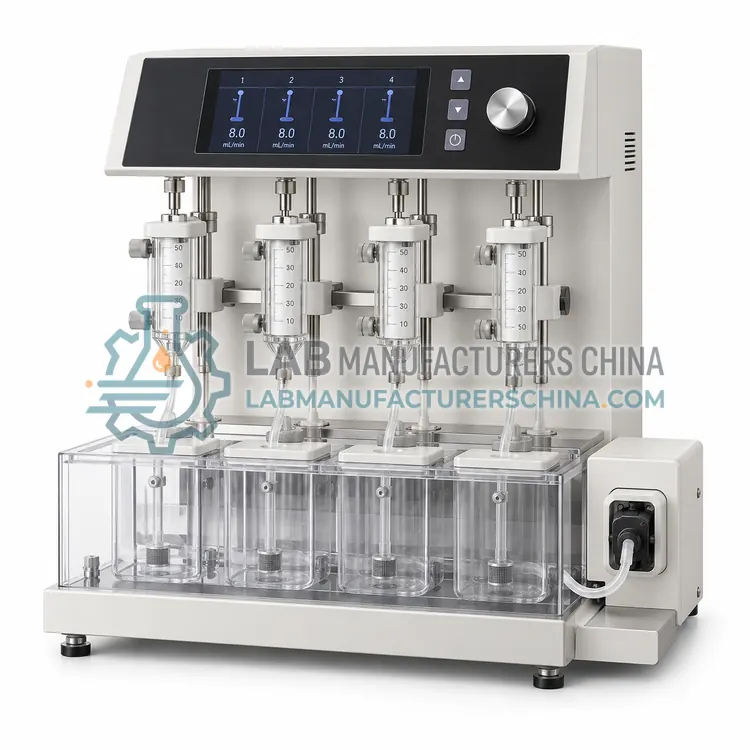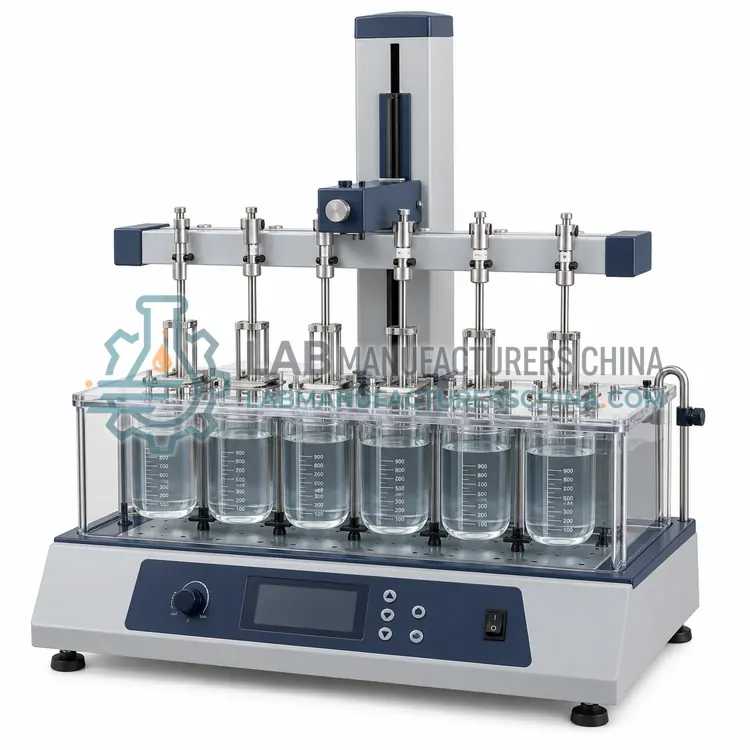
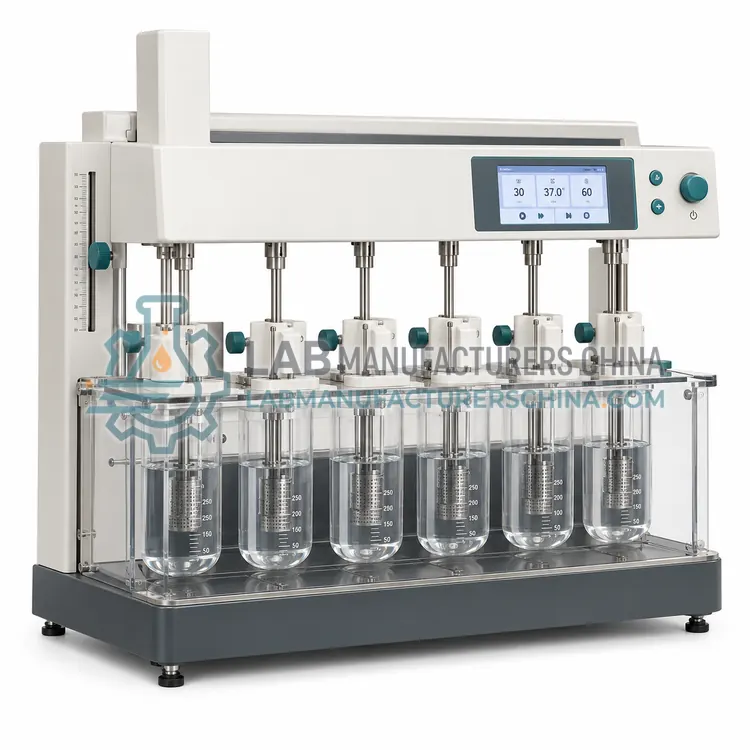
USP Apparatus 3 Reciprocating Cylinder Dissolution System
USP 装置 3 往复筒溶出系统
- SKU DIS-0003
- Dissolution Systems
- CE (to be confirmed)
- IEC 61010-1 compliance (to be confirmed)
- ISO 13485 manufacturing (to be confirmed)
Price on request — FOB / CIF quoted per order
Prices depend on configuration, quantity and destination port.
Key specifications
| Apparatus type | USP Apparatus 3 reciprocating cylinder |
|---|---|
| Tube volume | about 250 mL per tube |
| Temperature | 37 ±0.5 °C |
| Dip rate | 5–40 dips per minute |
| Stroke length | about 20–40 mm |
| Screen mesh | 40 mesh typical |
Request a quote Download brochure · to be provided
By Lab Manufacturers China Technical TeamLast reviewed Standards: USP <711>, USP <724>, USP <1092>
What is the USP Apparatus 3 Reciprocating Cylinder Dissolution System?
A USP Apparatus 3 system moves a sample in a reciprocating glass cylinder between rows of medium-filled tubes. It is chosen for modified-release dosage forms and for methods that need automatic pH changes.
What is the USP Apparatus 3 Reciprocating Cylinder Dissolution System?
A USP Apparatus 3 system moves a sample in a reciprocating glass cylinder between rows of medium-filled tubes. It is chosen for modified-release dosage forms and for methods that need automatic pH changes.
Overview
Apparatus 3 places the dosage form inside a glass cylinder with mesh screens at each end, which dips into successive rows of tubes containing dissolution medium. The cylinder reciprocates vertically at a set dip rate, and because the tubes are arranged in rows, the system can move the sample from one medium to another, for example from simulated gastric fluid at pH 1.2 to intestinal fluid at pH 6.8. This makes it well suited to enteric-coated and modified-release products and to automatic medium changes without operator intervention. Dip rate, stroke length, mesh size and tube volume are the key parameters. Compared with paddle and basket, Apparatus 3 is more complex, needs more tubes and medium, and its results are specific to its flow pattern, but it automates a sequence that would otherwise be manual.
How does it work?
A dissolution system holds a defined volume of dissolution medium at 37 °C and applies controlled agitation to a dosage form. Depending on the apparatus, a basket or paddle rotates in a vessel, a reciprocating cylinder moves the sample up and down between rows of tubes, a flow-through cell pumps medium past a fixed sample, or a holder oscillates in a small volume. Samples are withdrawn at set times by a manual syringe or an automated sampling station, filtered, and the dissolved amount is measured, usually by UV-Vis or HPLC. Results are expressed as percentage dissolved against labelled content, and a profile of several time points shows release behaviour. Temperature, agitation speed, medium composition, degassing and vessel geometry all affect the result, so equipment qualification and method control are critical.
What are the key features?
- Reciprocating glass cylinder with mesh screens
- Successive rows of medium-filled tubes
- Automatic transfer between different media
- Dip rate and stroke length programmable
- Suited to enteric and modified-release forms
- Automated medium changes without intervention
What are the technical specifications?
A typical usp apparatus 3 reciprocating cylinder dissolution system configuration offers apparatus type of USP Apparatus 3 reciprocating cylinder, tube volume of about 250 mL per tube, temperature of 37 ±0.5 °C, dip rate of 5–40 dips per minute, stroke length of about 20–40 mm and screen mesh of 40 mesh typical. Values are indicative of the product class; the exact figures for each configuration are confirmed on the quotation and the calibration documents supplied with the instrument.
Which applications is it used for?
The USP Apparatus 3 Reciprocating Cylinder Dissolution System is used in enteric-coated tablet testing, modified-release dosage forms, automatic pH change methods and delayed-release release profiling. Across the wider Dissolution Systems class, laboratories also deploy it for immediate-release tablet release testing, modified-release dosage form profiling and bioequivalence support.
Which standards and certifications apply?
Relevant standards and methods include USP <711>, USP <724>, USP <1092>, ICH Q2(R2), IEC 61010-1 and ISO 17025. Certification candidates for this model are CE, IEC 61010-1 compliance and ISO 13485 manufacturing; each is to be confirmed for the specific configuration before shipment, and certificates are supplied only where they have been issued.
Install the system on a stable, level bench away from vibration and draughts, because vibration and air movement disturb flow patterns. Verify vessel temperature at multiple positions inside each vessel, and check rotation speed with a tachometer at defined intervals. Degas medium consistently, since dissolved air changes results, and prepare media accurately with volumetric glassware or calibrated dispensers. Keep vessels clean and free of scratches, use the correct paddle or basket height, and replace worn parts. Document qualification, calibration and every run, including medium composition, degassing method and sample times, because dissolution results are highly method-dependent and subject to regulatory scrutiny.
How do I select the right USP Apparatus 3 Reciprocating Cylinder Dissolution System?
Choose Apparatus 3 for enteric and modified-release products where the method requires a sequence of media at different pH values. Confirm dip rate and stroke control, tube volume, row count and mesh size. Plan medium preparation and tube cleaning, since the method consumes more medium than paddle testing.
How does it compare with other Dissolution Systems variants?
Choose the apparatus that the pharmacopoeial monograph or validated in-house method specifies. Paddles and baskets cover most immediate-release tablets and capsules. Reciprocating cylinders suit modified-release dosage forms and automatic media changes. Flow-through cells serve poorly soluble drugs that need large volumes and continuous fresh medium, and reciprocating holders suit transdermal systems, stents and small implants. Then decide on manual or automated sampling, and on UV-Vis or HPLC analysis of the samples. Compare vessel count, temperature control and uniformity, agitation speed accuracy, sampling precision and whether media preparation and cleaning are automated. Confirm qualification documents and software suitable for a GMP environment.
Full specifications
| Apparatus type | USP Apparatus 3 reciprocating cylinder |
|---|---|
| Tube volume | about 250 mL per tube |
| Temperature | 37 ±0.5 °C |
| Dip rate | 5–40 dips per minute |
| Stroke length | about 20–40 mm |
| Screen mesh | 40 mesh typical |
| Rows of tubes | up to 6–7 rows |
| Power supply | 220 V, 50 Hz, about 1.5 kW |
Indicative values for this product class. Final specifications are confirmed on the quotation and in the calibration documents supplied with the instrument.
Applications
- Enteric-coated tablet testing
- Modified-release dosage forms
- Automatic pH change methods
- Delayed-release release profiling
Key features
- Reciprocating glass cylinder with mesh screens
- Successive rows of medium-filled tubes
- Automatic transfer between different media
- Dip rate and stroke length programmable
- Suited to enteric and modified-release forms
- Automated medium changes without intervention
Frequently asked questions about USP Apparatus 3 Reciprocating Cylinder Dissolution System
Because the reciprocating cylinder can be moved automatically from acidic to neutral medium at a defined time, mimicking gastric transit followed by intestinal release. This removes manual medium changes and makes the pH step reproducible between vessels and runs.
The monograph sets the dip rate, commonly 5 to 40 dips per minute. A higher rate increases agitation and release rate, while a lower rate gives gentler conditions. Stroke length and mesh size also affect the hydrodynamic environment around the sample.
Each row of tubes holds a full set of medium volumes, often about 250 mL per tube, so several litres may be prepared per run. This increases preparation effort and waste compared with paddle testing, and medium preparation should be planned accordingly.
The choice follows the monograph or validated method. Apparatus 1 baskets and Apparatus 2 paddles cover most immediate-release products, Apparatus 3 reciprocating cylinders suit modified-release forms, Apparatus 4 flow-through cells handle poorly soluble drugs, and Apparatus 7 holders suit transdermal and implantable devices.
Dissolved air forms bubbles that can change hydrodynamics and interfere with detection, and it also affects the measured concentration. Medium is therefore degassed by heating, vacuum, sonication or helium sparging, and the same method must be used every time.
Sink condition means the volume of medium is at least three times that needed to dissolve the labelled amount of drug, so the drug concentration stays well below saturation. It reduces the chance that dissolution slows because the medium is becoming saturated.
Related models