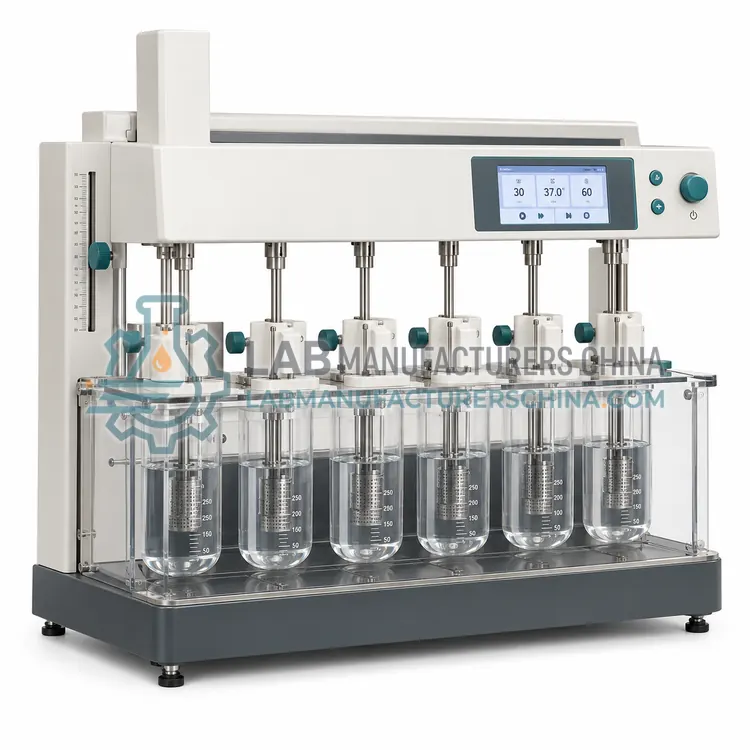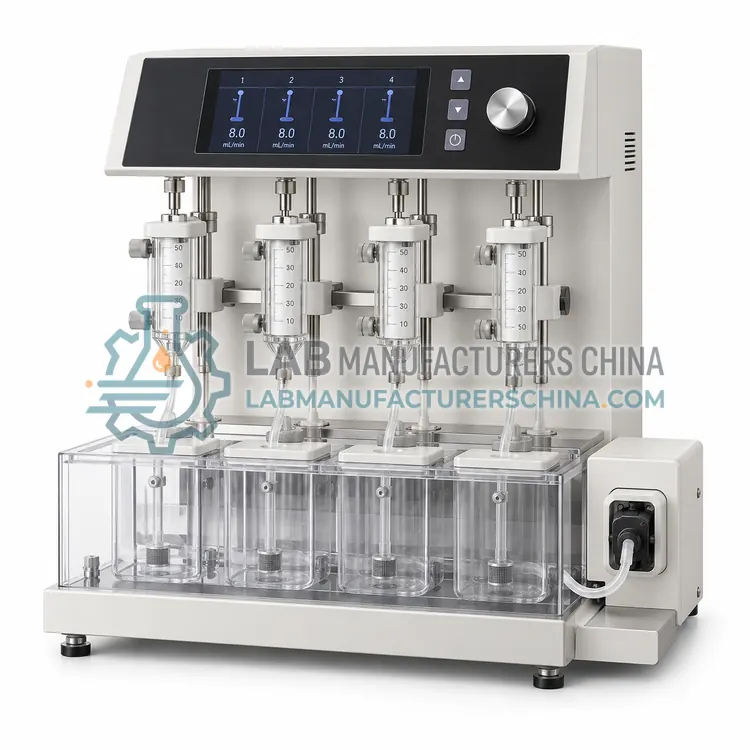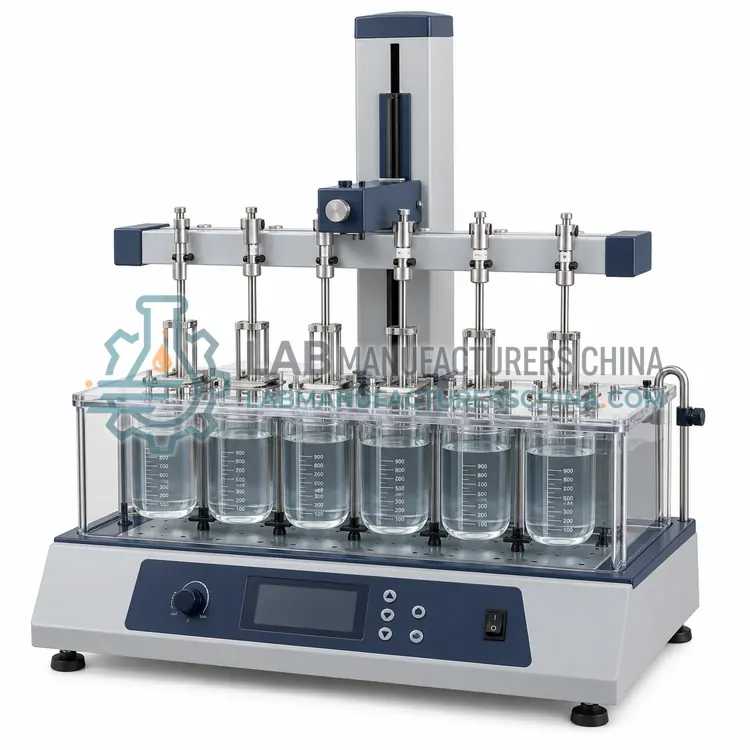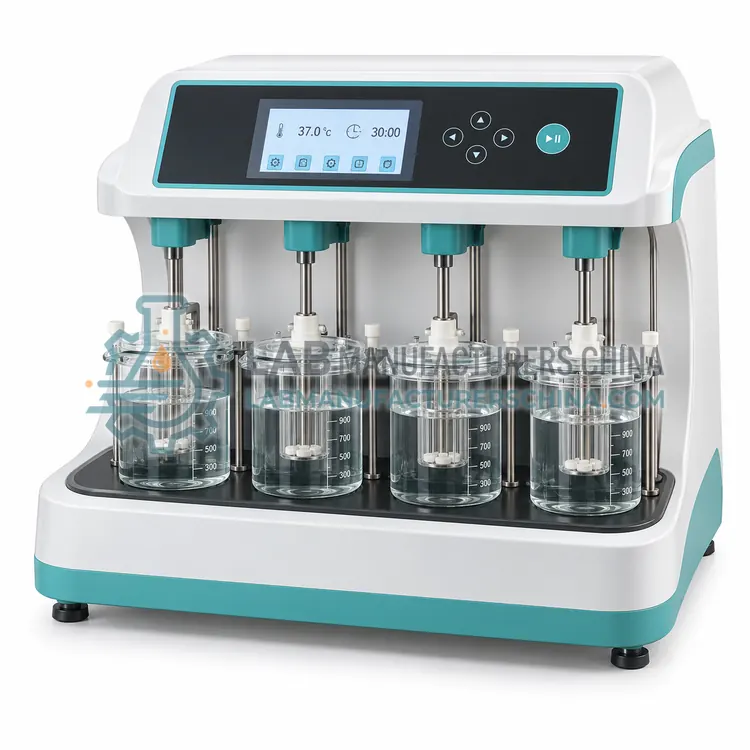
USP Apparatus 2 Paddle Dissolution System
USP 装置 2 桨法溶出系统
- SKU DIS-0002
- Dissolution Systems
- CE (to be confirmed)
- IEC 61010-1 compliance (to be confirmed)
- ISO 13485 manufacturing (to be confirmed)
Price on request — FOB / CIF quoted per order
Prices depend on configuration, quantity and destination port.
Key specifications
| Apparatus type | USP Apparatus 2 paddle |
|---|---|
| Vessel volume | 500–2000 mL |
| Temperature | 37 ±0.5 °C |
| Rotation speed | 25–200 rpm, ±4 percent |
| Paddle height | 25 ±2 mm from vessel base |
| Vessel positions | 6 or 8 |
Request a quote Download brochure · to be provided
By Lab Manufacturers China Technical TeamLast reviewed Standards: USP <711>, USP <724>, USP <1092>
What is the USP Apparatus 2 Paddle Dissolution System?
A USP Apparatus 2 system rotates a paddle above the dosage form in a vessel of medium, and is the most widely used dissolution method. It is chosen for immediate-release tablets and many capsules.
What is the USP Apparatus 2 Paddle Dissolution System?
A USP Apparatus 2 system rotates a paddle above the dosage form in a vessel of medium, and is the most widely used dissolution method. It is chosen for immediate-release tablets and many capsules.
Overview
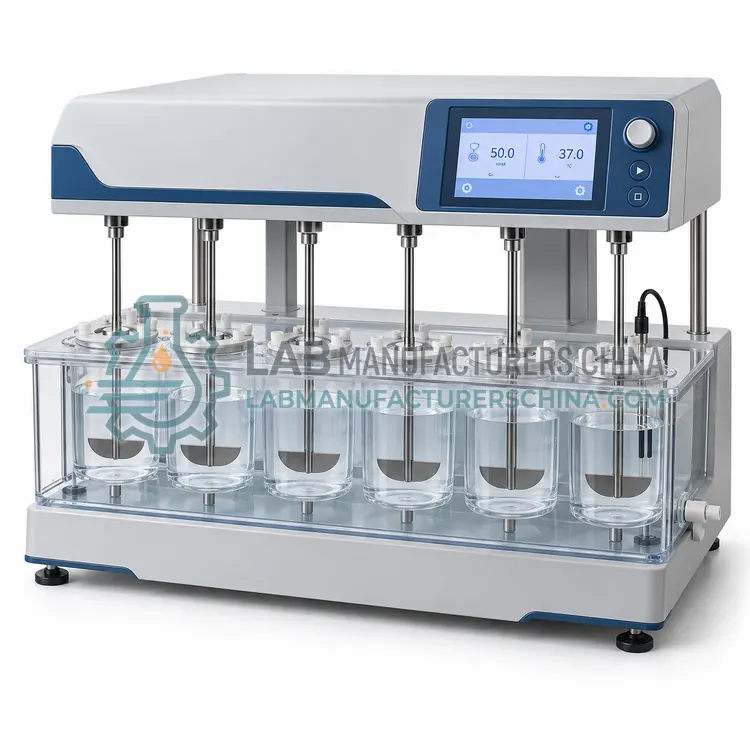
Apparatus 2 places a paddle at a defined height above the bottom of the vessel, and the dosage form sinks to the bottom, where the paddle creates a reproducible flow field. Because there is no basket, the paddle is easier to clean and does not retain undissolved material, and it is well suited to tablets and to most hard and soft capsules. Rotation speed is commonly 50 to 100 rpm, and vessel volume is usually 900 mL but may be 500, 1000 or 2000 mL for sink conditions or modified-release products. Paddle height and vertical alignment are critical and are checked with a gauge. Hydrodynamics differ from basket apparatus, so release profiles are not directly interchangeable. Most modern systems offer six or eight vessels with automated sampling and media preparation.
How does it work?
A dissolution system holds a defined volume of dissolution medium at 37 °C and applies controlled agitation to a dosage form. Depending on the apparatus, a basket or paddle rotates in a vessel, a reciprocating cylinder moves the sample up and down between rows of tubes, a flow-through cell pumps medium past a fixed sample, or a holder oscillates in a small volume. Samples are withdrawn at set times by a manual syringe or an automated sampling station, filtered, and the dissolved amount is measured, usually by UV-Vis or HPLC. Results are expressed as percentage dissolved against labelled content, and a profile of several time points shows release behaviour. Temperature, agitation speed, medium composition, degassing and vessel geometry all affect the result, so equipment qualification and method control are critical.
What are the key features?
- Paddle at a defined height above the vessel base
- Rotation speed typically 50–100 rpm
- Six or eight vessel configurations
- Easier cleaning than basket apparatus
- Automated sampling and media preparation options
- Paddle height gauge for alignment checks
What are the technical specifications?
A typical usp apparatus 2 paddle dissolution system configuration offers apparatus type of USP Apparatus 2 paddle, vessel volume of 500–2000 mL, temperature of 37 ±0.5 °C, rotation speed of 25–200 rpm, ±4 percent, paddle height of 25 ±2 mm from vessel base and vessel positions of 6 or 8. Values are indicative of the product class; the exact figures for each configuration are confirmed on the quotation and the calibration documents supplied with the instrument.
Which applications is it used for?
The USP Apparatus 2 Paddle Dissolution System is used in immediate-release tablet testing, capsule release testing, dissolution profile comparison and stability release testing. Across the wider Dissolution Systems class, laboratories also deploy it for immediate-release tablet release testing, modified-release dosage form profiling and bioequivalence support.
Which standards and certifications apply?
Relevant standards and methods include USP <711>, USP <724>, USP <1092>, ICH Q2(R2), IEC 61010-1 and ISO 17025. Certification candidates for this model are CE, IEC 61010-1 compliance and ISO 13485 manufacturing; each is to be confirmed for the specific configuration before shipment, and certificates are supplied only where they have been issued.
Install the system on a stable, level bench away from vibration and draughts, because vibration and air movement disturb flow patterns. Verify vessel temperature at multiple positions inside each vessel, and check rotation speed with a tachometer at defined intervals. Degas medium consistently, since dissolved air changes results, and prepare media accurately with volumetric glassware or calibrated dispensers. Keep vessels clean and free of scratches, use the correct paddle or basket height, and replace worn parts. Document qualification, calibration and every run, including medium composition, degassing method and sample times, because dissolution results are highly method-dependent and subject to regulatory scrutiny.
How do I select the right USP Apparatus 2 Paddle Dissolution System?
Choose paddle apparatus for most immediate-release tablets and capsules where the monograph specifies Apparatus 2. Confirm vessel count and volume, speed range, paddle height gauge, temperature control and sampling arrangement. Verify that automated sampling does not alter hydrodynamics or volume significantly.
How does it compare with other Dissolution Systems variants?
Choose the apparatus that the pharmacopoeial monograph or validated in-house method specifies. Paddles and baskets cover most immediate-release tablets and capsules. Reciprocating cylinders suit modified-release dosage forms and automatic media changes. Flow-through cells serve poorly soluble drugs that need large volumes and continuous fresh medium, and reciprocating holders suit transdermal systems, stents and small implants. Then decide on manual or automated sampling, and on UV-Vis or HPLC analysis of the samples. Compare vessel count, temperature control and uniformity, agitation speed accuracy, sampling precision and whether media preparation and cleaning are automated. Confirm qualification documents and software suitable for a GMP environment.
Full specifications
| Apparatus type | USP Apparatus 2 paddle |
|---|---|
| Vessel volume | 500–2000 mL |
| Temperature | 37 ±0.5 °C |
| Rotation speed | 25–200 rpm, ±4 percent |
| Paddle height | 25 ±2 mm from vessel base |
| Vessel positions | 6 or 8 |
| Sampling | Manual or automated |
| Power supply | 220 V, 50 Hz, about 1 kW |
Indicative values for this product class. Final specifications are confirmed on the quotation and in the calibration documents supplied with the instrument.
Applications
- Immediate-release tablet testing
- Capsule release testing
- Dissolution profile comparison
- Stability release testing
Key features
- Paddle at a defined height above the vessel base
- Rotation speed typically 50–100 rpm
- Six or eight vessel configurations
- Easier cleaning than basket apparatus
- Automated sampling and media preparation options
- Paddle height gauge for alignment checks
Frequently asked questions about USP Apparatus 2 Paddle Dissolution System
For standard vessels the paddle blade sits 25 mm plus or minus 2 mm above the inside bottom of the vessel. Height is verified with a gauge, because a paddle that is too high or too low changes the flow and the measured release rate.
Some formulations form a cone, a sticky mass or a mound under the paddle, which slows dissolution and gives low, variable results. Changing to basket apparatus, adding a sinker, or adjusting the method where the pharmacopoeia permits can resolve it.
Not directly, because the hydrodynamics differ and the basket restricts access of medium to the dosage form. Comparisons should be made within the same apparatus, and a method transfer between apparatus types requires a validated bridging study.
The choice follows the monograph or validated method. Apparatus 1 baskets and Apparatus 2 paddles cover most immediate-release products, Apparatus 3 reciprocating cylinders suit modified-release forms, Apparatus 4 flow-through cells handle poorly soluble drugs, and Apparatus 7 holders suit transdermal and implantable devices.
Dissolved air forms bubbles that can change hydrodynamics and interfere with detection, and it also affects the measured concentration. Medium is therefore degassed by heating, vacuum, sonication or helium sparging, and the same method must be used every time.
Sink condition means the volume of medium is at least three times that needed to dissolve the labelled amount of drug, so the drug concentration stays well below saturation. It reduces the chance that dissolution slows because the medium is becoming saturated.
Related models