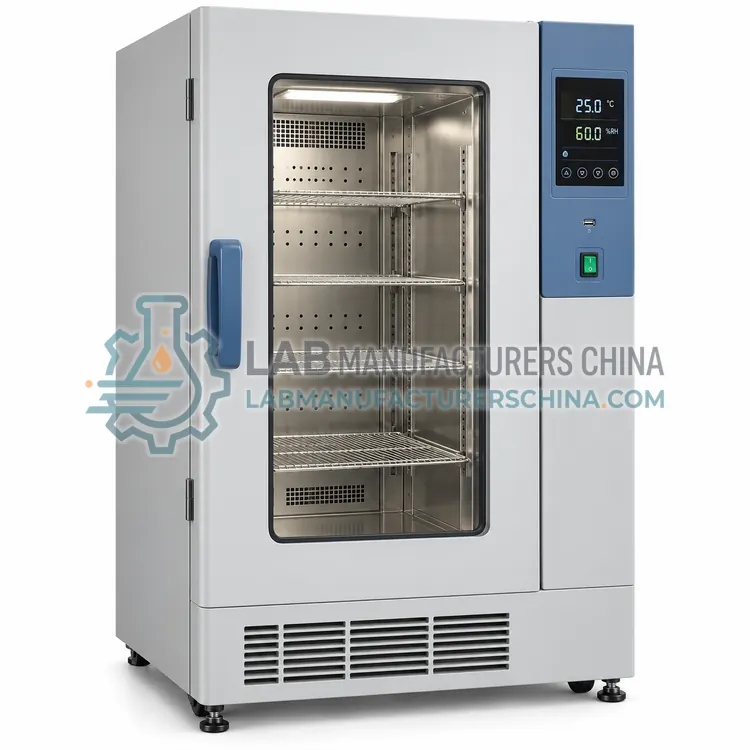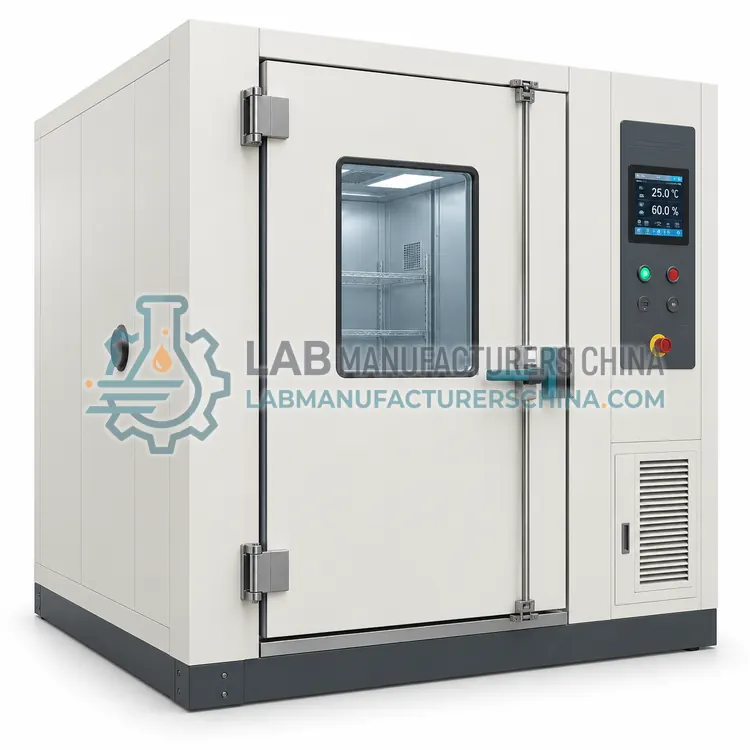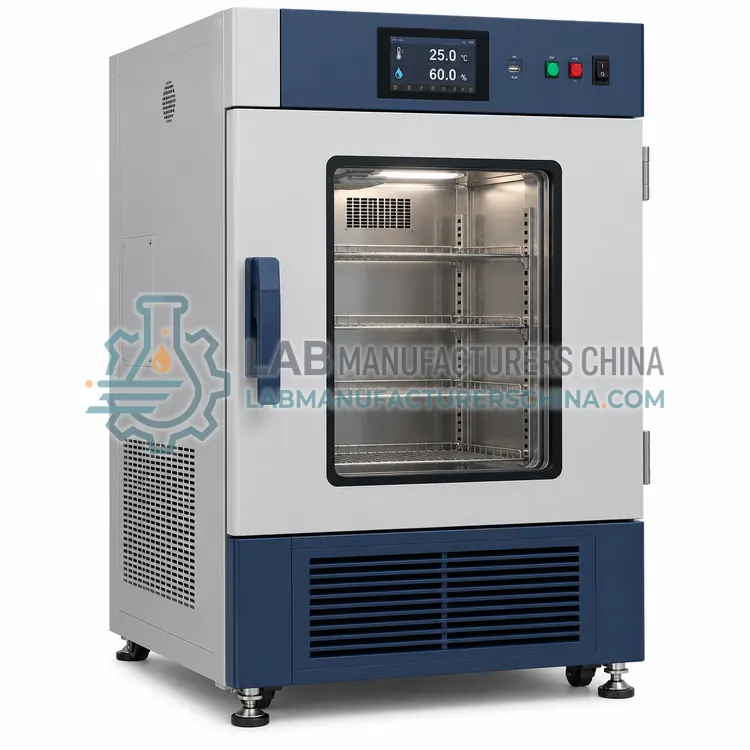
Photostability Chamber
光稳定性试验箱
- SKU STC-0004
- Stability Chambers
- CE (to be confirmed)
- IEC 61010-1 compliance (to be confirmed)
- ISO 13485 manufacturing (to be confirmed)
Price on request — FOB / CIF quoted per order
Prices depend on configuration, quantity and destination port.
Key specifications
| Visible illumination | not less than 1.2 million lux hours |
|---|---|
| Near-UV energy | not less than 200 W·h/m2 |
| Lamp type | Cool white fluorescent plus UV |
| Temperature control | about 25 °C ±2 °C |
| Humidity control | about 60 percent RH ±5 percent |
| Dark control position | Included |
Request a quote Download brochure · to be provided
By Lab Manufacturers China Technical TeamLast reviewed Standards: ICH Q1A(R2), ICH Q1B, ICH Q1C
What is the Photostability Chamber?
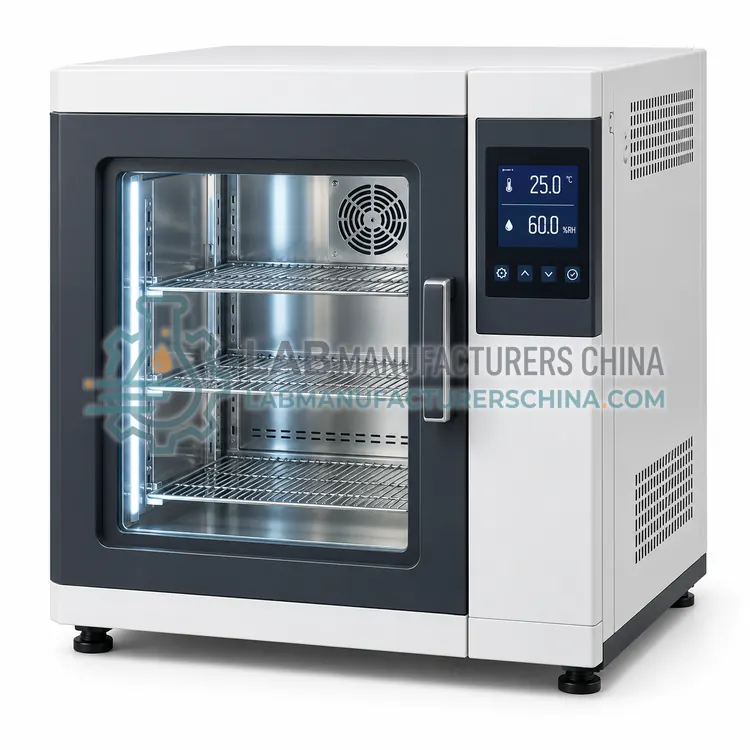
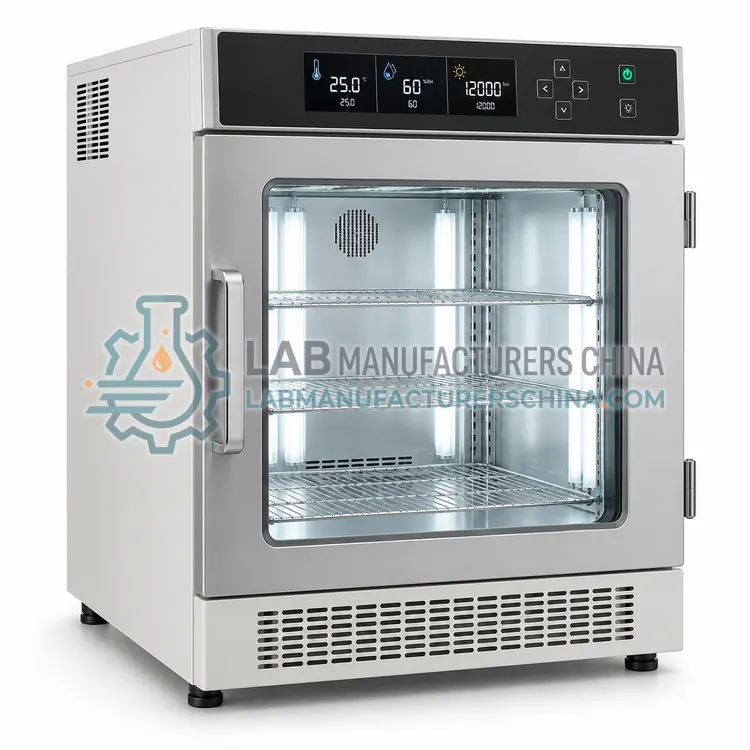
A photostability chamber exposes drug samples to controlled illumination for ICH Q1B testing while holding temperature and humidity. It is chosen when a product must be shown to withstand light exposure during storage and handling.
What is the Photostability Chamber?
A photostability chamber exposes drug samples to controlled illumination for ICH Q1B testing while holding temperature and humidity. It is chosen when a product must be shown to withstand light exposure during storage and handling.
Overview
Photostability testing examines whether light degrades a drug substance or product, as required by ICH Q1B. The chamber provides controlled illumination from fluorescent lamps in the visible and near-ultraviolet range, typically at an overall illumination of not less than 1.2 million lux hours and an integrated near-ultraviolet energy of not less than 200 watt hours per square metre. Temperature and humidity are controlled simultaneously, and a dark control position is included so that light-specific effects can be distinguished from thermal ones. Some chambers also offer cool white and ultraviolet lamp combinations with separate control. Dosimetry or calibrated sensors record cumulative exposure, and samples are placed in defined positions so each receives a comparable dose. Uniformity of illumination across the exposure plane is the key performance parameter.
How does it work?
A stability chamber controls the environment around stored samples. Compressor or Peltier cooling removes heat, resistive or steam humidification adds moisture, and heaters raise temperature when needed, all regulated by sensors and controllers. Forced-air circulation distributes conditioned air through the chamber so temperature and humidity are uniform around every shelf position. ICH guidance defines the conditions: 25 °C and 60 percent relative humidity, or 30 °C and 65 percent relative humidity, for long-term studies, and 40 °C and 75 percent relative humidity for accelerated studies, with photostability testing under defined illumination. Continuous monitoring with alarms and chart or electronic records proves that conditions stayed within limits, and some chambers can run different zones at different conditions simultaneously.
What are the key features?
- Controlled visible and near-ultraviolet illumination
- ICH Q1B light dose monitoring
- Simultaneous temperature and humidity control
- Dark control position for comparison
- Dosimetry or calibrated exposure sensors
- Uniform illumination across the exposure plane
What are the technical specifications?
A typical photostability chamber configuration offers visible illumination of not less than 1.2 million lux hours, near-UV energy of not less than 200 W·h/m2, lamp type of Cool white fluorescent plus UV, temperature control of about 25 °C ±2 °C, humidity control of about 60 percent RH ±5 percent and dark control position of Included. Values are indicative of the product class; the exact figures for each configuration are confirmed on the quotation and the calibration documents supplied with the instrument.
Which applications is it used for?
The Photostability Chamber is used in ICH Q1B photostability testing, light-sensitive product characterisation, packaging light protection studies and forced degradation studies. Across the wider Stability Chambers class, laboratories also deploy it for ICH long-term stability studies, accelerated stability testing and photostability testing.
Which standards and certifications apply?
Relevant standards and methods include ICH Q1A(R2), ICH Q1B, ICH Q1C, IEC 61010-1, IEC 61010-2-010 and ISO 17025. Certification candidates for this model are CE, IEC 61010-1 compliance and ISO 13485 manufacturing; each is to be confirmed for the specific configuration before shipment, and certificates are supplied only where they have been issued.
Install the chamber where ambient conditions are stable and within the manufacturer's limits, with clearance for airflow around the condensing unit. Connect a water supply or drain if humidification requires it, and prepare an emergency power plan so a failure does not destroy a long study. Map temperature and humidity at empty, partial and full load before use and after any major service, and repeat the mapping periodically. Set alarms for deviation, power loss and door-open events, and keep continuous records. Maintain the humidifier, filters and refrigeration system on schedule, and retain all monitoring data for the study period plus the required retention time.
How do I select the right Photostability Chamber?
Specify a photostability chamber when ICH Q1B testing is required or when light sensitivity must be characterised. Confirm lamp type and control, achievable visible and near-ultraviolet doses, illumination uniformity, temperature and humidity control, and the presence of a dark control. Ensure exposure is recorded so the delivered dose can be demonstrated.
How does it compare with other Stability Chambers variants?
Select a stability chamber from the ICH conditions you must support, the number of sample positions and the study duration. Benchtop units suit development and small batches; reach-in cabinets handle routine stability programmes; walk-in rooms are used when very large sample sets or many studies run in parallel. Photostability chambers add controlled illumination to the option list. Compare temperature and humidity range and stability, uniformity across shelves, recovery after door opening, alarm and monitoring systems, and whether the chamber supports multiple independent zones. Check the power, water and drainage requirements, and confirm that qualification documentation and mapping reports are provided, because regulators expect them.
Full specifications
| Visible illumination | not less than 1.2 million lux hours |
|---|---|
| Near-UV energy | not less than 200 W·h/m2 |
| Lamp type | Cool white fluorescent plus UV |
| Temperature control | about 25 °C ±2 °C |
| Humidity control | about 60 percent RH ±5 percent |
| Dark control position | Included |
| Exposure monitoring | Cumulative dose recording |
| Power supply | 220 V, 50 Hz, about 1–2 kW |
Indicative values for this product class. Final specifications are confirmed on the quotation and in the calibration documents supplied with the instrument.
Applications
- ICH Q1B photostability testing
- Light-sensitive product characterisation
- Packaging light protection studies
- Forced degradation studies
Key features
- Controlled visible and near-ultraviolet illumination
- ICH Q1B light dose monitoring
- Simultaneous temperature and humidity control
- Dark control position for comparison
- Dosimetry or calibrated exposure sensors
- Uniform illumination across the exposure plane
Frequently asked questions about Photostability Chamber
The guideline specifies not less than 1.2 million lux hours of visible illumination and not less than 200 watt hours per square metre of integrated near-ultraviolet energy, unless the sample degrades first, in which case the exposure is documented.
A dark control is stored at the same temperature and humidity but shielded from light, so any change in the dark sample must be caused by heat or moisture rather than light. Comparing the two isolates the light-specific effect.
With calibrated light and ultraviolet sensors placed at multiple positions across the exposure plane. The results show which positions receive comparable doses and define the qualified exposure area, so samples are placed only in verified locations.
General case long-term conditions are 25 °C and 60 percent relative humidity, or 30 °C and 65 percent relative humidity, for at least 12 months. Accelerated storage is 40 °C and 75 percent relative humidity for six months, with intermediate conditions where needed.
Temperature and humidity mapping is normally done after installation, then periodically, for example annually, and again after any major repair or relocation. Mapping is performed empty, at partial load and at full load so that the usable working volume and uniformity are demonstrated.
Conditions deviate and the event must be recorded and assessed for impact on the study. A backup generator or power supply, alarm notification and documented recovery procedure limit losses, and samples exposed to out-of-specification conditions may need to be re-tested or replaced.