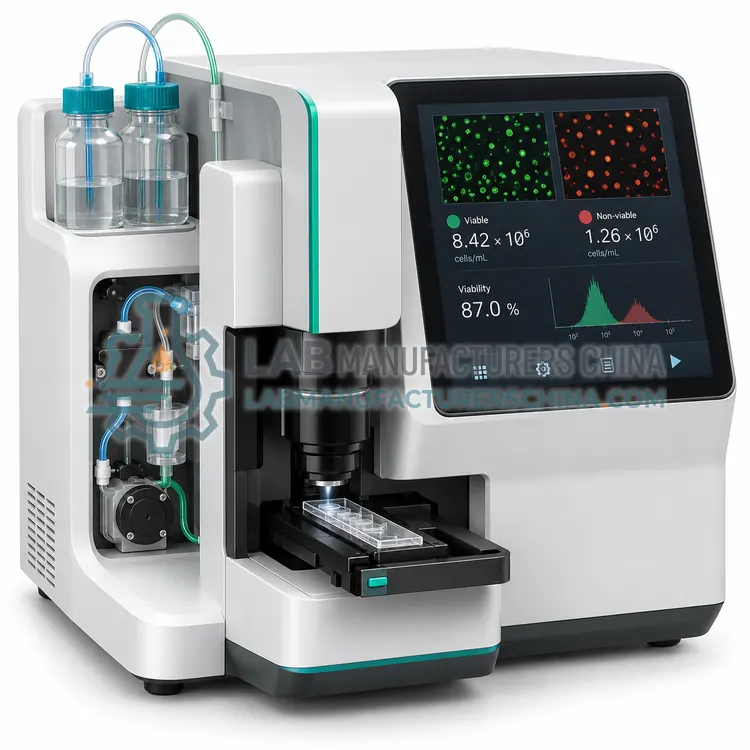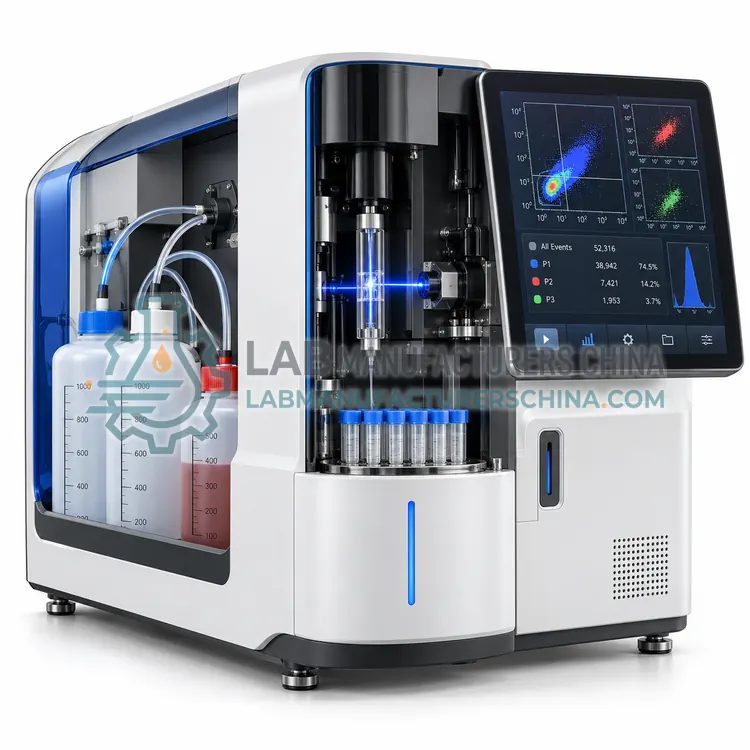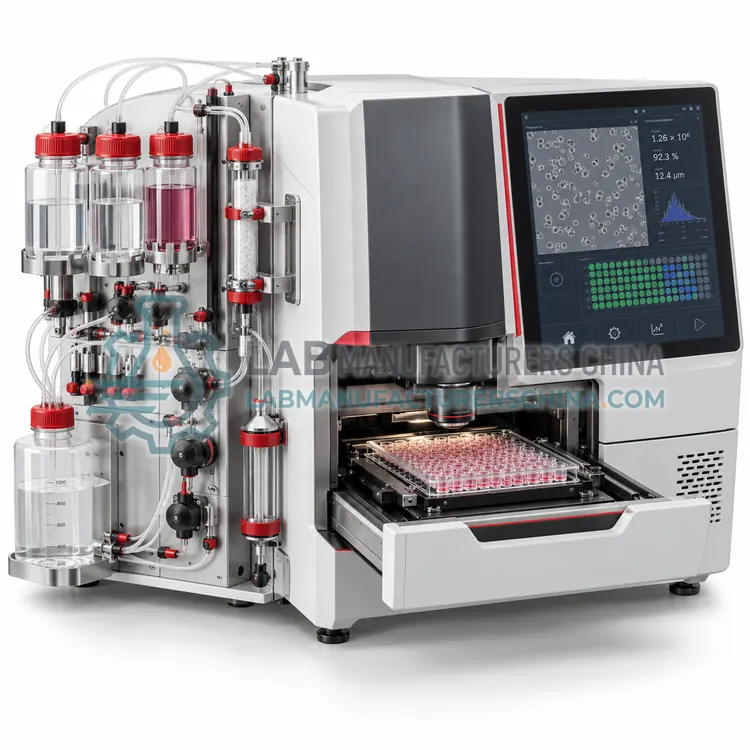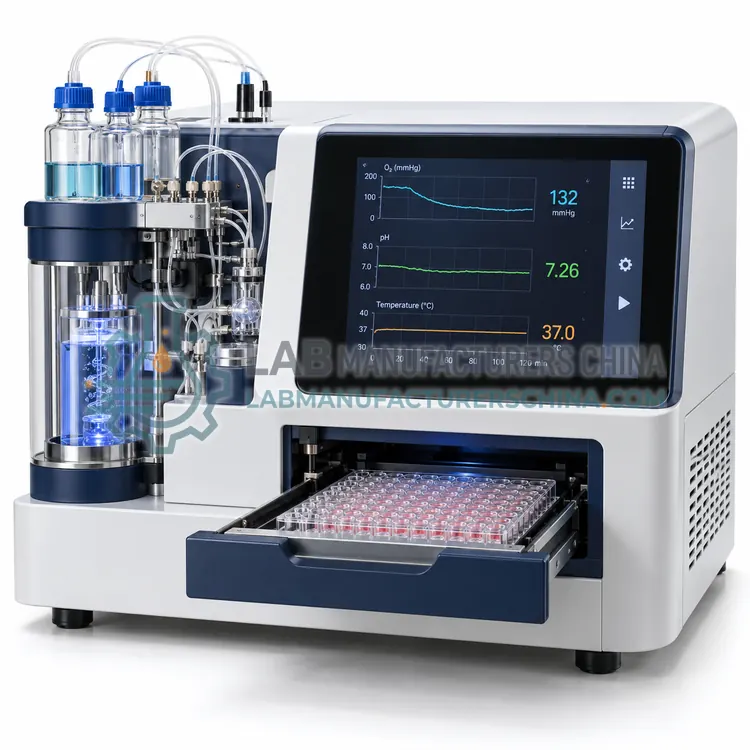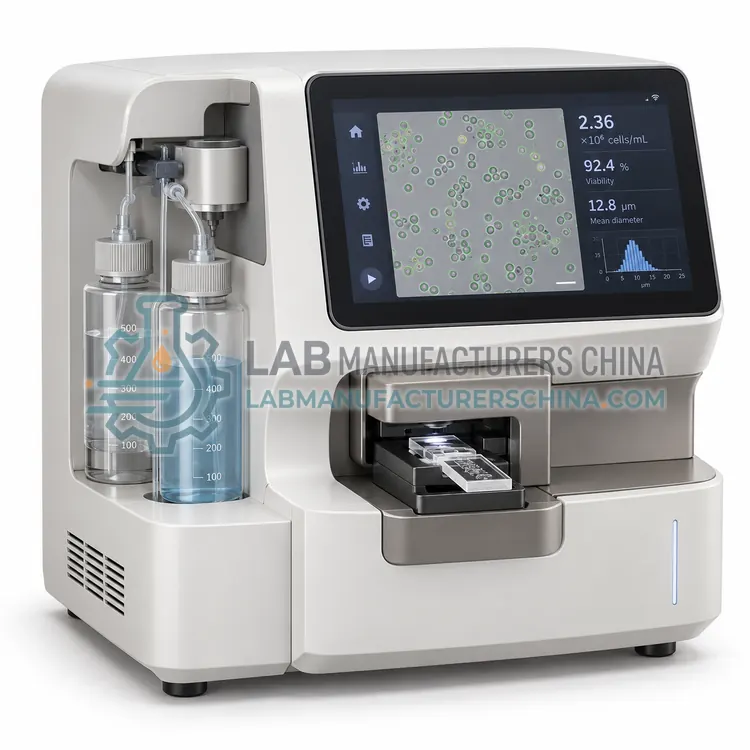
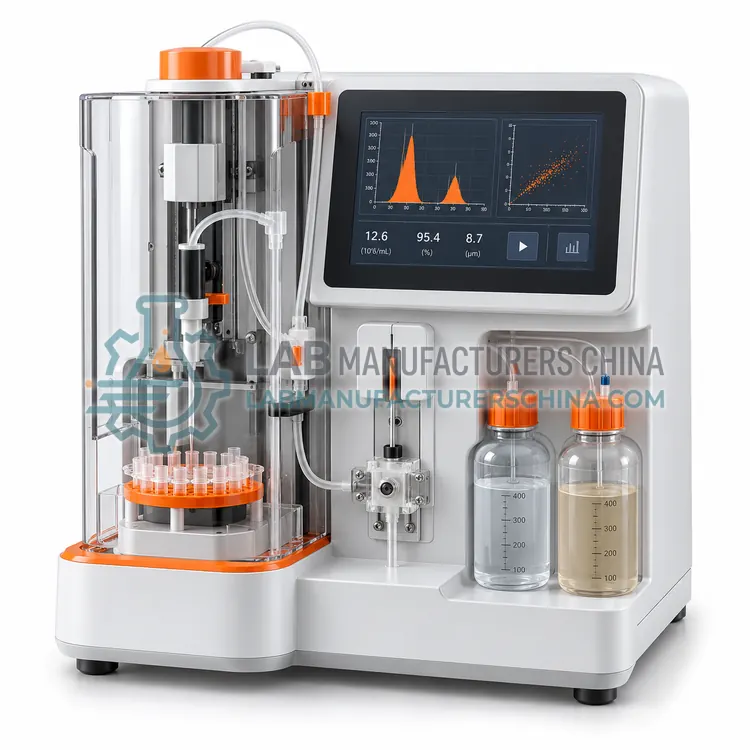
Electrical Impedance Cell Counter
电阻抗细胞计数仪
- SKU CEC-0003
- Cell Counters
- CE (to be confirmed)
- ISO 9001 manufacturing (to be confirmed)
- IEC 61010-1 safety (to be confirmed)
Price on request — FOB / CIF quoted per order
Prices depend on configuration, quantity and destination port.
Key specifications
| Cell size range | approx. 2–100 µm (aperture dependent) |
|---|---|
| Concentration range | approx. 1 x 10³–1 x 10⁷ cells/mL |
| Throughput | up to several thousand cells per second |
| Sample volume | 0.1–20 mL aspirated |
| Aperture sizes | 20, 50, 100, 140 and 200 µm options |
| Volume resolution | approx. 0.5 fL (typical) |
Request a quote Download brochure · to be provided
By Lab Manufacturers China Technical TeamLast reviewed Standards: ISO 20387, ISO 15189, IEC 61010-1
What is the Electrical Impedance Cell Counter?
An electrical impedance cell counter draws cells through a small aperture and counts voltage pulses whose height reflects cell volume, giving concentration and size distribution without any dye or optical measurement. It handles samples that are optically difficult.
What is the Electrical Impedance Cell Counter?
An electrical impedance cell counter draws cells through a small aperture and counts voltage pulses whose height reflects cell volume, giving concentration and size distribution without any dye or optical measurement. It handles samples that are optically difficult.
Overview
The instrument is based on the Coulter principle: a dilute cell suspension is drawn through an aperture with electrodes on each side, and each cell displaces conductive electrolyte, causing a measurable increase in resistance and a voltage pulse proportional to cell volume. Counting thousands of cells per second gives concentration directly from the aspirated volume, and pulse height analysis produces a volume distribution that reveals subpopulations, cell swelling and aggregation. Aperture tubes of different sizes cover cells from about 2 to 100 µm, selected according to cell diameter. Because no optical path or dye is involved, the method works with pigmented, turbid or highly concentrated samples, and it is insensitive to intracellular fluorescence. Diameter calibration with reference particles must be performed for each aperture size.
How does it work?
Counting methods differ in how they distinguish a cell from debris and from a dead cell. Trypan blue exclusion relies on the intact membrane of viable cells, which excludes the dye, so live cells appear bright and dead cells blue in transmitted light; automated counters image a fixed volume in a counting chamber and classify objects by size, shape and brightness. Fluorescence methods use acridine orange and propidium iodide, which stain all nuclei and membrane-damaged nuclei respectively, so concentration and viability are derived from two channels and are less affected by red blood cells, platelets and debris. Electrical impedance counters draw cells through a small aperture and count voltage pulses, where pulse height reflects cell volume. Flow cytometry counters add a known number of reference beads and calculate absolute counts from the ratio of cell to bead events, which also provides marker information. All methods require a well-mixed, appropriately diluted sample to be accurate.
What are the key features?
- Coulter principle measurement of cell volume and concentration
- Throughput of thousands of cells per second
- Aperture tubes sized for cells from 2 to 100 µm
- Volume distribution histograms revealing subpopulations
- No dye or optical path, so pigmented samples are supported
- Calibration with reference particles for each aperture
What are the technical specifications?
A typical electrical impedance cell counter configuration offers cell size range of approx. 2–100 µm (aperture dependent), concentration range of approx. 1 x 10³–1 x 10⁷ cells/mL, throughput of up to several thousand cells per second, sample volume of 0.1–20 mL aspirated, aperture sizes of 20, 50, 100, 140 and 200 µm options and volume resolution of approx. 0.5 fL (typical). Values are indicative of the product class; the exact figures for each configuration are confirmed on the quotation and the calibration documents supplied with the instrument.
Which applications is it used for?
The Electrical Impedance Cell Counter is used in cell volume and swelling studies, counting of pigmented or turbid suspensions, yeast and microalgae cell counting and aggregation and subpopulation analysis. Across the wider Cell Counters class, laboratories also deploy it for seeding density determination before experiments, culture growth and viability monitoring and cell therapy product release counts.
Which standards and certifications apply?
Relevant standards and methods include ISO 20387, ISO 15189, IEC 61010-1, IEC 60825-1, USP <1046> and ISO 17025. Certification candidates for this model are CE, ISO 9001 manufacturing and IEC 61010-1 safety; each is to be confirmed for the specific configuration before shipment, and certificates are supplied only where they have been issued.
Accuracy depends more on sample handling than on the instrument. Cells settle quickly, so mix by gentle inversion or low-speed pipetting immediately before sampling, and avoid vigorous vortexing that damages membranes. Dilute into the method's linear range, since concentrated samples saturate the sensor and very dilute samples lose precision. Consumables such as counting slides or chambers should be used once and disposed of as biohazard waste. Clean the optics and sample path regularly, and avoid samples containing strong dyes or fluorescent compounds that interfere with fluorescence channels. Validate each new cell type or matrix against a reference method such as a haemocytometer or a validated flow count, and document the dilution and settings used, because viability definitions differ between laboratories.
How do I select the right Electrical Impedance Cell Counter?
Select an impedance counter when cell volume distribution, pigmented samples or optical interference make imaging unreliable, or when continuous monitoring of cell size is useful. Specify aperture sizes, concentration range, throughput and the calibration programme for each aperture.
How does it compare with other Cell Counters variants?
Choose by sample type and required accuracy. For routine culture of established cell lines, an image-based counter with trypan blue is adequate and inexpensive. When samples contain debris, red cells, platelets or clumps, or when viability is low and must be measured precisely, choose a fluorescence counter with acridine orange and propidium iodide, which reports concentration and viability from nuclear staining. Impedance counters are useful for continuous monitoring of cell size distribution and for samples where optical clarity varies. Flow cytometry counters are the right choice when counts must be combined with surface marker measurement or when absolute counts are required for clinical reporting. Check the linear range, sample volume, time per count, consumable cost, cleaning requirements and whether the instrument reports aggregate or clump correction.
Full specifications
| Cell size range | approx. 2–100 µm (aperture dependent) |
|---|---|
| Concentration range | approx. 1 x 10³–1 x 10⁷ cells/mL |
| Throughput | up to several thousand cells per second |
| Sample volume | 0.1–20 mL aspirated |
| Aperture sizes | 20, 50, 100, 140 and 200 µm options |
| Volume resolution | approx. 0.5 fL (typical) |
| Electrolyte | Isotonic saline |
| Calibration | Reference particles per aperture size |
| Data output | Volume histograms and concentration tables |
| Dimensions (W x D x H) | approx. 300 x 350 x 450 mm |
Indicative values for this product class. Final specifications are confirmed on the quotation and in the calibration documents supplied with the instrument.
Applications
- Cell volume and swelling studies
- Counting of pigmented or turbid suspensions
- Yeast and microalgae cell counting
- Aggregation and subpopulation analysis
Key features
- Coulter principle measurement of cell volume and concentration
- Throughput of thousands of cells per second
- Aperture tubes sized for cells from 2 to 100 µm
- Volume distribution histograms revealing subpopulations
- No dye or optical path, so pigmented samples are supported
- Calibration with reference particles for each aperture
Frequently asked questions about Electrical Impedance Cell Counter
Cells suspended in electrolyte are drawn through a small aperture between two electrodes. Each cell displaces electrolyte and increases electrical resistance, producing a voltage pulse proportional to cell volume, so both concentration and volume distribution are obtained.
The aperture must be several times larger than the cell diameter to avoid blockage and coincidence errors, and pulse height scales with aperture size. Laboratories keep several aperture tubes and select one from the expected cell diameter.
Impedance counting itself does not distinguish live from dead cells, although dead cells have altered volume. Viability requires a separate dye exclusion or fluorescence measurement, or a combined instrument that adds an optical channel.
Most benchtop counters use 10–20 µL per count, and some fluorescence systems accept as little as 10 µL when viability is measured from nuclear staining. Samples are usually diluted with dye or buffer before counting.
Trypan blue measures membrane integrity, whereas fluorescence nuclear dyes also detect early apoptosis and can include cells that have lost nuclear structure. Instruments also differ in how they classify small or clumped objects, so methods should not be mixed within a study.
Gently pipette the suspension with a wide-bore tip or filter through a 40 µm mesh to break clumps before counting. Some instruments apply a clump correction factor, which should be verified against a reference count for each cell type.
Related models