Metabolic Cell Analyzer
细胞代谢分析仪
- SKU CAN-0004
- Cell Analyzers
- CE (to be confirmed)
- ISO 9001 manufacturing (to be confirmed)
- IEC 61010-1 safety (to be confirmed)
Price on request — FOB / CIF quoted per order
Prices depend on configuration, quantity and destination port.
Key specifications
| Plate formats | 96-well and 24-well |
|---|---|
| Assay time | approx. 60–120 min |
| Cells per well | 20,000–100,000 (cell type dependent) |
| Measured parameters | Oxygen consumption rate and extracellular acidification rate |
| Sensor type | Fluorescent optical oxygen and pH sensors |
| Injection ports | 4 per well |
Request a quote Download brochure · to be provided
By Lab Manufacturers China Technical TeamLast reviewed Standards: IEC 60825-1, IEC 61010-1, ISO 15189
What is the Metabolic Cell Analyzer?
A metabolic cell analyzer measures oxygen consumption and extracellular acidification in intact cells within a multi-well plate, reporting mitochondrial respiration and glycolysis under basal and stressed conditions. It is used for immunometabolism, cancer metabolism and drug mechanism studies.
What is the Metabolic Cell Analyzer?
A metabolic cell analyzer measures oxygen consumption and extracellular acidification in intact cells within a multi-well plate, reporting mitochondrial respiration and glycolysis under basal and stressed conditions. It is used for immunometabolism, cancer metabolism and drug mechanism studies.
Overview
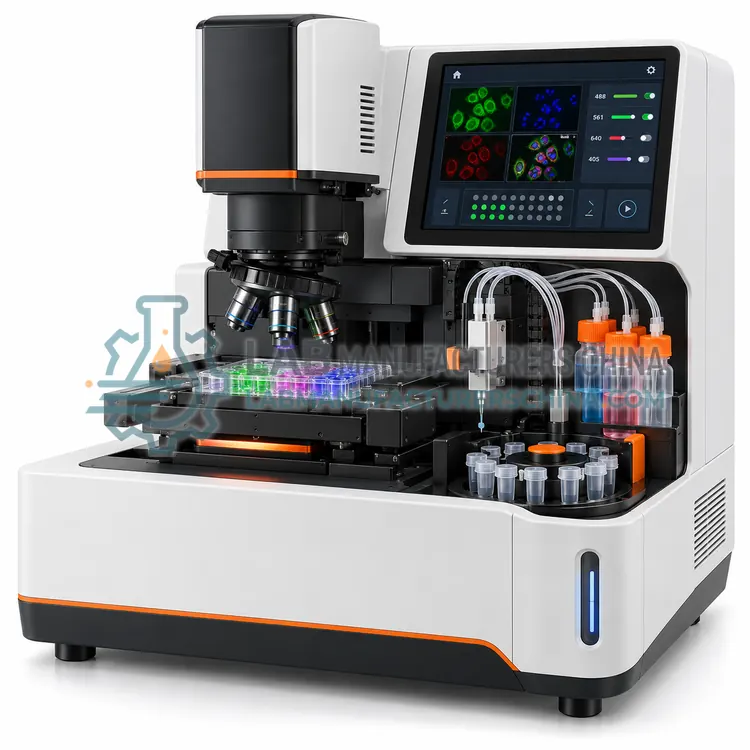
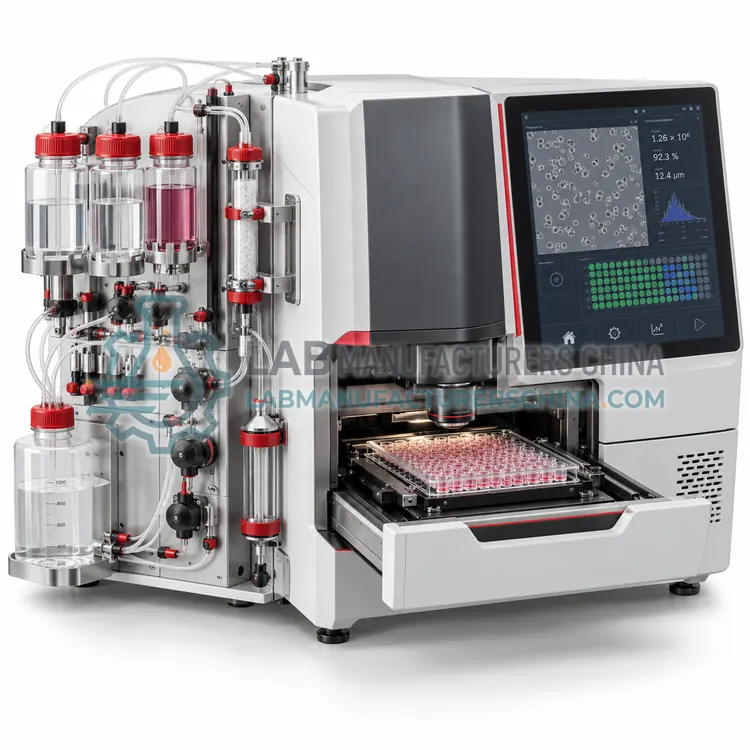
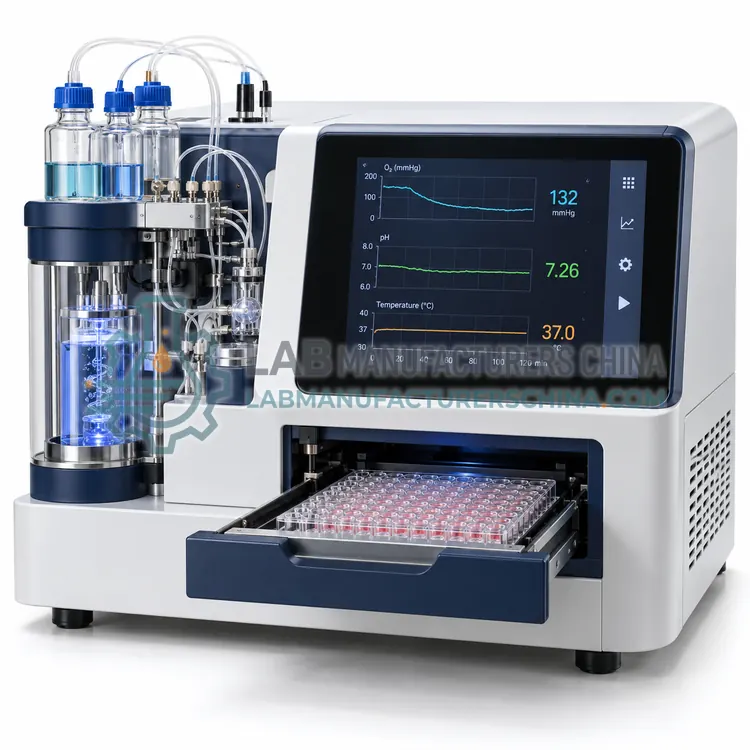
The instrument places a sensor cartridge above a cell monolayer or suspension in a 96-well or 24-well plate. Optical sensors embedded in the cartridge measure oxygen and pH in a small volume close to the cells, and the plate is moved up to form a transient microchamber so that changes caused by the cells can be detected. Reporter equations convert the measured rates into oxygen consumption rate, reflecting mitochondrial respiration, and extracellular acidification rate, reflecting glycolytic flux. Sequential injections of oligomycin, an uncoupler and respiratory inhibitors allow calculation of non-mitochondrial respiration, proton leak, ATP-linked respiration, maximal respiration and spare capacity. Typical assays take 60–120 minutes, and each well needs 20,000–100,000 cells or an equivalent amount of tissue.
How does it work?
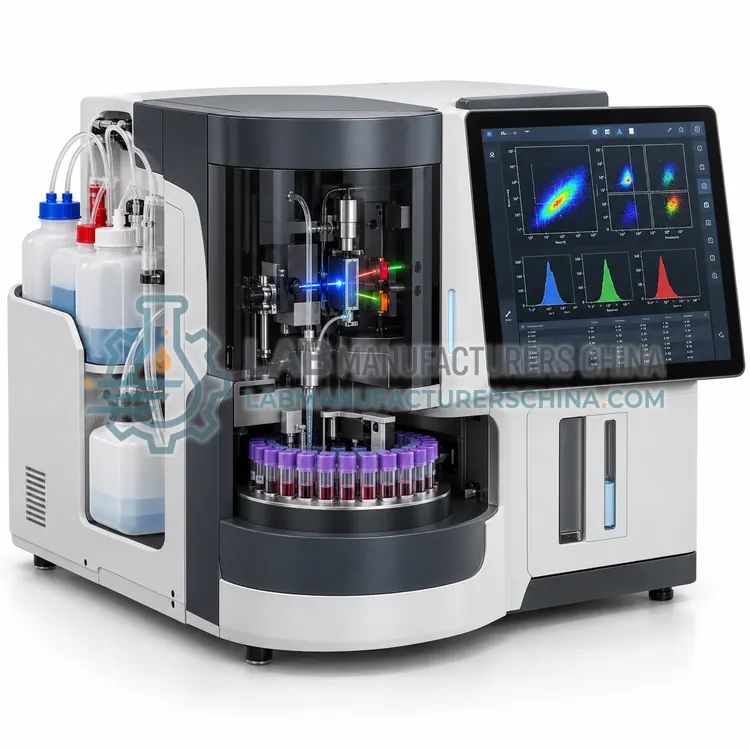
Flow-based cell analyzers suspend cells in a sheath fluid that hydrodynamically focuses them into a single file. Each cell passes one or more laser beams, and detectors record forward scatter, which relates to size, side scatter, which relates to granularity, and fluorescence from labelled antibodies or reporter proteins. Thousands of cells are measured per second, so rare populations can be quantified with statistical confidence. Spectral analyzers capture the full emission spectrum for each event and unmix overlapping dyes computationally, allowing larger panels. Imaging cytometers capture a brightfield and fluorescence image of each cell in flow, adding morphology and localisation information. Metabolic analyzers measure oxygen consumption and extracellular acidification in a plate by repeatedly sampling the medium above the cells, giving a readout of oxidative phosphorylation and glycolysis. Dedicated cell cycle analyzers measure DNA content and apoptosis markers with fixed panels.
What are the key features?
- Optical oxygen and pH sensors in a transient microchamber
- Simultaneous measurement of respiration and glycolysis
- Sequential compound injection for stress test profiles
- 96-well and 24-well plate formats
- Cell requirement of 20,000–100,000 cells per well
- Analysis software with automated rate calculation and normalisation
What are the technical specifications?
A typical metabolic cell analyzer configuration offers plate formats of 96-well and 24-well, assay time of approx. 60–120 min, cells per well of 20,000–100,000 (cell type dependent), measured parameters of Oxygen consumption rate and extracellular acidification rate, sensor type of Fluorescent optical oxygen and pH sensors and injection ports of 4 per well. Values are indicative of the product class; the exact figures for each configuration are confirmed on the quotation and the calibration documents supplied with the instrument.
Which applications is it used for?
The Metabolic Cell Analyzer is used in immunometabolism and T cell activation studies, cancer cell metabolic reprogramming, drug mechanism and toxicity screening and mitochondrial function assessment. Across the wider Cell Analyzers class, laboratories also deploy it for immunophenotyping of cell populations, cell cycle and apoptosis analysis and cell therapy product characterisation.
Which standards and certifications apply?
Relevant standards and methods include IEC 60825-1, IEC 61010-1, ISO 15189, CLSI H42, USP <1046> and ISO 17025. Certification candidates for this model are CE, ISO 9001 manufacturing and IEC 61010-1 safety; each is to be confirmed for the specific configuration before shipment, and certificates are supplied only where they have been issued.
Standardise sample preparation, since cell number, staining volume, incubation time and wash steps all shift signal intensity. Include single-stain compensation controls and an unstained control in every experiment, and run reference beads for instrument setup and daily quality control. Keep sheath fluid and waste containers at the correct levels, and follow the manufacturer's cleaning procedure to limit carry-over below 1%. Lasers fall under IEC 60825-1, so protective covers and interlocks must remain functional and staff should be trained. Fixed cells for DNA content analysis need correct fixation and RNase treatment. For regulated work, document compensation, gating strategy, acquisition settings and software version, and retain raw FCS files so that analyses can be reproduced.
How do I select the right Metabolic Cell Analyzer?
Select a metabolic analyser when energy metabolism is part of the biological question, such as immune activation, drug toxicity or mitochondrial disease models. Specify plate format, compound injection ports, temperature control, cell number requirements and normalisation options.
How does it compare with other Cell Analyzers variants?
Define the panel before specifying hardware. Count how many fluorophores must be measured simultaneously, then check that the laser and detector configuration can resolve them, including compensation or spectral unmixing capability. Conventional benchtop systems suit routine 4–10 colour panels for immunophenotyping and cell cycle work. Spectral systems are appropriate when panels exceed about 12 colours or when autofluorescence varies between samples. Imaging cytometry answers questions involving cell shape, internalisation or cell-cell contact that scatter and fluorescence alone cannot resolve. Metabolic analysis addresses a different question entirely: how cells produce energy, and how they respond to inhibitors or genetic changes. All platforms need consistent sample preparation, validated compensation or unmixing controls, and documented acquisition settings so that results remain comparable between runs.
Full specifications
| Plate formats | 96-well and 24-well |
|---|---|
| Assay time | approx. 60–120 min |
| Cells per well | 20,000–100,000 (cell type dependent) |
| Measured parameters | Oxygen consumption rate and extracellular acidification rate |
| Sensor type | Fluorescent optical oxygen and pH sensors |
| Injection ports | 4 per well |
| Temperature control | 37 °C controlled chamber |
| Derived parameters | Basal, maximal, ATP-linked respiration and spare capacity |
| Normalisation options | Cell count, protein or DNA content |
| Dimensions (W x D x H) | approx. 400 x 500 x 400 mm |
Indicative values for this product class. Final specifications are confirmed on the quotation and in the calibration documents supplied with the instrument.
Applications
- Immunometabolism and T cell activation studies
- Cancer cell metabolic reprogramming
- Drug mechanism and toxicity screening
- Mitochondrial function assessment
Key features
- Optical oxygen and pH sensors in a transient microchamber
- Simultaneous measurement of respiration and glycolysis
- Sequential compound injection for stress test profiles
- 96-well and 24-well plate formats
- Cell requirement of 20,000–100,000 cells per well
- Analysis software with automated rate calculation and normalisation
Frequently asked questions about Metabolic Cell Analyzer
Oxygen consumption rate indicates mitochondrial respiration, and extracellular acidification rate indicates glycolytic flux through lactate export. Together they describe how a cell produces ATP, and their ratio shows whether metabolism is oxidative or glycolytic.
Typically 20,000–100,000 cells, depending on cell size and metabolic rate, with adherent cells preferred for reproducibility. Suspension cells can be used after attachment with a coating or in specialised plates.
Each injection reveals a different aspect of mitochondrial function. Oligomycin shows ATP-linked respiration, an uncoupler reveals maximal respiratory capacity, and inhibitors of respiration separate mitochondrial from non-mitochondrial oxygen consumption.
Conventional benchtop analysers typically resolve 4–12 fluorescence colours using two to four lasers, while spectral analysers support panels above 12 colours by capturing full emission spectra. Practical panel size is limited by dye overlap and by the number of available detectors.
It measures oxygen consumption rate and extracellular acidification rate in a multi-well plate while injecting compounds. These readouts reflect mitochondrial respiration and glycolysis, allowing cells to be compared under different nutrients, inhibitors or genetic backgrounds.
Fluorophores emit across a range of wavelengths, so signal from one dye appears in detectors assigned to others. Single-stain controls allow the software to calculate and subtract that spillover, keeping populations in their correct quadrants and preventing false positive calls.
Related models