External-Calibration Analytical Balance
外校分析天平
- SKU ANB-0001
- Analytical Balances
- CE (to be confirmed)
- ISO 9001 manufacturing (to be confirmed)
- RoHS (to be confirmed)
Price on request — FOB / CIF quoted per order
Prices depend on configuration, quantity and destination port.
Key specifications
| Readability | 0.1 mg |
|---|---|
| Capacity | 120–320 g |
| Repeatability (SD) | ≤ 0.1 mg |
| Linearity | ±0.2–0.3 mg |
| Stabilization time | ≈ 3–5 s |
| Calibration | External weight |
Request a quote Download brochure · to be provided
By Lab Manufacturers China Technical TeamLast reviewed Standards: USP <41>, USP <1251>, OIML R 76-1
What is the External-Calibration Analytical Balance?
An external-calibration analytical balance reads to 0.1 mg with capacities around 120 to 320 g and relies on an operator-placed certified weight for calibration. It is the economical choice for routine weighing in stable laboratory conditions.
What is the External-Calibration Analytical Balance?
An external-calibration analytical balance reads to 0.1 mg with capacities around 120 to 320 g and relies on an operator-placed certified weight for calibration. It is the economical choice for routine weighing in stable laboratory conditions.
Overview
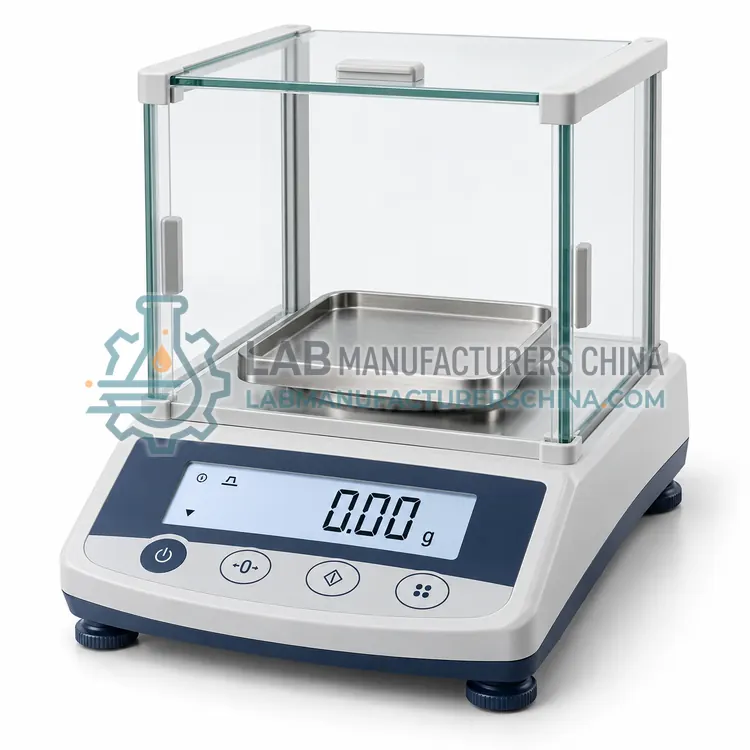
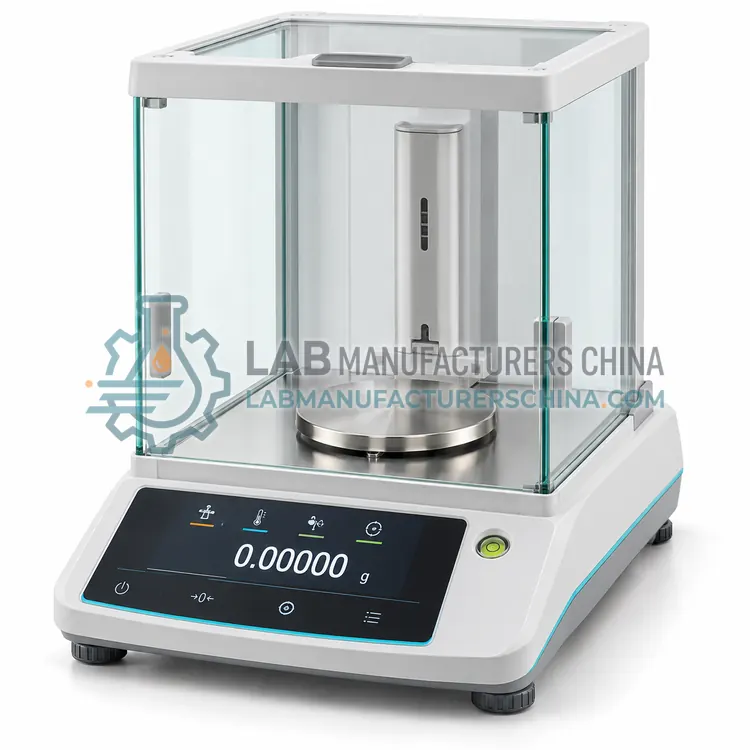
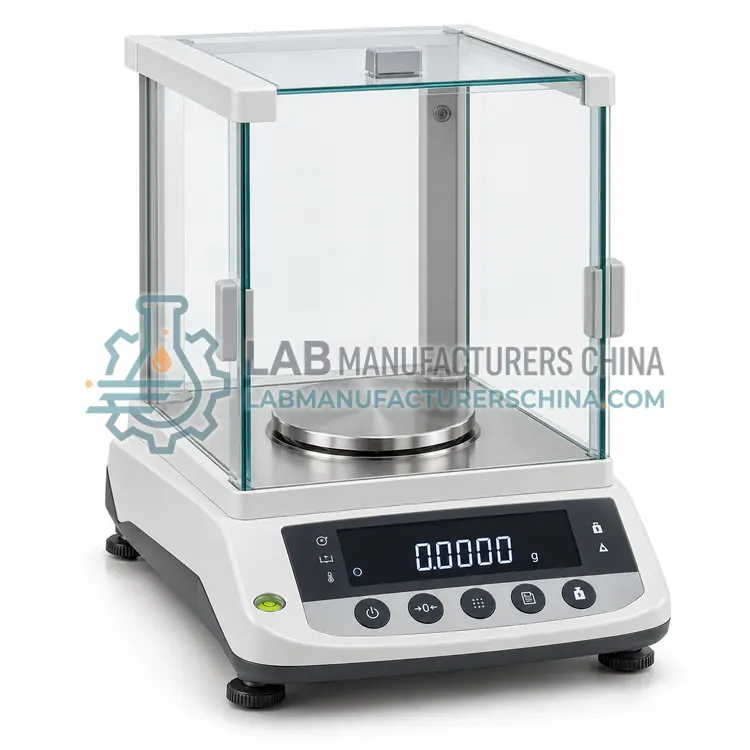
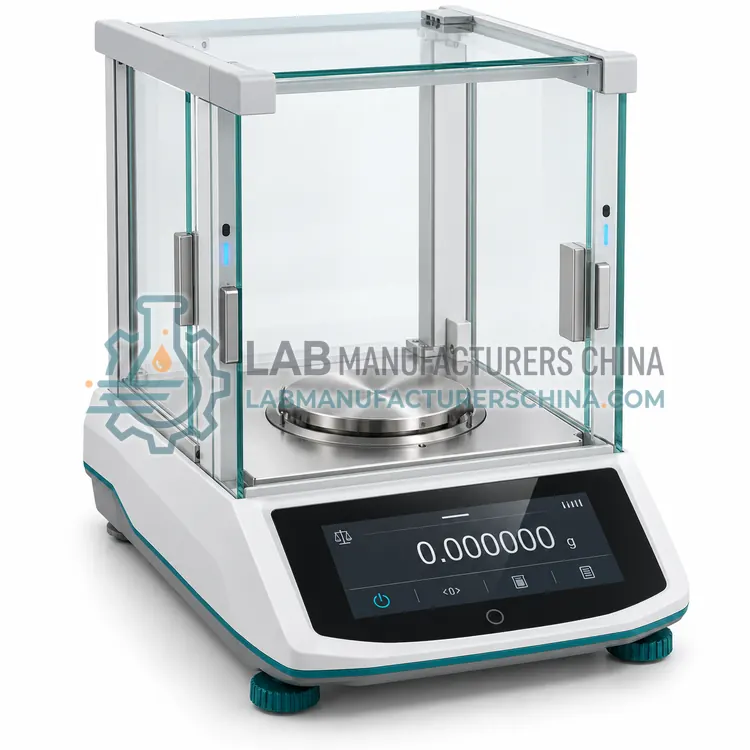
This is the basic analytical balance configuration. An electromagnetic force-restoration cell and a manual draft shield with sliding side and top doors deliver 0.1 mg readability. Calibration needs a certified weight of 100 to 200 g, stored in a case and handled with forceps. Capacity typically spans 120 to 320 g, and linearity is about 0.2 to 0.3 mg. Stabilization time is about 3 to 5 seconds. A backlit LCD shows mass, units and stability, and an RS-232 or USB port outputs data to a printer or computer. Because there is no motorized reference mass, accuracy depends on consistent bench temperature and periodic operator-driven calibration. It is well suited to teaching, routine chemistry and quality control where conditions do not vary widely.
How does it work?
Most analytical balances use electromagnetic force restoration. A weighing pan is attached to a lever system or monolithic cell, and a coil in a permanent magnetic field generates the force that returns the pan to its reference position. The coil current needed to do this is proportional to the load and is converted by an analog-to-digital converter into a mass reading. Optical or inductive sensors detect pan position. A draft shield isolates the pan from air currents, and temperature sensors compensate drift. Internal calibration uses a built-in reference mass driven by a motor, while external calibration uses a traceable weight placed by the operator. Leveling feet and a level indicator ensure the pan is vertical. Electronics apply filters to stabilize readings against vibration.
What are the key features?
- Electromagnetic force-restoration cell with 0.1 mg readability
- Manual glass draft shield with sliding side and top doors
- Stainless steel pan with hook for below-balance weighing
- Multiple weighing units and parts counting function
- RS-232 or USB output for printers and computers
What are the technical specifications?
A typical external-calibration analytical balance configuration offers readability of 0.1 mg, capacity of 120–320 g, repeatability (SD) of ≤ 0.1 mg, linearity of ±0.2–0.3 mg, stabilization time of ≈ 3–5 s and calibration of External weight. Values are indicative of the product class; the exact figures for each configuration are confirmed on the quotation and the calibration documents supplied with the instrument.
Which applications is it used for?
The External-Calibration Analytical Balance is used in teaching laboratory weighing, routine reagent preparation, general chemistry sample weighing and quality control of raw materials. Across the wider Analytical Balances class, laboratories also deploy it for pharmaceutical QC weighing, standard solution preparation and gravimetric analysis.
Which standards and certifications apply?
Relevant standards and methods include USP <41>, USP <1251>, OIML R 76-1, Ph. Eur. 2.1.7, ASTM E898, GB/T 26497 and ISO 9001. Certification candidates for this model are CE, ISO 9001 manufacturing and RoHS; each is to be confirmed for the specific configuration before shipment, and certificates are supplied only where they have been issued.
Install the balance on a rigid, vibration-free bench away from doors, air conditioning vents, direct sunlight and heat sources. Allow warm-up of at least 30 minutes to a few hours before use, as specified by the manufacturer. Level the balance and calibrate after every move. Routine checks with certified weights, plus periodic calibration by an accredited service, support compliance with pharmacopoeial requirements. Keep the pan and chamber clean, and avoid placing samples directly on the pan. Control humidity roughly between 40 and 60 percent to limit static and drift. Use antistatic accessories for powders. Record routine tests, eccentricity and repeatability to support quality audits.
How do I select the right External-Calibration Analytical Balance?
Select the external-calibration model when the room temperature is stable, the balance is not moved often and budget matters. It needs operator discipline for calibration, unlike internal-calibration siblings. In the RFQ, specify capacity, readability, pan size, calibration weight class, interfaces and voltage.
How does it compare with other Analytical Balances variants?
Decide readability first. A 0.1 mg balance serves most routine weighing, while 0.01 mg semi-micro models are needed for small samples or minimum weight limits of a few milligrams. Then check capacity, since higher capacity usually reduces repeatability. Consider how calibration will be handled: internal calibration reduces operator effort and drift in variable conditions, while external calibration is cheaper. For regulated laboratories, verify data-integrity software, audit trail and printouts. Automatic draft-shield doors reduce operator influence and static. Also consider the installation site, because vibration, drafts and temperature change affect performance more than the nominal specification. Finally, check the minimum weight at the required tolerance, using the balance's own repeatability data rather than readability alone.
Full specifications
| Readability | 0.1 mg |
|---|---|
| Capacity | 120–320 g |
| Repeatability (SD) | ≤ 0.1 mg |
| Linearity | ±0.2–0.3 mg |
| Stabilization time | ≈ 3–5 s |
| Calibration | External weight |
| Pan size | Ø 80–90 mm |
| Display | Backlit LCD |
| Interfaces | RS-232, USB |
| Power supply | 100–240 V AC adapter |
Indicative values for this product class. Final specifications are confirmed on the quotation and in the calibration documents supplied with the instrument.
Applications
- Teaching laboratory weighing
- Routine reagent preparation
- General chemistry sample weighing
- Quality control of raw materials
Key features
- Electromagnetic force-restoration cell with 0.1 mg readability
- Manual glass draft shield with sliding side and top doors
- Stainless steel pan with hook for below-balance weighing
- Multiple weighing units and parts counting function
- RS-232 or USB output for printers and computers
Frequently asked questions about External-Calibration Analytical Balance
Enter the calibration mode, let the balance zero, then place a certified weight of the stated mass on the pan when prompted. The balance stores the correction. Use gloves or forceps, allow the weight to reach room temperature and repeat after any relocation.
Accuracy degrades when ambient temperature changes by several degrees, after moving or re-leveling, and as sensitivity drifts over weeks. Without automatic adjustment, daily checks with a test weight are needed to detect deviations before they affect results.
OIML class E2 or F1 weights are commonly used for 0.1 mg analytical balances, with class E2 preferred for compliance work. The weight should have a calibration certificate traceable to national standards, and its tolerance should be well below the balance's repeatability.
An analytical balance reads to 0.1 mg or finer, has a draft shield and typically weighs up to 320 g. A precision balance reads to 1 mg up to 0.01 g, is open or has a simple shield, and handles larger capacities. Analytical models suit sample preparation and assays.
Perform a quick check with a certified weight each day of use, and calibrate after moving or leveling the balance. A full calibration and uncertainty assessment by an accredited provider is typically done annually or as set by the laboratory's risk assessment and quality system.
Minimum weight is the smallest sample mass that can be weighed at a stated relative tolerance, for example 0.1 percent. It depends on the balance's repeatability and is often about 1000 times the standard deviation. USP <41> bases it on measured repeatability.
Related models
GLP-Compliant Analytical Balance with Data-Integrity Software
符合 GLP 要求的带数据完整性软件分析天平
- CE (to be confirmed)
- +2