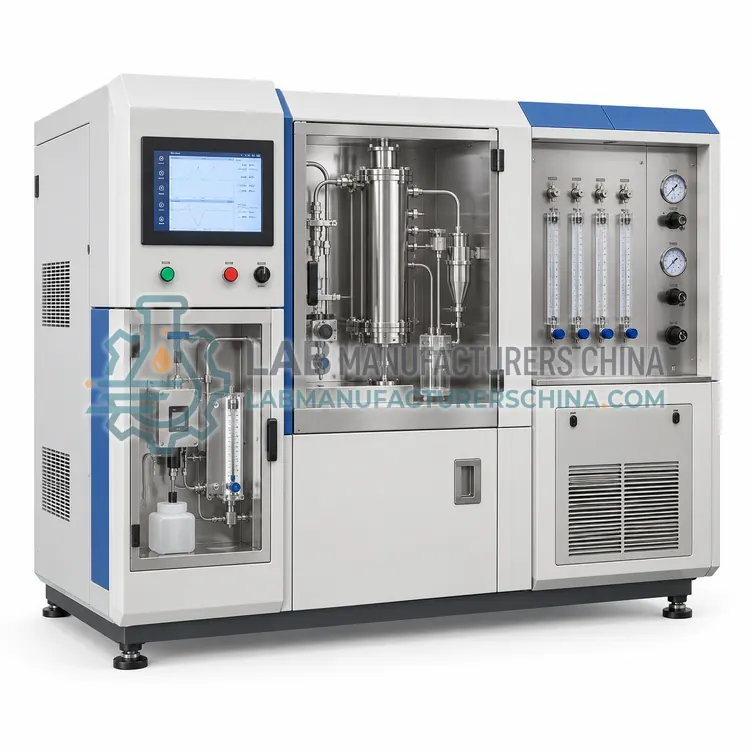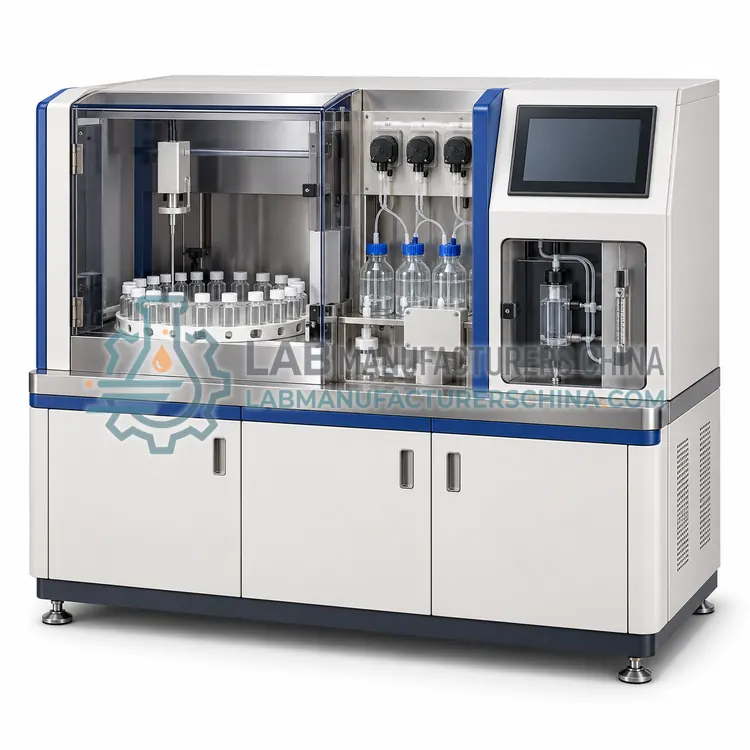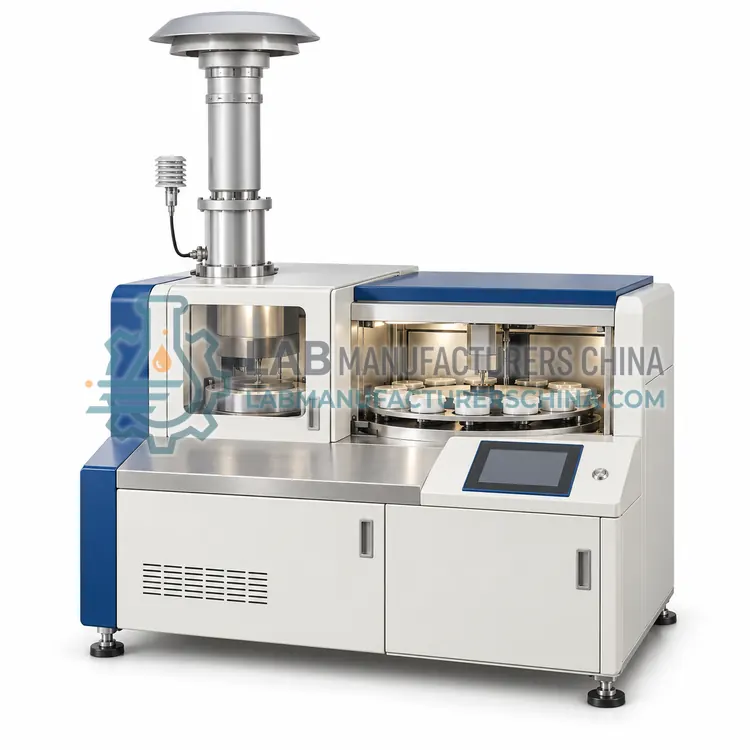
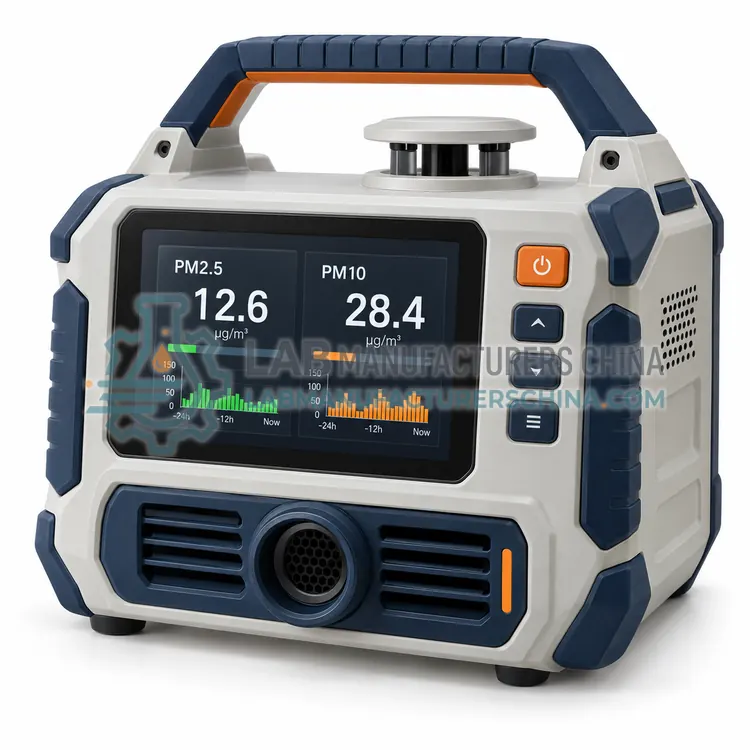
Laser Scattering PM2.5 and PM10 Air Quality Monitor
激光散射 PM2.5 和 PM10 空气质量监测仪
- SKU AIM-0001
- Air Monitoring
- CE (to be confirmed)
- RoHS (to be confirmed)
- China MC metrology approval (to be confirmed)
Price on request — FOB / CIF quoted per order
Prices depend on configuration, quantity and destination port.
Key specifications
| Measured fractions | PM1, PM2.5, PM10 |
|---|---|
| Particle size range | 0.3–10 µm |
| Mass concentration range | 0–1000 µg/m³ |
| Accuracy | ±10 µg/m³ up to 100 µg/m³, ±10% above |
| Resolution | 1 µg/m³ |
| Response time | ≤ 10 s |
Request a quote Download brochure · to be provided
By Lab Manufacturers China Technical TeamLast reviewed Standards: EN 12341, EN 14211, EN 14212
What is the Laser Scattering PM2.5 and PM10 Air Quality Monitor?
A compact monitor that counts particles by laser light scattering and reports PM1, PM2.5 and PM10 mass concentrations in near real time. It is the right choice for community networks, indoor air checks and dust control where low cost and dense coverage matter more than reference accuracy.
What is the Laser Scattering PM2.5 and PM10 Air Quality Monitor?
A compact monitor that counts particles by laser light scattering and reports PM1, PM2.5 and PM10 mass concentrations in near real time. It is the right choice for community networks, indoor air checks and dust control where low cost and dense coverage matter more than reference accuracy.
Overview
This monitor pulls air with a small fan through a laser chamber where particles scatter light onto a photodiode. The pulse count and amplitude are converted to particle number and mass using a calibration factor that assumes a particle density and refractive index. Models cover 0.3 to 10 µm with outputs of PM1, PM2.5 and PM10, and many add temperature and humidity compensation and optional CO2 or VOC sensors. Readings update every one to ten seconds, and Wi-Fi or cellular links send data to a cloud platform. A dryer or heated inlet reduces humidity bias. The instrument is light enough for wall or pole mounting and is widely used in networks, but it is classified as indicative rather than reference equipment and needs collocation for bias correction.
How does it work?
Air monitors sample air through an inlet and quantify target components by physical or chemical sensing. Particulate instruments use laser light scattering, beta ray attenuation or gravimetric collection on filters, often after a size-selective inlet such as a PM2.5 impactor. Gas sensing uses electrochemical cells, metal oxide semiconductors, non-dispersive infrared absorption, photoionization, or ultraviolet and chemiluminescence analyzers for reference-grade measurements. Active samplers draw air at a controlled flow, for example 16.7 L/min for PM filters or 0.1 to 1 L/min for sorbent tubes and impingers, while passive samplers rely on diffusion. Meteorological sensors record wind, temperature, humidity and pressure to interpret results. A controller logs data, applies calibration factors and communicates over wireless networks.
What are the key features?
- Laser scattering chamber detects particles from 0.3 to 10 µm in near real time.
- Built-in humidity compensation reduces the positive bias of hygroscopic aerosol readings.
- Optional CO2, VOC and formaldehyde sensors add indoor air quality parameters.
- Wi-Fi, 4G or LoRa connectivity sends data to cloud dashboards and APIs.
- Compact housing mounts on walls or poles with weather shielding for outdoor use.
- Low power consumption supports solar operation in remote locations.
What are the technical specifications?
A typical laser scattering pm2.5 and pm10 air quality monitor configuration offers measured fractions of PM1, PM2.5, PM10, particle size range of 0.3–10 µm, mass concentration range of 0–1000 µg/m³, accuracy of ±10 µg/m³ up to 100 µg/m³, ±10% above, resolution of 1 µg/m³ and response time of ≤ 10 s. Values are indicative of the product class; the exact figures for each configuration are confirmed on the quotation and the calibration documents supplied with the instrument.
Which applications is it used for?
The Laser Scattering PM2.5 and PM10 Air Quality Monitor is used in community air quality networks, indoor air assessment, construction dust management and school and building monitoring. Across the wider Air Monitoring class, laboratories also deploy it for regional air quality networks, indoor air quality assessment and occupational exposure monitoring.
Which standards and certifications apply?
Relevant standards and methods include EN 12341, EN 14211, EN 14212, EN 14625, EN 14626, ISO 7708, US EPA 40 CFR Part 50 and HJ 653. Certification candidates for this model are CE, RoHS and China MC metrology approval; each is to be confirmed for the specific configuration before shipment, and certificates are supplied only where they have been issued.
Site the inlet away from local sources and obstructions, typically 1.5 to 15 m above ground with a clear airflow, following regulatory siting criteria. Use inert sampling lines such as PTFE for reactive gases and keep them short. Calibrate gas analyzers with certified standards and zero air, and verify flow rates on samplers with a traceable flow meter. Replace filters, pump diaphragms and sensor cells on schedule, and protect instruments from condensation and extreme temperatures with shelters or enclosures. Sensor-based devices drift with humidity and temperature, so collocate with a reference periodically. Document all events, because flagged data is required for validation and for any compliance reporting.
How do I select the right Laser Scattering PM2.5 and PM10 Air Quality Monitor?
Select the laser scattering monitor for dense low-cost coverage, indoor checks and trend tracking. It is not a substitute for beta attenuation or gravimetric monitors where regulatory data is required. In an RFQ, specify size fractions, outdoor rating, communications, expected accuracy and any collocation or calibration certificate requirements.
How does it compare with other Air Monitoring variants?
Define the pollutants, the required accuracy and the decision the data supports. Regulatory networks need reference or equivalent analyzers, while screening, mapping and community monitoring can use sensor-based units with periodic collocation. For exposure assessment of workers, personal pumps with sorbent tubes or filters are required. Indoor air quality investigations usually use handheld instruments for CO2, temperature, humidity, VOC and particulates. Check range, detection limit, response time, humidity compensation and operating temperature. Consider calibration effort, consumables, power availability and communication. For mobile surveys, consider battery life, GPS and weight. Confirm that the supplier provides calibration certificates and data formats compatible with your reporting platform.
Full specifications
| Measured fractions | PM1, PM2.5, PM10 |
|---|---|
| Particle size range | 0.3–10 µm |
| Mass concentration range | 0–1000 µg/m³ |
| Accuracy | ±10 µg/m³ up to 100 µg/m³, ±10% above |
| Resolution | 1 µg/m³ |
| Response time | ≤ 10 s |
| Flow rate | 0.1 L/min (fan-driven) |
| Operating temperature | −20 to 60 °C |
| Communication | Wi-Fi, 4G, RS-485, LoRa options |
| Power supply | 5 VDC or 12 VDC, under 3 W |
Indicative values for this product class. Final specifications are confirmed on the quotation and in the calibration documents supplied with the instrument.
Applications
- Community air quality networks
- Indoor air assessment
- Construction dust management
- School and building monitoring
Key features
- Laser scattering chamber detects particles from 0.3 to 10 µm in near real time.
- Built-in humidity compensation reduces the positive bias of hygroscopic aerosol readings.
- Optional CO2, VOC and formaldehyde sensors add indoor air quality parameters.
- Wi-Fi, 4G or LoRa connectivity sends data to cloud dashboards and APIs.
- Compact housing mounts on walls or poles with weather shielding for outdoor use.
- Low power consumption supports solar operation in remote locations.
Frequently asked questions about Laser Scattering PM2.5 and PM10 Air Quality Monitor
Hygroscopic particles absorb water and grow larger in humid air, so they scatter more light than dry particles of the same mass. Humidity correction factors or a heated inlet reduce this bias, which is most noticeable above about 70 percent relative humidity.
Laser diodes and fans typically last two to five years of continuous operation. Dust accumulation gradually affects readings, so cleaning or sensor replacement every one to two years, plus periodic collocation checks, are recommended for sustained accuracy.
No. Optical scattering loses sensitivity below about 0.3 µm, so ultrafine particles under 0.1 µm are not counted. Condensation particle counters or scanning mobility particle sizers are needed for ultrafine number concentration.
It measures particulate matter such as PM2.5 and PM10, gases including CO, CO2, NO2, SO2 and O3, volatile organic compounds, and meteorological variables such as wind, temperature and humidity. Some samplers collect material on filters or sorbents for laboratory analysis.
Laser scattering sensors track trends well but typically overestimate mass at high humidity and vary between units. After collocation and correction against a reference monitor they can reach about 10 to 25 percent error, which suits screening but not compliance.
Active sampling draws air through a filter or sorbent with a pump at a controlled flow, giving time-weighted concentrations over hours. Passive sampling relies on diffusion onto a sorbent over days or weeks, needing no power but giving lower time resolution and accuracy.
Related models
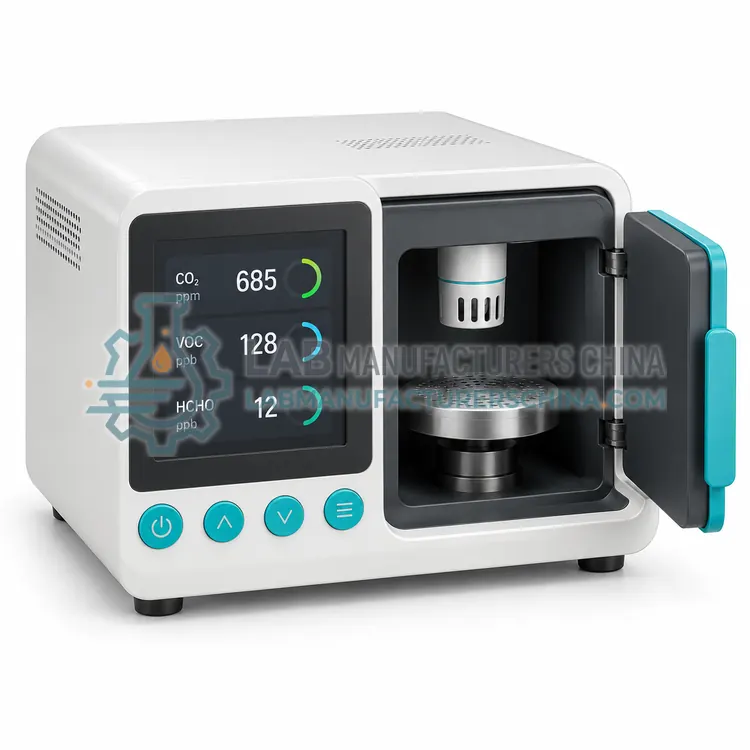
Indoor Air Quality Monitor for CO2, VOC and Formaldehyde
室内空气质量监测仪(CO2、VOC 和甲醛)
- CE (to be confirmed)
- +2