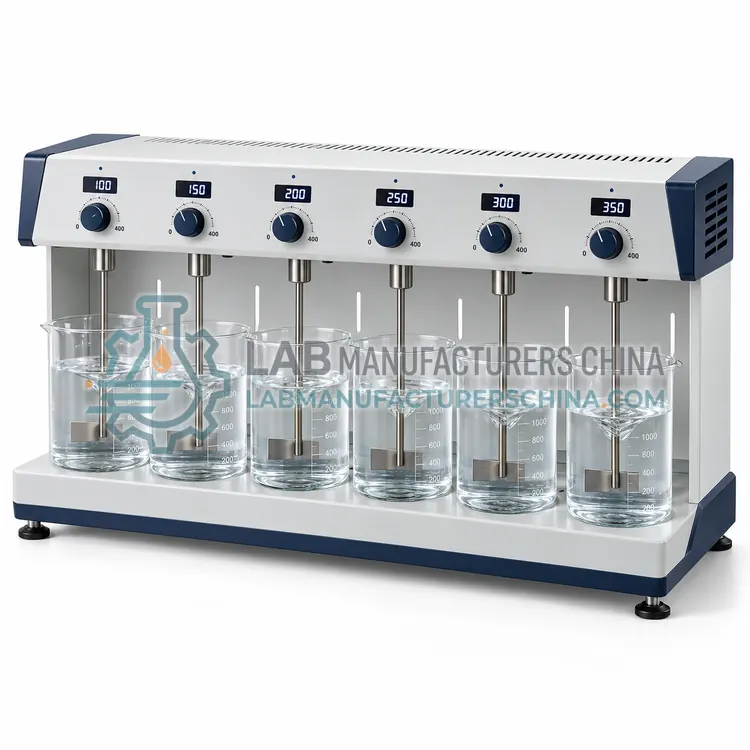
How do Multi-Position Stirrers work?
Multi-position stirrers use one of two drive layouts. In the shared-drive layout, a single motor rotates a belt, gear train or large magnetic array under all positions, so every vessel sees the same speed. In the independent-drive layout, each position has its own motor or electromagnet and can be set separately. Magnetic versions spin coated stir bars in flasks or vials, while paddle versions, such as jar testers, lower shafts with flat blades into beakers and control shear through speed. Heated versions add a hotplate or heating block with a temperature sensor, and some units include reflux condensers or inert gas manifolds. The key performance factor is speed uniformity between positions, which depends on drive accuracy, magnet strength and vessel alignment. Position layout influences bench space and accessibility.
Which Multi-Position Stirrers variants are available?
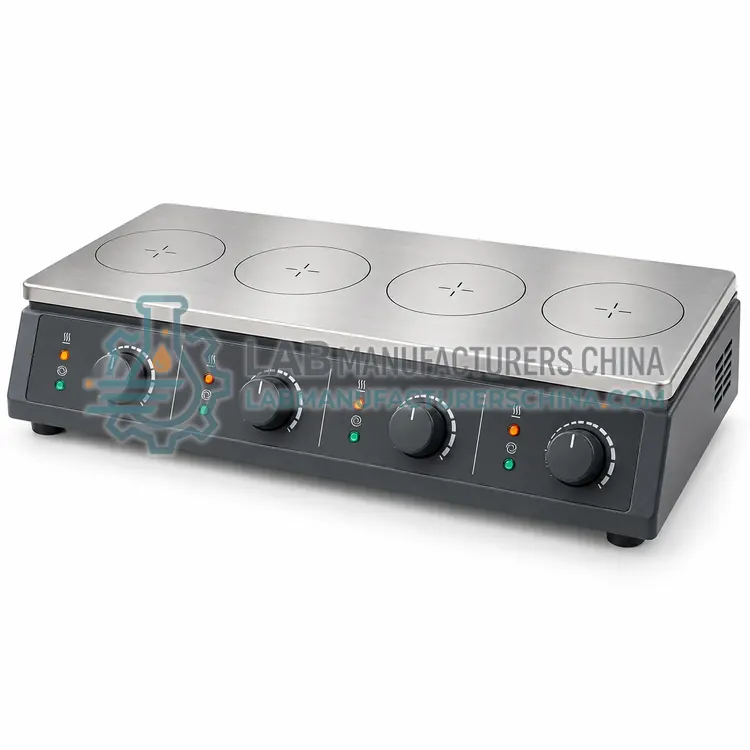
- 4-Position Magnetic Stirrer — A 4-position magnetic stirrer runs four flasks or beakers at once from a compact base, usually with one shared speed control.
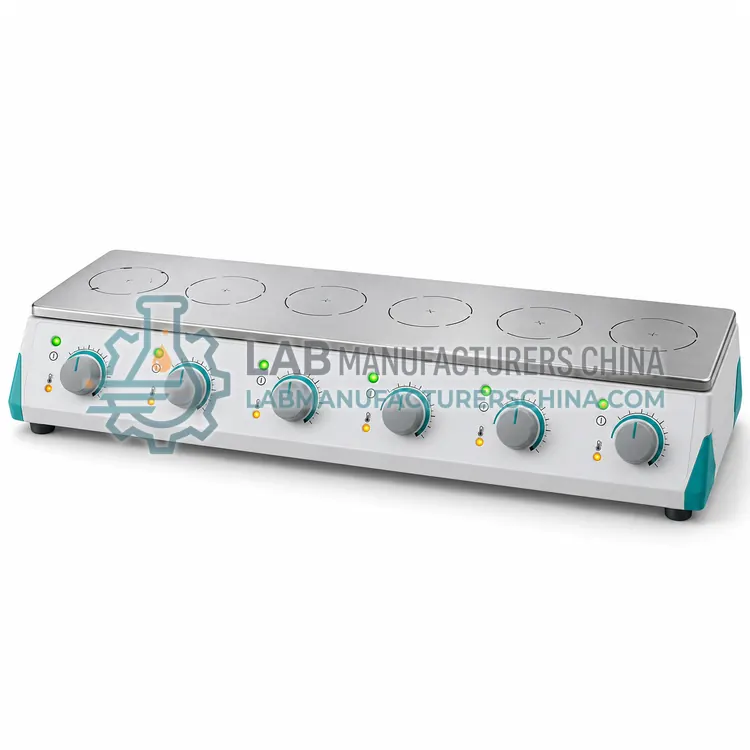
- 6-Position Magnetic Stirrer with Independent Speed Control — This 6-position magnetic stirrer has a separate motor and speed setting for each station, so six vessels can run at six different speeds at once.
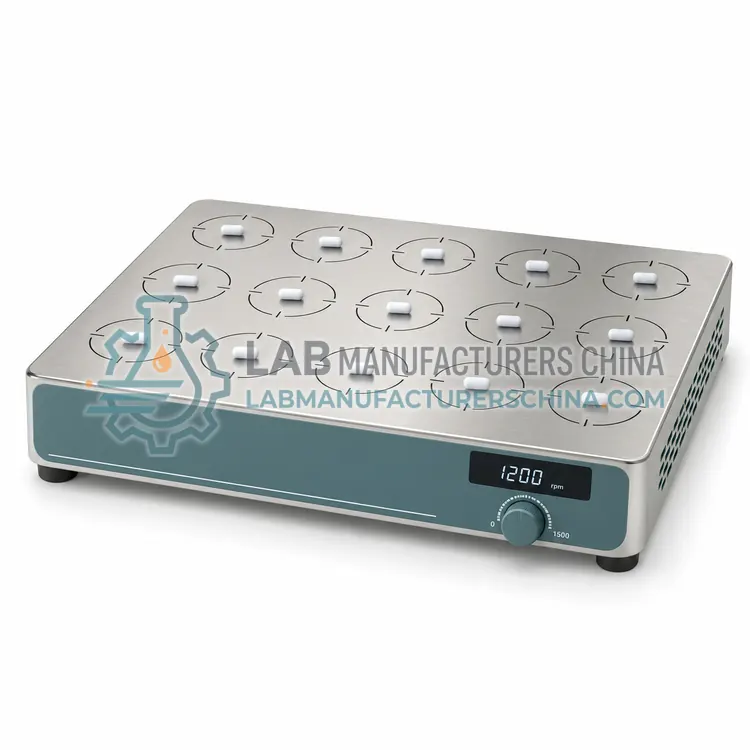
- 15-Position Magnetic Stirrer — A 15-position magnetic stirrer arranges 15 small stations on one slim base for high-throughput stirring of vials and small flasks.
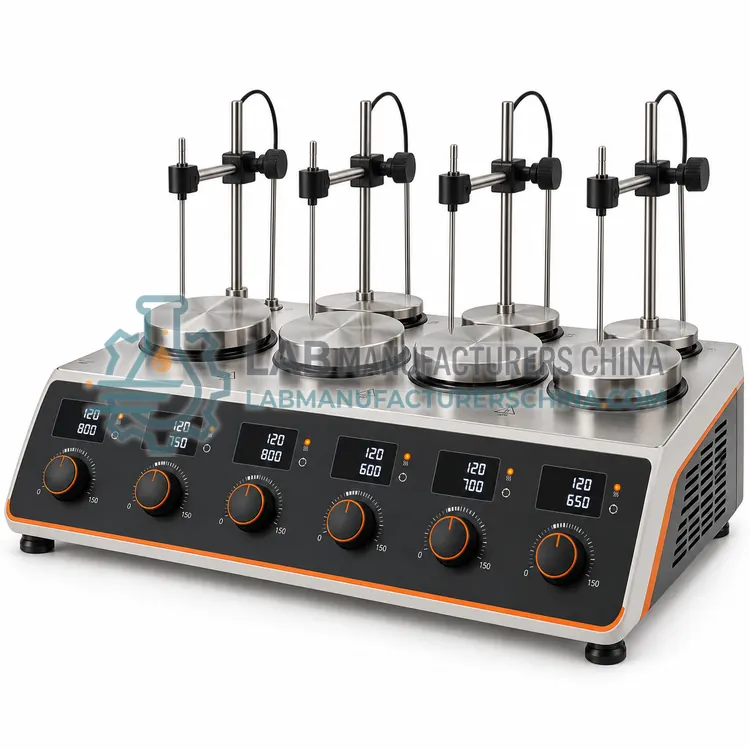
- Multi-Position Heating Magnetic Stirrer Reaction Station — A multi-position heating stirrer reaction station combines a heated aluminum block, magnetic stirring and optional reflux condensers across 6–24 positions.
- Six-Paddle Jar Test Stirrer — A six-paddle jar test stirrer lowers flat paddles into six beakers at synchronized, programmable speeds to simulate coagulation and flocculation.
How do I choose the right variant?
First set the number of positions and vessel size, since these determine the footprint and plate geometry. Decide whether all positions can share one speed, which is cheaper and adequate for dissolution or extraction, or whether each needs individual control for optimization studies. Check speed range and uniformity between positions, typically within a few percent, and maximum volume per position. If heating is needed, compare temperature range, uniformity across positions and whether a probe controls the block. For water treatment, choose a jar tester with paddle speed range suited to rapid-mix and slow-mix stages and with a lighted base if turbidity observations are made. Consider chemical resistance, hood fit, interface, and whether programmable speed steps are required. Give position count, flask sizes, speed and temperature range in the inquiry.
Where are Multi-Position Stirrers used?
Multi-Position Stirrers are specified in parallel dissolution and solubility screening, liquid-liquid and solid-liquid extraction, coagulation and flocculation jar testing, reaction condition optimization and stability and compatibility studies.
Which standards and certifications apply?
Work with Multi-Position Stirrers is commonly governed by ASTM D2035, IEC 61010-1, IEC 61010-2-010, IEC 61326-1, USP <711>, GB/T 16881 and ISO 9001. Instrument certifications such as CE marking are confirmed per configuration and never assumed.
What are the key considerations before purchase?
Place the stirrer on a level, rigid bench and verify that every position is in full contact with its vessel. Check speed uniformity across positions with a tachometer during installation and at intervals, since belt wear or magnet mismatch shifts speed. Use identical vessels and stir bars in all positions to keep mixing comparable. Load positions evenly to avoid vibration. Clean spills promptly, because liquid under the plate can damage drive parts. For heated units, follow the same precautions as hotplate stirrers, including a working safety cut-out. For jar testers, follow the method for paddle geometry and beaker size, such as ASTM D2035. Keep service records and consider preventive maintenance annually.