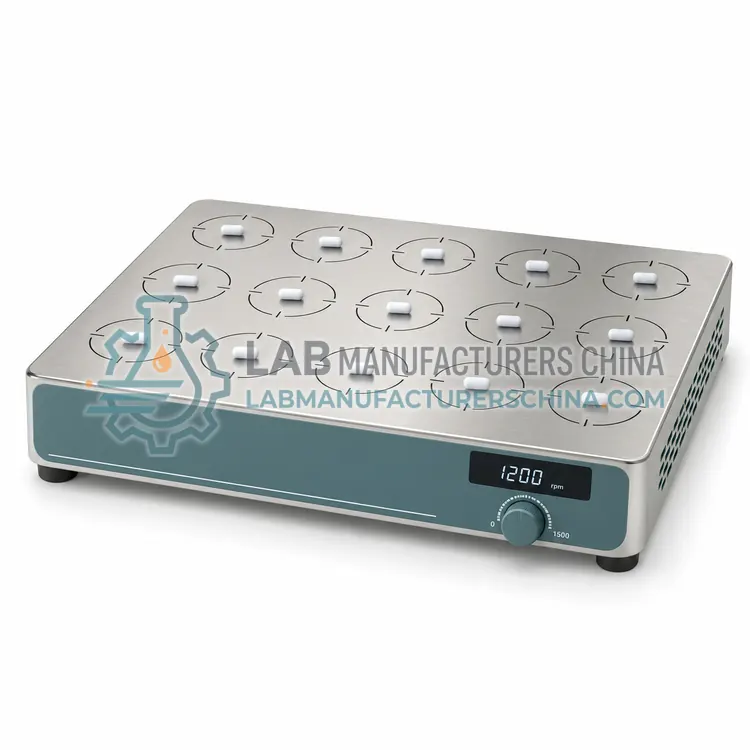
15-Position Magnetic Stirrer
十五工位磁力搅拌器
- SKU MPS-0003
- Multi-Position Stirrers
- CE (to be confirmed)
- RoHS (to be confirmed)
- ISO 9001 manufacturing (to be confirmed)
Price on request — FOB / CIF quoted per order
Prices depend on configuration, quantity and destination port.
Key specifications
| Number of positions | 15 |
|---|---|
| Speed range | 100–1,200 rpm |
| Max volume per position (water) | 100–500 mL |
| Speed uniformity between positions | ±5 % |
| Station layout | 3 rows × 5 columns |
| Speed control | Shared, digital |
Request a quote Download brochure · to be provided
By Lab Manufacturers China Technical TeamLast reviewed Standards: ASTM D2035, IEC 61010-1, IEC 61010-2-010
What is the 15-Position Magnetic Stirrer?
A 15-position magnetic stirrer arranges 15 small stations on one slim base for high-throughput stirring of vials and small flasks. It is used for solubility screening, extraction of many samples at once and small-volume reaction or formulation screening.
What is the 15-Position Magnetic Stirrer?
A 15-position magnetic stirrer arranges 15 small stations on one slim base for high-throughput stirring of vials and small flasks. It is used for solubility screening, extraction of many samples at once and small-volume reaction or formulation screening.
Overview
The 15-position format uses a shared magnetic drive, usually a single motor with a belt or a rotating magnet bar array, to spin stir bars in 15 vessels. Stations are laid out in three rows of five, sized for vials of 20 to 100 mL or flasks up to 500 mL. Speed is set from about 100 to 1,200 rpm with digital or analog control, and variation between stations is typically within ±5 percent. Some models use an overhead platform with holders for vials, while others are slim enough for a water bath. A timer and memory settings help repeat sample preparation steps. Because it is optimized for small volumes, load capacity per station is smaller than in 4- or 6-position models. The unit is common in pharmaceutical pre-formulation and analytical sample preparation.
How does it work?
Multi-position stirrers use one of two drive layouts. In the shared-drive layout, a single motor rotates a belt, gear train or large magnetic array under all positions, so every vessel sees the same speed. In the independent-drive layout, each position has its own motor or electromagnet and can be set separately. Magnetic versions spin coated stir bars in flasks or vials, while paddle versions, such as jar testers, lower shafts with flat blades into beakers and control shear through speed. Heated versions add a hotplate or heating block with a temperature sensor, and some units include reflux condensers or inert gas manifolds. The key performance factor is speed uniformity between positions, which depends on drive accuracy, magnet strength and vessel alignment. Position layout influences bench space and accessibility.
What are the key features?
- Fifteen stations for high-throughput stirring of vials and small flasks
- Shared drive keeps comparable speed across all positions
- Speed range of roughly 100–1,200 rpm with digital control
- Timer and stored programs for repeatable preparation steps
- Slim housing suitable for use inside water baths in selected models
- Vial holders and racks available for common vial formats
What are the technical specifications?
A typical 15-position magnetic stirrer configuration offers number of positions of 15, speed range of 100–1,200 rpm, max volume per position (water) of 100–500 mL, speed uniformity between positions of ±5 %, station layout of 3 rows × 5 columns and speed control of Shared, digital. Values are indicative of the product class; the exact figures for each configuration are confirmed on the quotation and the calibration documents supplied with the instrument.
Which applications is it used for?
The 15-Position Magnetic Stirrer is used in pharmaceutical solubility screening, high-throughput sample extraction, formulation compatibility screening, dissolution of multiple reference standards and small-volume microbial media mixing. Across the wider Multi-Position Stirrers class, laboratories also deploy it for parallel dissolution and solubility screening, liquid-liquid and solid-liquid extraction and coagulation and flocculation jar testing.
Which standards and certifications apply?
Relevant standards and methods include ASTM D2035, IEC 61010-1, IEC 61010-2-010, IEC 61326-1, USP <711>, GB/T 16881 and ISO 9001. Certification candidates for this model are CE, RoHS and ISO 9001 manufacturing; each is to be confirmed for the specific configuration before shipment, and certificates are supplied only where they have been issued.
Place the stirrer on a level, rigid bench and verify that every position is in full contact with its vessel. Check speed uniformity across positions with a tachometer during installation and at intervals, since belt wear or magnet mismatch shifts speed. Use identical vessels and stir bars in all positions to keep mixing comparable. Load positions evenly to avoid vibration. Clean spills promptly, because liquid under the plate can damage drive parts. For heated units, follow the same precautions as hotplate stirrers, including a working safety cut-out. For jar testers, follow the method for paddle geometry and beaker size, such as ASTM D2035. Keep service records and consider preventive maintenance annually.
How do I select the right 15-Position Magnetic Stirrer?
Select a 15-position unit when throughput matters and volumes per sample are below about 500 mL. For larger vessels or independent speeds, use 4- or 6-position models. In the RFQ, state vial and flask sizes, speed range, timer requirements, bath compatibility and maximum number of samples per run.
How does it compare with other Multi-Position Stirrers variants?
First set the number of positions and vessel size, since these determine the footprint and plate geometry. Decide whether all positions can share one speed, which is cheaper and adequate for dissolution or extraction, or whether each needs individual control for optimization studies. Check speed range and uniformity between positions, typically within a few percent, and maximum volume per position. If heating is needed, compare temperature range, uniformity across positions and whether a probe controls the block. For water treatment, choose a jar tester with paddle speed range suited to rapid-mix and slow-mix stages and with a lighted base if turbidity observations are made. Consider chemical resistance, hood fit, interface, and whether programmable speed steps are required. Give position count, flask sizes, speed and temperature range in the inquiry.
Full specifications
| Number of positions | 15 |
|---|---|
| Speed range | 100–1,200 rpm |
| Max volume per position (water) | 100–500 mL |
| Speed uniformity between positions | ±5 % |
| Station layout | 3 rows × 5 columns |
| Speed control | Shared, digital |
| Timer range | 1 min–99 h |
| Housing height | 30–60 mm |
| Power consumption | 30–80 W |
| Dimensions (W×D×H) | 400 × 300 × 60 mm |
Indicative values for this product class. Final specifications are confirmed on the quotation and in the calibration documents supplied with the instrument.
Applications
- Pharmaceutical solubility screening
- High-throughput sample extraction
- Formulation compatibility screening
- Dissolution of multiple reference standards
- Small-volume microbial media mixing
Key features
- Fifteen stations for high-throughput stirring of vials and small flasks
- Shared drive keeps comparable speed across all positions
- Speed range of roughly 100–1,200 rpm with digital control
- Timer and stored programs for repeatable preparation steps
- Slim housing suitable for use inside water baths in selected models
- Vial holders and racks available for common vial formats
Frequently asked questions about 15-Position Magnetic Stirrer
Vials of 20 to 100 mL and flasks up to about 500 mL, depending on station diameter. Because stations are small, large beakers do not fit, so check station size and spacing before ordering.
A shared belt or magnet array drives all positions, so speed is set by one motor. Uniformity depends on alignment and magnet strength, typically within a few percent. Verify with a tachometer at installation and periodically.
Some slim models are sealed and designed for placement under a bath or vessel holder for temperature-controlled work. Confirm the ingress rating, temperature limits and chemical compatibility of the housing before immersion.
It stirs several vessels simultaneously at the same speed, and sometimes temperature, so multiple samples are processed under identical conditions. Typical uses are parallel dissolution, extraction, solubility screening, reaction optimization and jar testing in water treatment.
Measure rpm at each position with a calibrated non-contact tachometer or stroboscope at several set speeds, and compare with the set value. Differences within a few percent are typical. Repeat at installation, after repairs and at routine intervals.
Independent control suits optimization studies where each vessel needs a different speed. A shared drive is cheaper and gives consistent speed for replicate work such as dissolution or extraction, where the same conditions should apply everywhere.
Related models