Lab Manufacturers China

Moisture Balances

水分测定仪

MOB · Laboratory Balances · 5 models

By Lab Manufacturers China Technical TeamLast reviewed Standards: USP <731>, Ph. Eur. 2.2.32, ISO 712

Standards referenced

  • USP <731>
  • Ph. Eur. 2.2.32
  • ISO 712
  • ISO 6540
  • AOAC 925.10
  • ASTM D6980
  • GB 5009.3

What are Moisture Balances?

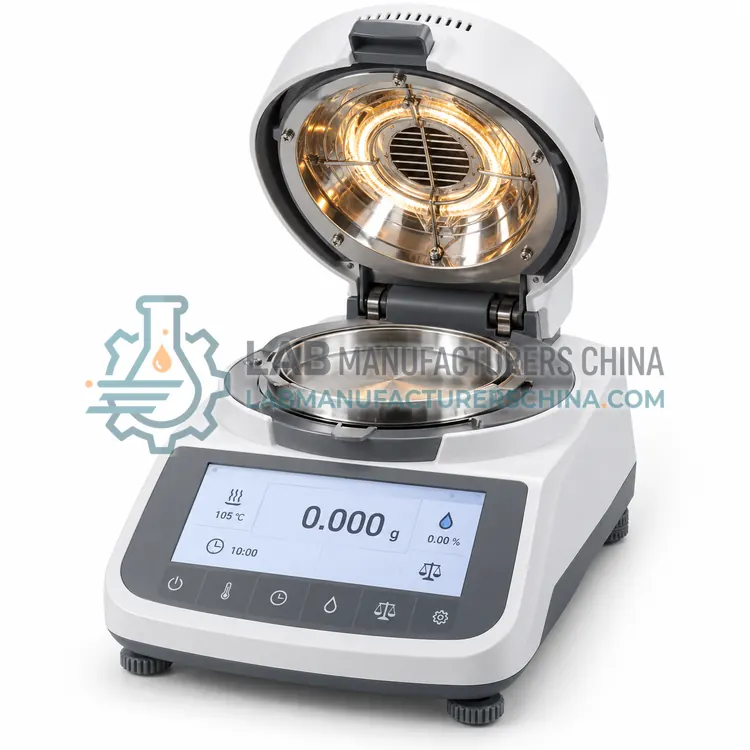
Moisture balances, also called moisture analyzers, combine a precision balance with a heating unit to determine moisture content by the loss-on-drying method. A sample is weighed, heated and re-weighed continuously until mass stabilizes. They are used in food, pharmaceutical, chemical, plastics and agricultural laboratories for rapid moisture results.

5 models of Moisture Balances

The 5 models below are current configurations; specifications are confirmed on quotation.

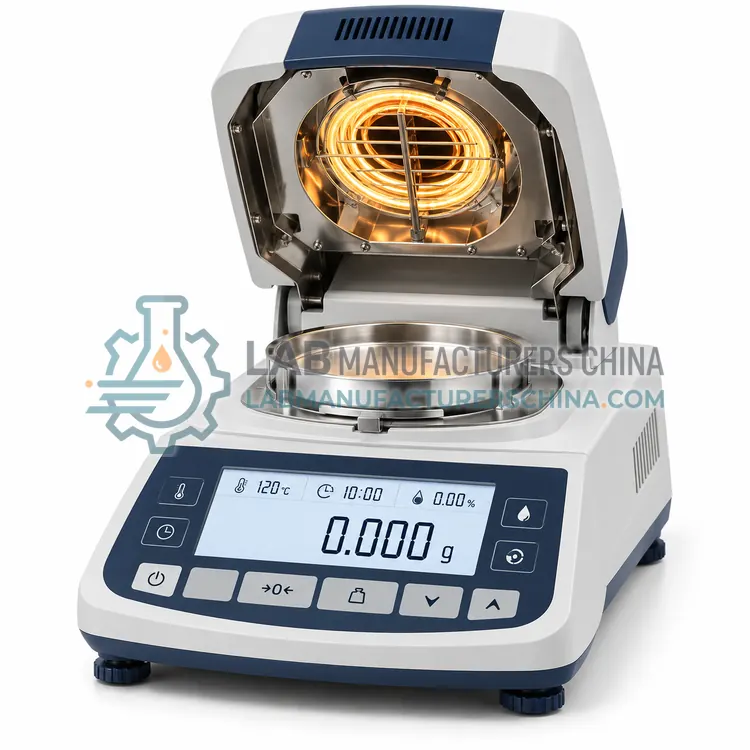
Halogen Moisture Analyzer

卤素水分测定仪

  • MOB-0001
  • Moisture Balances
  • CE (to be confirmed)
  • ISO 9001 manufacturing (to be confirmed)
  • RoHS (to be confirmed)
Readability:
1 mg (0.1 mg optional)
Sample capacity:
50–160 g
Moisture readability:
0.01–0.1%
Temperature range:
40–200 C
Heating source:
Halogen lamp, 400–500 W
Typical sample mass:
0.5–20 g

A halogen moisture analyzer uses a halogen lamp as its heat source, reaching drying temperature within one to two minutes and cutting analysis time compared with oven drying. It is the most widely used type for general solids and powders.

Request a quote
View details

Infrared Lamp Moisture Balance

红外灯水分测定仪

  • MOB-0002
  • Moisture Balances
  • CE (to be confirmed)
  • ISO 9001 manufacturing (to be confirmed)
  • RoHS (to be confirmed)
Readability:
1–10 mg
Sample capacity:
50–120 g
Moisture readability:
0.01–0.1%
Temperature range:
50–160 C
Heating source:
Infrared lamp, 250–375 W
Time to 105 C:
≈ 2–3 min

An infrared lamp moisture balance uses a conventional infrared emitter for heating and offers a lower-cost route to loss-on-drying measurement. It suits routine quality control of powders and granules where analysis speed is less critical.

Request a quote
View details

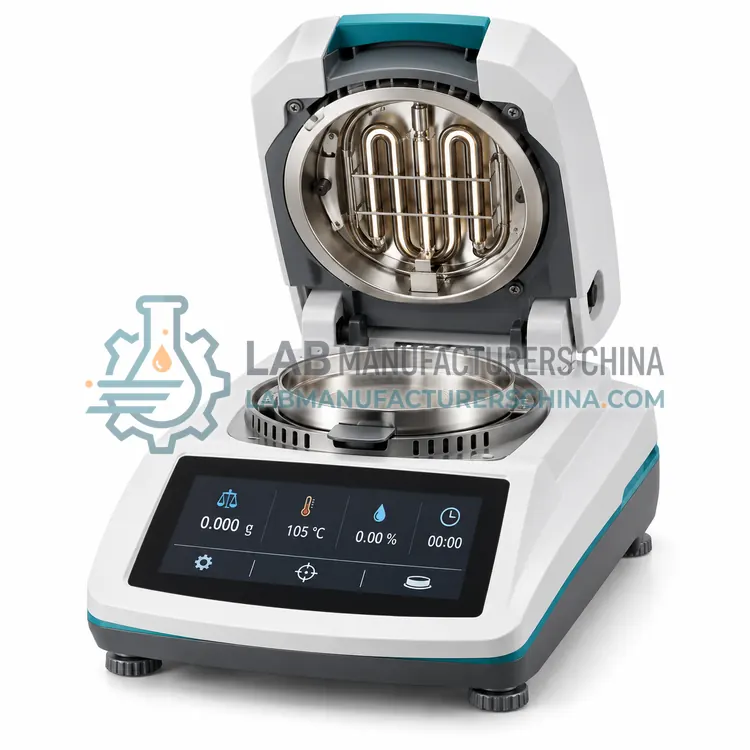
Tubular Metal-Heater Moisture Analyzer

管式金属加热水分测定仪

  • MOB-0003
  • Moisture Balances
  • CE (to be confirmed)
  • ISO 9001 manufacturing (to be confirmed)
  • RoHS (to be confirmed)
Readability:
1 mg (0.1 mg optional)
Sample capacity:
50–120 g
Moisture readability:
0.01–0.1%
Temperature range:
40–200 C
Heating source:
Ring or tubular metal heater
Time to 105 C:
≈ 3–5 min

A tubular metal-heater moisture analyzer heats the sample with a ring-shaped metal or ceramic heating element around the pan, giving uniform heating and stable temperature. It suits sugars, polymers, cheese and other materials that scorch under intense radiation.

Request a quote
View details

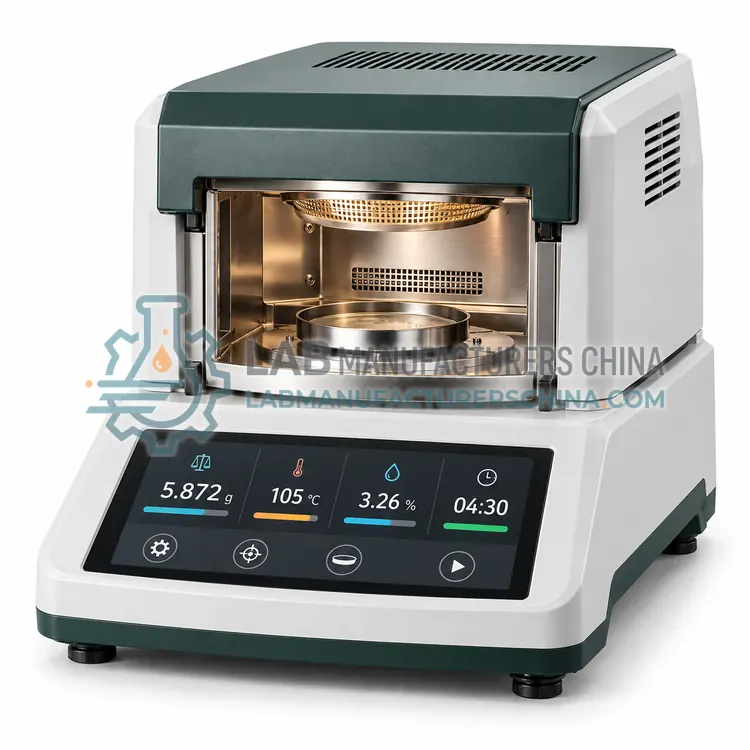
Microwave Moisture Analyzer

微波水分测定仪

  • MOB-0004
  • Moisture Balances
  • CE (to be confirmed)
  • Microwave leakage safety test (to be confirmed)
  • ISO 9001 manufacturing (to be confirmed)
Readability:
1–10 mg
Sample mass range:
5–100 g
Microwave frequency:
2.45 GHz
Microwave power:
Adjustable to 900 W
Moisture readability:
0.01–0.1%
Typical analysis time:
≈ 2–6 min

A microwave moisture analyzer heats the sample by microwave energy that couples directly with water molecules, drying large or high-moisture samples evenly and quickly. It suits meat, dairy, cheese, pastes and bulky products where surface heating is slow.

Request a quote
View details

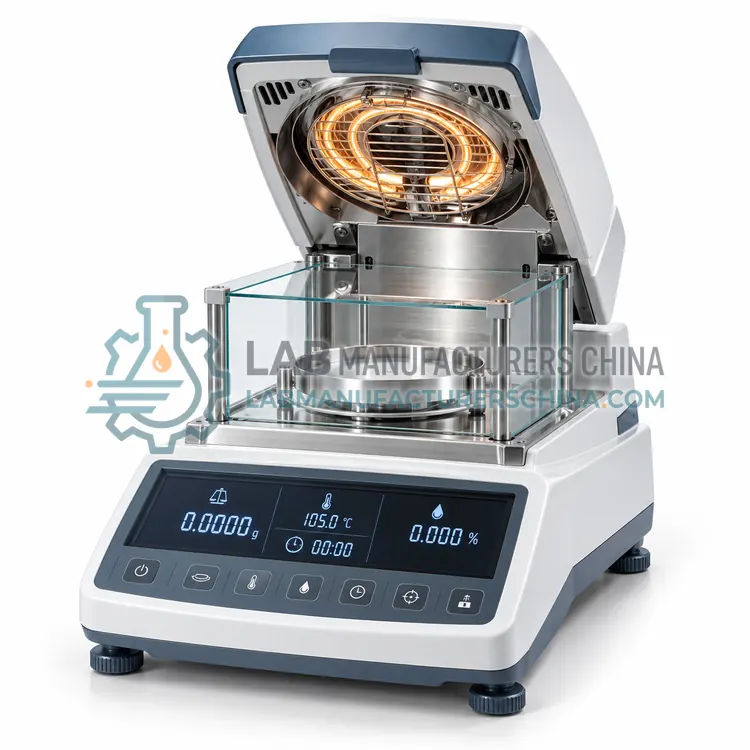
High-Resolution 0.1 mg Moisture Analyzer

0.1 mg 高分辨率水分测定仪

  • MOB-0005
  • Moisture Balances
  • CE (to be confirmed)
  • ISO 9001 manufacturing (to be confirmed)
  • Data integrity software validation support (to be confirmed)
Readability:
0.1 mg (0.01 mg optional)
Sample capacity:
40–120 g
Moisture readability:
0.001–0.01%
Temperature range:
40–200 C
Heating source:
Halogen or ceramic
Typical sample mass:
0.5–10 g

A high-resolution moisture analyzer has a 0.1 mg or 0.01 mg weighing cell and halogen or similar heating. It resolves small moisture losses in low-moisture materials and small sample masses, such as active pharmaceutical ingredients and polymers.

Request a quote
View details

Compare Moisture Balances models

ModelReadabilitySample capacityMoisture readabilityTemperature rangeHeating source
Halogen Moisture AnalyzerMOB-00011 mg (0.1 mg optional)50–160 g0.01–0.1%40–200 CHalogen lamp, 400–500 W
Infrared Lamp Moisture BalanceMOB-00021–10 mg50–120 g0.01–0.1%50–160 CInfrared lamp, 250–375 W
Tubular Metal-Heater Moisture AnalyzerMOB-00031 mg (0.1 mg optional)50–120 g0.01–0.1%40–200 CRing or tubular metal heater
Microwave Moisture AnalyzerMOB-00041–10 mg—0.01–0.1%——
High-Resolution 0.1 mg Moisture AnalyzerMOB-00050.1 mg (0.01 mg optional)40–120 g0.001–0.01%40–200 CHalogen or ceramic

Indicative values for this product class. Final specifications are confirmed on the quotation and in the calibration documents supplied with the instrument.

How do Moisture Balances work?

A moisture balance applies the thermogravimetric loss-on-drying principle. The sample, typically 0.5 to 20 g, is placed on a pan inside a heating chamber, and its initial mass is recorded. A heater, such as a halogen lamp, infrared emitter, metal tube or microwave source, raises the sample temperature to a set value, commonly 40 to 200 C. A built-in weighing cell records mass continuously as water and other volatiles evaporate. The analysis ends when mass change falls below a defined rate, for example 1 mg per 50 seconds, or after a set time. Moisture content is calculated as mass loss divided by initial mass. Temperature sensors and profiles, such as standard, rapid or stepwise heating, control energy input to avoid decomposition of the sample.

Which Moisture Balances variants are available?

  • Halogen Moisture Analyzer — A halogen moisture analyzer uses a halogen lamp as its heat source, reaching drying temperature within one to two minutes and cutting analysis time compared with oven drying.
  • Infrared Lamp Moisture Balance — An infrared lamp moisture balance uses a conventional infrared emitter for heating and offers a lower-cost route to loss-on-drying measurement.
  • Tubular Metal-Heater Moisture Analyzer — A tubular metal-heater moisture analyzer heats the sample with a ring-shaped metal or ceramic heating element around the pan, giving uniform heating and stable temperature.
  • Microwave Moisture Analyzer — A microwave moisture analyzer heats the sample by microwave energy that couples directly with water molecules, drying large or high-moisture samples evenly and quickly.
  • High-Resolution 0.1 mg Moisture Analyzer — A high-resolution moisture analyzer has a 0.1 mg or 0.01 mg weighing cell and halogen or similar heating.

How do I choose the right variant?

Choose the heating technology by sample type. Halogen and infrared units suit most solids and powders, tubular heaters give gentler and more uniform heating for sugars and polymers, and microwave units penetrate large or high-moisture samples quickly. Then check readability, with 1 mg for routine work and 0.1 mg for low-moisture samples or small masses. Consider capacity, usually 50 to 200 g, and temperature range. Validate the method against a reference such as oven drying or Karl Fischer titration, since loss-on-drying also captures other volatiles. Look at programmable drying profiles, data outputs and audit trail for regulated use. Also check sample pans, pan handlers and ease of cleaning, which influence throughput and reproducibility.

Where are Moisture Balances used?

Moisture Balances are specified in food and grain moisture testing, pharmaceutical loss on drying, plastic granule moisture control, chemical powder drying checks, tobacco and feed analysis and paper and pulp moisture.

Which standards and certifications apply?

Work with Moisture Balances is commonly governed by USP <731>, Ph. Eur. 2.2.32, ISO 712, ISO 6540, AOAC 925.10, ASTM D6980 and GB 5009.3. Instrument certifications such as CE marking are confirmed per configuration and never assumed.

What are the key considerations before purchase?

Install the instrument on a level, vibration-free bench, away from drafts and direct heat, since air movement affects the weighing cell. Allow warm-up before use and calibrate the balance with certified weights. Verify temperature with a calibrated temperature kit, because heater drift changes results. Keep the chamber, reflector and pan clean, as residues absorb heat and alter drying. Use consistent sample mass and distribution, for example a thin even layer, to ensure reproducibility. Hazardous or flammable volatile samples can be unsafe in a heated chamber, so assess each method. Document method parameters, and validate against a reference method when compliance is needed.

Frequently asked questions about Moisture Balances

It weighs the sample, heats it and records mass continuously while water evaporates. Moisture content equals mass lost divided by initial mass, expressed as a percentage. The test ends when mass stops changing at a defined rate or after a set time.

Need help specifying Moisture Balances?

Request a quote