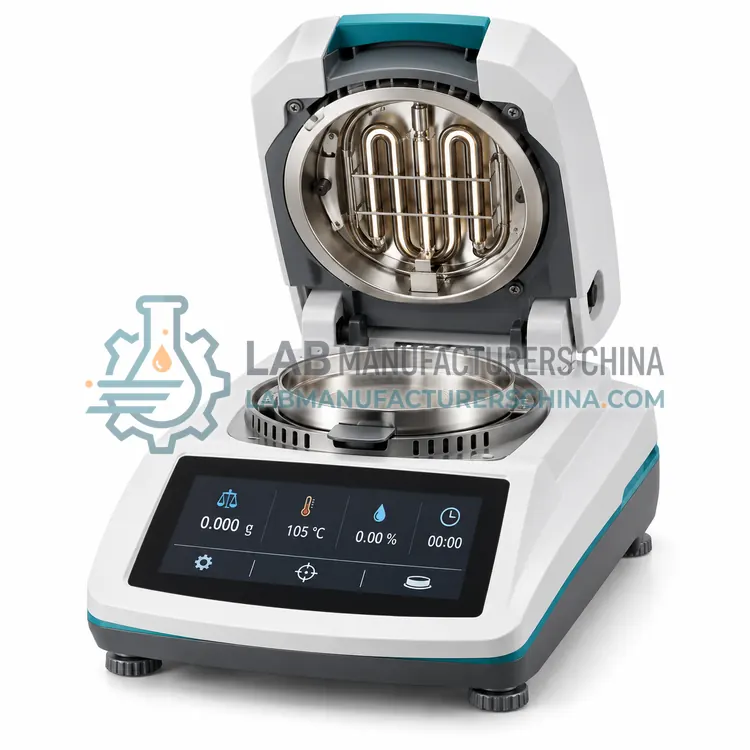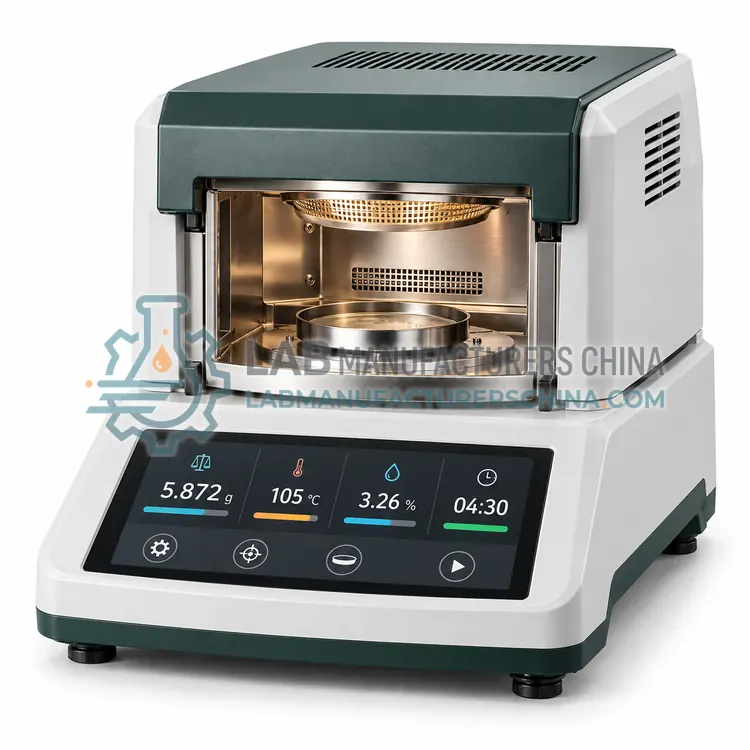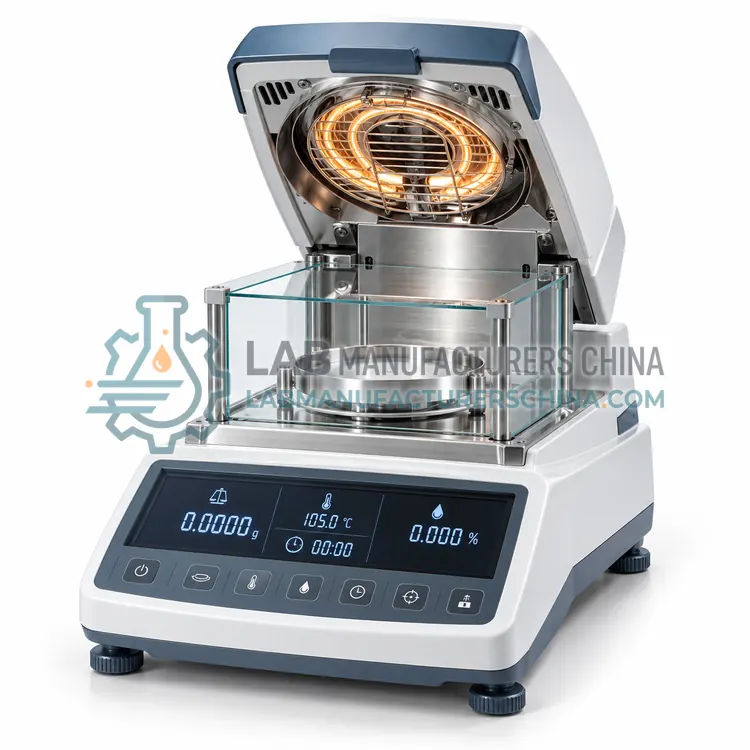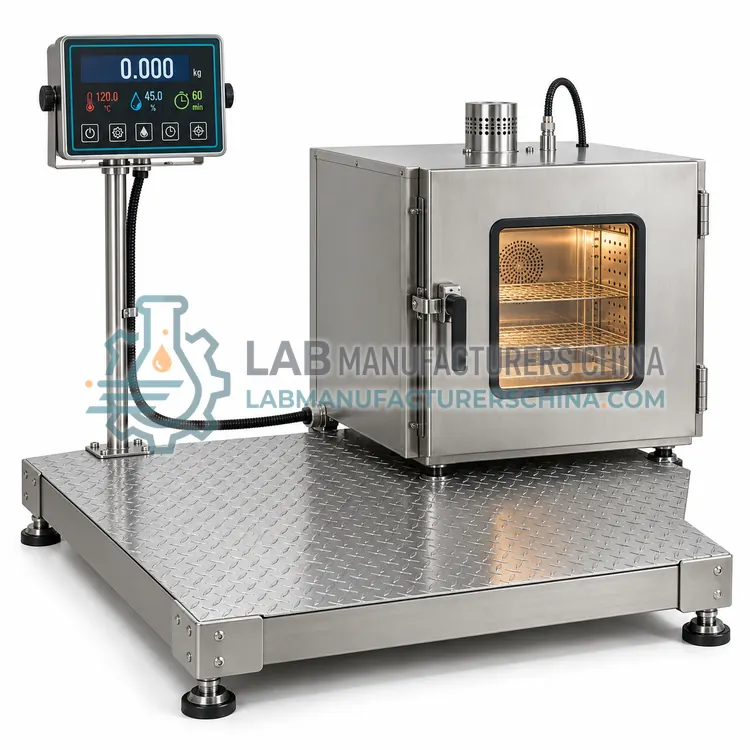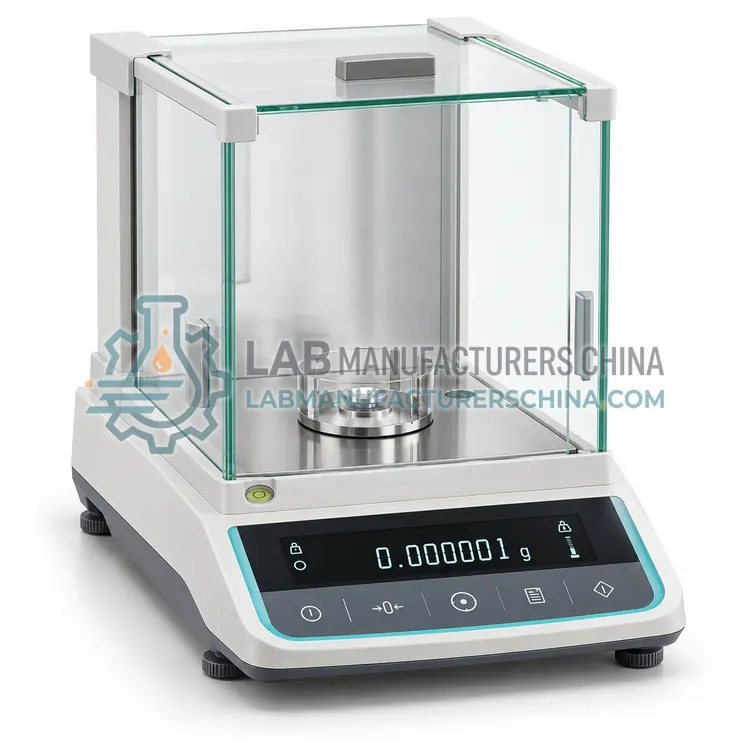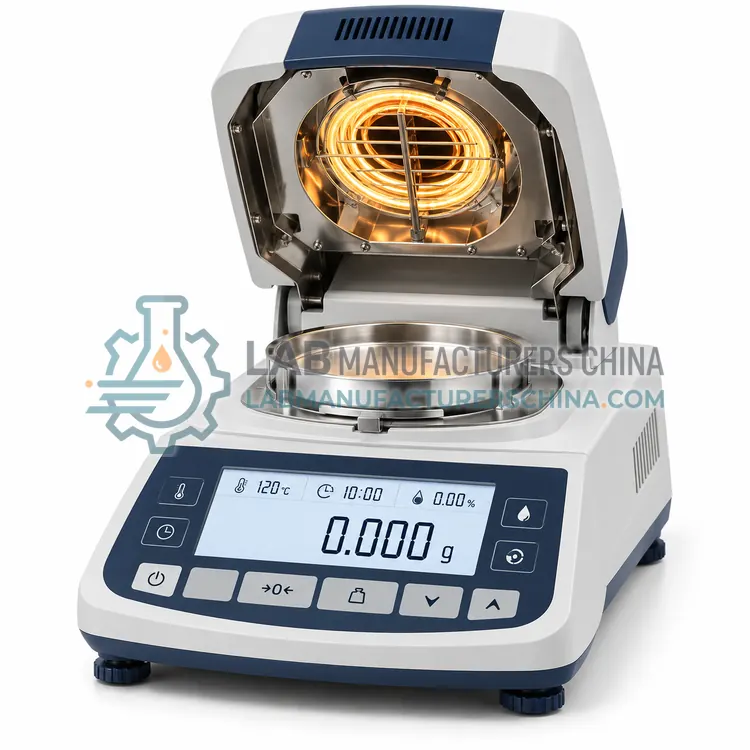
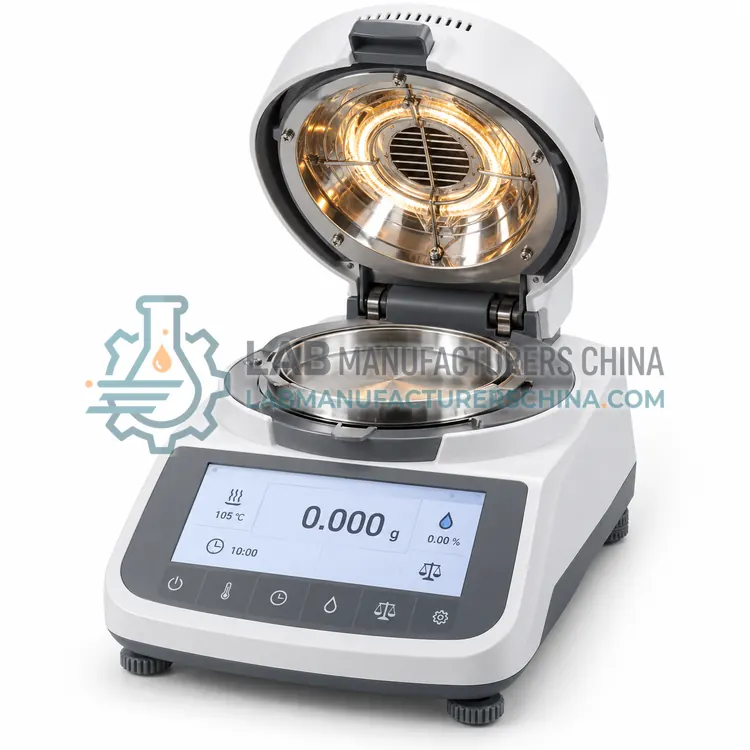
Halogen Moisture Analyzer
卤素水分测定仪
- SKU MOB-0001
- Moisture Balances
- CE (to be confirmed)
- ISO 9001 manufacturing (to be confirmed)
- RoHS (to be confirmed)
Price on request — FOB / CIF quoted per order
Prices depend on configuration, quantity and destination port.
Key specifications
| Readability | 1 mg (0.1 mg optional) |
|---|---|
| Sample capacity | 50–160 g |
| Moisture readability | 0.01–0.1% |
| Temperature range | 40–200 C |
| Heating source | Halogen lamp, 400–500 W |
| Typical sample mass | 0.5–20 g |
Request a quote Download brochure · to be provided
By Lab Manufacturers China Technical TeamLast reviewed Standards: USP <731>, Ph. Eur. 2.2.32, ISO 712
What is the Halogen Moisture Analyzer?
A halogen moisture analyzer uses a halogen lamp as its heat source, reaching drying temperature within one to two minutes and cutting analysis time compared with oven drying. It is the most widely used type for general solids and powders.
What is the Halogen Moisture Analyzer?
A halogen moisture analyzer uses a halogen lamp as its heat source, reaching drying temperature within one to two minutes and cutting analysis time compared with oven drying. It is the most widely used type for general solids and powders.
Overview
The halogen lamp produces intense near-infrared radiation that penetrates the sample surface and reaches set temperatures such as 160 C in about 60 to 90 seconds. Readability is 1 mg for most models, with some offering 0.1 mg, and the sample capacity is 50 to 160 g. A temperature sensor controls lamp output, and drying programs include standard, rapid, gentle and stepwise profiles. The switch-off criterion can be set by time or by rate of mass change, for example 1 mg per 30 to 90 seconds. Typical analysis takes 3 to 10 minutes compared with 2 to 24 hours in an oven. Reflector and lamp glass must be kept clean because deposits alter heat transfer. The analyzer works well for grain, powders, granules, pastes spread on glass-fiber pads and many chemical products.
How does it work?
A moisture balance applies the thermogravimetric loss-on-drying principle. The sample, typically 0.5 to 20 g, is placed on a pan inside a heating chamber, and its initial mass is recorded. A heater, such as a halogen lamp, infrared emitter, metal tube or microwave source, raises the sample temperature to a set value, commonly 40 to 200 C. A built-in weighing cell records mass continuously as water and other volatiles evaporate. The analysis ends when mass change falls below a defined rate, for example 1 mg per 50 seconds, or after a set time. Moisture content is calculated as mass loss divided by initial mass. Temperature sensors and profiles, such as standard, rapid or stepwise heating, control energy input to avoid decomposition of the sample.
What are the key features?
- Halogen lamp heating reaching 160 C in about 60 to 90 seconds
- Standard, rapid, gentle and stepwise drying profiles
- Switch-off by time or by mass change per time criterion
- Method memory for repeat analyses of common products
- Removable sample pan handler and draft-protected chamber
What are the technical specifications?
A typical halogen moisture analyzer configuration offers readability of 1 mg (0.1 mg optional), sample capacity of 50–160 g, moisture readability of 0.01–0.1%, temperature range of 40–200 C, heating source of Halogen lamp, 400–500 W and typical sample mass of 0.5–20 g. Values are indicative of the product class; the exact figures for each configuration are confirmed on the quotation and the calibration documents supplied with the instrument.
Which applications is it used for?
The Halogen Moisture Analyzer is used in grain and flour moisture, pharmaceutical granule loss on drying, chemical powders and food ingredient testing. Across the wider Moisture Balances class, laboratories also deploy it for food and grain moisture testing, pharmaceutical loss on drying and plastic granule moisture control.
Which standards and certifications apply?
Relevant standards and methods include USP <731>, Ph. Eur. 2.2.32, ISO 712, ISO 6540, AOAC 925.10, ASTM D6980 and GB 5009.3. Certification candidates for this model are CE, ISO 9001 manufacturing and RoHS; each is to be confirmed for the specific configuration before shipment, and certificates are supplied only where they have been issued.
Install the instrument on a level, vibration-free bench, away from drafts and direct heat, since air movement affects the weighing cell. Allow warm-up before use and calibrate the balance with certified weights. Verify temperature with a calibrated temperature kit, because heater drift changes results. Keep the chamber, reflector and pan clean, as residues absorb heat and alter drying. Use consistent sample mass and distribution, for example a thin even layer, to ensure reproducibility. Hazardous or flammable volatile samples can be unsafe in a heated chamber, so assess each method. Document method parameters, and validate against a reference method when compliance is needed.
How do I select the right Halogen Moisture Analyzer?
Select the halogen analyzer as the default for routine solids and powders when fast, repeatable loss-on-drying is needed. It is unsuitable for materials that burn or skin over at high radiation intensity. In the RFQ, specify readability, capacity, temperature range, methods and data output.
How does it compare with other Moisture Balances variants?
Choose the heating technology by sample type. Halogen and infrared units suit most solids and powders, tubular heaters give gentler and more uniform heating for sugars and polymers, and microwave units penetrate large or high-moisture samples quickly. Then check readability, with 1 mg for routine work and 0.1 mg for low-moisture samples or small masses. Consider capacity, usually 50 to 200 g, and temperature range. Validate the method against a reference such as oven drying or Karl Fischer titration, since loss-on-drying also captures other volatiles. Look at programmable drying profiles, data outputs and audit trail for regulated use. Also check sample pans, pan handlers and ease of cleaning, which influence throughput and reproducibility.
Full specifications
| Readability | 1 mg (0.1 mg optional) |
|---|---|
| Sample capacity | 50–160 g |
| Moisture readability | 0.01–0.1% |
| Temperature range | 40–200 C |
| Heating source | Halogen lamp, 400–500 W |
| Typical sample mass | 0.5–20 g |
| Repeatability (5 g sample) | ≈ 0.05–0.2% moisture |
| Drying programs | Standard, rapid, gentle, stepwise |
| Memory | ≥ 20 methods |
| Power supply | 220 V, 50/60 Hz |
Indicative values for this product class. Final specifications are confirmed on the quotation and in the calibration documents supplied with the instrument.
Applications
- Grain and flour moisture
- Pharmaceutical granule loss on drying
- Chemical powders
- Food ingredient testing
Key features
- Halogen lamp heating reaching 160 C in about 60 to 90 seconds
- Standard, rapid, gentle and stepwise drying profiles
- Switch-off by time or by mass change per time criterion
- Method memory for repeat analyses of common products
- Removable sample pan handler and draft-protected chamber
Frequently asked questions about Halogen Moisture Analyzer
The halogen lamp delivers intense radiant energy directly into the sample, and the thin layer and small mass dry quickly, typically in minutes rather than hours. Continuous weighing also ends the test as soon as mass is stable.
Start with the temperature of the reference oven method, often 105 C for many foods and powders, and adjust to avoid decomposition. Halogen heat can make the sample surface hotter than the display shows, so validate against an oven reference.
Check temperature at least annually, and after lamp replacement, using a calibrated temperature sensor kit offered for the instrument. Weight calibration should be checked with certified weights on a schedule defined by laboratory procedures.
It weighs the sample, heats it and records mass continuously while water evaporates. Moisture content equals mass lost divided by initial mass, expressed as a percentage. The test ends when mass stops changing at a defined rate or after a set time.
Loss-on-drying measures all volatiles lost at the set temperature, not only water, so results may differ from Karl Fischer titration, which is specific to water. A validated method can correlate closely, but Karl Fischer remains the reference for low-moisture or heat-sensitive samples.
Typically 1 to 10 g for routine samples, chosen so that the expected moisture loss is well above the balance resolution, often at least 10 mg. Use a thin, even layer to allow uniform drying and avoid overloading the pan.
Related models