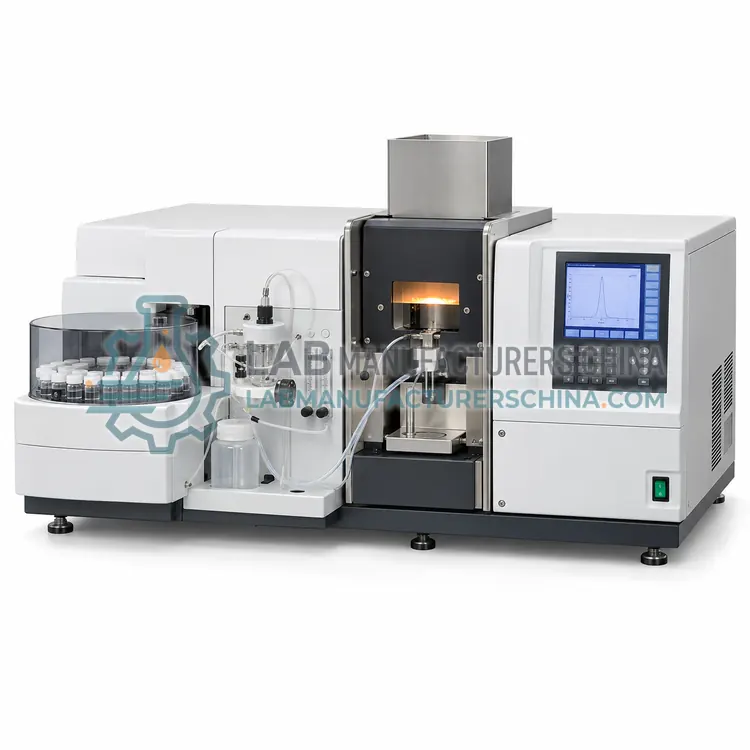
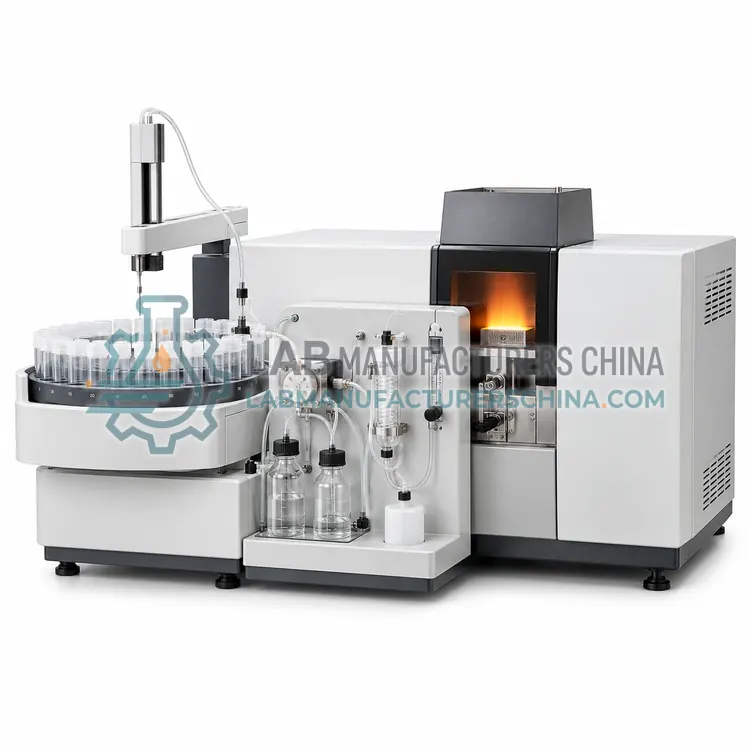
How do Hydride Generation AAS work?
The sample is mixed with acid and sodium borohydride, which reduces the analyte to a volatile covalent hydride such as arsine or selenide. A carrier gas sweeps the hydride into a heated quartz tube or a small flame, where it decomposes into free atoms. The atoms absorb light from an element-specific hollow-cathode lamp, and absorbance follows the Beer-Lambert law. Because the hydride is separated from the liquid matrix before atomization, most interferents remain behind, which gives high sensitivity and low background. Mercury can be determined by cold vapor generation without heating because it is already volatile. Reaction conditions such as acid type and concentration, borohydride concentration, flow rates and reaction temperature must be tightly controlled, and interfering ions such as copper and nickel are masked or removed. Calibration uses aqueous standards treated in the same way as samples.
Which Hydride Generation AAS variants are available?
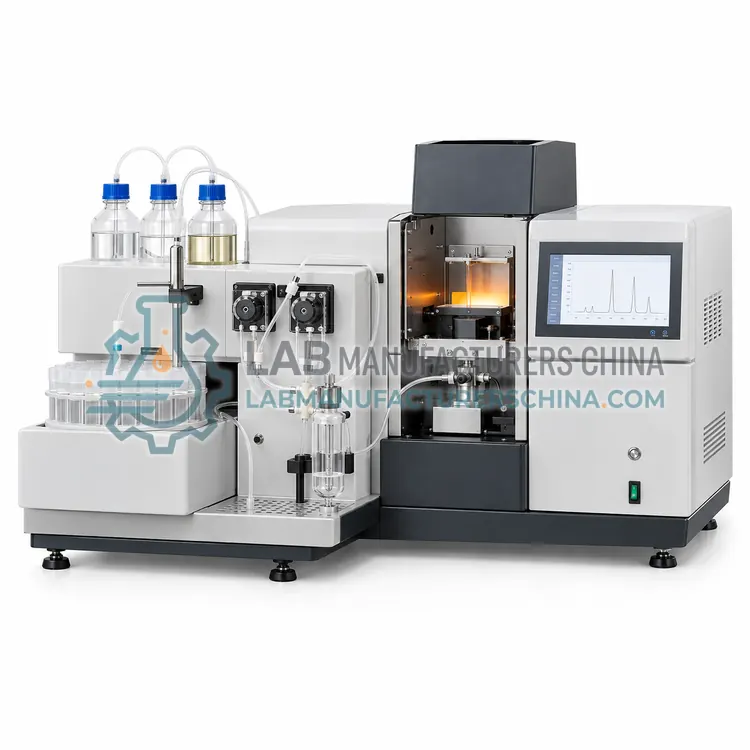
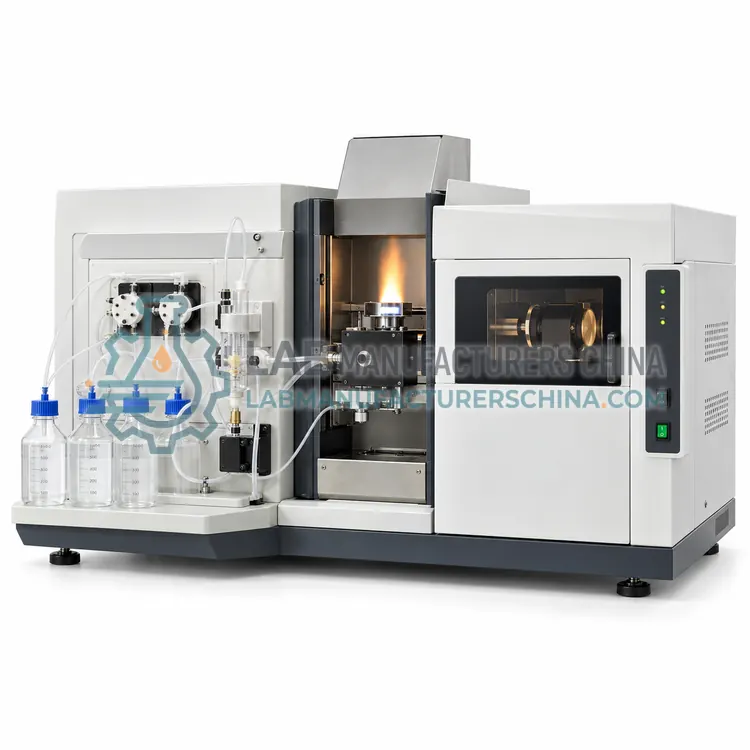
- Continuous-Flow Hydride Generation AAS — A continuous-flow hydride generation AAS mixes sample, acid and reductant continuously and feeds a steady hydride stream to the atomizer.
- Flow-Injection Hydride Generation AAS — A flow-injection hydride generation AAS injects discrete sample plugs into a flowing reagent stream.
- Batch Hydride Generation AAS — A batch hydride generation AAS reacts each sample in a closed vessel and transfers the hydride to the atomizer.
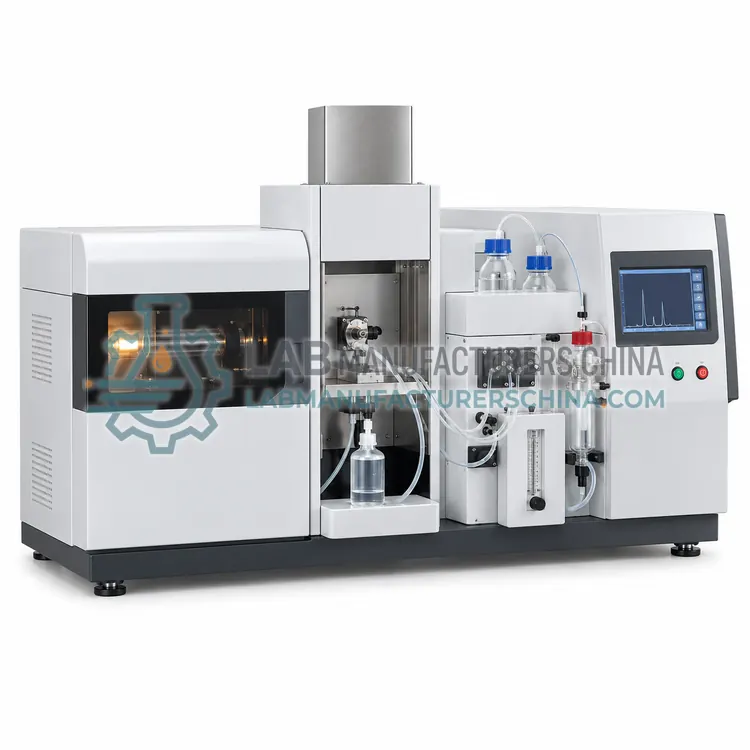
- Hydride Generation AAS with Cold Vapor Mercury Module — This system combines hydride generation for arsenic, selenium and related elements with a cold vapor module for mercury.
- Multi-Element Hydride Generation AAS — A multi-element hydride generation AAS measures several hydride-forming elements in one run using multiple lamps and detection channels.
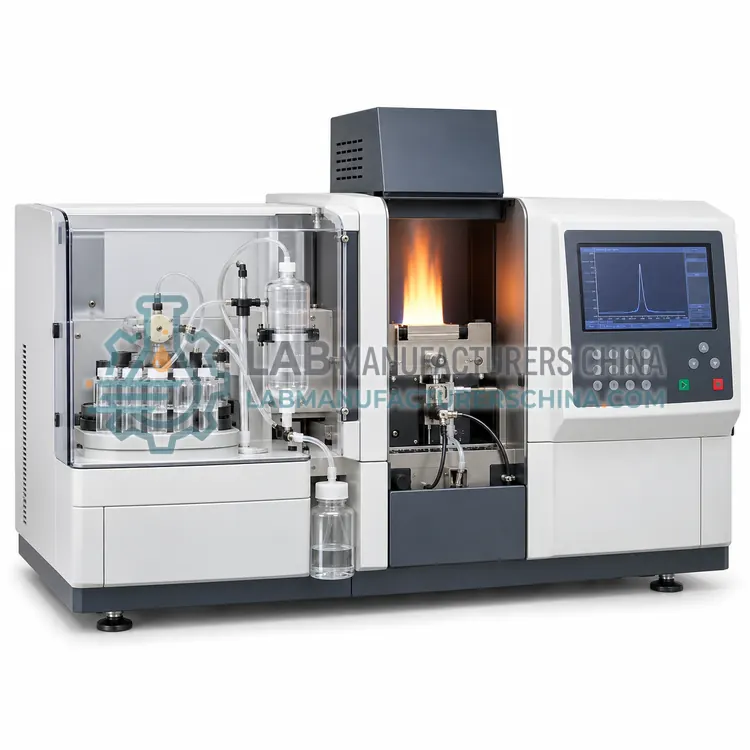
- Automated Hydride Generation AAS with Autosampler — An automated hydride generation AAS uses an autosampler to prepare and deliver samples and reagents in sequence.
How do I choose the right variant?
Choose a hydride generation system when the target elements are arsenic, selenium, antimony, bismuth, tin, tellurium or mercury and detection limits around 0.01 to 0.5 micrograms per litre are required at moderate cost. Continuous-flow designs offer stable signals and good throughput, flow-injection designs use less reagent and allow fast transient measurements, and batch systems are cheapest but slowest. If mercury is also required, add a cold vapor module or select an instrument with both modes. Multi-element configurations reduce time when several hydride-forming elements are measured together. For very low detection limits on arsenic and selenium, compare with ICP-MS, which may offer lower limits at higher cost.
Where are Hydride Generation AAS used?
Hydride Generation AAS are specified in arsenic and selenium in drinking water, arsenic and mercury in rice, fish and seafood, antimony and tin in packaging material migration and selenium and arsenic in soil and geological samples.
Which standards and certifications apply?
Work with Hydride Generation AAS is commonly governed by Ph. Eur. 2.2.22 Atomic absorption spectrometry, USP <852> Atomic Absorption Spectroscopy, ISO 11969 Water quality — Determination of arsenic by AAS, US EPA Method 7062 Arsenic by hydride generation, US EPA Method 7473 Mercury in solids and solutions and IEC 61010-1. Instrument certifications such as CE marking are confirmed per configuration and never assumed.
What are the key considerations before purchase?
Hydride generation uses sodium borohydride solutions that must be prepared fresh or kept cooled, and reactions can release hydrogen gas, so ventilation is required. Acid and reductant concentrations, tubing lengths and gas flows affect the yield and must be fixed in the method. Interfering elements are controlled with masking agents such as thiourea or by separation. Quartz cells cloud with use and need periodic cleaning or replacement, and their temperature affects atomization efficiency. Because the technique measures a transient or steady signal from a gas, blank contamination from reagents is a common problem; ultrapure reagents and method blanks are essential. Install the system on the flame or furnace instrument with the correct gas supply and waste handling.