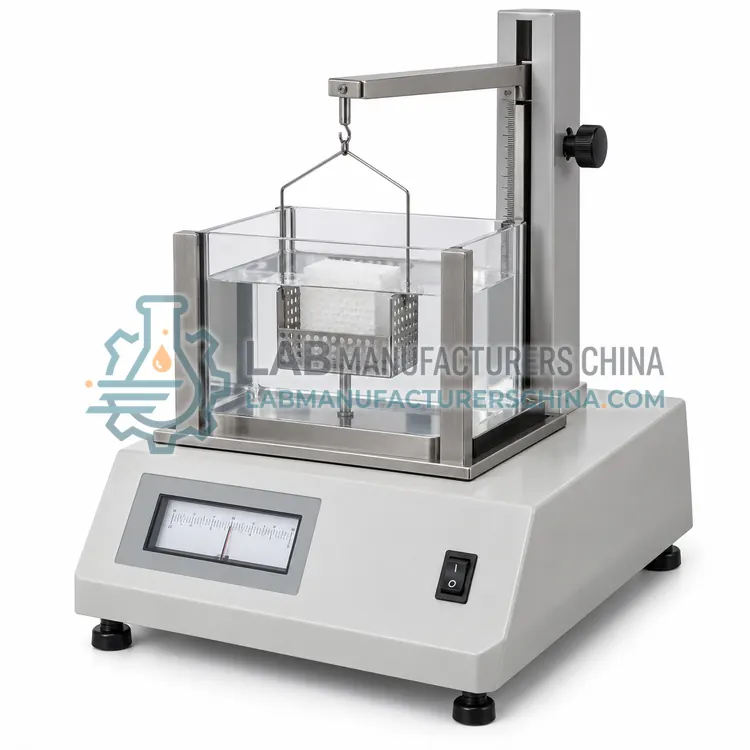
How do Density Testing work?
The classical method applies Archimedes' principle: the sample is weighed in air and again while immersed in a liquid of known density, and the difference gives the sample volume. This suits void-free solid specimens and returns density to three or four decimal places. A density gradient column contains a liquid column whose density varies linearly with height, so a small specimen sinks to the level matching its own density and is read against calibrated glass floats, which is useful for very small or thin samples. Gas pycnometry measures the volume of a sample by helium displacement in a calibrated chamber, so it handles powders and porous or irregular material. Bulk and apparent density methods instead measure the mass that fills a defined volume, which is the relevant quantity for granules, powders and cellular plastics.
Which Density Testing variants are available?
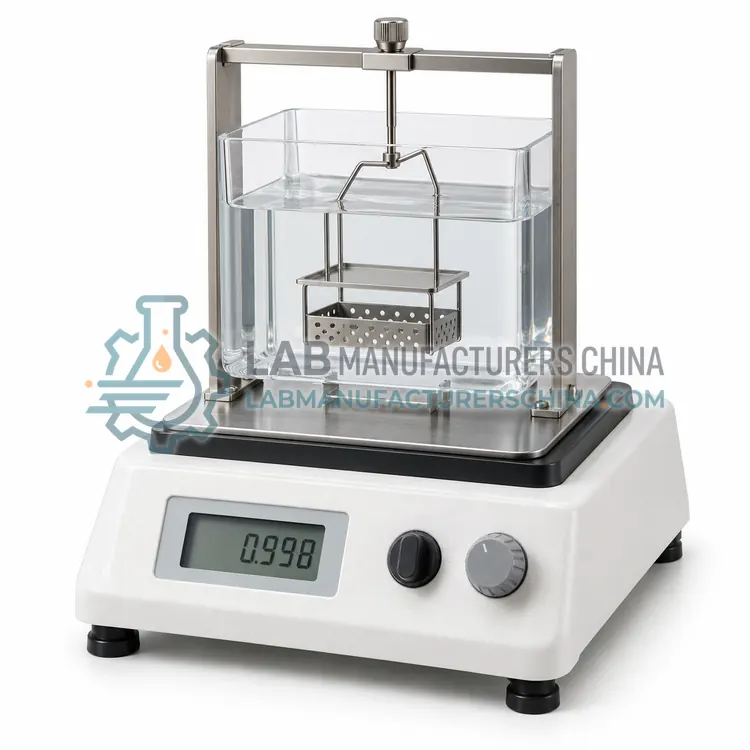
- Electronic Densimeter for Plastics — An electronic densimeter weighs a plastic specimen in air and in a covering liquid, then calculates density automatically from buoyancy.
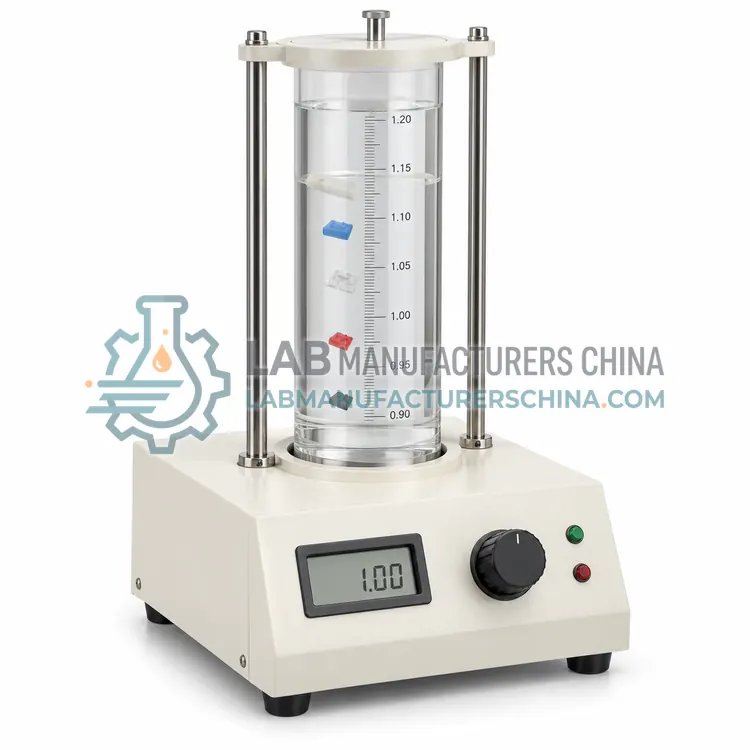
- Density Gradient Column for Plastics — A density gradient column holds liquid whose density increases linearly with depth, so a small plastic specimen settles at the level matching its own density.
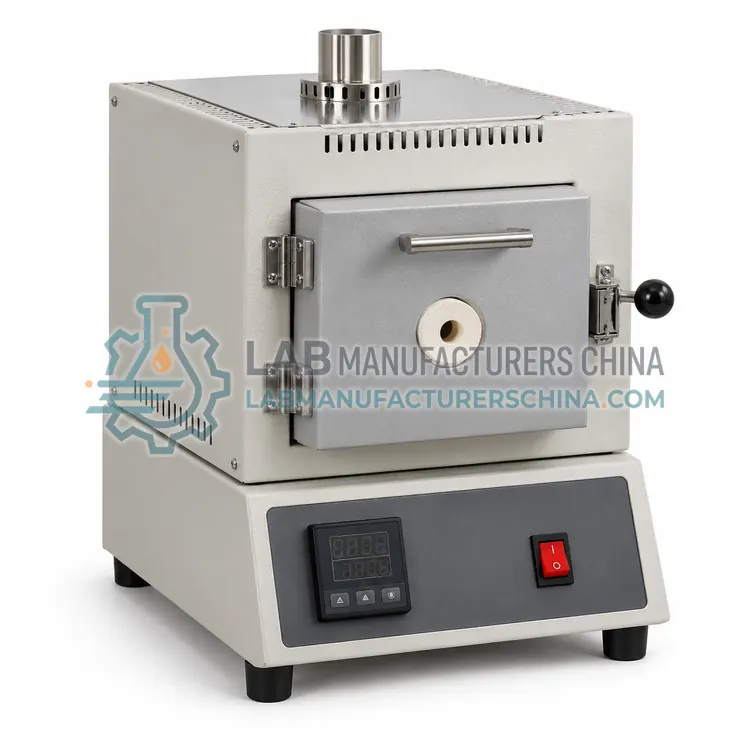
- Gas Pycnometer for Plastic Density Measurement — A gas pycnometer measures the volume of a plastic sample by helium displacement in calibrated chambers, giving true density for powders, porous parts and irregular shapes.
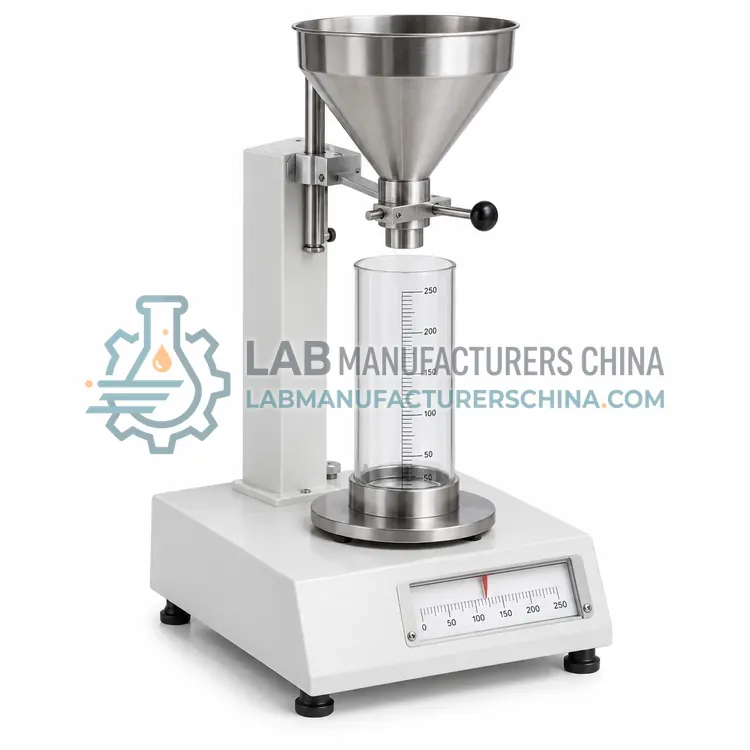
- Bulk Density Tester for Plastic Granules and Powders — A bulk density tester measures the mass of granules, flakes or powder that fills a standard cup poured through a defined funnel.
- Apparent Density Tester for Cellular Plastics — An apparent density tester determines the mass per unit volume of rigid or flexible cellular plastic specimens, including any skin, by weighing and measuring the specimen.
How do I choose the right variant?
Match the method to the material form. Solid, void-free mouldings and pellets are measured by immersion balances or by density gradient columns when only a small specimen is available. Powders, porous parts and materials that must not contact a liquid are measured by gas pycnometry. Granules, flakes and powders that are handled in bulk are characterised by bulk or apparent density, and rigid cellular plastics by their own apparent density method with a defined specimen. For specification testing, follow the method named in the material standard: ISO 1183 parts and ASTM D792 give different procedures and tolerances for solid plastics, and results from different methods should not be mixed in one data set.
Where are Density Testing used?
Density Testing are specified in incoming verification of resin density, filler and mineral content estimation in compounds, crystallinity and formulation consistency checks, density of rigid and flexible cellular plastics, bulk density of granules, powders and regrind and void and porosity assessment of moulded parts.
Which standards and certifications apply?
Work with Density Testing is commonly governed by ISO 1183-1, ISO 1183-2, ISO 1183-3, ASTM D792, ASTM D1895, ASTM D1622, ISO 845 and IEC 61010-1. Instrument certifications such as CE marking are confirmed per configuration and never assumed.
What are the key considerations before purchase?
Temperature control is essential because liquid density and sample volume both change with temperature; record the temperature and apply the liquid's density-temperature table. Remove air bubbles from immersed specimens and from pycnometer chambers, as a single trapped bubble changes the volume materially. Weigh the specimen wet mass promptly to limit evaporation and use a covering liquid that does not swell or dissolve the polymer. Calibrate the balance and verify liquid density with a certified glass float or hydrometer at defined intervals. For bulk density, follow the specified funnel, orifice and cup, since changing any of these changes the result.