Density Gradient Column for Plastics
塑料密度梯度柱
- SKU DET-0002
- Density Testing
- CE (to be confirmed)
- ISO 9001 manufacturing (to be confirmed)
Price on request — FOB / CIF quoted per order
Prices depend on configuration, quantity and destination port.
Key specifications
| Density range | 0.850–1.100 g/cm³ typical |
|---|---|
| Accuracy | About ±0.0002 g/cm³ |
| Temperature control | ±0.05 °C |
| Column height | About 1000 mm |
| Specimen size | From about 5 mg |
| Calibration method | Certified glass floats |
Request a quote Download brochure · to be provided
By Lab Manufacturers China Technical TeamLast reviewed Standards: ISO 1183-1, ISO 1183-2, ISO 1183-3
What is the Density Gradient Column for Plastics?
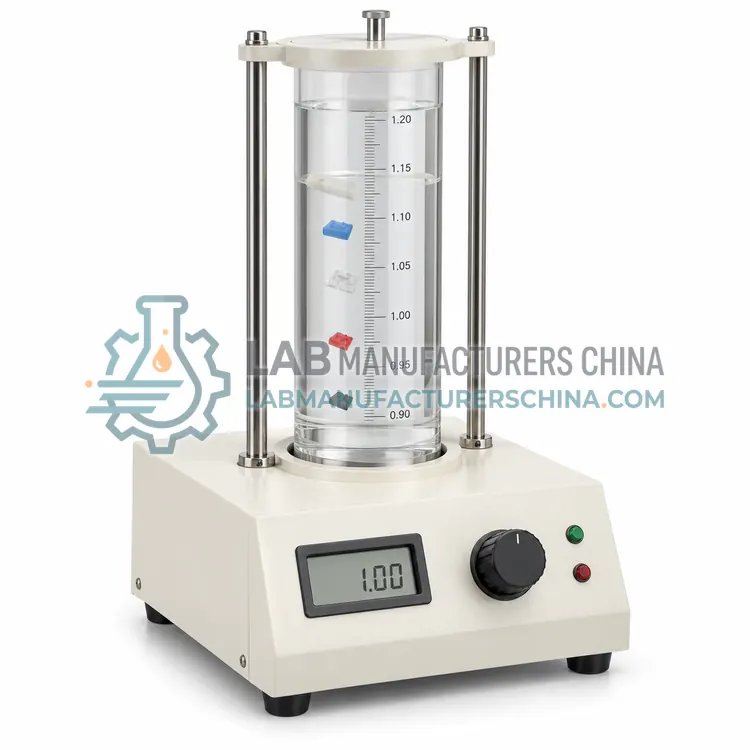
A density gradient column holds liquid whose density increases linearly with depth, so a small plastic specimen settles at the level matching its own density. It measures fragments of a few milligrams to high precision and is used for polymer crystallinity and process studies.
What is the Density Gradient Column for Plastics?
A density gradient column holds liquid whose density increases linearly with depth, so a small plastic specimen settles at the level matching its own density. It measures fragments of a few milligrams to high precision and is used for polymer crystallinity and process studies.
Overview
Two liquids of different densities are combined to form a column in which density varies linearly with height, and the gradient is stabilised by slow diffusion in a jacketed glass tube held at constant temperature. Calibrated glass floats of known density define the scale, and the specimen is inserted, allowed to settle, and its height converted into density by linear interpolation between floats. Accuracy approaching 0.0002 g/cm³ is achievable, which is better than immersion methods, and only a very small specimen is needed, which matters for extruded tape, microtome sections or single fibre fragments. The column must be temperature controlled to a few hundredths of a degree, because the gradient shifts measurably with temperature, and it is normally replaced or recalibrated after a defined period or after heavy use.
How does it work?
The classical method applies Archimedes' principle: the sample is weighed in air and again while immersed in a liquid of known density, and the difference gives the sample volume. This suits void-free solid specimens and returns density to three or four decimal places. A density gradient column contains a liquid column whose density varies linearly with height, so a small specimen sinks to the level matching its own density and is read against calibrated glass floats, which is useful for very small or thin samples. Gas pycnometry measures the volume of a sample by helium displacement in a calibrated chamber, so it handles powders and porous or irregular material. Bulk and apparent density methods instead measure the mass that fills a defined volume, which is the relevant quantity for granules, powders and cellular plastics.
What are the key features?
- Linear density gradient over a defined range
- Calibrated glass floats for the scale
- Accuracy to about 0.0002 g/cm³
- Small specimen requirement of a few milligrams
- Jacketed tube with precise temperature control
- Optional multiple columns for batch work
What are the technical specifications?
A typical density gradient column for plastics configuration offers density range of 0.850–1.100 g/cm³ typical, accuracy of About ±0.0002 g/cm³, temperature control of ±0.05 °C, column height of About 1000 mm, specimen size of From about 5 mg and calibration method of Certified glass floats. Values are indicative of the product class; the exact figures for each configuration are confirmed on the quotation and the calibration documents supplied with the instrument.
Which applications is it used for?
The Density Gradient Column for Plastics is used in crystallinity assessment of polyolefin samples, density of extruded tape and fibre fragments, process study of quench and annealing effects and verification of density in small test specimens. Across the wider Density Testing class, laboratories also deploy it for incoming verification of resin density, filler and mineral content estimation in compounds and crystallinity and formulation consistency checks.
Which standards and certifications apply?
Relevant standards and methods include ISO 1183-1, ISO 1183-2, ISO 1183-3, ASTM D792, ASTM D1895, ASTM D1622, ISO 845 and IEC 61010-1. Certification candidates for this model are CE and ISO 9001 manufacturing; each is to be confirmed for the specific configuration before shipment, and certificates are supplied only where they have been issued.
Temperature control is essential because liquid density and sample volume both change with temperature; record the temperature and apply the liquid's density-temperature table. Remove air bubbles from immersed specimens and from pycnometer chambers, as a single trapped bubble changes the volume materially. Weigh the specimen wet mass promptly to limit evaporation and use a covering liquid that does not swell or dissolve the polymer. Calibrate the balance and verify liquid density with a certified glass float or hydrometer at defined intervals. For bulk density, follow the specified funnel, orifice and cup, since changing any of these changes the result.
How do I select the right Density Gradient Column for Plastics?
Choose a gradient column when only a very small specimen is available, or when the required precision is beyond what immersion weighing can deliver, for example in crystallinity or annealing studies. Confirm the density range covers your materials, and that the floats and prepared liquid pair supplied match that range. Consider a two-column unit if routine throughput matters.
How does it compare with other Density Testing variants?
Match the method to the material form. Solid, void-free mouldings and pellets are measured by immersion balances or by density gradient columns when only a small specimen is available. Powders, porous parts and materials that must not contact a liquid are measured by gas pycnometry. Granules, flakes and powders that are handled in bulk are characterised by bulk or apparent density, and rigid cellular plastics by their own apparent density method with a defined specimen. For specification testing, follow the method named in the material standard: ISO 1183 parts and ASTM D792 give different procedures and tolerances for solid plastics, and results from different methods should not be mixed in one data set.
Full specifications
| Density range | 0.850–1.100 g/cm³ typical |
|---|---|
| Accuracy | About ±0.0002 g/cm³ |
| Temperature control | ±0.05 °C |
| Column height | About 1000 mm |
| Specimen size | From about 5 mg |
| Calibration method | Certified glass floats |
| Column medium | Aqueous salt or organic liquid pair |
| Settling time | 10–30 min depending on specimen |
| Power supply | 220 V, 50/60 Hz |
Indicative values for this product class. Final specifications are confirmed on the quotation and in the calibration documents supplied with the instrument.
Applications
- Crystallinity assessment of polyolefin samples
- Density of extruded tape and fibre fragments
- Process study of quench and annealing effects
- Verification of density in small test specimens
Key features
- Linear density gradient over a defined range
- Calibrated glass floats for the scale
- Accuracy to about 0.0002 g/cm³
- Small specimen requirement of a few milligrams
- Jacketed tube with precise temperature control
- Optional multiple columns for batch work
Frequently asked questions about Density Gradient Column for Plastics
Settling usually takes 10 to 30 minutes depending on specimen size, shape and the difference between its density and the surrounding liquid. The reading is taken only after the position is stable, and specimens that remain tilted or that clearly did not wet properly should be re-inserted or discarded.
The density of the liquid column changes with temperature, and the gradient itself shifts with any temperature change, so a variation of a few tenths of a degree displaces the specimen and changes the reading by more than the method's own accuracy. Water jackets with circulation from a thermostatic bath are used to hold the column within a few hundredths of a degree.
Recalibration with certified floats is normally performed on a fixed interval, such as monthly or quarterly, and whenever floats are added, the liquid is topped up or the column is disturbed. If floats no longer fall on a straight line through the data, the column has aged and should be replaced rather than adjusted.
A density gradient column can measure fragments of a few milligrams, because the specimen simply settles at the level matching its density. The immersion method also works if the fragment is large enough to weigh accurately in air and in liquid without significant surface tension error, but very small specimens make both weighings uncertain.
Polymer matrices have densities around 0.90 to 1.20 g/cm³, while mineral fillers are typically 2.6 to 2.8 g/cm³ and glass fibre about 2.5 g/cm³. The measured compound density therefore rises with filler fraction, so a density check detects a loading error quickly, although exact quantification requires ashing or thermogravimetry.
Bulk density is the mass of granules or powder that fills a defined volume, so it includes the voids between particles and depends on particle shape, size distribution and how the container was filled. True density measures only the material itself and is always higher. Both values are reported for powders and granules.