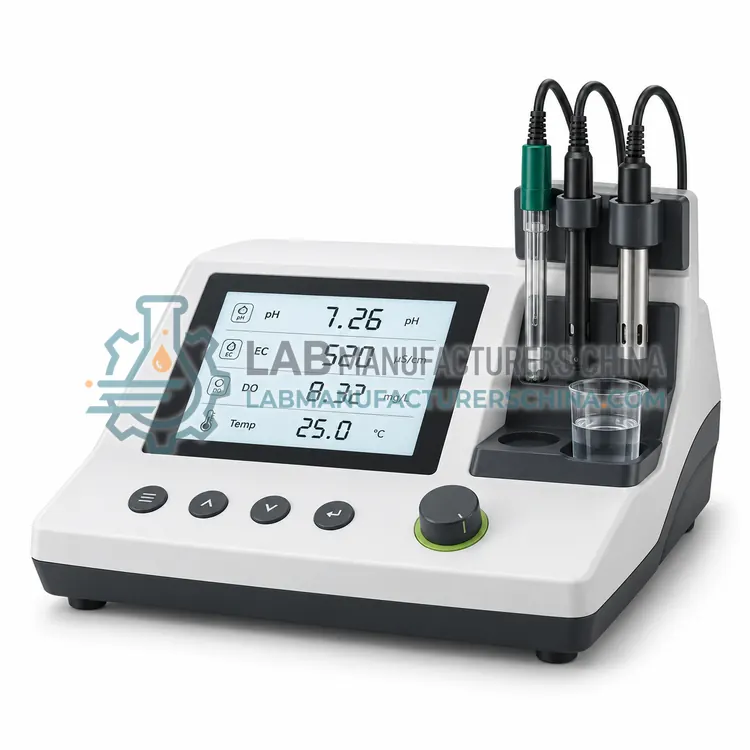
Portable Multi-Parameter Water Quality Meter
便携式多参数水质检测仪
- SKU WQA-0002
- Water Quality Analyzers
- CE (to be confirmed)
- RoHS (to be confirmed)
Price on request — FOB / CIF quoted per order
Prices depend on configuration, quantity and destination port.
Key specifications
| pH range / accuracy | 0–14 / ± 0.01 |
|---|---|
| Conductivity range | 0–200 mS/cm |
| Conductivity accuracy | ± 1% of reading |
| Dissolved oxygen range | 0–50 mg/L |
| Dissolved oxygen accuracy | ± 0.1 mg/L or ± 1% of reading |
| Temperature accuracy | ± 0.2 °C |
Request a quote Download brochure · to be provided
By Lab Manufacturers China Technical TeamLast reviewed Standards: ISO 10523, ISO 7888, ISO 5814
What is the Portable Multi-Parameter Water Quality Meter?
A rugged handheld instrument that measures pH, conductivity, dissolved oxygen, temperature and often turbidity or ORP in the field. It is the practical option for inspectors, aquaculture technicians and sampling crews needing readings on site within a minute.
What is the Portable Multi-Parameter Water Quality Meter?
A rugged handheld instrument that measures pH, conductivity, dissolved oxygen, temperature and often turbidity or ORP in the field. It is the practical option for inspectors, aquaculture technicians and sampling crews needing readings on site within a minute.
Overview
This variant is a handheld digital meter rated IP67 that floats and withstands drops, with a backlit display and one or two multi-sensor ports. A single cable carries a combination probe for pH, conductivity, dissolved oxygen and temperature, available in 4 to 20 m lengths for profiling wells, lakes and tanks. Optical dissolved oxygen options remove the warm-up and stirring requirement of membrane probes. Typical accuracy is ± 0.01 pH, ± 1% of reading for conductivity and ± 0.1 mg/L for dissolved oxygen, sufficient for screening and operational control. The meter stores 500 to 5000 data points with GPS, transfers them by USB or Bluetooth and runs 100 hours on AA or rechargeable batteries. Calibration is guided and can be performed in the field using a small kit of buffers and standards. Precision is lower than benchtop instruments, and sensors should be rinsed and stored properly between trips.
How does it work?
Water quality analyzers combine several sensor technologies in one instrument. pH is measured with a glass membrane electrode whose potential follows the Nernst equation. Conductivity uses a cell with two or four electrodes and temperature compensation to a 25 °C reference. Dissolved oxygen is sensed either by a polarographic or galvanic membrane sensor or, increasingly, by optical luminescence quenching of a dye. Turbidity is measured by nephelometry, detecting light scattered at 90° from an infrared or white source. Residual chlorine is determined amperometrically or by DPD colorimetry. A microprocessor applies calibration and temperature compensation, logs the readings and outputs them to a display, memory or digital network. Submersible and online designs add cleaning systems and housings for continuous deployment.
What are the key features?
- IP67 floating housing that withstands drops for field use
- Single-cable combination probe for pH, conductivity, dissolved oxygen and temperature
- Optical dissolved oxygen option with no warm-up or stirring requirement
- Cable lengths of 4 to 20 m for wells, lakes and tanks
- Stores 500 to 5000 records with GPS and transfers via USB or Bluetooth
- About 100 hours battery life with guided field calibration
What are the technical specifications?
A typical portable multi-parameter water quality meter configuration offers pH range / accuracy of 0–14 / ± 0.01, conductivity range of 0–200 mS/cm, conductivity accuracy of ± 1% of reading, dissolved oxygen range of 0–50 mg/L, dissolved oxygen accuracy of ± 0.1 mg/L or ± 1% of reading and temperature accuracy of ± 0.2 °C. Values are indicative of the product class; the exact figures for each configuration are confirmed on the quotation and the calibration documents supplied with the instrument.
Which applications is it used for?
The Portable Multi-Parameter Water Quality Meter is used in environmental field surveys of rivers and lakes, aquaculture pond management, groundwater well profiling and compliance inspection and spot sampling. Across the wider Water Quality Analyzers class, laboratories also deploy it for drinking water treatment and distribution monitoring, river, lake and groundwater surveys and aquaculture dissolved oxygen and pH control.
Which standards and certifications apply?
Relevant standards and methods include ISO 10523, ISO 7888, ISO 5814, ISO 7027-1, ASTM D1293, ASTM D1125, ASTM D888, HJ 1147 and IEC 61010-1. Certification candidates for this model are CE and RoHS; each is to be confirmed for the specific configuration before shipment, and certificates are supplied only where they have been issued.
Calibrate pH with at least two buffers bracketing the sample range, conductivity with a standard near the expected value, and dissolved oxygen in water-saturated air or zero solution. Turbidity needs formazin or stabilized polymer standards. Rinse probes with deionized water between samples, store electrodes in the recommended solution and replace membranes, caps and reference fill on schedule. Biofouling on submersible sondes can ruin readings within days, so use wipers or copper guards and inspect regularly. Record calibration logs and sensor replacement dates for quality audits, and follow the method when results support regulatory reporting. Protect instruments from condensation, freezing and strong electromagnetic interference.
How do I select the right Portable Multi-Parameter Water Quality Meter?
Select the portable meter for spot measurements and surveys at multiple locations where results are needed on site. Use a sonde if continuous unattended logging is required, or a benchtop meter for laboratory accuracy. In an RFQ, specify parameters, probe cable length, optical or membrane dissolved oxygen, GPS and Bluetooth needs, and operating temperature.
How does it compare with other Water Quality Analyzers variants?
Begin by listing the parameters you must report and their ranges, since sensor selection sets cost and maintenance. Decide where the instrument will work: a benchtop meter for laboratory use, a handheld for spot checks, a submersible sonde for long-term deployment in rivers and lakes, or an online analyzer for treatment plants. Consider accuracy needs, for instance ± 0.01 pH for lab work versus ± 0.1 pH for field screening. Optical dissolved oxygen sensors need less maintenance than membrane types. Check the ingress protection rating, cable length, battery life and data logging capacity for field instruments. For online systems, evaluate automated cleaning and calibration options, and communication protocols. Finally compare sensor replacement costs and calibration solution requirements over the instrument's life.
Full specifications
| pH range / accuracy | 0–14 / ± 0.01 |
|---|---|
| Conductivity range | 0–200 mS/cm |
| Conductivity accuracy | ± 1% of reading |
| Dissolved oxygen range | 0–50 mg/L |
| Dissolved oxygen accuracy | ± 0.1 mg/L or ± 1% of reading |
| Temperature accuracy | ± 0.2 °C |
| Cable length | 4–20 m |
| Ingress protection | IP67 |
| Data storage | 500–5000 records with GPS |
| Battery life | ≈ 100 h |
Indicative values for this product class. Final specifications are confirmed on the quotation and in the calibration documents supplied with the instrument.
Applications
- Environmental field surveys of rivers and lakes
- Aquaculture pond management
- Groundwater well profiling
- Compliance inspection and spot sampling
Key features
- IP67 floating housing that withstands drops for field use
- Single-cable combination probe for pH, conductivity, dissolved oxygen and temperature
- Optical dissolved oxygen option with no warm-up or stirring requirement
- Cable lengths of 4 to 20 m for wells, lakes and tanks
- Stores 500 to 5000 records with GPS and transfers via USB or Bluetooth
- About 100 hours battery life with guided field calibration
Frequently asked questions about Portable Multi-Parameter Water Quality Meter
Optical sensors have no consumed oxygen, need no stirring, warm up quickly and drift less, but the sensing cap needs periodic replacement. Membrane sensors cost less upfront but require electrolyte and membrane changes and stable flow at the tip.
Battery life is about 100 hours of operation, which is several weeks of typical field use. Bring spare batteries and calibration solutions, protect the display from freezing and recalibrate pH and dissolved oxygen each day of use.
Yes. Salinity and TDS are calculated from conductivity and temperature using practical salinity scale or a TDS conversion factor, typically 0.5–0.7. For precise TDS, determine the factor for your water type by comparing with gravimetric measurement.
Typical parameters are pH, conductivity, total dissolved solids, salinity, dissolved oxygen, turbidity, temperature and oxidation-reduction potential. Optional sensors add ammonium, nitrate, chlorophyll, blue-green algae, residual chlorine and depth, depending on the model.
A portable meter is held or dipped for spot measurements and displays readings immediately. A sonde is a submersible multi-sensor probe that logs data autonomously for days or weeks, resists biofouling and is used for continuous monitoring in rivers, lakes and tanks.
Dissolved oxygen indicates the capacity of water to support aquatic life and aerobic treatment. Levels below about 4 mg/L stress most fish, and aeration control in wastewater plants depends on it. It varies with temperature, salinity and pressure, so readings need compensation.
Related models
Online Multi-Parameter Water Quality Analyzer for Treatment Plants
水处理厂在线多参数水质分析仪
- CE (to be confirmed)
- +2