UV Air Sterilizer
紫外线空气消毒机
- SKU UVS-0002
- UV Sterilizers
- CE (to be confirmed)
- ISO 9001 manufacturing (to be confirmed)
- IEC 62471 photobiological safety report (to be confirmed)
Price on request — FOB / CIF quoted per order
Prices depend on configuration, quantity and destination port.
Key specifications
| Airflow rate | 100-1,200 m³/h |
|---|---|
| Lamp type | Shielded 253.7 nm germicidal lamps |
| Lamp power | 30-200 W total |
| Room size covered | 20-150 m² |
| Air changes delivered | 3-12 ACH |
| Pre-filter | Washable coarse dust filter |
Request a quote Download brochure · to be provided
By Lab Manufacturers China Technical TeamLast reviewed Standards: IEC 62471, IEC 61010-1, GB 19258
What is the UV Air Sterilizer?
A unit that draws room air through a chamber with shielded UV-C lamps and returns it disinfected, so the room can stay occupied during operation. It is used in laboratories, animal rooms and preparation areas.
What is the UV Air Sterilizer?
A unit that draws room air through a chamber with shielded UV-C lamps and returns it disinfected, so the room can stay occupied during operation. It is used in laboratories, animal rooms and preparation areas.
Overview
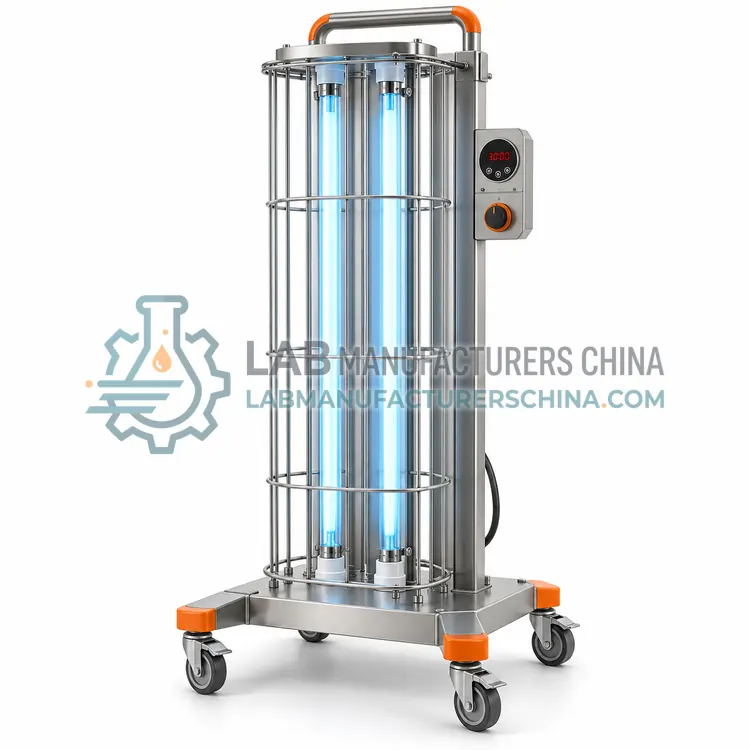
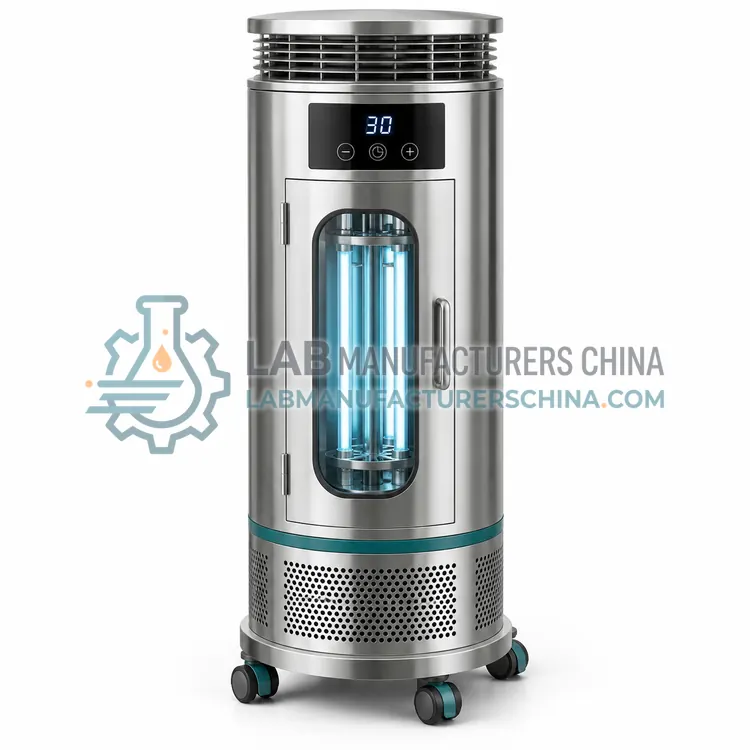
The UV air sterilizer forces room air across UV-C lamps inside a light-tight duct or chamber. Residence time, airflow and lamp power set the delivered dose, and baffles or multiple lamp banks increase the exposure path so that a single pass inactivates a useful fraction of airborne microorganisms. Because the beam is enclosed, occupants are not exposed and the unit can run continuously, unlike open lamps. Models range from wall-mounted units of 100 to 400 m³/h to ceiling cassettes and mobile cabinets of up to 1,200 m³/h. Air passes through a pre-filter that captures dust, which would otherwise shield microorganisms and coat the lamps. A fan and timer control airflow, and some units add a HEPA filter and a particle or lamp-hours counter. Effectiveness depends on air mixing in the room, so unit placement matters.
How does it work?
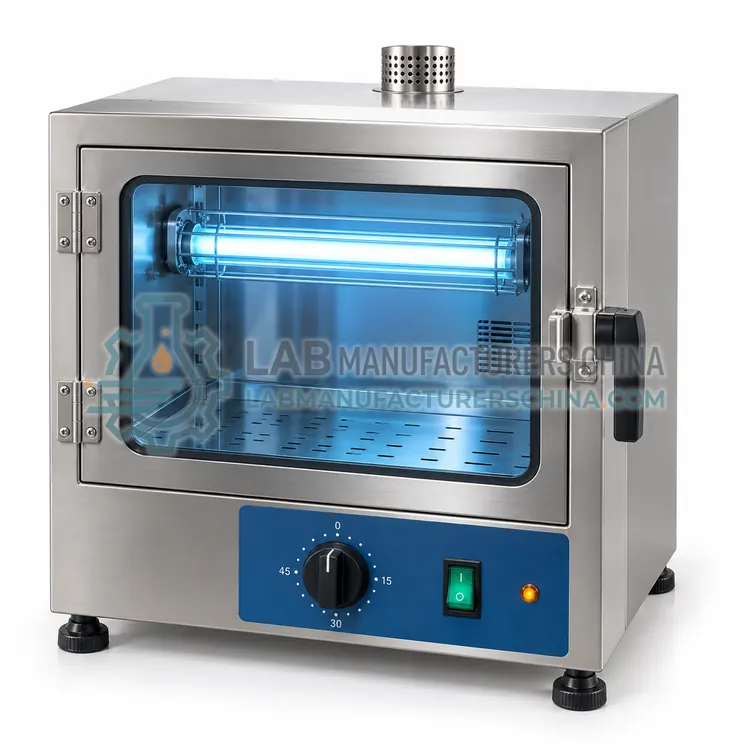
Ultraviolet sterilization uses UV-C light, emitted mainly at 253.7 nm by low-pressure mercury lamps, which nucleic acids absorb so that pyrimidine dimers form and block replication. Efficacy depends on dose, the product of irradiance in µW/cm² and exposure time in seconds, expressed in mJ/cm². Germicidal cabinets place items on a reflective stainless steel tray below one or more lamps and run a timed cycle of 5 to 60 minutes. Air sterilizers draw room air through a chamber with lamps and baffles so the moving air receives the required dose while people remain outside the direct beam. Water units pass the flow around quartz-sleeved lamps. Because UV light travels in straight lines, only surfaces in direct view are treated, so shadowed, covered or dusty areas are not disinfected.
What are the key features?
- Enclosed lamps allow continuous operation with people present.
- Airflow of 100 to 1,200 m³/h depending on model.
- Pre-filter protects lamps from dust and lint.
- Baffles or multiple lamp banks extend the exposure path.
- Wall-mounted, ceiling and mobile configurations.
- Optional HEPA filter and lamp-hour counter.
What are the technical specifications?
A typical uv air sterilizer configuration offers airflow rate of 100-1,200 m³/h, lamp type of Shielded 253.7 nm germicidal lamps, lamp power of 30-200 W total, room size covered of 20-150 m², air changes delivered of 3-12 ACH and pre-filter of Washable coarse dust filter. Values are indicative of the product class; the exact figures for each configuration are confirmed on the quotation and the calibration documents supplied with the instrument.
Which applications is it used for?
The UV Air Sterilizer is used in continuous air disinfection in occupied laboratories, animal room air treatment, media and sample preparation areas and cell culture room air quality support. Across the wider UV Sterilizers class, laboratories also deploy it for disinfection of work surfaces and small instruments, air disinfection in laboratories and animal rooms and feed water and rinse water disinfection.
Which standards and certifications apply?
Relevant standards and methods include IEC 62471, IEC 61010-1, GB 19258, ISO 15858, ASTM E3135 and ISO 9001 manufacturing. Certification candidates for this model are CE, ISO 9001 manufacturing and IEC 62471 photobiological safety report; each is to be confirmed for the specific configuration before shipment, and certificates are supplied only where they have been issued.
UV is a surface method, so clean items before irradiation and do not expect penetration into lumens, joints or packaging. Protect eyes and skin: run lamps only in closed cabinets or with interlocked rooms, and post warning signs. Fluence should be checked with a calibrated radiometer at installation and then at fixed intervals, since lamp output falls long before the lamp fails to light. Clean quartz sleeves and lamp tubes with alcohol to remove dust films that reduce output. Replace lamps at the rated hours or when measured output falls below about 70 percent. Consider 185 nm ozone-generating lamps only in ventilated, unoccupied spaces, and never use UV as a replacement for validated heat sterilization.
How do I select the right UV Air Sterilizer?
Size the unit by room volume and the air changes per hour you need, then check that the stated airflow is measured at the filter rather than free air. For occupied rooms, confirm the lamps are shielded and that noise stays acceptable for the workspace. Ask for single-pass inactivation data and recommended installation height, and consider a unit with a lamp-hour counter to simplify maintenance planning.
How does it compare with other UV Sterilizers variants?
Start with the target: surfaces, air or water, because each needs a different enclosure and dose. For cabinets, compare internal volume with the items to be treated and check that lamps reach every corner, since shadows limit efficacy. For air sterilizers, look at airflow in m³/h and the rated lamp power, as these together set the residence time and dose. For water units, check flow rate, lamp count and sleeve material. Confirm lamp type (253.7 nm germicidal or 254 nm amalgam), rated life in hours, quartz versus borosilicate sleeves, door interlocks and timer range. Where sporicidal or validated disinfection is required, ask for dose verification data rather than relying on nominal lamp power.
Full specifications
| Airflow rate | 100-1,200 m³/h |
|---|---|
| Lamp type | Shielded 253.7 nm germicidal lamps |
| Lamp power | 30-200 W total |
| Room size covered | 20-150 m² |
| Air changes delivered | 3-12 ACH |
| Pre-filter | Washable coarse dust filter |
| Noise level | ≤55 dB(A) at 1 m |
| Rated lamp life | 6,000-9,000 h |
| Installation | Wall mount, ceiling or mobile cabinet |
| Power supply | 220 V, 50 Hz, 60-250 W |
Indicative values for this product class. Final specifications are confirmed on the quotation and in the calibration documents supplied with the instrument.
Applications
- Continuous air disinfection in occupied laboratories
- Animal room air treatment
- Media and sample preparation areas
- Cell culture room air quality support
Key features
- Enclosed lamps allow continuous operation with people present.
- Airflow of 100 to 1,200 m³/h depending on model.
- Pre-filter protects lamps from dust and lint.
- Baffles or multiple lamp banks extend the exposure path.
- Wall-mounted, ceiling and mobile configurations.
- Optional HEPA filter and lamp-hour counter.
Frequently asked questions about UV Air Sterilizer
Yes, if the lamps are fully enclosed and no UV escapes. This is the main advantage over open germicidal lamps. Verify shielding at installation and measure stray UV where staff work.
Multiply room volume by the desired air changes per hour to get the required flow. A 60 m³ room needing six air changes per hour needs about 360 m³/h, plus margin for filter loading and duct losses.
Not by itself. UV inactivates microorganisms but leaves particles airborne, so add a HEPA filter if particle reduction is required. The pre-filter only protects the lamps from dust and lint.
Exposure time depends on the required dose and the lamp irradiance at the surface. Typical cabinet cycles run 15 to 30 minutes, surface lamps 30 to 60 minutes, and air sterilizers work continuously. Measure irradiance at the target surface rather than assuming a fixed time.
Ordinary window glass blocks most UV-C, and most plastics absorb it as well. Items must be directly exposed, so wrapped, covered or bagged goods and closed containers are not disinfected by UV.
Only with controls. Direct UV-C exposure harms eyes and skin, so lamps belong in interlocked cabinets or closed rooms, warning signs are required, and personal protective equipment should include UV-blocking eyewear. Measure stray radiation where staff work.
Related models