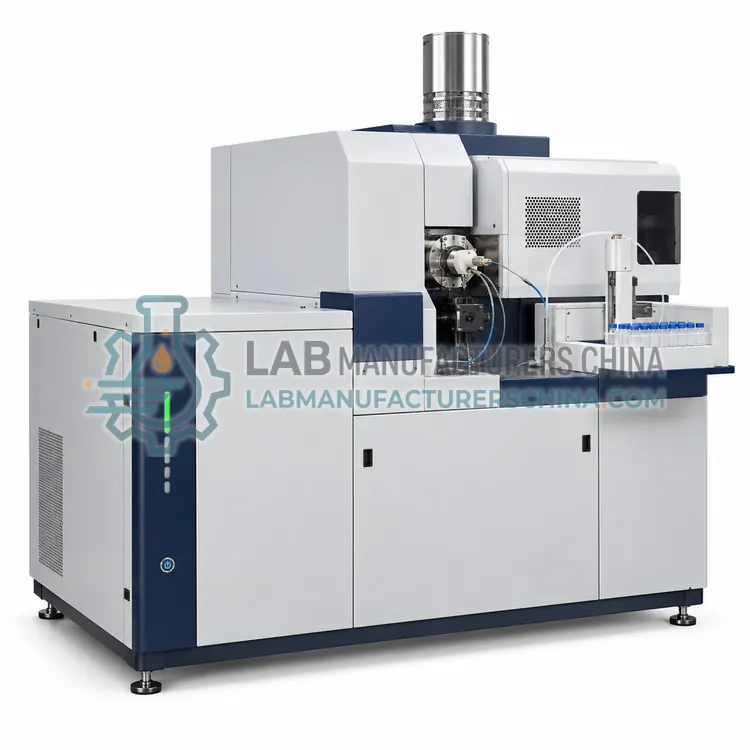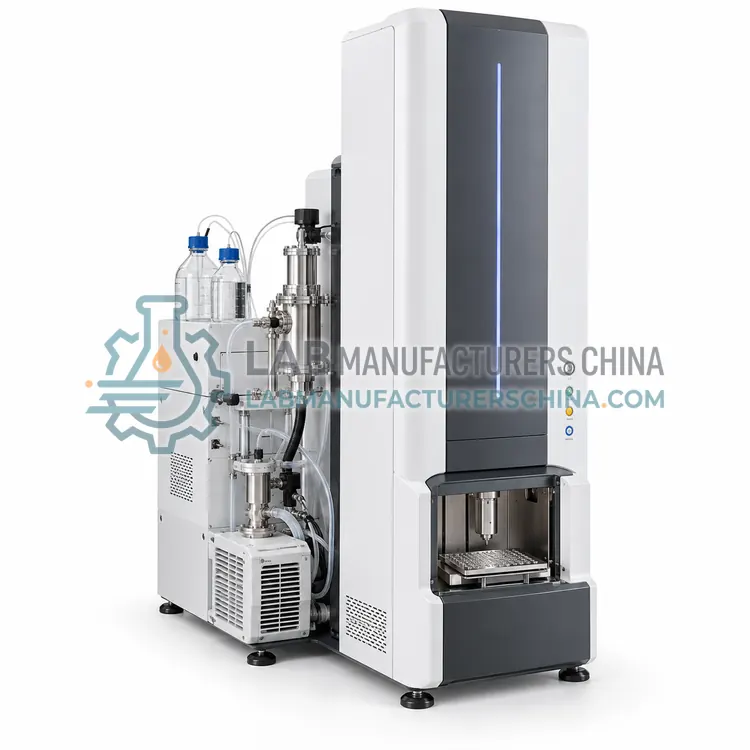
Linear MALDI-TOF Mass Spectrometer for Microbial Identification
用于微生物鉴定的线性 MALDI-TOF 质谱仪
- CE (to be confirmed)
- +3
Welcome to Lab Manufacturers China — laboratory instruments direct from a Chinese manufacturer
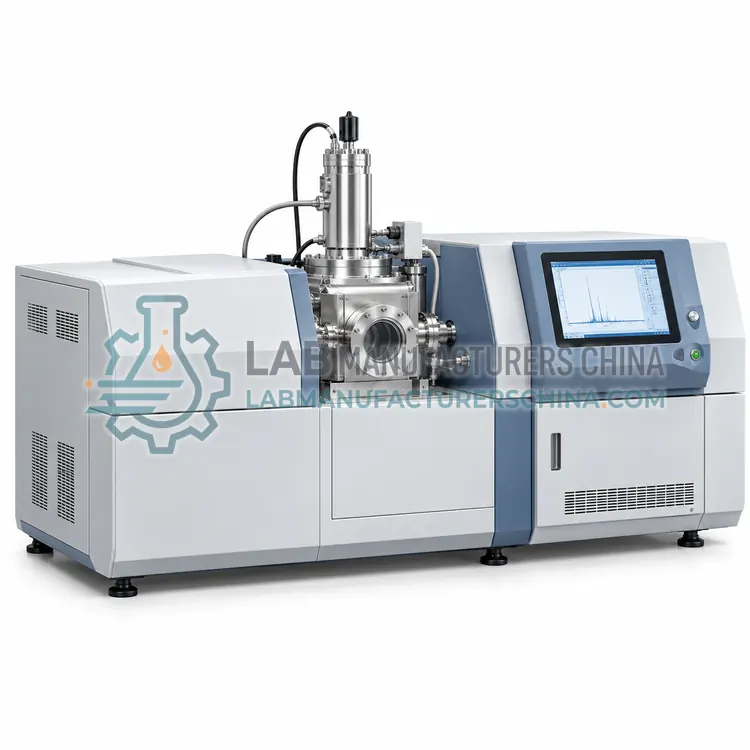
反射式 MALDI-TOF 质谱仪
Price on request — FOB / CIF quoted per order
Prices depend on configuration, quantity and destination port.
| Mass range (reflectron) | m/z 500–30000 |
|---|---|
| Mass range (linear) | up to m/z 500000 |
| Resolution (reflectron, m/z 2500) | ≥ 15000 FWHM |
| Mass accuracy (internal calibration) | ≤ 5 ppm |
| Mass accuracy (external calibration) | ≤ 20 ppm |
| Laser repetition rate | up to 2 kHz |
By Lab Manufacturers China Technical TeamLast reviewed Standards: ASTM D7134, ISO 11260, ISO/TS 16940
A reflectron MALDI-TOF adds an ion mirror to the flight path, reaching resolution of 15000 to 25000 and mass accuracy of a few ppm for peptides, oligonucleotides and polymers. It is used for peptide mass fingerprinting, synthetic polymer end-group analysis and quality control of biomolecules.
A reflectron MALDI-TOF adds an ion mirror to the flight path, reaching resolution of 15000 to 25000 and mass accuracy of a few ppm for peptides, oligonucleotides and polymers. It is used for peptide mass fingerprinting, synthetic polymer end-group analysis and quality control of biomolecules.
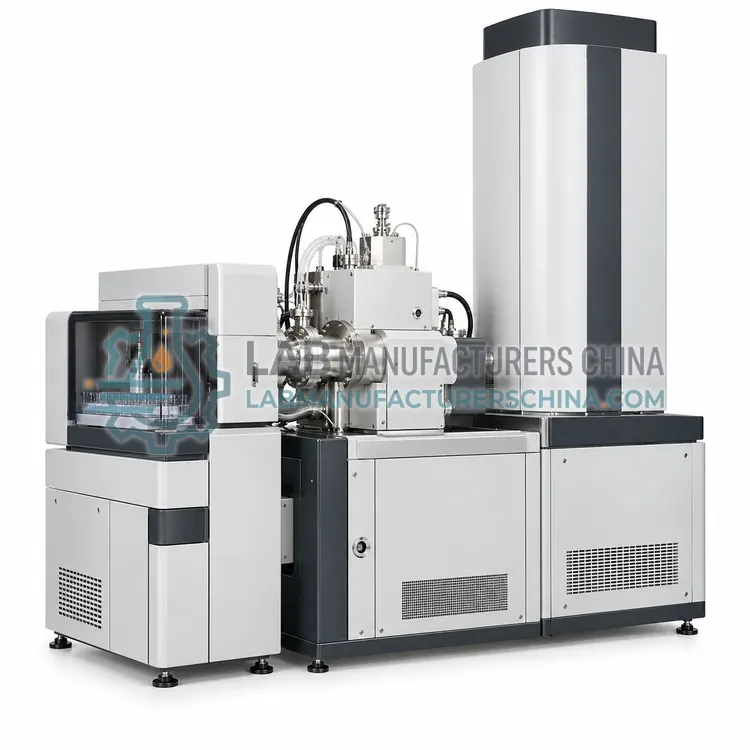
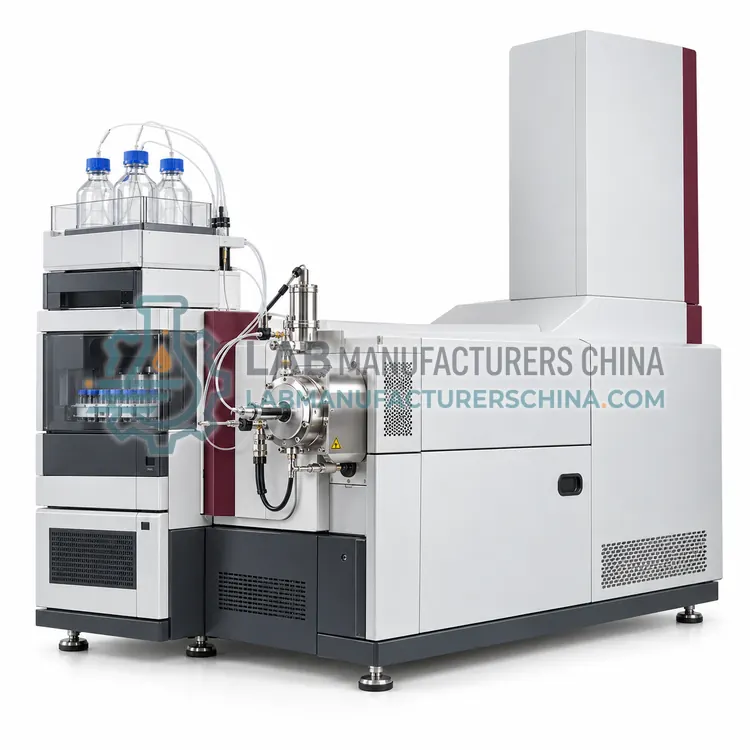
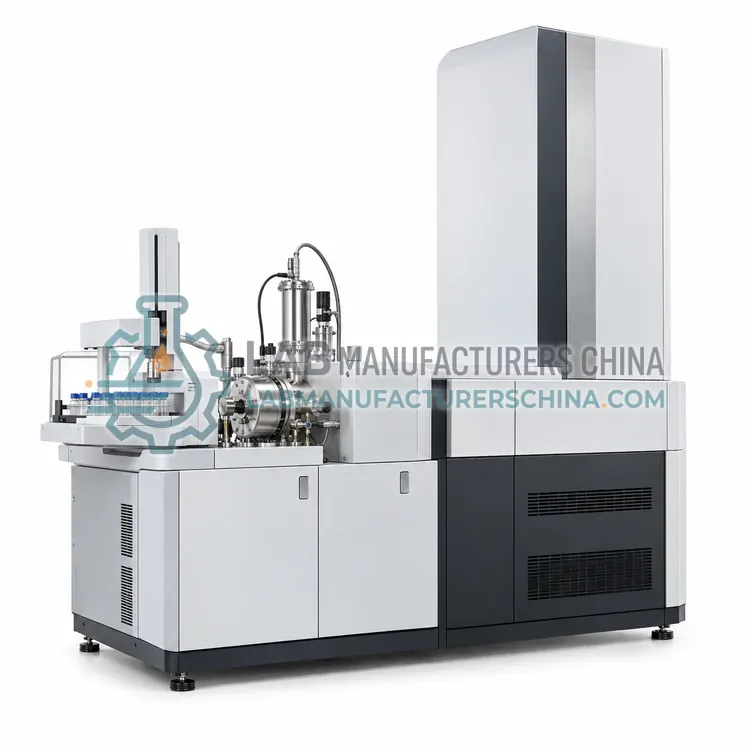
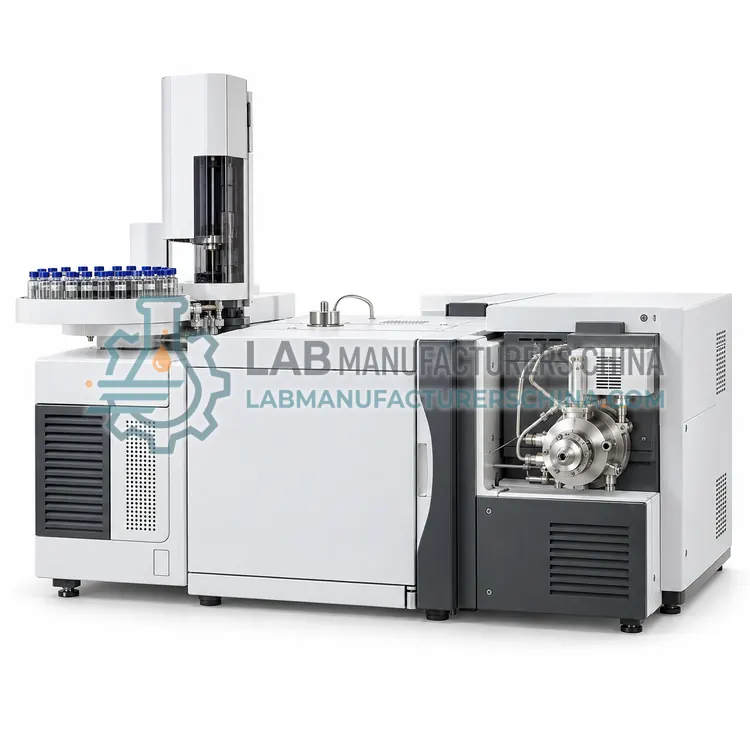
A reflectron MALDI-TOF uses a pulsed laser to desorb and ionize analytes from a crystalline matrix, and a reflectron to refocus ions. Delayed extraction of a few hundred nanoseconds corrects for initial velocity spread, and the combined effect lifts resolution to 15000 to 25000 FWHM at m/z 2500, resolving isotopic peaks of peptides and small proteins. Mass accuracy is 5 to 20 ppm with external calibration and below 5 ppm with internal calibration. The instrument runs in linear mode for large molecules above about m/z 30000 and in reflectron mode for lower masses, switching automatically. Laser repetition rates of 1 to 2 kHz allow fast acquisition and imaging at 50 to 100 µm spatial resolution. Fragmentation is limited to post-source decay, so peptide sequencing is weaker than on TOF/TOF instruments. The configuration is well suited to peptide mass fingerprinting, polymer molecular weight distributions and oligonucleotide quality checks.
In a time-of-flight mass spectrometer, ions are given the same kinetic energy by an accelerating potential of several hundred volts to 20 kV and then drift through a field-free tube. Flight time scales with the square root of m/z, so the detector, a microchannel plate or fast electron multiplier, records ions in order of mass. Resolution depends on flight path length and on correcting initial energy spread. A reflectron, an ion mirror, extends the path and refocuses ions of equal mass but different energies, raising resolution from about 1000 to 20000 or more. MALDI sources pulse ions naturally, while orthogonal acceleration converts continuous ESI or ICP beams into pulses. Time-to-digital converters or fast digitizers at gigahertz rates record the signals.
A typical reflectron maldi-tof mass spectrometer configuration offers mass range (reflectron) of m/z 500–30000, mass range (linear) of up to m/z 500000, resolution (reflectron, m/z 2500) of ≥ 15000 FWHM, mass accuracy (internal calibration) of ≤ 5 ppm, mass accuracy (external calibration) of ≤ 20 ppm and laser repetition rate of up to 2 kHz. Values are indicative of the product class; the exact figures for each configuration are confirmed on the quotation and the calibration documents supplied with the instrument.
The Reflectron MALDI-TOF Mass Spectrometer is used in peptide mass fingerprinting for protein identification, synthetic polymer molecular weight distribution, oligonucleotide quality control, tissue imaging mass spectrometry and intact mass of small proteins and antibody fragments. Across the wider TOF-MS class, laboratories also deploy it for microbial identification in clinical microbiology, intact protein and peptide mass analysis and synthetic polymer molecular weight distribution.
Relevant standards and methods include ASTM D7134, ISO 11260, ISO/TS 16940, USP <1052> Biotechnology-Derived Articles, ASTM E2933, ISO 15189, ISO/IEC 17025 and IEC 61010-1. Certification candidates for this model are CE, ISO 9001 manufacturing and IEC 61010-1 safety; each is to be confirmed for the specific configuration before shipment, and certificates are supplied only where they have been issued.
TOF instruments are sensitive to temperature changes, because drift-tube expansion shifts flight time, so install them in a room stable within ±1 to 2 °C and away from drafts. Calibrate frequently with standards or internal lock mass to sustain mass accuracy below 5 ppm. MALDI systems require matrix preparation, such as alpha-cyano-4-hydroxycinnamic acid or sinapinic acid, and careful target plate cleaning. Detector microchannel plates degrade over time, so monitor gain and plan replacement, usually after several years. Keep the vacuum system leak tight, with analyzer pressure below 10^-6 mbar. Regulated laboratories, particularly those using MALDI for clinical microbiology, should confirm validated databases and software supporting audit trail and access control.
Select a reflectron MALDI-TOF when accurate mass of peptides, polymers or oligonucleotides is needed but sequencing by MS/MS is not. Choose MALDI-TOF/TOF for sequencing. In an RFQ, specify resolution at a named m/z, mass accuracy mode, laser rate, imaging option and polymer software.
Select by ionization source and required resolving power. MALDI-TOF suits intact proteins, polymers and microbial identification, where linear mode reaches m/z above 100000 and reflectron mode improves accuracy for peptides. Orthogonal-acceleration ESI-TOF gives accurate mass for LC-MS at rates compatible with UHPLC. Multi-reflecting designs reach resolving power of 50000 to 100000 in a compact footprint for demanding screening. Consider mass accuracy, typically 1 to 5 ppm with calibration, resolution at your m/z range, acquisition rate, and dynamic range, which is narrower than quadrupoles. Decide whether tandem MS is needed, since TOF/TOF adds fragmentation for sequencing. Check software for microbial databases or polymer analysis, calibration strategy, and service support.
| Mass range (reflectron) | m/z 500–30000 |
|---|---|
| Mass range (linear) | up to m/z 500000 |
| Resolution (reflectron, m/z 2500) | ≥ 15000 FWHM |
| Mass accuracy (internal calibration) | ≤ 5 ppm |
| Mass accuracy (external calibration) | ≤ 20 ppm |
| Laser repetition rate | up to 2 kHz |
| Sensitivity (angiotensin II) | ≤ 1 fmol on target |
| Acceleration voltage | up to 25 kV |
| Flight path (reflectron) | ~2 m |
| Target capacity | 384 spots (standard plate) |
Indicative values for this product class. Final specifications are confirmed on the quotation and in the calibration documents supplied with the instrument.
Peptide mass fingerprinting digests an isolated protein with an enzyme such as trypsin, measures the resulting peptide masses by MALDI-TOF, and compares them with theoretical digests of database proteins. A sufficient number of matching masses identifies the protein.
Alpha-cyano-4-hydroxycinnamic acid is preferred for peptides below about 5000 Da, sinapinic acid for larger proteins, and 2,5-dihydroxybenzoic acid for glycans and some polymers. Matrix choice affects sensitivity, adduct formation and crystal homogeneity.
Relative quantitation is feasible with isotopic labels or internal standards, but absolute quantitation is challenging because signal depends on crystal heterogeneity and ion suppression. Precision is usually 10 to 20 percent RSD, which is lower than with LC-MS/MS.
TOF analyzers theoretically have no upper mass limit, since every ion eventually reaches the detector. In practice MALDI-TOF in linear mode measures intact proteins and polymers above m/z 100000, while ESI-TOF instruments typically scan up to m/z 10000 to 20000, with multiply charged ions extending the effective molecular weight range.
A reflectron uses an electrostatic mirror to turn ions around. Ions with higher energy penetrate deeper and take longer in the mirror, so ions of the same mass but different energy arrive at the detector together. This corrects energy spread and lengthens the flight path, improving resolution.
With proper calibration, TOF instruments typically achieve 1 to 5 ppm mass accuracy, and multi-reflecting models can reach below 1 ppm with lock mass correction. Accuracy depends on temperature stability, calibration frequency, ion statistics and peak shape, so it must be verified during validation.
用于微生物鉴定的线性 MALDI-TOF 质谱仪