Paddle Blender for Food and Microbiology Samples
食品和微生物样品拍打式均质器
- SKU TIH-0005
- Tissue Homogenizers
- CE (to be confirmed)
- RoHS (to be confirmed)
- ISO 9001 manufacturing (to be confirmed)
Price on request — FOB / CIF quoted per order
Prices depend on configuration, quantity and destination port.
Key specifications
| Stroke rate | 4–12 strokes/s |
|---|---|
| Bag volume | 10–400 mL |
| Blending time | 30 s–3 min |
| Bag type | Sterile, with or without filter |
| Sample weight | 5–100 g typical |
| Paddle material | Stainless steel |
Request a quote Download brochure · to be provided
By Lab Manufacturers China Technical TeamLast reviewed Standards: IEC 61010-1, IEC 61010-2-051, ISO 6887-1
What is the Paddle Blender for Food and Microbiology Samples?
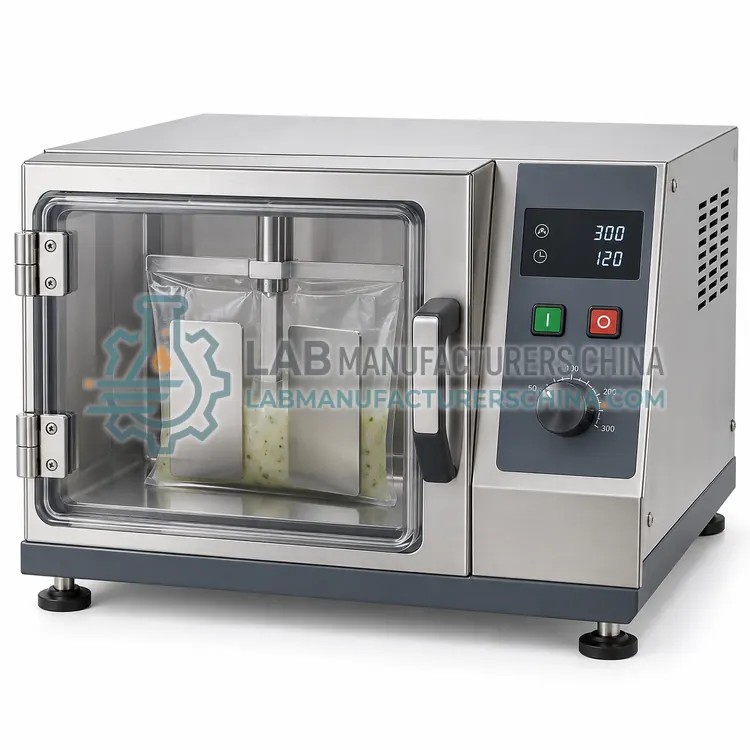
A paddle blender uses two reciprocating paddles to press and release samples inside a sterile bag, releasing microorganisms and analytes without cutting. It is the standard sample preparation step for food, environmental and pharmaceutical microbiology.
What is the Paddle Blender for Food and Microbiology Samples?
A paddle blender uses two reciprocating paddles to press and release samples inside a sterile bag, releasing microorganisms and analytes without cutting. It is the standard sample preparation step for food, environmental and pharmaceutical microbiology.
Overview
The paddle blender has a chamber with two paddles that strike a filter bag containing sample and diluent. Typical speeds are 4 to 12 strokes per second, and the bag sizes handle 10 to 400 mL or 3,500 mL on larger models. The bag is sterile, disposable and often has an inner filter that separates particles from the suspension. The action presses the sample between paddles and bag, dislodging microorganisms from surfaces without grinding, which keeps the suspension free of small particles and minimizes heating. Blending times are 30 seconds to 3 minutes. The design follows microbiological methods such as ISO 6887 sample preparation and is used for food, swabs, soil and pharmaceutical materials. Because contact is only with the bag, no cleaning is needed and there is no cross-contamination. Noise and size are moderate, and a door interlock is fitted.
How does it work?
Tissue homogenizers apply mechanical force to rupture tissue structure and cell walls. Bead mills shake sealed tubes containing the sample and ceramic, glass or steel beads at high speed, typically 4 to 7 m/s, so that collisions crush and shear the tissue. Motorized Potter-Elvehjem homogenizers rotate a close-fitting pestle inside a glass tube at 200 to 2,000 rpm, forcing tissue through a narrow clearance of 0.1 to 0.15 mm. Cryogenic grinders use a magnetic impactor in liquid-nitrogen-cooled vials to pulverize brittle frozen tissue. Paddle blenders use reciprocating paddles to press and release material in a sterile bag. Key components are a drive unit, a vessel or tube, the grinding element such as beads or pestle, and a cooling or cryogenic system to preserve labile biomolecules.
What are the key features?
- Two-paddle action releases microorganisms without cutting
- Sterile disposable bags with optional inner filter
- Stroke rate of 4–12 per second with adjustable time
- Bag volumes from 10 to 400 mL, larger on big models
- No cleaning needed, eliminating cross-contamination
- Door interlock and quiet operation for routine use
What are the technical specifications?
A typical paddle blender for food and microbiology samples configuration offers stroke rate of 4–12 strokes/s, bag volume of 10–400 mL, blending time of 30 s–3 min, bag type of Sterile, with or without filter, sample weight of 5–100 g typical and paddle material of Stainless steel. Values are indicative of the product class; the exact figures for each configuration are confirmed on the quotation and the calibration documents supplied with the instrument.
Which applications is it used for?
The Paddle Blender for Food and Microbiology Samples is used in food microbiology testing, environmental sample suspension, pharmaceutical microbial limit tests, swab and surface sample processing and soil and sediment preparation. Across the wider Tissue Homogenizers class, laboratories also deploy it for DNA and RNA extraction from tissue, protein and enzyme extraction and plant and seed sample preparation.
Which standards and certifications apply?
Relevant standards and methods include IEC 61010-1, IEC 61010-2-051, ISO 6887-1, ISO 7218 and GB 4789.1. Certification candidates for this model are CE, RoHS and ISO 9001 manufacturing; each is to be confirmed for the specific configuration before shipment, and certificates are supplied only where they have been issued.
Keep tissue cold and process quickly to preserve RNA, proteins and enzyme activity; add stabilizing buffers where appropriate. Load tubes symmetrically in bead mills and do not exceed the rated tube fill volume, which is usually half of the tube. Select bead size and material to match tissue hardness, and avoid contamination with metals if trace element analysis follows. Follow the supplier's method for each tissue type, and validate homogenization efficiency against a reference method. For infectious or biohazardous material, use sealed tubes and work in a biosafety cabinet. Clean glass homogenizers thoroughly, and handle liquid nitrogen with protective equipment. Comply with IEC 61010-1 and local biosafety rules.
How do I select the right Paddle Blender for Food and Microbiology Samples?
Choose a paddle blender for microbiological sample suspension in bags, where cutting or contamination must be avoided. Use bead mills or grinders for DNA or RNA extraction. In the RFQ, specify bag sizes, stroke rate, programs and any compliance with ISO 6887.
How does it compare with other Tissue Homogenizers variants?
Choose a tissue homogenizer by sample type, throughput, sample size and downstream analysis. Bead mills handle soft and tough tissues, microbes and plant material in sealed tubes, and are the usual choice for high throughput with 24 or more samples at once. Choose cryogenic cooling for RNA and labile metabolites. Potter-Elvehjem homogenizers give gentle, reproducible disruption of soft tissue such as liver and brain, preserving organelles. Cryogenic grinders pulverize very hard or brittle samples such as bone and seeds. Paddle blenders suit food and microbiology samples of 10 to 400 mL. Check tube volumes, bead types, speed control, cooling and aerosol containment. For regulated testing, consider cross-contamination prevention and documented cleaning steps. Confirm noise, vibration and safety interlocks.
Full specifications
| Stroke rate | 4–12 strokes/s |
|---|---|
| Bag volume | 10–400 mL |
| Blending time | 30 s–3 min |
| Bag type | Sterile, with or without filter |
| Sample weight | 5–100 g typical |
| Paddle material | Stainless steel |
| Door safety | Interlock |
| Programs | Up to 10 stored |
| Noise level | < 65 dB(A) |
| Power supply | 100–240 V, 50/60 Hz |
| Dimensions (W×D×H) | 270 × 400 × 330 mm |
Indicative values for this product class. Final specifications are confirmed on the quotation and in the calibration documents supplied with the instrument.
Applications
- Food microbiology testing
- Environmental sample suspension
- Pharmaceutical microbial limit tests
- Swab and surface sample processing
- Soil and sediment preparation
Key features
- Two-paddle action releases microorganisms without cutting
- Sterile disposable bags with optional inner filter
- Stroke rate of 4–12 per second with adjustable time
- Bag volumes from 10 to 400 mL, larger on big models
- No cleaning needed, eliminating cross-contamination
- Door interlock and quiet operation for routine use
Frequently asked questions about Paddle Blender for Food and Microbiology Samples
Filter bags separate particles from the liquid suspension, so pipetting is easier and plating is cleaner. They also speed up analyses for microbiological counts.
The action is gentle compared with cutting blades, so microbial cells remain viable. Blending time should be kept short, typically 30 to 120 seconds.
No, because samples stay inside disposable bags and the paddles do not touch the sample. Wipe the chamber if a bag leaks and follow your laboratory disinfection routine.
A tissue homogenizer breaks tissue into uniform suspensions or lysates by bead impact, grinding, pestle shear or paddle action. It prepares samples for DNA, RNA, protein and metabolite analysis in life science, clinical and food laboratories.
Bead mills with cooling and cryogenic grinders protect RNA by keeping samples cold and processing quickly. Use RNase-free tubes and lysis buffer that inactivates nucleases immediately.
A bead mill shakes sealed tubes with beads and handles many samples, while a rotor-stator probe is immersed in each sample. Bead mills avoid cross-contamination, whereas probes handle larger volumes.