
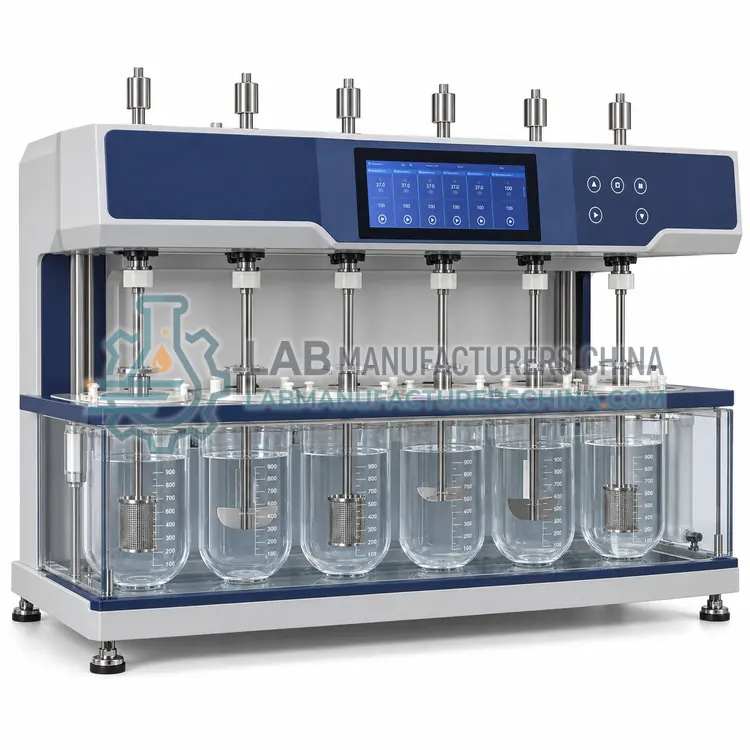
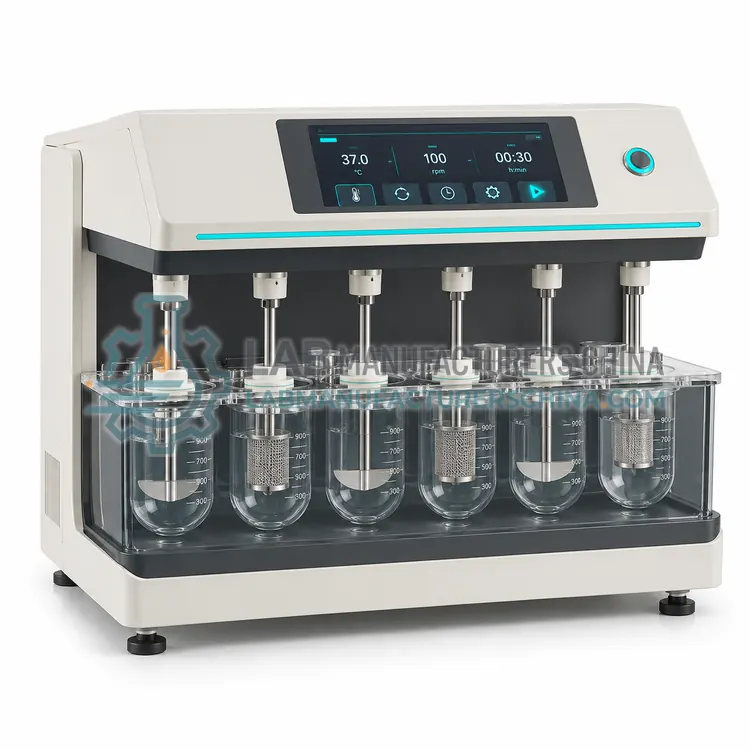
Transdermal Dissolution Tester (USP Apparatus 5/6)
透皮制剂溶出度仪(USP 装置 5/6)
- SKU TDT-0005
- Tablet Dissolution Testers
- CE (to be confirmed)
- ISO 9001 manufacturing (to be confirmed)
Price on request — FOB / CIF quoted per order
Prices depend on configuration, quantity and destination port.
Key specifications
| Apparatus types | USP Apparatus 5 (paddle over disk), 6 (cylinder) |
|---|---|
| Number of vessels | 6 |
| Vessel volume | 500–900 mL |
| Test temperature | 32 ± 0.5 °C |
| Rotation speed | 25–150 rpm |
| Paddle-to-disk distance | 25 ± 2 mm |
Request a quote Download brochure · to be provided
By Lab Manufacturers China Technical TeamLast reviewed Standards: USP <711>, USP <1092>, Ph. Eur. 2.9.3
What is the Transdermal Dissolution Tester (USP Apparatus 5/6)?
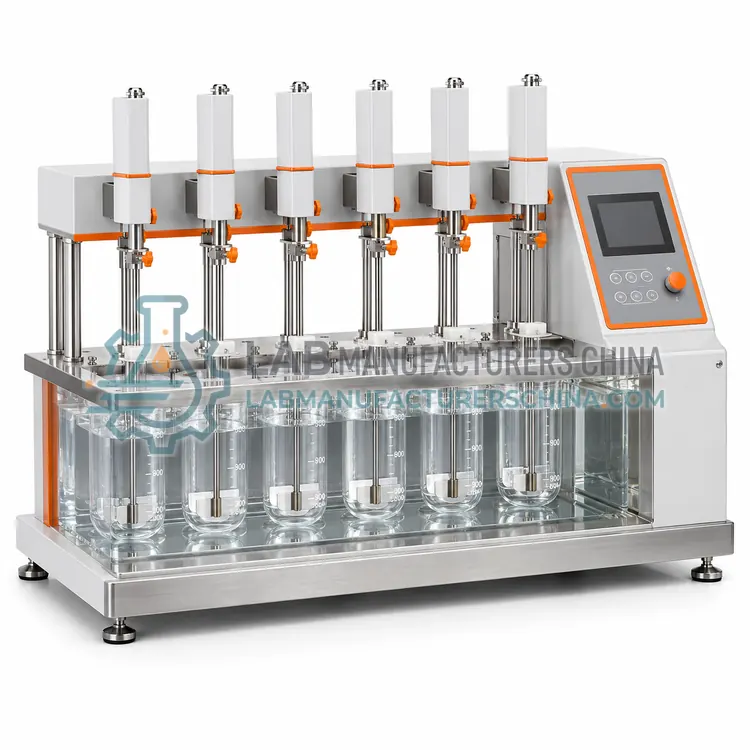
A transdermal dissolution tester adapts a six-vessel bath to USP Apparatus 5 (paddle over disk) and Apparatus 6 (rotating cylinder) for patches and other transdermal delivery systems. It is used for release testing and batch comparison of transdermal products.
What is the Transdermal Dissolution Tester (USP Apparatus 5/6)?
A transdermal dissolution tester adapts a six-vessel bath to USP Apparatus 5 (paddle over disk) and Apparatus 6 (rotating cylinder) for patches and other transdermal delivery systems. It is used for release testing and batch comparison of transdermal products.
Overview
This variant uses the same heated bath and drive as a standard paddle tester but is fitted with the accessories required for transdermal systems. In Apparatus 5, the patch is secured on a stainless steel disk assembly placed flat at the vessel bottom, with the paddle positioned 25 ± 2 mm above it. In Apparatus 6, the patch is wrapped around a rotating cylinder that replaces the basket. Vessel volume is typically 500–900 mL, and temperature is maintained at 32 ± 0.5 °C to simulate skin surface temperature, unlike 37 °C for oral forms. Disk and cylinder dimensions, paddle height and mesh screens must conform to USP <724>. Accessories are inert stainless steel or PTFE to avoid adsorption of lipophilic actives. Sampling can be manual or automated, typically with extended sampling times of several hours to a day.
How does it work?
A dissolution tester places the dosage form in a vessel of temperature-controlled medium, usually 500–1000 mL of buffer or acid, and agitates it by a rotating basket (Apparatus 1), paddle (Apparatus 2), reciprocating cylinder (Apparatus 3) or flow of medium (Apparatus 4). Aliquots are withdrawn at specified times through filters and assayed by UV-Vis or HPLC. The key components are a thermostatted water bath or waterless heater, a drive head holding shaft speed within ±2 rpm, polished glass or plastic vessels of defined geometry, and calibrated shafts with minimal wobble. Hydrodynamics, shaft position, centering and vibration all influence results, so mechanical qualification is integral. Drug release follows Noyes–Whitney kinetics, where dissolution rate depends on surface area, solubility and boundary layer thickness, and sink conditions must be maintained so that the medium volume is at least three times the saturation volume.
What are the key features?
- Disk assembly for Apparatus 5 with adjustable paddle height
- Rotating cylinders for Apparatus 6 in stainless steel or PTFE
- Temperature control set to 32 ± 0.5 °C for skin simulation
- Paddle height gauge for 25 ± 2 mm setting
- Low-adsorption wetted parts for lipophilic actives
- Extended-duration methods with programmable sampling
What are the technical specifications?
A typical transdermal dissolution tester (usp apparatus 5/6) configuration offers apparatus types of USP Apparatus 5 (paddle over disk), 6 (cylinder), number of vessels of 6, vessel volume of 500–900 mL, test temperature of 32 ± 0.5 °C, rotation speed of 25–150 rpm and paddle-to-disk distance of 25 ± 2 mm. Values are indicative of the product class; the exact figures for each configuration are confirmed on the quotation and the calibration documents supplied with the instrument.
Which applications is it used for?
The Transdermal Dissolution Tester (USP Apparatus 5/6) is used in transdermal patch release testing, batch-to-batch comparison, topical semisolid adhesive systems and method development. Across the wider Tablet Dissolution Testers class, laboratories also deploy it for pharmaceutical QC, generic drug bioequivalence support and formulation development.
Which standards and certifications apply?
Relevant standards and methods include USP <711>, USP <1092>, Ph. Eur. 2.9.3, JP 6.10, ChP 0931, USP <724>, ASTM E2503 and FDA Guidance on Dissolution Testing of Immediate Release Solid Oral Dosage Forms. Certification candidates for this model are CE and ISO 9001 manufacturing; each is to be confirmed for the specific configuration before shipment, and certificates are supplied only where they have been issued.
Place the tester on a vibration-free bench, level it, and keep it away from air currents and centrifuges. Perform mechanical calibration of shaft wobble, vessel centering, verticality, speed and temperature at installation and at regular intervals, and run performance verification with USP prednisone or salicylic acid calibrator tablets. Degas media to prevent bubbles, clean vessels after each run, inspect shafts and baskets for corrosion or damage, and replace filters per SOP. Documentation should cover IQ/OQ/PQ, calibration records, and data-integrity controls.
How do I select the right Transdermal Dissolution Tester (USP Apparatus 5/6)?
Choose this variant for patches and transdermal systems per USP <724>. Specify disk or cylinder set, vessel volume, test temperature (usually 32 °C), wetted-part material, and whether a convertible kit for Apparatus 1/2 is needed. Conventional tablet-only laboratories should verify that the same bath can be reconfigured for routine work.
How does it compare with other Tablet Dissolution Testers variants?
Start with the apparatus type the monograph specifies: Apparatus 1 or 2 for most immediate-release products, Apparatus 3 for extended-release and pH-shift profiling, Apparatus 5 or 6 for patches. Then choose vessel count by throughput: six for routine QC, eight for batches with standards, and automated systems for unattended profiles. Consider temperature control (bath versus waterless), speed range and accuracy, and compatibility with an autosampler or UV interface. For regulated sites, require IQ/OQ documentation, mechanical calibration fixtures, and software with audit trail. Also check vessel volume range, because low-dose or poorly soluble products may need 100–250 mL mini-vessels or 2–4 L vessels.
Full specifications
| Apparatus types | USP Apparatus 5 (paddle over disk), 6 (cylinder) |
|---|---|
| Number of vessels | 6 |
| Vessel volume | 500–900 mL |
| Test temperature | 32 ± 0.5 °C |
| Rotation speed | 25–150 rpm |
| Paddle-to-disk distance | 25 ± 2 mm |
| Disk material | 316 stainless steel or PTFE |
| Cylinder diameter | 22 mm nominal |
| Test duration | up to 24 h |
| Power supply | 220 V AC, 50/60 Hz, about 1.2 kW |
Indicative values for this product class. Final specifications are confirmed on the quotation and in the calibration documents supplied with the instrument.
Applications
- Transdermal patch release testing
- Batch-to-batch comparison
- Topical semisolid adhesive systems
- Method development
Key features
- Disk assembly for Apparatus 5 with adjustable paddle height
- Rotating cylinders for Apparatus 6 in stainless steel or PTFE
- Temperature control set to 32 ± 0.5 °C for skin simulation
- Paddle height gauge for 25 ± 2 mm setting
- Low-adsorption wetted parts for lipophilic actives
- Extended-duration methods with programmable sampling
Frequently asked questions about Transdermal Dissolution Tester (USP Apparatus 5/6)
Skin surface temperature is approximately 32 °C, so transdermal release tests use 32 ± 0.5 °C rather than 37 °C to reflect in-use conditions. The exact temperature should follow the product monograph or validated method.
Apparatus 5 lays the patch on a disk at the vessel bottom beneath a paddle. Apparatus 6 wraps the patch around a rotating cylinder. The choice depends on the monograph and patch geometry.
Yes, if the system is convertible. The same drive and bath can accept basket and paddle shafts for Apparatus 1/2, but temperature and paddle height must be reset and recalibrated for each configuration.
It measures the amount of active ingredient released from a tablet or capsule into a medium over time under controlled temperature and agitation. Results are compared with monograph limits to confirm batch consistency and predict in vivo release behavior.
Follow the monograph. Apparatus 2 (paddle) suits most tablets, while Apparatus 1 (basket) is used for capsules and dosage forms that float. Both can run on a standard six-vessel tester by exchanging shaft attachments.
Dissolved air forms bubbles on the tablet, baskets and vessel walls during the test, which alters hydrodynamics and lowers apparent dissolution. Degassing by heat, filtration and vacuum, or helium sparging is required by USP <711> unless validated otherwise.
Related models
Open-Loop Flow-Through Dissolution System (USP Apparatus 4)
开环流通池溶出系统(USP 装置 4)
- CE (to be confirmed)
- +1