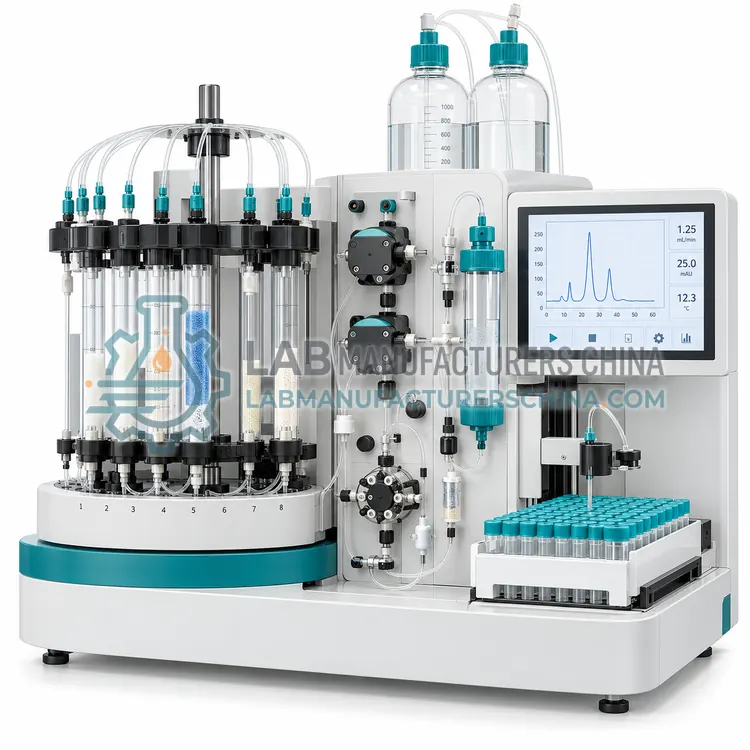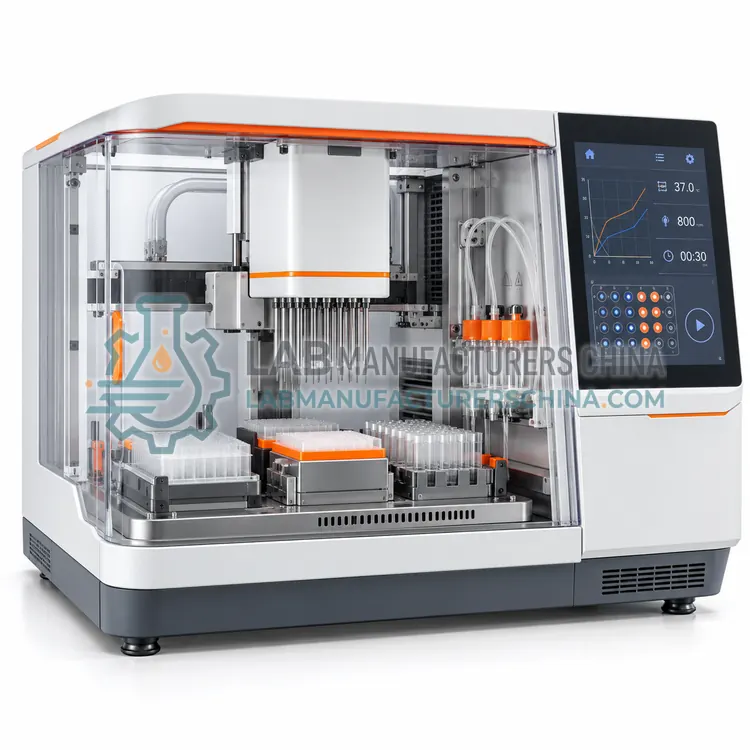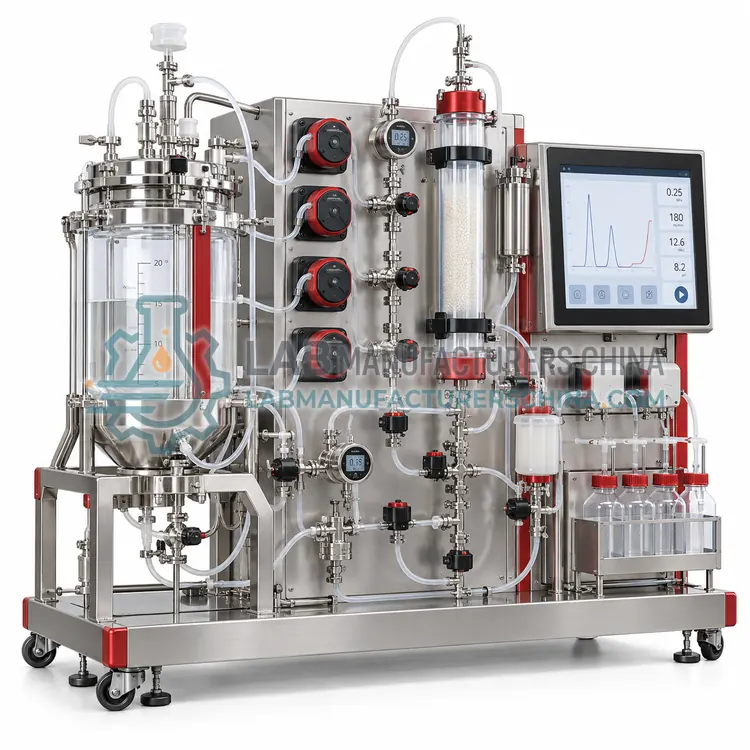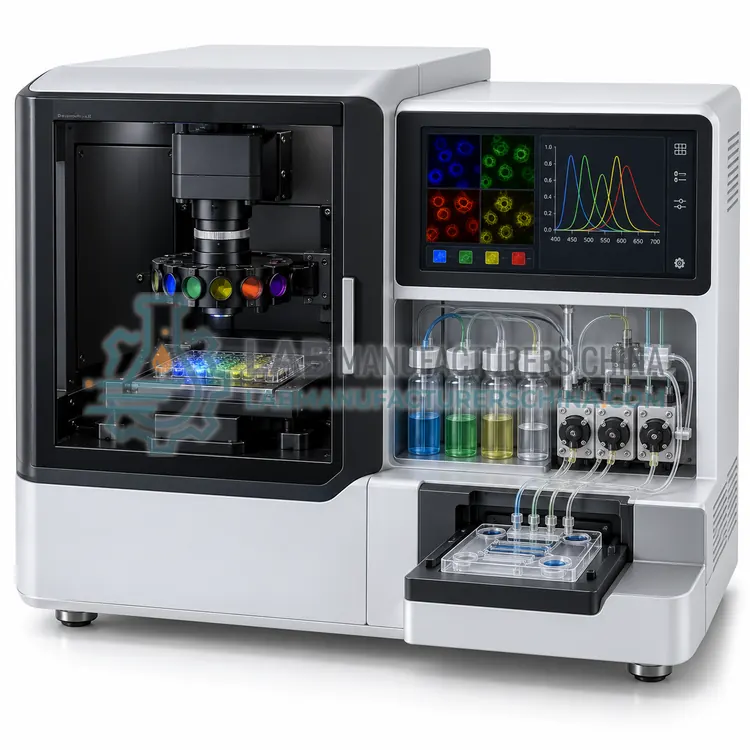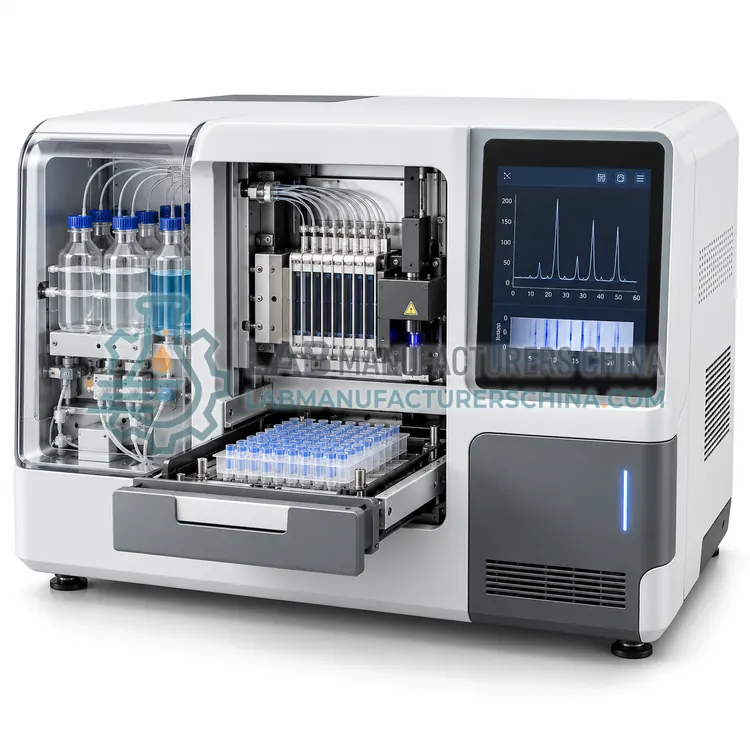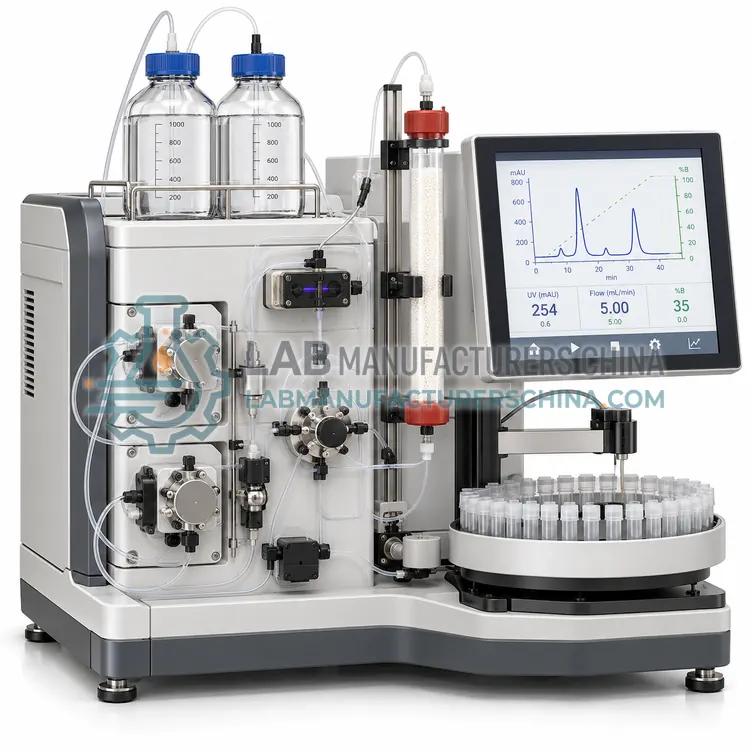
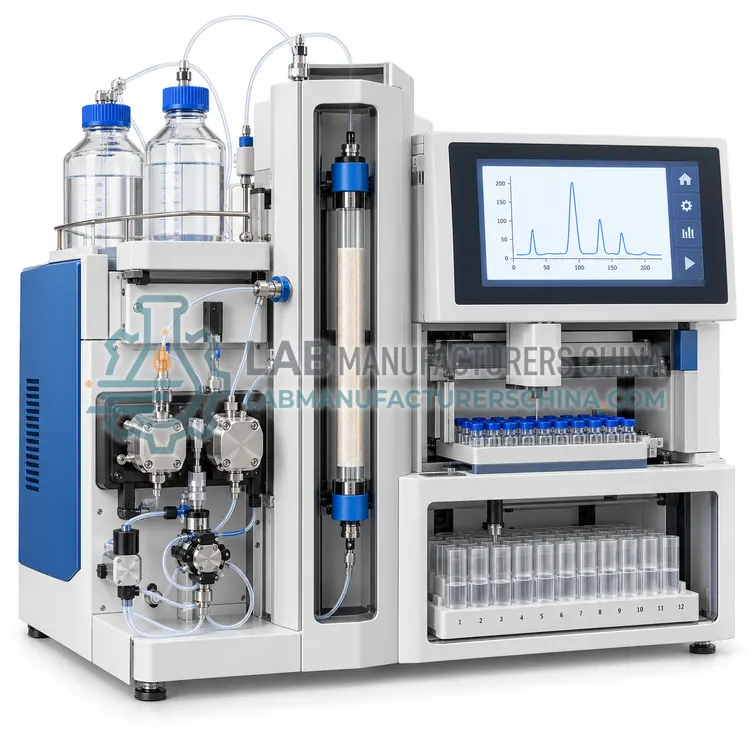
Size Exclusion Chromatography System
体积排阻层析系统
- SKU PRP-0004
- Protein Purification
- CE (to be confirmed)
- ISO 9001 manufacturing (to be confirmed)
- IEC 61010-1 safety (to be confirmed)
Price on request — FOB / CIF quoted per order
Prices depend on configuration, quantity and destination port.
Key specifications
| Separation range | approx. 1–700 kDa (resin dependent) |
|---|---|
| Column length | 300 mm analytical, 100–600 mm available |
| Flow rate | 0.3–1.0 mL/min |
| Maximum pressure | approx. 2 MPa |
| Run time | approx. 20–40 min |
| Resolution | monomer and dimer resolved (typical) |
Request a quote Download brochure · to be provided
By Lab Manufacturers China Technical TeamLast reviewed Standards: USP <1057>, Ph. Eur. 2.2.29, Ph. Eur. 2.2.30
What is the Size Exclusion Chromatography System?
A size exclusion chromatography system separates proteins by hydrodynamic radius on a porous resin, with large molecules eluting first. It removes aggregates and fragments and exchanges samples into the final buffer without binding the protein to the resin.
What is the Size Exclusion Chromatography System?
A size exclusion chromatography system separates proteins by hydrodynamic radius on a porous resin, with large molecules eluting first. It removes aggregates and fragments and exchanges samples into the final buffer without binding the protein to the resin.
Overview
The column is packed with rigid porous particles that have a defined pore size distribution. Molecules larger than the pores pass through the void volume and elute first, while smaller molecules enter the pores and are retarded, so elution order follows decreasing size. Because there is no binding step, buffer composition changes little during separation, which makes the method gentle and suitable for labile proteins and for aggregate quantitation. Resolution depends on column length and particle size, with analytical columns of 300 mm resolving monomer from dimer. Typical flow rates are 0.3–1 mL/min at pressures below 2 MPa, and runs take 20–40 minutes. The purity and aggregate content derived from the chromatogram are widely used in comparability and stability testing.
How does it work?
Chromatographic purification separates proteins by differences in a specific property. In affinity chromatography, a ligand such as immobilised nickel for histidine tags, glutathione for GST tags or protein A for antibodies retains the target while other proteins wash through, and a competing agent or a pH shift elutes it. Ion exchange uses charged resins so that proteins bind according to net charge at a chosen pH and elute under a salt gradient. Hydrophobic interaction chromatography binds proteins in high-salt buffers and elutes them as salt decreases. Size exclusion separates by hydrodynamic radius, with large molecules eluting first, which makes it useful for aggregate removal and buffer exchange. Magnetic bead methods bind the target on functionalised particles and collect them with a magnet, allowing parallel small-scale purification. Throughout, detectors measure absorbance at 280 nm and conductivity, and fractions are collected by peak.
What are the key features?
- Rigid porous resin with defined pore size for size-based separation
- No binding step, so buffer composition stays nearly constant
- Separation of monomer, dimer and higher aggregates
- Analytical columns with 300 mm length for high resolution
- UV detection at 280 nm with optional multi-angle light scattering
- Simultaneous buffer exchange during separation
What are the technical specifications?
A typical size exclusion chromatography system configuration offers separation range of approx. 1–700 kDa (resin dependent), column length of 300 mm analytical, 100–600 mm available, flow rate of 0.3–1.0 mL/min, maximum pressure of approx. 2 MPa, run time of approx. 20–40 min and resolution of monomer and dimer resolved (typical). Values are indicative of the product class; the exact figures for each configuration are confirmed on the quotation and the calibration documents supplied with the instrument.
Which applications is it used for?
The Size Exclusion Chromatography System is used in aggregate and fragment quantification, buffer exchange into formulation buffer, purity determination of purified proteins and molecular weight estimation with a calibration set. Across the wider Protein Purification class, laboratories also deploy it for recombinant protein purification for analysis, antibody purification from culture supernatant and aggregate and fragment removal before testing.
Which standards and certifications apply?
Relevant standards and methods include USP <1057>, Ph. Eur. 2.2.29, Ph. Eur. 2.2.30, IEC 61010-1, ISO 17025 and 21 CFR Part 11. Certification candidates for this model are CE, ISO 9001 manufacturing and IEC 61010-1 safety; each is to be confirmed for the specific configuration before shipment, and certificates are supplied only where they have been issued.
Maintain the system at a stable temperature, either at ambient with buffer equilibration or in a cold cabinet for labile proteins. Filter and degas all buffers to prevent pump damage and baseline noise, and choose buffers compatible with the resin and the downstream assay. Sanitise or clean-in-place the flow path between different proteins to avoid cross-contamination, and store columns in the recommended preservative. Monitor pressure throughout the run, because resin compression or a blocked line shows up first as rising pressure and then as distorted peaks. Keep tubing volumes small to limit peak broadening. Validate linearity, precision and carry-over before use in quality control, and retain chromatograms, gradients and fraction records so that a purification can be reproduced or investigated later.
How do I select the right Size Exclusion Chromatography System?
Select a size exclusion system when aggregates and fragments must be quantified, when a gentle buffer exchange is needed, or when the protein is sensitive to binding to a resin. Specify resin pore size and separation range, column length, flow rate and pressure limits, and detector options.
How does it compare with other Protein Purification variants?
Match the purification mode to the property you will exploit: a tag or known binding partner points to affinity chromatography, charge differences to ion exchange, salt-dependent hydrophobicity to hydrophobic interaction, and size differences to size exclusion. Then decide on scale and automation. Magnetic bead instruments suit parallel screening of 8–96 small samples where yield optimisation matters. Fast protein liquid chromatography systems with gradient pumps and fraction collectors handle method development and preparative work up to tens of milligrams per run. For screening many conditions quickly, perfusion chromatography allows short cycles at high flow rates. Check pressure rating, flow rate range, column and resin compatibility, gradient accuracy, fraction collector capacity and whether the software records methods and runs for traceability.
Full specifications
| Separation range | approx. 1–700 kDa (resin dependent) |
|---|---|
| Column length | 300 mm analytical, 100–600 mm available |
| Flow rate | 0.3–1.0 mL/min |
| Maximum pressure | approx. 2 MPa |
| Run time | approx. 20–40 min |
| Resolution | monomer and dimer resolved (typical) |
| Detection | UV absorbance at 280 nm |
| Sample volume | 10–500 µL (1–5% of column volume) |
| Buffer consumption | approx. 50–150 mL per run |
| Dimensions (W x D x H) | approx. 400 x 400 x 450 mm |
Indicative values for this product class. Final specifications are confirmed on the quotation and in the calibration documents supplied with the instrument.
Applications
- Aggregate and fragment quantification
- Buffer exchange into formulation buffer
- Purity determination of purified proteins
- Molecular weight estimation with a calibration set
Key features
- Rigid porous resin with defined pore size for size-based separation
- No binding step, so buffer composition stays nearly constant
- Separation of monomer, dimer and higher aggregates
- Analytical columns with 300 mm length for high resolution
- UV detection at 280 nm with optional multi-angle light scattering
- Simultaneous buffer exchange during separation
Frequently asked questions about Size Exclusion Chromatography System
Because the resin pores exclude molecules above a certain size, so they travel only in the space between particles. Smaller molecules enter the pores and take a longer path, so they elute later. This is the opposite of ion exchange or affinity behaviour.
Load 1–5% of the column volume, typically 10–500 µL on a 300 mm analytical column. Larger volumes improve the amount recovered but broaden peaks and reduce resolution between monomer and aggregate peaks.
Yes. Because the protein does not bind the resin, it elutes in whatever buffer is used as the mobile phase. Running with the final formulation buffer therefore both purifies by size and exchanges the sample into that buffer.
If the target carries a tag, start with affinity chromatography because it usually gives the highest purity in one step. If no tag is available, use ion exchange or hydrophobic interaction based on the protein's charge and hydrophobicity, followed by size exclusion for polishing.
A UV detector at 280 nm measures protein concentration in the eluate, and a conductivity monitor tracks the salt gradient. Together they show when the target elutes and allow fractions to be pooled, which is then confirmed by electrophoresis or activity assay.
Affinity purification removes most impurities but leaves aggregates, fragments and buffer components. Size exclusion separates molecules by hydrodynamic radius, so it removes aggregates and simultaneously exchanges the sample into the final formulation buffer.