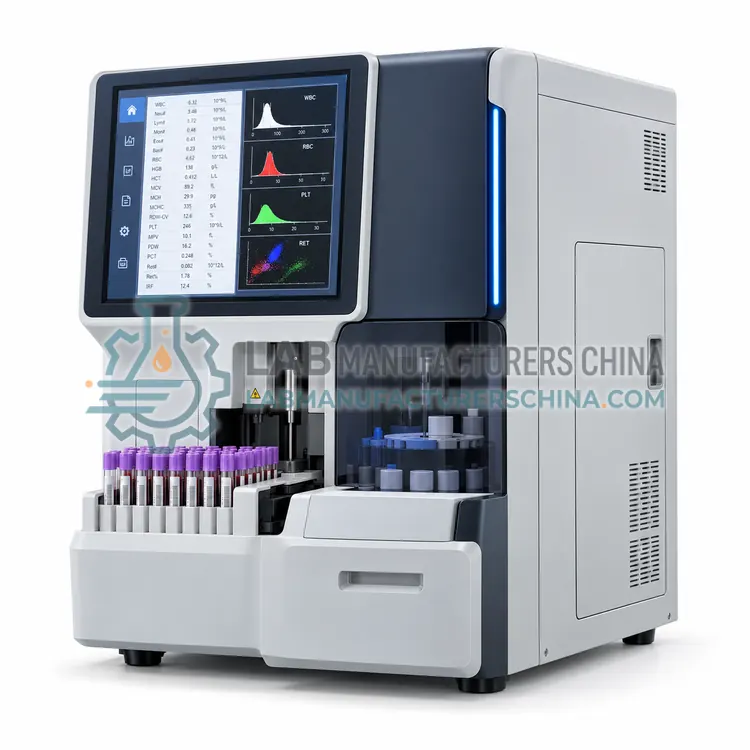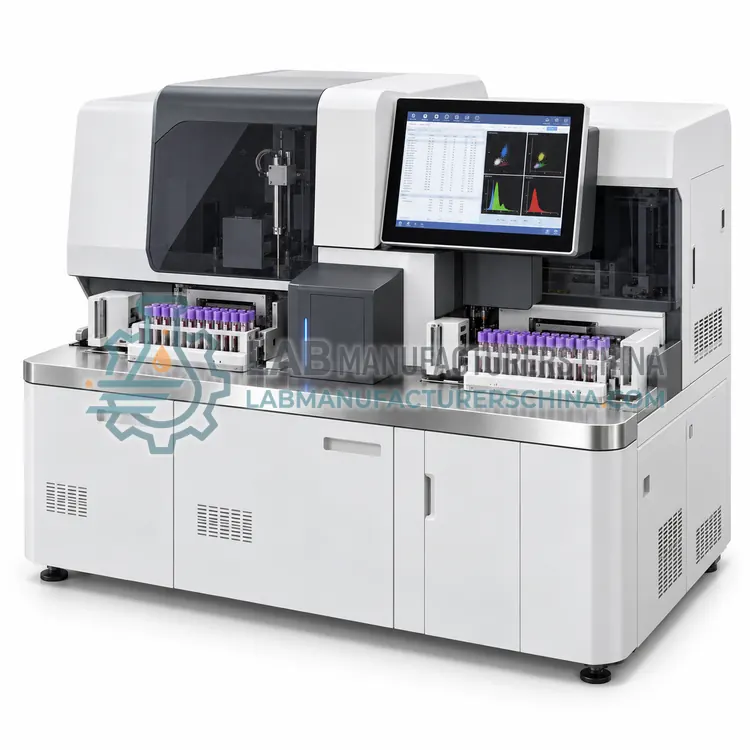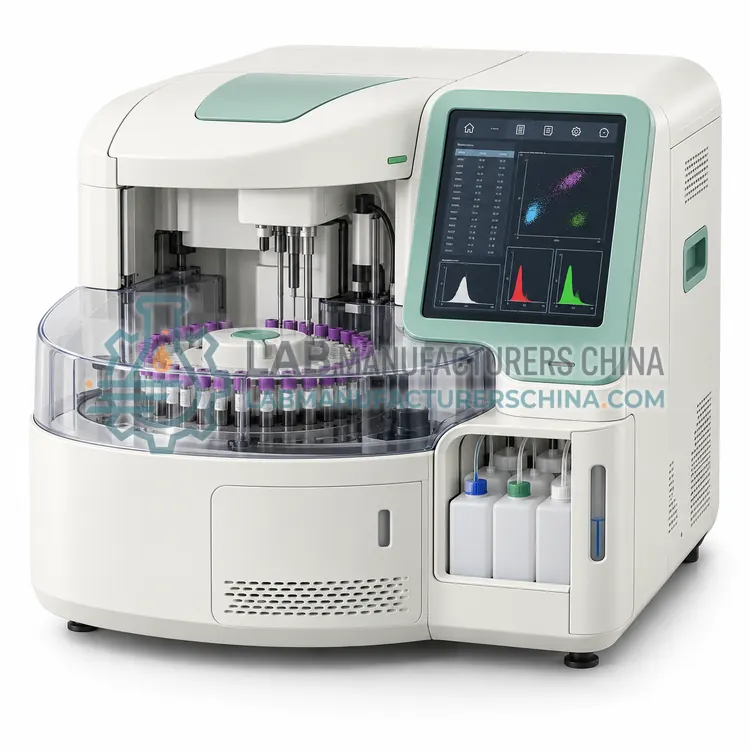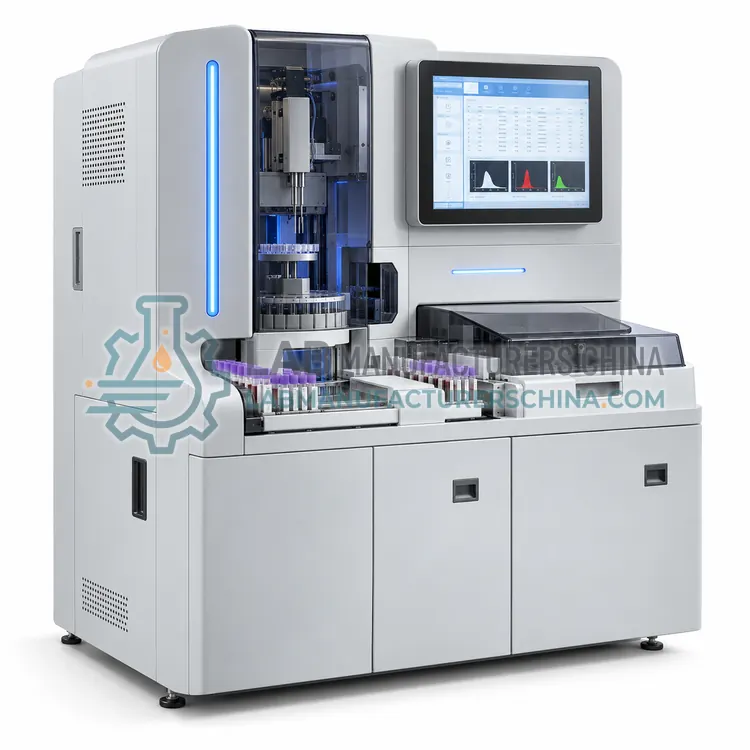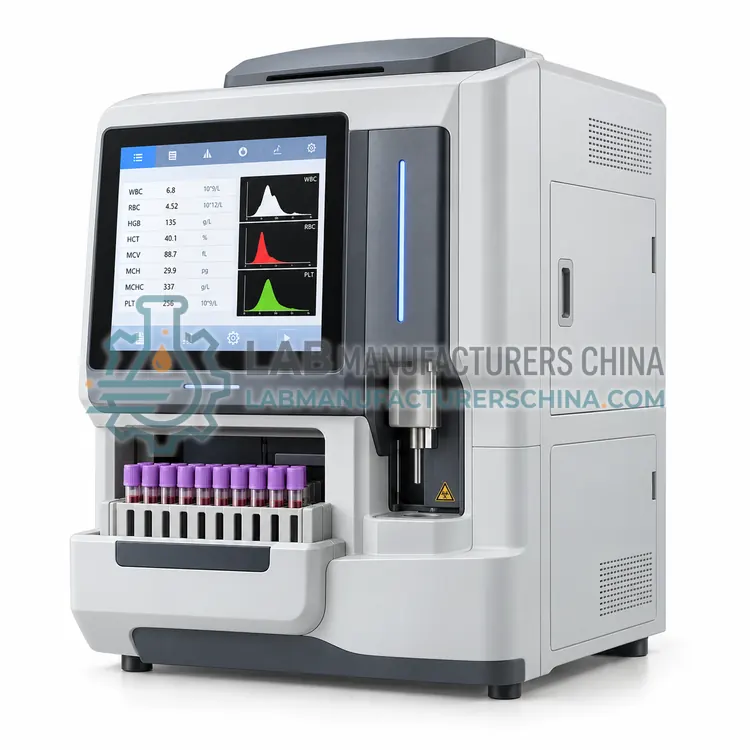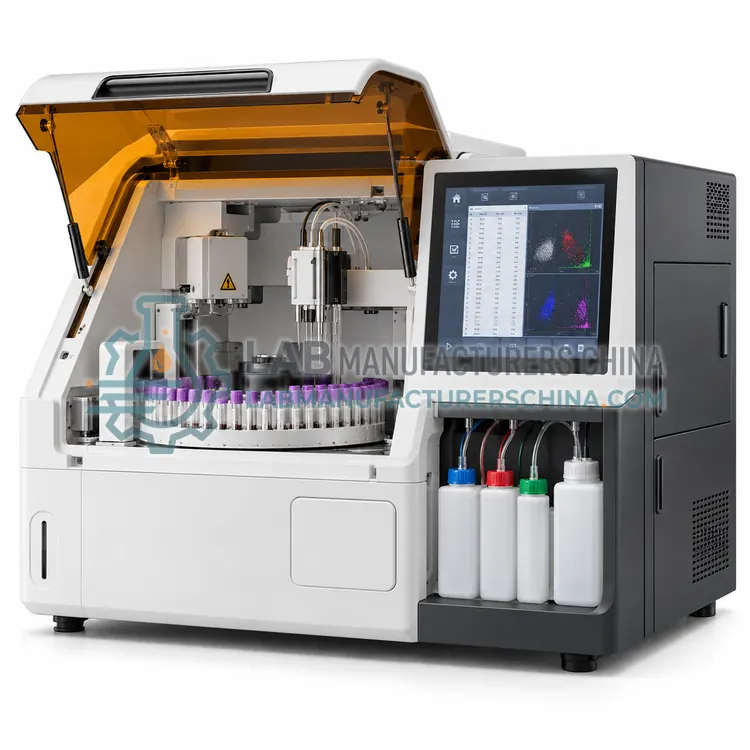
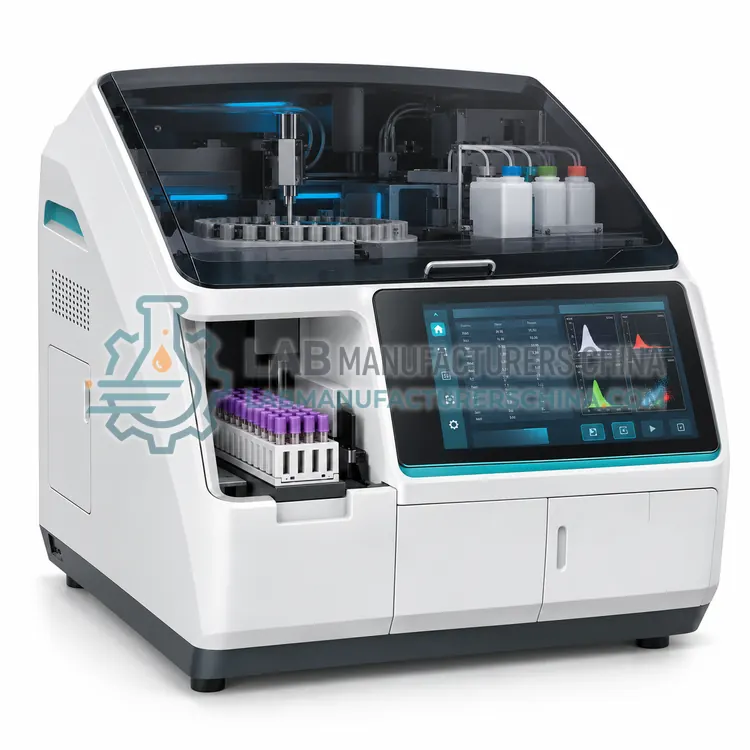
High-Throughput 5-Part Hematology Analyzer
高通量五分类血液分析仪
- SKU PAR-0002
- 5-Part Analyzers
- CE (to be confirmed)
- ISO 13485 manufacturing (to be confirmed)
- NMPA class II registration (to be confirmed)
Price on request — FOB / CIF quoted per order
Prices depend on configuration, quantity and destination port.
Key specifications
| Throughput | 100–150 samples/h with 5-part differential |
|---|---|
| Autoloader capacity | ≥100 tubes with continuous loading |
| Reportable parameters | 28 parameters plus optional reticulocyte module |
| Sample volume | 25 µL whole blood |
| WBC linear range | 0.1–200 ×10⁹/L |
| Reagent capacity | Onboard reagent for 500–800 tests |
Request a quote Download brochure · to be provided
By Lab Manufacturers China Technical TeamLast reviewed Standards: ISO 15189, CLSI H26-A2, CLSI H20-A2
What is the High-Throughput 5-Part Hematology Analyzer?
A high-throughput 5-part analyzer processes 100 to 150 samples per hour with continuous rack loading, which suits large hospital core laboratories and reference laboratories whose daily counts exceed several hundred samples. Sample review by a technologist, not instrument speed, becomes the limiting factor.
What is the High-Throughput 5-Part Hematology Analyzer?
A high-throughput 5-part analyzer processes 100 to 150 samples per hour with continuous rack loading, which suits large hospital core laboratories and reference laboratories whose daily counts exceed several hundred samples. Sample review by a technologist, not instrument speed, becomes the limiting factor.
Overview
This variant scales the flow cytometry platform for continuous operation. Racks of tubes are loaded in bulk, barcoded and aspirated without operator intervention, while the software maintains a worklist, applies review rules, and reorders flagged samples to a designated rack or review lane. Two aspiration needles or a parallel channel are used in some models to raise speed, and the reagent system holds enough volume for a full shift. Result output is designed for high-volume reporting, with delta checks, moving averages of normal results, and automatic transmission to the laboratory information system. Optional modules may include reticulocytes, nucleated red cells, immature platelet fraction and body fluid analysis, and some configurations connect to a slide maker and stainer for automated film preparation.
How does it work?
These analyzers combine impedance counting with a flow cytometry channel. A diluted and stained sample passes a sheath flow cell where hydrodynamic focusing aligns cells in single file. A laser beam strikes each cell, and three signals are recorded: forward scatter, which reflects cell size; side scatter, which reflects internal granularity and complexity; and fluorescence from a dye that stains nucleic acids and cell membranes. Clustering algorithms in the instrument software separate the signals into five leukocyte populations, and the same data support flags for band forms, blasts, atypical lymphocytes and nucleated red cells. Impedance channels measure red cells, platelets and a second white cell count for comparison. Hemoglobin is measured photometrically after lysis. Because the flow channel provides much more information than a size histogram, the analyzer can also report reticulocytes, immature platelet fraction and body fluid cell counts when the corresponding reagent and software options are installed.
What are the key features?
- Continuous rack loading with bulk capacity of 100 tubes or more
- Throughput of 100 to 150 samples per hour with five-part differential
- Automatic reordering of flagged samples to a review lane
- Moving average of normal results for continuous drift detection
- Optional connection to a slide maker and stainer
- Reagent capacity sized for a full working shift
What are the technical specifications?
A typical high-throughput 5-part hematology analyzer configuration offers throughput of 100–150 samples/h with 5-part differential, autoloader capacity of ≥100 tubes with continuous loading, reportable parameters of 28 parameters plus optional reticulocyte module, sample volume of 25 µL whole blood, WBC linear range of 0.1–200 ×10⁹/L and reagent capacity of Onboard reagent for 500–800 tests. Values are indicative of the product class; the exact figures for each configuration are confirmed on the quotation and the calibration documents supplied with the instrument.
Which applications is it used for?
The High-Throughput 5-Part Hematology Analyzer is used in large hospital core laboratory hematology, reference laboratory high-volume testing, multi-site laboratory consolidation and clinical trial central laboratory testing. Across the wider 5-Part Analyzers class, laboratories also deploy it for hospital routine and emergency blood counts, neutropenia and chemotherapy monitoring and leukemia and lymphoma screening.
Which standards and certifications apply?
Relevant standards and methods include ISO 15189, CLSI H26-A2, CLSI H20-A2, CLSI EP05, CLSI H21, IEC 61010-1 and IEC 61010-2-101. Certification candidates for this model are CE, ISO 13485 manufacturing and NMPA class II registration; each is to be confirmed for the specific configuration before shipment, and certificates are supplied only where they have been issued.
Install the analyzer on a stable bench with a dedicated grounded outlet, controlled room temperature of about 15 to 30 degrees Celsius and low dust. Verify performance at installation with precision, carryover, linearity and method comparison studies, including a specific check of the differential against manual microscopy on abnormal samples. Run three levels of control each day, join an external quality assessment scheme, and review flag rates regularly, because an excessive flag rate increases manual reviews and delays reporting. Clean the flow cell, probes and waste lines according to the maintenance plan, protect the laser and optics from vibration, and keep sheath fluid and cleaning reagents within their expiry dates. Handle all blood samples as potentially infectious.
How do I select the right High-Throughput 5-Part Hematology Analyzer?
Choose this variant when more than about four hundred counts are reported each day or when peak-hour queues delay reporting. In the RFQ state the daily volume, peak-hour volume, expected number of review samples, and whether connection to a track system or slide maker is planned. Confirm reagent capacity per shift, autoloader capacity, downtime behaviour, and the supplier response time for a laboratory without redundancy.
How does it compare with other 5-Part Analyzers variants?
Specify a 5-part analyzer when clinicians act on the differential, for example to follow neutropenia during chemotherapy, to screen for leukemia, or to manage pediatric infections. Compare throughput, which ranges from about 60 to more than 120 samples per hour, and the first-result time for emergency work. Check which optional modes are included: reticulocyte count, nucleated red cell count, immature platelet fraction and body fluid analysis all require dedicated reagents and software licences. Confirm the minimum sample volume for pediatric samples and the linearity at low white cell counts. Ask about the flagging performance for blasts, the review rules the software applies, and whether a slide maker or digital morphology review is supported. Confirm LIS connectivity, reagent openness, calibration interval of the flow channel, and local service support.
Full specifications
| Throughput | 100–150 samples/h with 5-part differential |
|---|---|
| Autoloader capacity | ≥100 tubes with continuous loading |
| Reportable parameters | 28 parameters plus optional reticulocyte module |
| Sample volume | 25 µL whole blood |
| WBC linear range | 0.1–200 ×10⁹/L |
| Reagent capacity | Onboard reagent for 500–800 tests |
| Review workflow | Automatic rack assignment of flagged results |
| Data storage | 100,000 patient records |
| Interfaces | LAN with HL7 or ASTM; track connection optional |
Indicative values for this product class. Final specifications are confirmed on the quotation and in the calibration documents supplied with the instrument.
Applications
- Large hospital core laboratory hematology
- Reference laboratory high-volume testing
- Multi-site laboratory consolidation
- Clinical trial central laboratory testing
Key features
- Continuous rack loading with bulk capacity of 100 tubes or more
- Throughput of 100 to 150 samples per hour with five-part differential
- Automatic reordering of flagged samples to a review lane
- Moving average of normal results for continuous drift detection
- Optional connection to a slide maker and stainer
- Reagent capacity sized for a full working shift
Frequently asked questions about High-Throughput 5-Part Hematology Analyzer
Plan the review workflow before installing the analyzer. Define which flags require a film review, decide whether a technologist is dedicated to review during the peak shift, and configure the software to route review samples to a separate rack. Without these arrangements a fast analyzer can outrun the review capacity of the laboratory.
Reagent volume per test is usually similar to a standard 5-part analyzer, but the onboard capacity is larger so that the instrument can run for a full shift or a full day without refilling. Package sizes are larger as well, and some reagents have a limited shelf life after opening.
Most core laboratories avoid a single point of failure by keeping a second analyzer, which may be a lower-throughput unit used for backup and STAT samples. A service contract with a guaranteed response time, an adequate stock of critical spare parts and a written downtime procedure are also recommended.
A 5-part differential reports neutrophils, lymphocytes, monocytes, eosinophils and basophils separately rather than as grouped populations. This supports monitoring of neutropenia, allergic and parasitic conditions, and abnormal white cell patterns, and the underlying flow cytometry data also allow flags for immature cell populations.
No. Analyzers flag many abnormalities, but morphological assessment of blasts, dysplastic cells, malaria parasites and red cell shape still needs a stained film and microscopy. Most laboratories review films for a defined proportion of samples or whenever specific flags appear, as part of their validation and review rules.
Reticulocyte and nucleated red cell counts are useful for anemia assessment, the immature platelet fraction helps distinguish platelet destruction from reduced production, and body fluid modes support cerebrospinal and synovial fluid cell counts. Each module needs dedicated reagent and software, so order only what the clinical service will use.
Related models