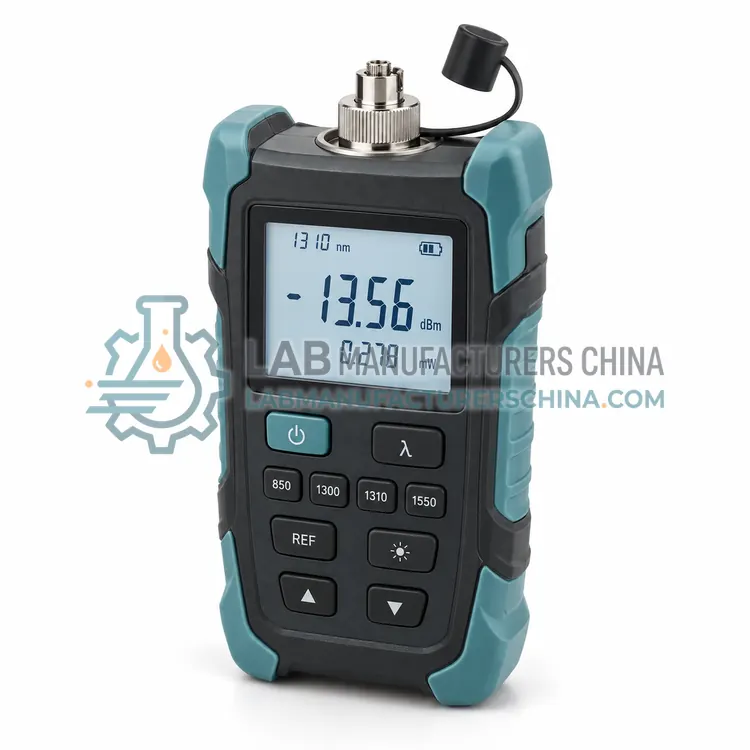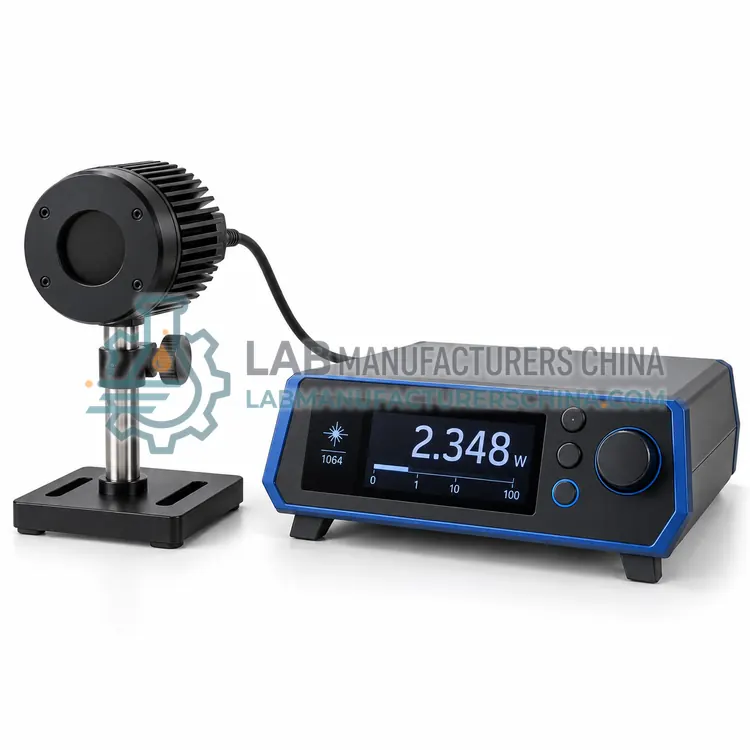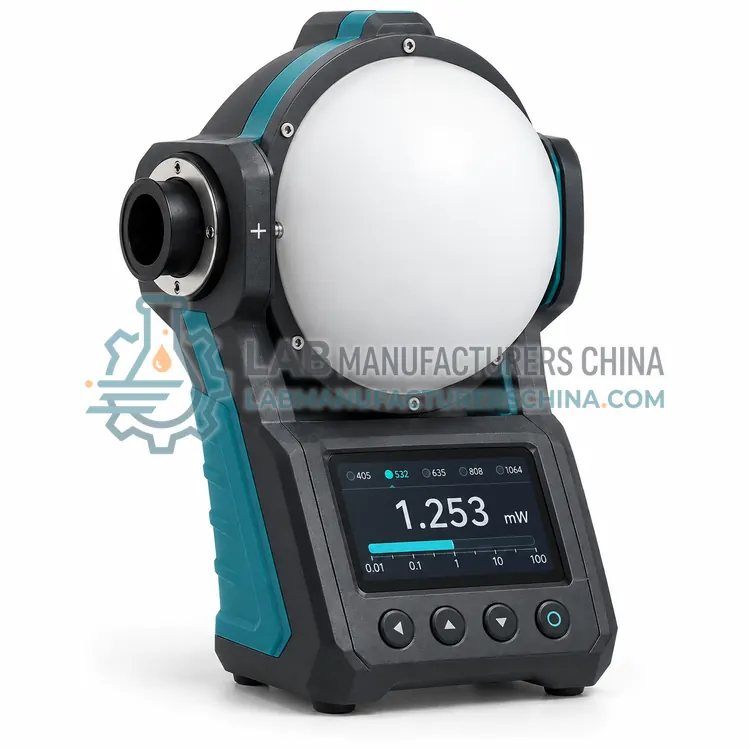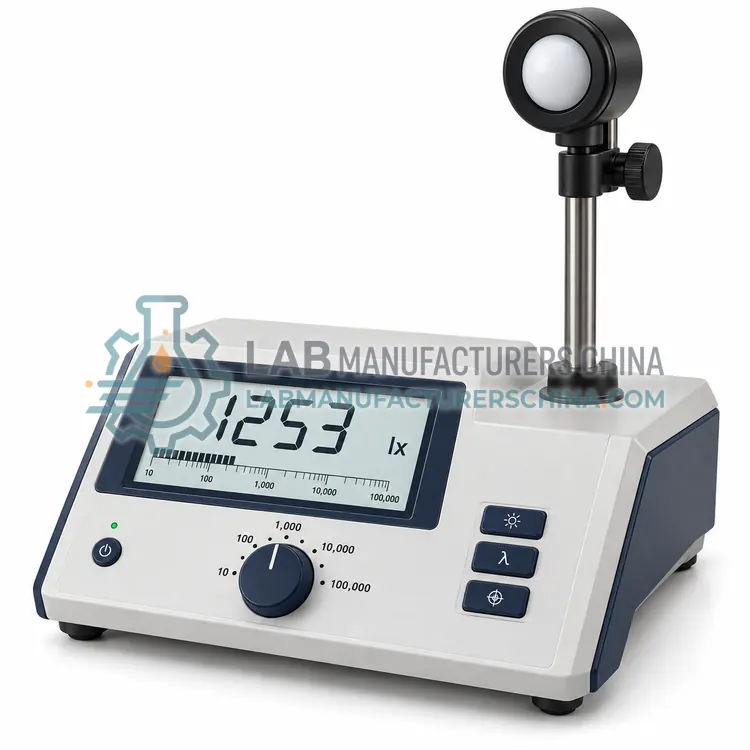
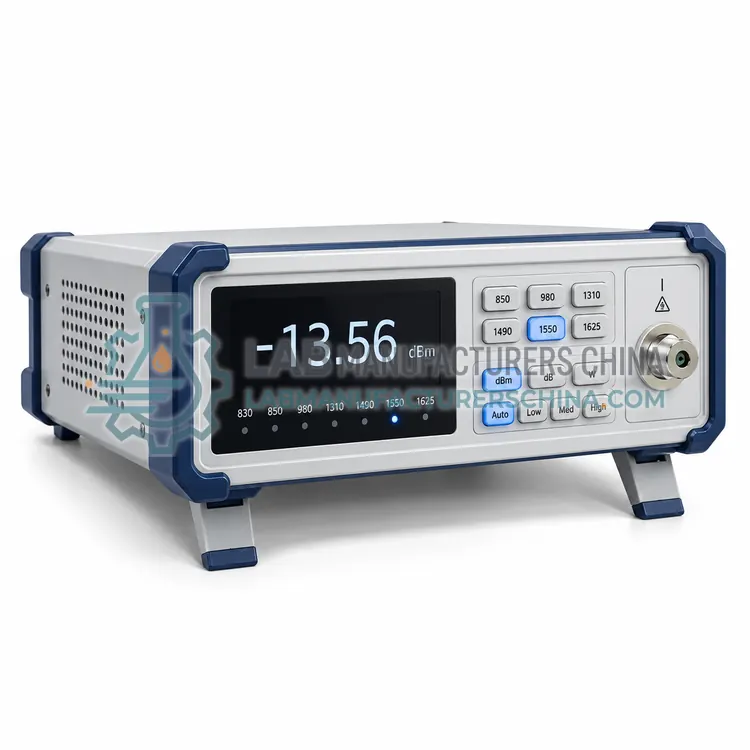
Benchtop Optical Power Meter
台式光功率计
- SKU OPM-0001
- Optical Power Meters
- CE (to be confirmed)
- ISO 9001 manufacturing (to be confirmed)
Price on request — FOB / CIF quoted per order
Prices depend on configuration, quantity and destination port.
Key specifications
| Wavelength range | 200–1800 nm, sensor dependent |
|---|---|
| Power range | 1 pW to 10 W, head dependent |
| Sensor types | Photodiode, thermopile, pyroelectric |
| Power accuracy | ±2% of reading |
| Display resolution | 0.001 dB |
| Sampling rate | 10 Hz |
Request a quote Download brochure · to be provided
By Lab Manufacturers China Technical TeamLast reviewed Standards: IEC 60825-1, ISO 11554, IEC 61315
What is the Benchtop Optical Power Meter?
A benchtop optical power meter is a laboratory instrument that provides stable, high-resolution power measurement with interchangeable sensors. It is used for characterization and calibration of lasers, sources and optical components where accuracy and repeatability are critical.
What is the Benchtop Optical Power Meter?
A benchtop optical power meter is a laboratory instrument that provides stable, high-resolution power measurement with interchangeable sensors. It is used for characterization and calibration of lasers, sources and optical components where accuracy and repeatability are critical.
Overview
A benchtop optical power meter uses a mainframe that accepts multiple sensor heads covering different power ranges and wavelengths. The mainframe provides stable power, low-noise amplification, wavelength correction and a calibrated readout. Interchangeable photodiode, thermopile and pyroelectric heads let one instrument cover picowatts to hundreds of watts. Analogue output and computer interfaces support automated measurements, logging and integration into test benches. Because the electronics are separated from the sensor, thermal and electrical stability are good. The instrument is used where traceable, repeatable measurement and detailed data records are required. Sensors can be swapped without recalibrating the mainframe.
How does it work?
An optical power meter converts incident light into an electrical signal with a sensor whose spectral response is known. Photodiodes are fast and sensitive and suit low to moderate power; thermopiles absorb light and measure the resulting temperature rise for higher powers and broad wavelength coverage; pyroelectric sensors respond to pulsed energy. The signal is amplified, digitized and displayed in watts, dBm or relative units. Calibration against a traceable reference sets the responsivity, and the meter applies wavelength correction when the source differs from the calibration wavelength. Attenuators, integrating spheres and diffusers adapt the sensor to high power or divergent beams. Linearity, noise floor and response time define the usable measurement range.
What are the key features?
- Interchangeable sensor heads for wide power and wavelength coverage
- High-resolution calibrated readout with wavelength correction
- Analogue output and digital interfaces for automation
- Low-noise electronics for picowatt-level measurement
- Data logging for calibration and traceability records
What are the technical specifications?
A typical benchtop optical power meter configuration offers wavelength range of 200–1800 nm, sensor dependent, power range of 1 pW to 10 W, head dependent, sensor types of Photodiode, thermopile, pyroelectric, power accuracy of ±2% of reading, display resolution of 0.001 dB and sampling rate of 10 Hz. Values are indicative of the product class; the exact figures for each configuration are confirmed on the quotation and the calibration documents supplied with the instrument.
Which applications is it used for?
The Benchtop Optical Power Meter is used in laser and source characterization, optical component transmission and loss testing, calibration laboratory reference measurement and automated photonic test benches. Across the wider Optical Power Meters class, laboratories also deploy it for laser output power verification, fibre-optic link loss and attenuation testing and LED and display source characterization.
Which standards and certifications apply?
Relevant standards and methods include IEC 60825-1, ISO 11554, IEC 61315, ISO 13694 and IEC 61010-1. Certification candidates for this model are CE and ISO 9001 manufacturing; each is to be confirmed for the specific configuration before shipment, and certificates are supplied only where they have been issued.
Keep sensors clean and never exceed the specified maximum power or power density, which can damage the absorber permanently. Allow warm-up for stable readings and observe the recommended zeroing before low-level measurement. Calibration should be traceable and repeated at intervals defined by use and the quality system, typically annually. Follow laser safety requirements, including eye protection, beam enclosures and controlled areas, and mark the maximum permissible exposure for the setup. Store sensors with protective caps and document calibration certificates and corrections.
How do I select the right Benchtop Optical Power Meter?
Choose a benchtop optical power meter when accuracy, repeatability and traceability are priorities, and when several sensor types or wavelengths must be covered. Specify the power range, wavelength range and required measurement uncertainty, and confirm the interfaces needed for automation. Verify that calibration certificates and wavelength correction data are supplied with the sensor heads.
How does it compare with other Optical Power Meters variants?
Start with the sensor type because it sets the power range, wavelength coverage and response time. Choose a photodiode meter for low-power, high-sensitivity work in the visible and near-infrared, a thermopile meter for medium to high laser power and broad wavelengths, and a pyroelectric meter for pulsed sources. For free-space beams, integrating spheres handle divergence and high power density; for fibre testing, choose a meter with the right connector and calibrated telecom wavelengths. Then confirm the required accuracy, resolution, wavelength correction range, display units and connectivity to records or control systems.
Full specifications
| Wavelength range | 200–1800 nm, sensor dependent |
|---|---|
| Power range | 1 pW to 10 W, head dependent |
| Sensor types | Photodiode, thermopile, pyroelectric |
| Power accuracy | ±2% of reading |
| Display resolution | 0.001 dB |
| Sampling rate | 10 Hz |
| Analogue output | 0–2 V |
| Data interface | USB, RS-232, GPIB |
| Power supply | 100–240 V AC |
| Display | Graphic LCD |
Indicative values for this product class. Final specifications are confirmed on the quotation and in the calibration documents supplied with the instrument.
Applications
- Laser and source characterization
- Optical component transmission and loss testing
- Calibration laboratory reference measurement
- Automated photonic test benches
Key features
- Interchangeable sensor heads for wide power and wavelength coverage
- High-resolution calibrated readout with wavelength correction
- Analogue output and digital interfaces for automation
- Low-noise electronics for picowatt-level measurement
- Data logging for calibration and traceability records
Frequently asked questions about Benchtop Optical Power Meter
Different sensors cover different power ranges, wavelengths and response speeds. A photodiode head suits low power, a thermopile head suits higher power and broad wavelengths, and a pyroelectric head suits pulses. One mainframe with several heads replaces several single-purpose meters.
Thermal sensors are sensitive to ambient temperature changes, which can cause zero drift, so instruments include zeroing and temperature compensation. Allow the sensor to reach thermal equilibrium after moving it between environments, and re-zero before low-level measurements.
Sensors are calibrated against reference detectors or standard sources that are traceable to a national metrology institute. The calibration certificate states the responsivity, uncertainty and wavelength range. Recalibration at defined intervals maintains traceability for quality systems.
A photodiode sensor is fast and sensitive and suits low-power measurements over a limited wavelength range. A thermopile absorbs light and measures temperature rise, covering broad wavelengths and higher powers but with slower response. The choice depends on power level and response requirements.
Sensor responsivity varies with wavelength, so a meter calibrated at one wavelength can read incorrectly at another. Modern meters store a responsivity curve and apply a correction when the user enters the source wavelength. Using uncorrected readings introduces errors of several percent.
Use a sensor rated above the expected power and power density, attenuate or expand the beam if necessary, and follow IEC 60825-1 safety practice. Avoid direct viewing, control the beam path and use an integrating sphere for high-power or divergent beams to spread the energy.
Related models