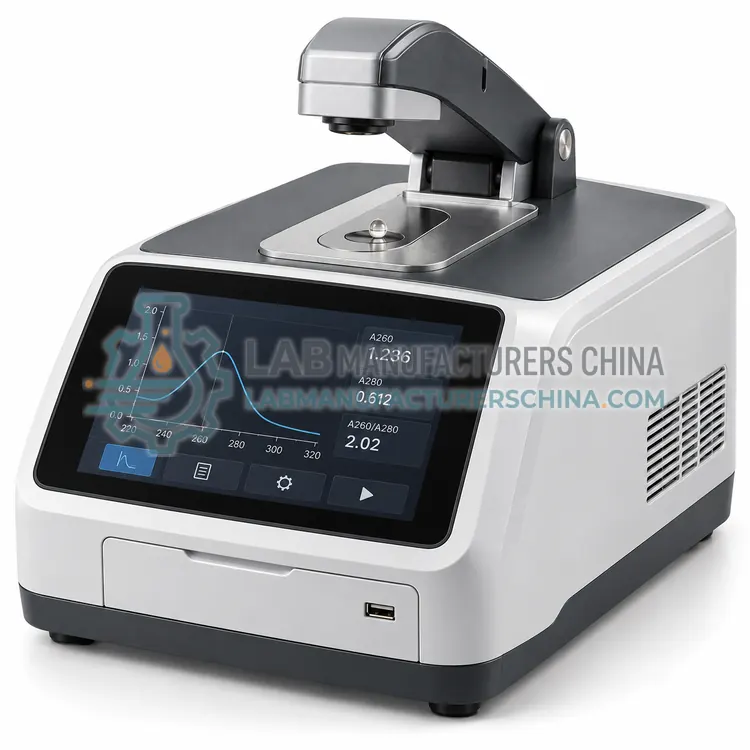
Microvolume UV-Vis Nucleic Acid Analyzer
微量紫外核酸分析仪
- SKU NUC-0001
- Nucleic Acid Analysis
- CE (to be confirmed)
- ISO 9001 manufacturing (to be confirmed)
- IEC 61010-1 test report (to be confirmed)
Price on request — FOB / CIF quoted per order
Prices depend on configuration, quantity and destination port.
Key specifications
| Wavelength range | 190-850 nm |
|---|---|
| Sample volume | 1-2 µL |
| Pathlength | 0.5-1 mm, corrected to 10 mm |
| Detection limit | About 2 ng/µL dsDNA |
| Upper linear range | 15,000 ng/µL dsDNA |
| Repeatability | Within 2 percent |
Request a quote Download brochure · to be provided
By Lab Manufacturers China Technical TeamLast reviewed Standards: ISO 20395, ISO 13485 manufacturing, MIQE guidelines
What is the Microvolume UV-Vis Nucleic Acid Analyzer?
A spectrophotometer that measures 1 to 2 µL samples at 260, 280 and 230 nm on a pedestal, reporting concentration and purity ratios in seconds. It is the routine instrument for plasmid and PCR template checks.
What is the Microvolume UV-Vis Nucleic Acid Analyzer?
A spectrophotometer that measures 1 to 2 µL samples at 260, 280 and 230 nm on a pedestal, reporting concentration and purity ratios in seconds. It is the routine instrument for plasmid and PCR template checks.
Overview
The microvolume analyser uses a pedestal and a moving arm to form a liquid column of 0.5 to 1 mm, so measurement needs only 1 to 2 µL and no cuvette. A xenon flash lamp or LED source covers 190 to 850 nm, and a CCD or photodiode array detector reads the whole spectrum, allowing the software to apply pathlength correction and automatically express results as if measured in a 10 mm cuvette. Full-spectrum scanning from 220 to 350 nm reveals contamination peaks, and a built-in algorithm detects bubbles or an insufficient sample and prompts a repeat. Typical performance includes a detection limit near 2 ng/µL for double-stranded DNA, a linear range to about 15,000 ng/µL and repeatability within 2 percent. Small footprint and no consumables make it the first-line tool in most molecular laboratories.
How does it work?
Two measurement principles dominate. Absorbance analysis uses a 1 mm or 0.5 mm pathlength in a microvolume cell and reads at 260 nm, where nucleic acids absorb strongly, then scales the result to a standard 10 mm path. A260 of 1.0 corresponds to about 50 µg/mL double-stranded DNA, 33 µg/mL single-stranded DNA and 40 µg/mL RNA, and ratios at 260/280 and 260/230 indicate protein or salt contamination. Fluorescence methods use dyes that bind specifically to double-stranded DNA or to total RNA, so signal comes only from the target, which makes them more tolerant of protein, salts and free nucleotides. Capillary electrophoresis separates fragments in a sieving polymer and reports sizes in base pairs together with molarity. Automated workstations combine measurement with pipetting so samples can be diluted to a target concentration.
What are the key features?
- Pedestal measurement with 1 to 2 µL sample volume.
- Pathlength of 0.5 to 1 mm with automatic 10 mm correction.
- Full spectrum scan from 190 to 850 nm.
- Detection limit near 2 ng/µL for double-stranded DNA.
- Bubble and low-volume detection with repeat prompt.
- No cuvettes or other consumables required.
What are the technical specifications?
A typical microvolume uv-vis nucleic acid analyzer configuration offers wavelength range of 190-850 nm, sample volume of 1-2 µL, pathlength of 0.5-1 mm, corrected to 10 mm, detection limit of About 2 ng/µL dsDNA, upper linear range of 15,000 ng/µL dsDNA and repeatability of Within 2 percent. Values are indicative of the product class; the exact figures for each configuration are confirmed on the quotation and the calibration documents supplied with the instrument.
Which applications is it used for?
The Microvolume UV-Vis Nucleic Acid Analyzer is used in plasmid and genomic DNA quantification, PCR and qPCR template checks, RNA concentration measurement and oligonucleotide concentration checks. Across the wider Nucleic Acid Analysis class, laboratories also deploy it for next-generation sequencing library quality control, template quantification before qPCR and plasmid and oligonucleotide quality checks.
Which standards and certifications apply?
Relevant standards and methods include ISO 20395, ISO 13485 manufacturing, MIQE guidelines, CLSI MM06-A2, IEC 61010-1 and IVDR (EU) 2017/746. Certification candidates for this model are CE, ISO 9001 manufacturing and IEC 61010-1 test report; each is to be confirmed for the specific configuration before shipment, and certificates are supplied only where they have been issued.
Blank the instrument with the same buffer as the sample, because buffer absorbance differs and elution buffers containing guanidine or EDTA give misleading ratios. Keep the measurement pedestal clean and wipe it between samples to avoid carryover, and check microvolume accuracy with a reference standard periodically. Fluorescent assays need fresh standards and protection of dye reagents from light, and dye-based concentration depends on assay chemistry, so do not compare results from different kits. For fragment analysis, follow the vendor's sample and ladder preparation closely, since ionic strength affects injection. Store eluted nucleic acids cold, avoid repeated freeze-thaw, and record concentration, ratios and method with every sample.
How do I select the right Microvolume UV-Vis Nucleic Acid Analyzer?
Select the microvolume analyser for routine quantification where speed and low cost per sample matter more than selectivity for double-stranded DNA. Compare wavelength range, detection limit and upper linear range against your sample types, and check whether cuvette or cuvette-mode measurement is also needed for concentrated samples. Confirm the pedestal cleaning routine and recalibration interval.
How does it compare with other Nucleic Acid Analysis variants?
Choose the method by how much selectivity you need. Absorbance is fast, inexpensive and sufficient for routine plasmid or PCR checks, but it cannot distinguish DNA from RNA and is affected by protein, phenol and salts. Fluorescence dyes are selective for double-stranded DNA or RNA and need as little as a few picograms, which suits sequencing libraries and low-yield samples. Capillary electrophoresis adds size and integrity information that no spectrophotometer provides, which matters for library insert size and RNA integrity. Throughput then decides between single-tube devices, microplate readers and automated workstations that combine measurement with normalisation. Check the minimum sample volume, detection limit, linear range, required standards and the export format your data system accepts.
Full specifications
| Wavelength range | 190-850 nm |
|---|---|
| Sample volume | 1-2 µL |
| Pathlength | 0.5-1 mm, corrected to 10 mm |
| Detection limit | About 2 ng/µL dsDNA |
| Upper linear range | 15,000 ng/µL dsDNA |
| Repeatability | Within 2 percent |
| Light source | Xenon flash lamp or LED |
| Detector | CCD or photodiode array |
| Measurement time | 3-5 s per sample |
| Power supply | 100-240 V, 50/60 Hz, 30-60 W |
Indicative values for this product class. Final specifications are confirmed on the quotation and in the calibration documents supplied with the instrument.
Applications
- Plasmid and genomic DNA quantification
- PCR and qPCR template checks
- RNA concentration measurement
- Oligonucleotide concentration checks
Key features
- Pedestal measurement with 1 to 2 µL sample volume.
- Pathlength of 0.5 to 1 mm with automatic 10 mm correction.
- Full spectrum scan from 190 to 850 nm.
- Detection limit near 2 ng/µL for double-stranded DNA.
- Bubble and low-volume detection with repeat prompt.
- No cuvettes or other consumables required.
Frequently asked questions about Microvolume UV-Vis Nucleic Acid Analyzer
Common causes are a buffer blank mismatch, an air bubble in the column, insufficient sample, or a sample left on the pedestal too long so it evaporates and concentrates. Re-blank with the same elution buffer and repeat the measurement.
No. Both absorb at 260 nm, so an absorbance reading reports total nucleic acid. Use a double-stranded DNA or RNA-specific fluorescent dye when the distinction matters, as it does for sequencing libraries.
Wipe both surfaces with a lint-free tissue moistened with water or 70 percent ethanol, then dry before the next measurement. Clean after every sample if concentrations differ widely, to prevent carryover.
A260/280 near 1.8 for DNA and 2.0 for RNA indicates low protein contamination, while A260/230 above about 2.0 suggests little carryover of salts, phenols or guanidine. Values well below these ranges usually mean the sample needs repurification.
Use fluorescence when the sample is scarce, when the template contains protein, phenol or free nucleotides, or when only double-stranded DNA should be measured. Dyes such as PicoGreen or RiboGreen report the target specifically, so values are less affected by contaminants.
For sequencing libraries, RNA samples and amplicon panels, yes. Concentration alone cannot show whether a library insert is the correct length or whether RNA is degraded, and those properties determine sequencing and qPCR performance.
Related models
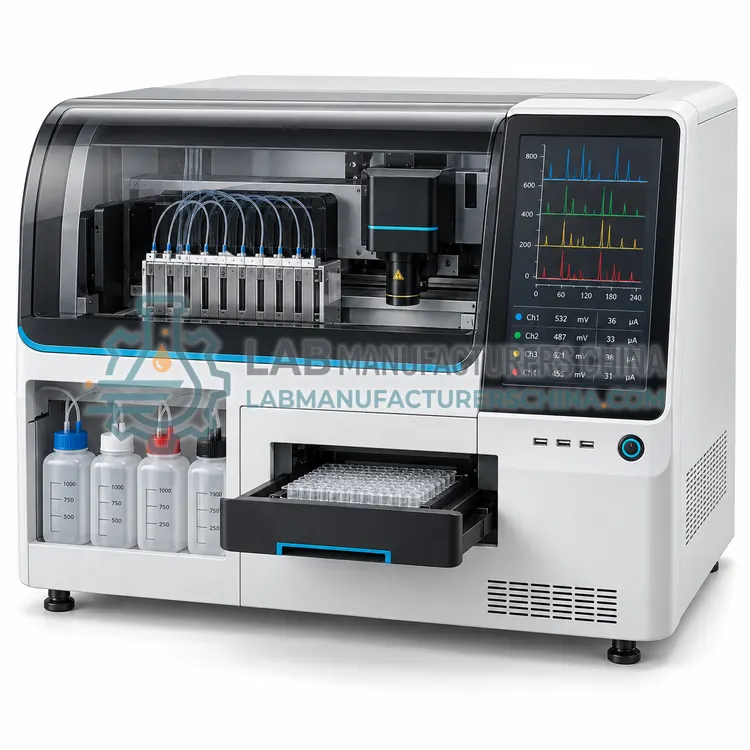
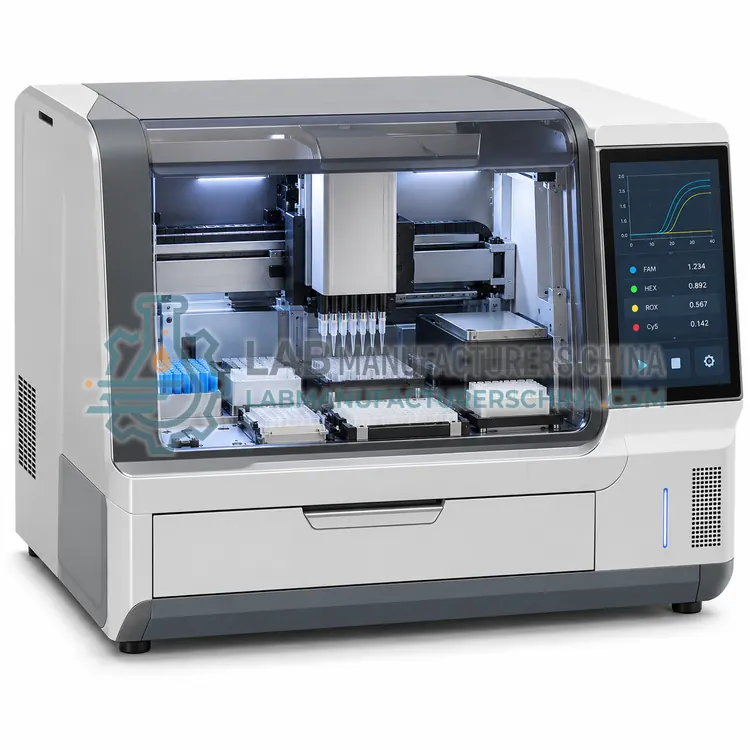
Automated Nucleic Acid Quantification and Normalization Workstation
自动核酸定量与均一化工作站
- CE (to be confirmed)
- +2