Blue-Light LED Gel Documentation System
蓝光 LED 凝胶成像系统
- SKU GED-0002
- Gel Documentation
- CE (to be confirmed)
- ISO 9001 manufacturing (to be confirmed)
- IEC 62471 photobiological safety report (to be confirmed)
Price on request — FOB / CIF quoted per order
Prices depend on configuration, quantity and destination port.
Key specifications
| Excitation wavelength | 470 nm blue LED, 460-480 nm |
|---|---|
| Light panel area | 15 cm × 15 cm to 20 cm × 25 cm |
| Emission filter | Amber or orange, 500-560 nm bandpass |
| Camera type | Cooled CCD or sCMOS |
| Camera resolution | 1-8 megapixels |
| Bit depth | 12-16 bit |
Request a quote Download brochure · to be provided
By Lab Manufacturers China Technical TeamLast reviewed Standards: IEC 61010-1, IEC 61010-2-081, IEC 62471
What is the Blue-Light LED Gel Documentation System?
A documentation system with blue LED excitation near 470 nm for SYBR-type safe stains, which avoids UV hazards and reduces DNA damage. It is generally preferred where operator safety and successful downstream cloning both matter.
What is the Blue-Light LED Gel Documentation System?
A documentation system with blue LED excitation near 470 nm for SYBR-type safe stains, which avoids UV hazards and reduces DNA damage. It is generally preferred where operator safety and successful downstream cloning both matter.
Overview
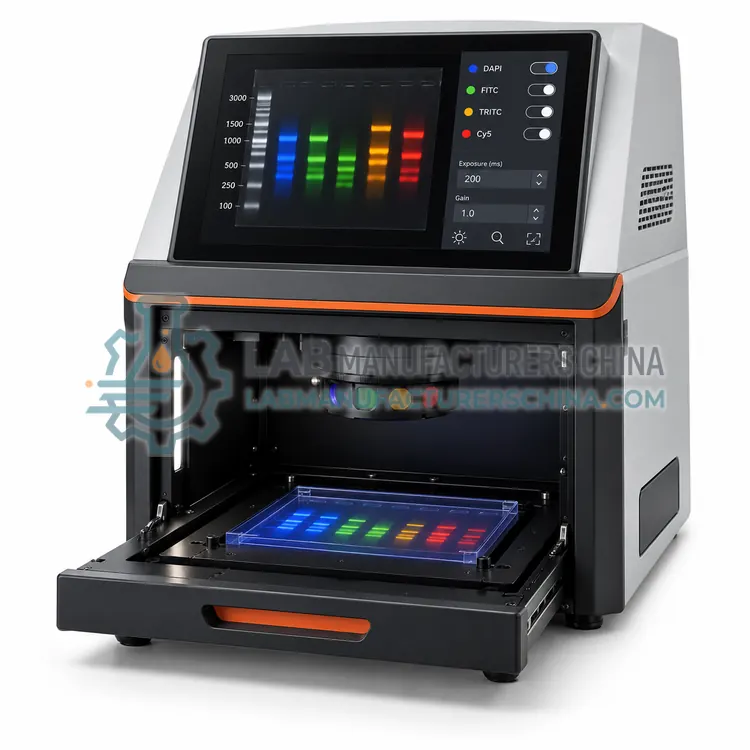
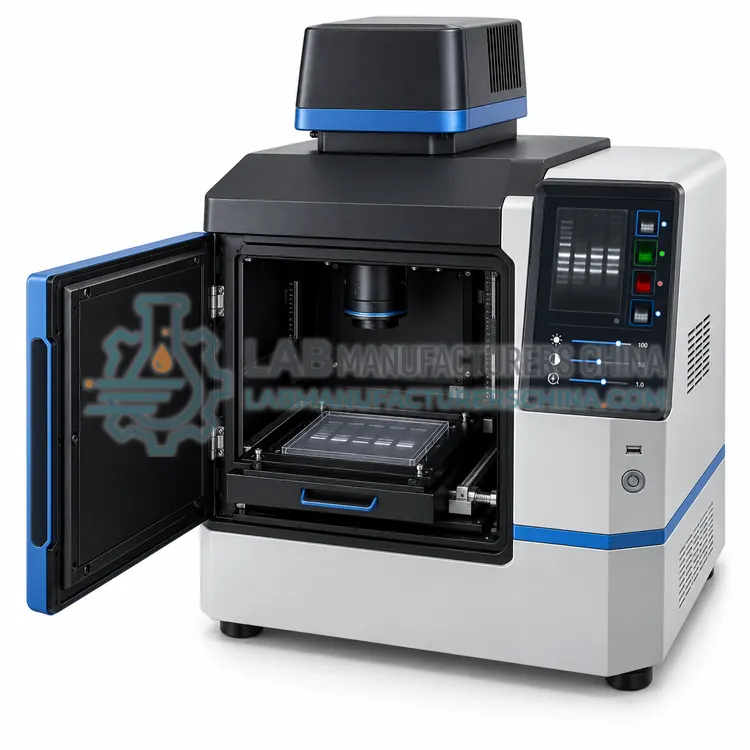
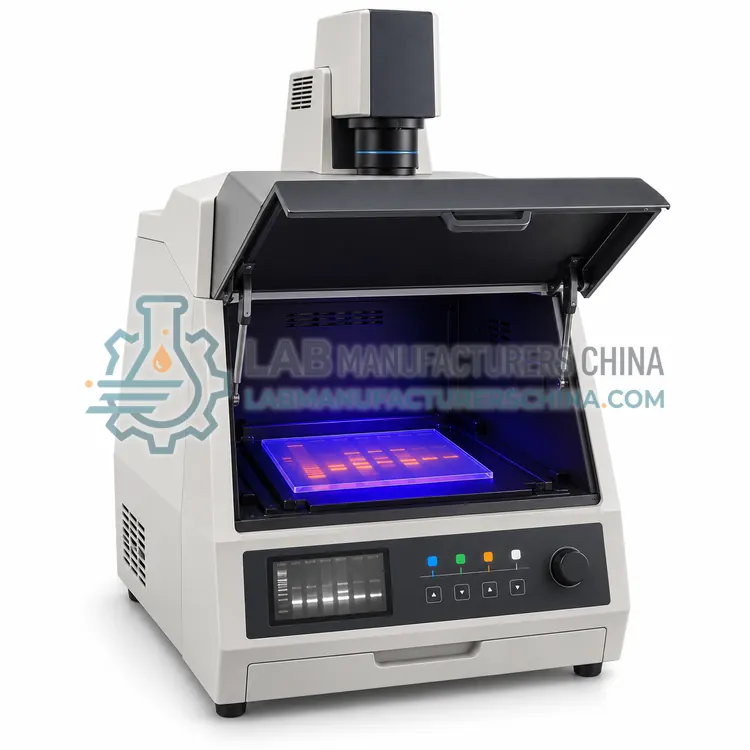
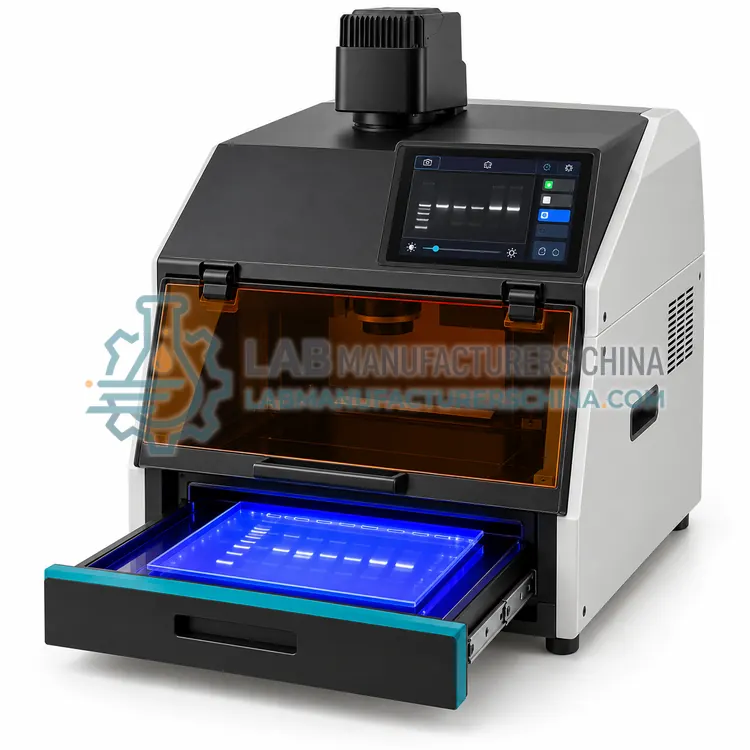
The blue-light system replaces the UV transilluminator with an LED panel emitting around 470 nm and the UV emission filter with a bandpass or long-pass filter matched to green-emitting dyes such as SYBR Safe, GelGreen or GelRed. Because blue light is far less hazardous than UV, the enclosure needs only a modest shield and users can often work with safety glasses rather than full UV protection, and DNA bands suffer less nicking, which improves cloning and sequencing success. Excitation efficiency for ethidium bromide is lower, so sensitivity is reduced when that stain is used. Systems usually include an amber or orange filter wheel and may add white epi-illumination for colorimetric gels. Cameras are similar to UV systems, with 1 to 8 megapixels and 12 to 16-bit output.
How does it work?
Gel documentation converts a stained or labelled gel into a digital image. A light source excites the sample, either from below through a transilluminator or from above with reflected light, and an emission filter blocks the excitation wavelengths so that only fluorescent signal reaches the camera. UV at 302 nm excites stains such as ethidium bromide, blue LEDs at about 470 nm excite SYBR-type dyes, and chemiluminescence needs no excitation because the blot emits light directly. A fixed-focus or motorized lens projects the image onto a cooled CCD or sCMOS sensor, where long exposures accumulate signal while cooling limits dark current. Software controls exposure, binning and filter selection, then displays 16-bit images and can measure band intensity, calculate molecular weights against a ladder and quantify fluorescence for densitometry.
What are the key features?
- 470 nm blue LED excitation panel in place of UV.
- Filters matched to SYBR-type green-emitting dyes.
- Lower DNA damage for cloning and sequencing work.
- Reduced hazard, so simple eye protection is sufficient.
- Amber or orange filter wheel for stain selection.
- Optional white epi-illumination for colorimetric gels.
What are the technical specifications?
A typical blue-light led gel documentation system configuration offers excitation wavelength of 470 nm blue LED, 460-480 nm, light panel area of 15 cm × 15 cm to 20 cm × 25 cm, emission filter of Amber or orange, 500-560 nm bandpass, camera type of Cooled CCD or sCMOS, camera resolution of 1-8 megapixels and bit depth of 12-16 bit. Values are indicative of the product class; the exact figures for each configuration are confirmed on the quotation and the calibration documents supplied with the instrument.
Which applications is it used for?
The Blue-Light LED Gel Documentation System is used in SYBR Safe and GelGreen stained gels, cloning and sequencing template checks, teaching laboratories with student operators and routine PCR product documentation. Across the wider Gel Documentation class, laboratories also deploy it for agarose gel imaging after electrophoresis, western blot chemiluminescence imaging and fluorescence multiplex gel documentation.
Which standards and certifications apply?
Relevant standards and methods include IEC 61010-1, IEC 61010-2-081, IEC 62471, IEC 61326-1 and ISO 13485 manufacturing. Certification candidates for this model are CE, ISO 9001 manufacturing and IEC 62471 photobiological safety report; each is to be confirmed for the specific configuration before shipment, and certificates are supplied only where they have been issued.
Position the system away from strong ambient light and vibration, and keep the enclosure closed during exposure. Inspect and clean the UV transilluminator filter periodically, because scratches and stains scatter light and reduce contrast. Protect the camera lens and emission filter from dust and fingerprints, storing filters in their cases. Check UV intensity with a radiometer at defined intervals, replace lamps at the rated hours and verify the interlock each time the unit is serviced. Apply a consistent exposure and aperture setting across a project so intensities are comparable, and record imaging parameters with each saved file. Ensure that users follow local rules on UV exposure, gloves and stain waste disposal.
How do I select the right Blue-Light LED Gel Documentation System?
Select the blue-light system when safe stains are used, when operators include students or visitors, or when DNA is excised for cloning. Confirm that your stain and filter combination gives adequate sensitivity, since blue excitation is weaker for ethidium bromide. Check panel size, filter options and whether a camera with low-light performance is offered.
How does it compare with other Gel Documentation variants?
Choose by the detection chemistry: UV transillumination for ethidium bromide and similar stains, blue-light LED for safer alternatives, and multifluorescence for multiplexed labels. Chemiluminescence work needs a darkroom system with a deeply cooled camera but no light source. Sensitivity depends mainly on camera quantum efficiency, cooling and lens aperture, so compare those before resolution figures. Check the excitation wavelengths and emission filters provided, whether the transilluminator is 302, 365 or dual wavelength, and how much of the gel area the lens covers. Confirm software features for band detection, ladder-based sizing, densitometry and export, and verify UV shielding and interlocks for operator safety.
Full specifications
| Excitation wavelength | 470 nm blue LED, 460-480 nm |
|---|---|
| Light panel area | 15 cm × 15 cm to 20 cm × 25 cm |
| Emission filter | Amber or orange, 500-560 nm bandpass |
| Camera type | Cooled CCD or sCMOS |
| Camera resolution | 1-8 megapixels |
| Bit depth | 12-16 bit |
| Lens | Fixed or motorized, f/1.4 |
| Exposure range | 0.1 s to 60 s |
| Software | Capture, sizing, densitometry, image export |
| Safety | LED panel, light shield, low-hazard operation |
Indicative values for this product class. Final specifications are confirmed on the quotation and in the calibration documents supplied with the instrument.
Applications
- SYBR Safe and GelGreen stained gels
- Cloning and sequencing template checks
- Teaching laboratories with student operators
- Routine PCR product documentation
Key features
- 470 nm blue LED excitation panel in place of UV.
- Filters matched to SYBR-type green-emitting dyes.
- Lower DNA damage for cloning and sequencing work.
- Reduced hazard, so simple eye protection is sufficient.
- Amber or orange filter wheel for stain selection.
- Optional white epi-illumination for colorimetric gels.
Frequently asked questions about Blue-Light LED Gel Documentation System
For SYBR-type dyes, sensitivity is comparable. For ethidium bromide, blue excitation is less efficient and signal is weaker, so choose a stain designed for blue light or accept longer exposures if that dye must be used.
Yes, although the hazard is much lower than UV. Blue light at high intensity can still cause retinal effects, so use the enclosure shield and follow the manufacturer's recommendation for filtering eyewear.
UV causes pyrimidine dimers and strand breaks that reduce cloning and sequencing efficiency. Blue light causes fewer lesions, so fragments excised after blue-light imaging are more likely to ligate and transform successfully.
UV at 302 nm excites ethidium bromide and similar intercalating stains, blue LEDs near 470 nm excite SYBR-type dyes, and white or coloured epi-illumination suits colorimetric stains. Chemiluminescence needs no light source at all.
Moderately cooled cameras are adequate for bright UV-excited gels, while chemiluminescence and weak fluorescence need cooling to -30 °C or below to keep dark current low during long exposures. Cooling extends usable exposure time.
Only with care. Intensity depends on exposure, aperture, stain concentration, gel thickness and illumination uniformity. Use fixed settings, include a ladder or standard on each gel, and confirm that no band is saturated before comparing samples.