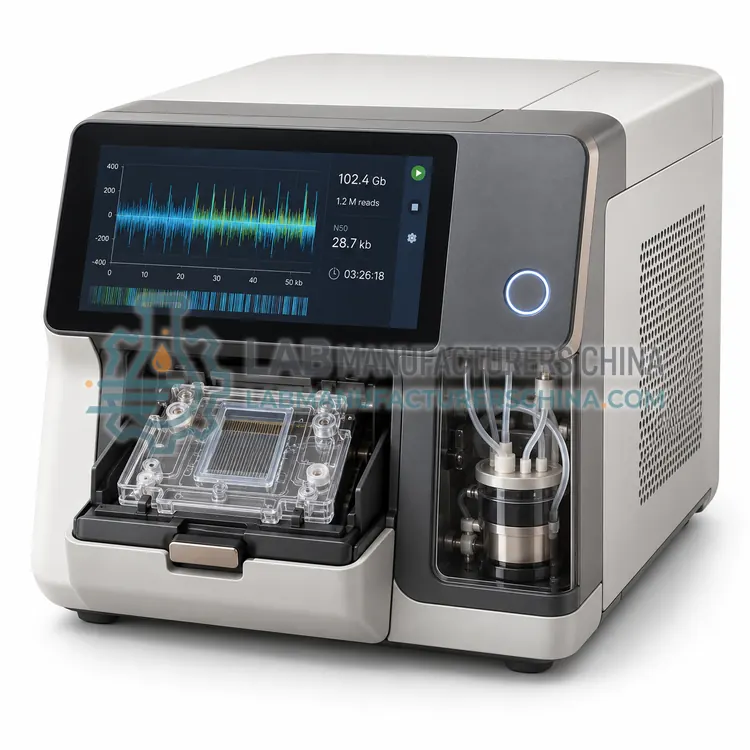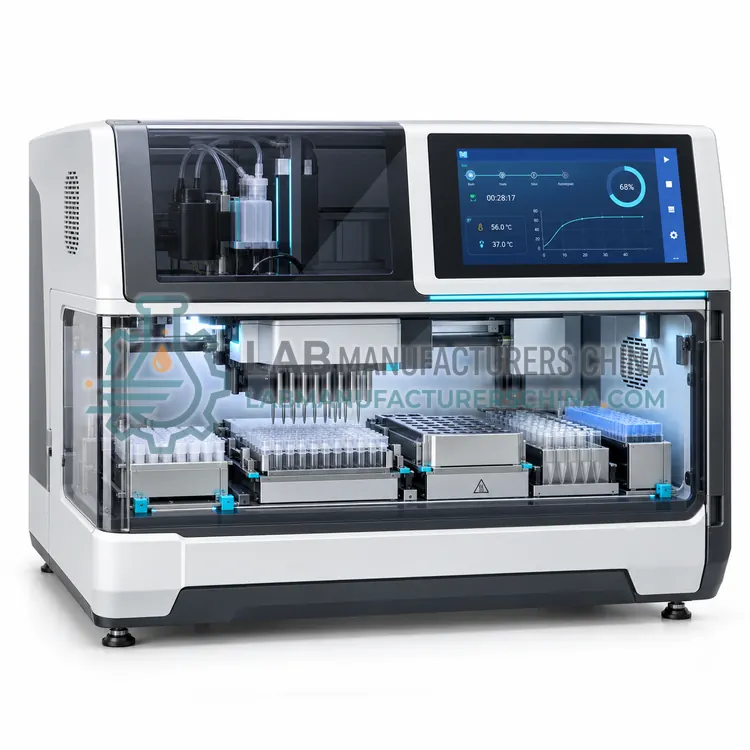
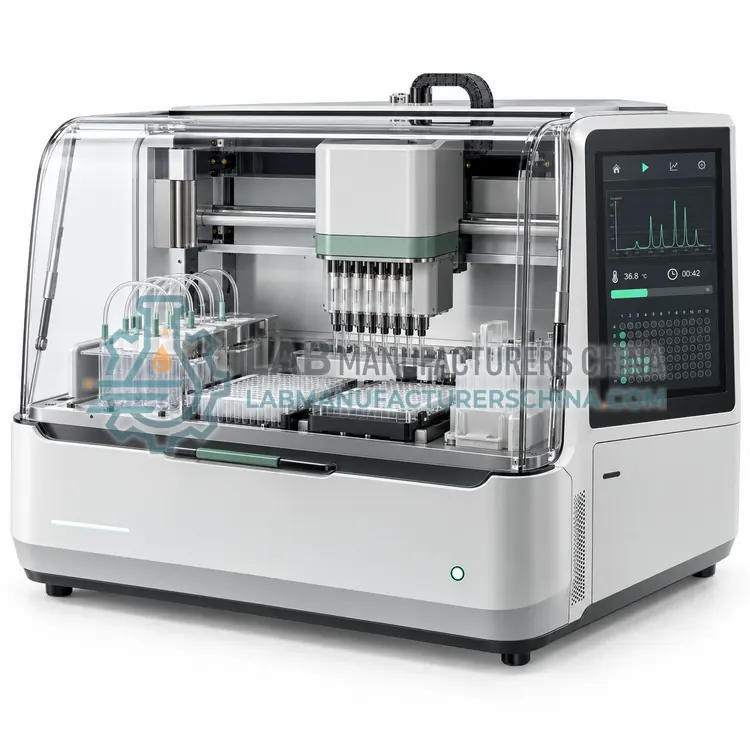
96-Well High-Throughput Extraction Platform
96 孔高通量核酸提取平台
- SKU NAE-0002
- Nucleic Acid Extractors
- CE (to be confirmed)
- ISO 9001 manufacturing (to be confirmed)
- IEC 61010-1 safety (to be confirmed)
Price on request — FOB / CIF quoted per order
Prices depend on configuration, quantity and destination port.
Key specifications
| Samples per run | up to 96 |
|---|---|
| Plate format | 96-deep-well plate |
| Sample volume | 200–500 µL |
| Elution volume | 50–100 µL |
| Batch time | approx. 30–90 min |
| Lysis temperature | ambient to 95 °C |
Request a quote Download brochure · to be provided
By Lab Manufacturers China Technical TeamLast reviewed Standards: ISO 20395, ISO 22174, ISO 15189
What is the 96-Well High-Throughput Extraction Platform?
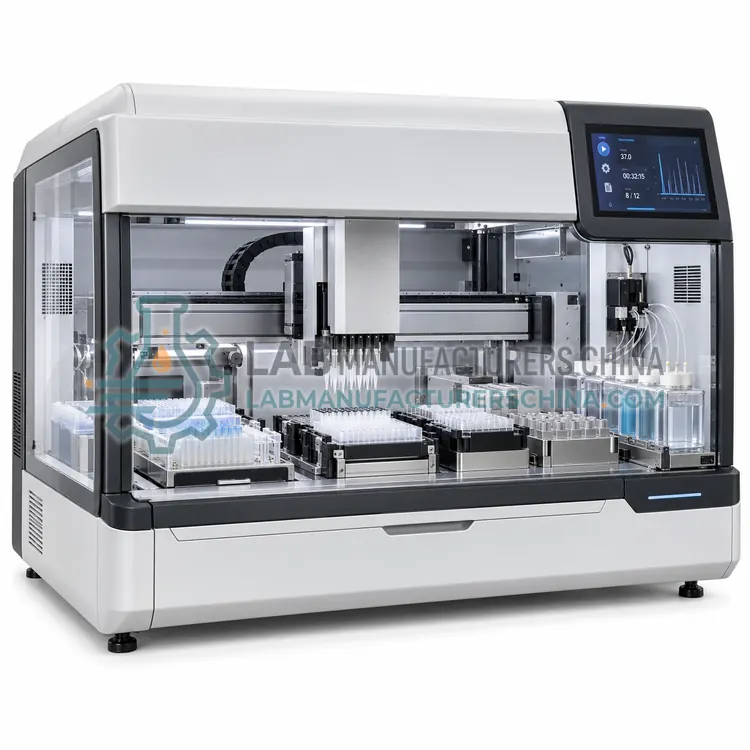
A 96-well extraction platform purifies up to 96 samples in parallel on deep-well plates, using magnetic rods or silica plates with programmable heating and mixing. It suits diagnostic laboratories and service facilities with daily batches of tens to hundreds of samples.
What is the 96-Well High-Throughput Extraction Platform?
A 96-well extraction platform purifies up to 96 samples in parallel on deep-well plates, using magnetic rods or silica plates with programmable heating and mixing. It suits diagnostic laboratories and service facilities with daily batches of tens to hundreds of samples.
Overview
The platform scales magnetic bead chemistry to a full 96-well deep-well plate. A plate carrier moves between lysis, binding, wash and elution positions, while a 96-rod magnetic head collects and releases beads across the plate simultaneously. Heating blocks reach 95 °C for lysis, and mixing is driven by vertical oscillation of the rods or by a shaker deck. Typical batch time is 30–90 minutes for 96 samples, with elution into 50–100 µL per well. Many instruments accept prefilled reagent plates for diagnostic kits, which reduces pipetting errors and hands-on time to a few minutes. Some models include a plate reader for yield estimation, barcode scanners for plate tracking, and software with user access levels and audit trails. Because the chemistry is parallel, uniformity of heating across the plate is the key performance parameter.
How does it work?
Extraction starts with lysis, which releases nucleic acid using chaotropic salts such as guanidinium thiocyanate together with detergents, proteinase K or mechanical bead beating for tough samples. In magnetic particle methods, silica-coated or carboxyl-coated beads bind nucleic acid in the presence of high salt and alcohol; a magnetic rod or plate collects the beads while wash buffers remove proteins, salts and PCR inhibitors, and a low-salt elution buffer releases the purified nucleic acid. Silica membrane and glass fibre columns work on the same chemistry but rely on vacuum or centrifugal flow through a membrane. Automated platforms move plates, tips and magnetic rods between heating, mixing, washing and elution positions. Where an internal control and DNase treatment are used, the eluate may be ready for quantitative PCR without further cleanup.
What are the key features?
- Parallel processing of up to 96 samples per plate
- 96-rod magnetic head with uniform collection across the plate
- Heated lysis and mixing up to 95 °C
- Barcode plate tracking with user access control
- Optional on-board reader for yield and purity checks
- Prefilled reagent plate compatibility for diagnostic kits
What are the technical specifications?
A typical 96-well high-throughput extraction platform configuration offers samples per run of up to 96, plate format of 96-deep-well plate, sample volume of 200–500 µL, elution volume of 50–100 µL, batch time of approx. 30–90 min and lysis temperature of ambient to 95 °C. Values are indicative of the product class; the exact figures for each configuration are confirmed on the quotation and the calibration documents supplied with the instrument.
Which applications is it used for?
The 96-Well High-Throughput Extraction Platform is used in high-volume diagnostic sample preparation, blood donor screening nucleic acid testing, plant and seed batch genotyping and food pathogen testing in service laboratories. Across the wider Nucleic Acid Extractors class, laboratories also deploy it for molecular diagnostics sample preparation, pathogen detection in food and water and plant and seed genotyping.
Which standards and certifications apply?
Relevant standards and methods include ISO 20395, ISO 22174, ISO 15189, IEC 61010-1, CLSI MM03 and GB/T 19495.3. Certification candidates for this model are CE, ISO 9001 manufacturing and IEC 61010-1 safety; each is to be confirmed for the specific configuration before shipment, and certificates are supplied only where they have been issued.
Place the extractor away from post-amplification areas to avoid amplicon contamination, and keep pre-PCR and post-PCR rooms physically separate. Perform daily contamination checks with no-template controls, clean the deck and magnetic rods with 70% ethanol or a validated decontaminant, and replace worn O-rings or rods. Verify yield and purity at installation and after service using a reference sample, and monitor the ratio of absorbance or fluorescence values over time as a trend indicator. Eluates are usually stored at 2–8 °C for short periods or below −20 °C for longer storage; repeated freeze-thaw cycles reduce integrity. For clinical use, extraction performance should be part of the assay validation under ISO 15189, including limit of detection and precision studies.
How do I select the right 96-Well High-Throughput Extraction Platform?
Select a 96-well platform when batches are large enough to fill a plate regularly, because partial plates waste reagents and time. Specify plate format, batch time, heating uniformity, prefilled plate compatibility, barcode tracking, software access control and the availability of validated diagnostic protocols.
How does it compare with other Nucleic Acid Extractors variants?
Selection begins with sample type and volume, since blood, tissue, swabs, stool and plant material differ greatly in lysis difficulty and inhibitor content. Determine the required throughput in samples per run and per day, then choose between magnetic bead platforms for flexibility, 96-well plates for parallel processing, and vacuum manifolds for low-cost manual workflows where a centrifuge is already available. Check whether the chemistry is supplied as open kits or proprietary cartridges, because this controls cost and method development freedom. Elution volume should match downstream needs: quantitative PCR tolerates 50–100 µL eluate, while low-input library preparation often requires a concentration step. Confirm cross-contamination control, barcode tracking, UV decontamination, audit trails and the availability of validated protocols for your matrices.
Full specifications
| Samples per run | up to 96 |
|---|---|
| Plate format | 96-deep-well plate |
| Sample volume | 200–500 µL |
| Elution volume | 50–100 µL |
| Batch time | approx. 30–90 min |
| Lysis temperature | ambient to 95 °C |
| Plate uniformity | within ±1 °C (typical) |
| Barcode reader | 1D/2D plate and sample tracking |
| Data management | Audit trail with user access levels |
| Dimensions (W x D x H) | approx. 600 x 600 x 500 mm |
Indicative values for this product class. Final specifications are confirmed on the quotation and in the calibration documents supplied with the instrument.
Applications
- High-volume diagnostic sample preparation
- Blood donor screening nucleic acid testing
- Plant and seed batch genotyping
- Food pathogen testing in service laboratories
Key features
- Parallel processing of up to 96 samples per plate
- 96-rod magnetic head with uniform collection across the plate
- Heated lysis and mixing up to 95 °C
- Barcode plate tracking with user access control
- Optional on-board reader for yield and purity checks
- Prefilled reagent plate compatibility for diagnostic kits
Frequently asked questions about 96-Well High-Throughput Extraction Platform
Most protocols finish in 30–90 minutes depending on lysis time, the number of wash steps and whether a dry step is included. Total time is set by the chemistry, not by the instrument, so faster kits are the usual way to shorten batches.
Yes on most instruments, but unused wells still consume reagents in prefilled plates and heaters must be loaded evenly for uniform temperature. Laboratories usually pool samples until a plate is reasonably full to control cost per sample.
Only if the kit supplies plates or cartridges matching the instrument's geometry and magnet layout, and if the supplier has validated that combination. Ask for a verification report showing yield, purity and limit of detection on the combination you intend to use.
Magnetic bead methods bind nucleic acid to particles that are collected with a magnet, which suits automation and high throughput. Column methods bind nucleic acid on a silica membrane and rely on vacuum or centrifugation. Both give comparable purity when the protocol is followed.
Inhibition usually comes from residual ethanol, guanidinium salts, haemoglobin, humic acids or polysaccharides carried over from the sample matrix. Additional wash steps, a longer drying step before elution, or dilution of the eluate generally resolves it. Internal controls help confirm inhibition.
Bench magnetic bead instruments typically accept 200–1,000 µL per sample, while 96-well platforms usually work with 200–500 µL. Larger volume protocols improve sensitivity for low-titre samples but need longer lysis and binding times.