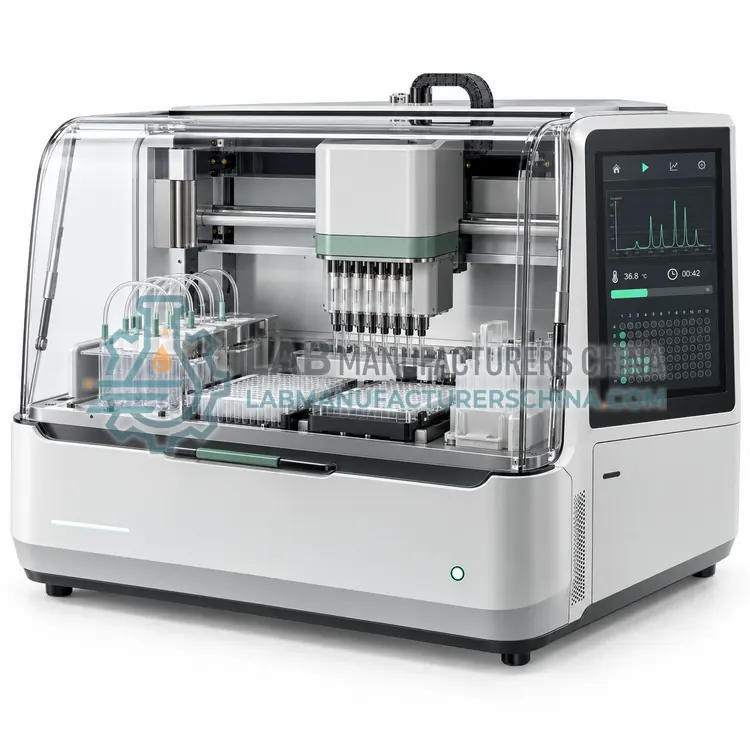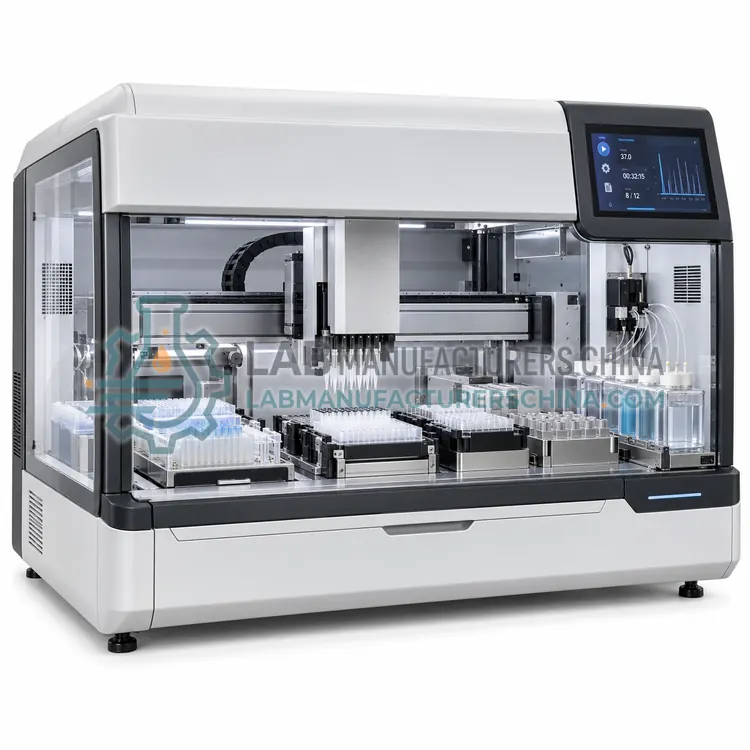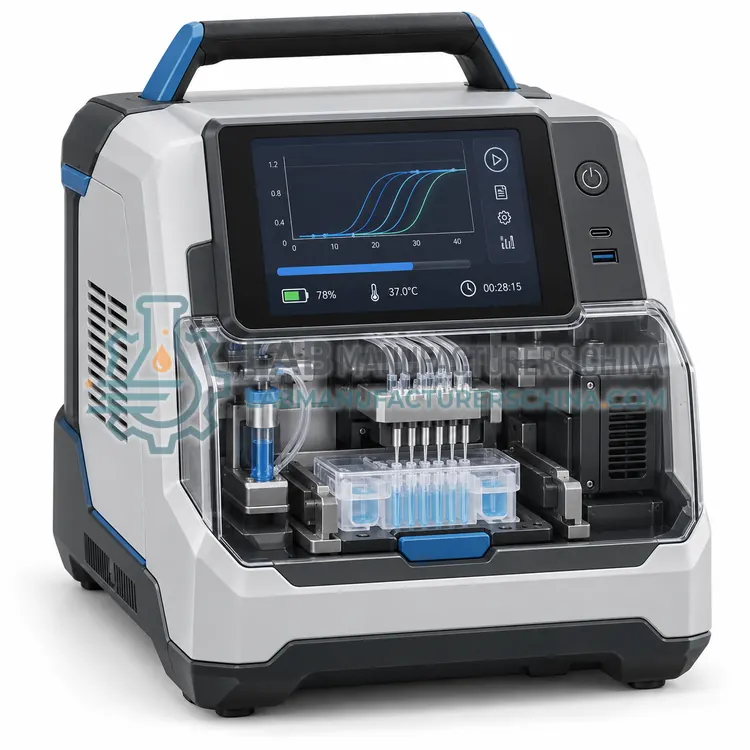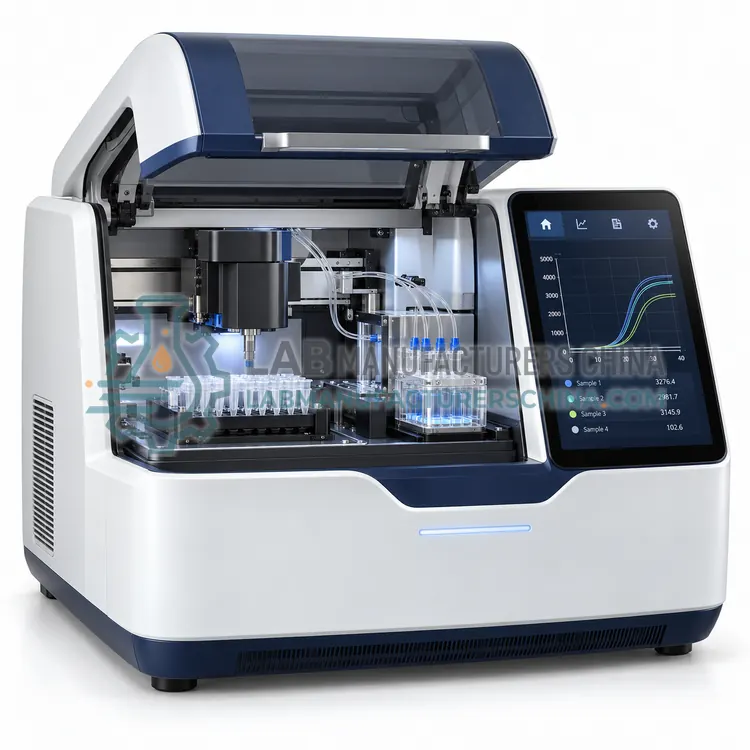
Vacuum Manifold Column Purification System
真空歧管柱纯化系统
- SKU NAE-0004
- Nucleic Acid Extractors
- ISO 9001 manufacturing (to be confirmed)
- CE (to be confirmed)
Price on request — FOB / CIF quoted per order
Prices depend on configuration, quantity and destination port.
Key specifications
| Format | 24-well or 96-well manifold |
|---|---|
| Samples per batch | 24–96 |
| Vacuum requirement | approx. −50 to −80 kPa |
| Sample volume | 200–1,000 µL per well |
| Elution volume | 30–100 µL |
| Membrane | Silica glass fibre |
Request a quote Download brochure · to be provided
By Lab Manufacturers China Technical TeamLast reviewed Standards: ISO 20395, ISO 22174, ISO 15189
What is the Vacuum Manifold Column Purification System?
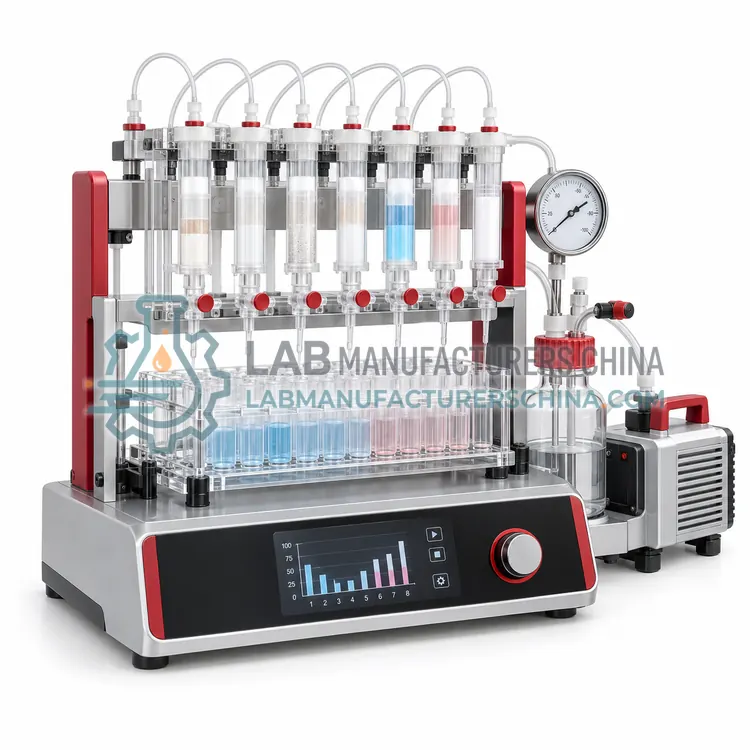
A vacuum manifold system purifies nucleic acid on silica spin plates or columns under vacuum, processing 24 to 96 samples at low equipment cost. It is the practical choice for laboratories that already have a vacuum source and centrifuge and need economical batch purification.
What is the Vacuum Manifold Column Purification System?
A vacuum manifold system purifies nucleic acid on silica spin plates or columns under vacuum, processing 24 to 96 samples at low equipment cost. It is the practical choice for laboratories that already have a vacuum source and centrifuge and need economical batch purification.
Overview
The manifold is a plate holder with individual wells that connect to a vacuum pump, so that lysis mixtures and wash buffers are drawn through a silica membrane in seconds rather than by centrifugation. Samples are lysed and bound in tubes or a deep-well plate, transferred to the spin plate, washed under vacuum, dried briefly, and eluted either by vacuum or by centrifugation. Configurations range from 24-well manifolds for manual work to 96-well versions that accept multi-channel pipettes or a plate centrifuge. Because no magnetic beads or robotics are involved, consumable cost per sample is among the lowest available, but hands-on time is higher than on automated platforms. Membrane binding capacity limits the amount of nucleic acid per well, and viscous lysates may need longer vacuum times.
How does it work?
Extraction starts with lysis, which releases nucleic acid using chaotropic salts such as guanidinium thiocyanate together with detergents, proteinase K or mechanical bead beating for tough samples. In magnetic particle methods, silica-coated or carboxyl-coated beads bind nucleic acid in the presence of high salt and alcohol; a magnetic rod or plate collects the beads while wash buffers remove proteins, salts and PCR inhibitors, and a low-salt elution buffer releases the purified nucleic acid. Silica membrane and glass fibre columns work on the same chemistry but rely on vacuum or centrifugal flow through a membrane. Automated platforms move plates, tips and magnetic rods between heating, mixing, washing and elution positions. Where an internal control and DNase treatment are used, the eluate may be ready for quantitative PCR without further cleanup.
What are the key features?
- 24-well and 96-well manifold formats for batch purification
- Silica membrane binding under vacuum for fast wash steps
- Works with existing vacuum pump and plate centrifuge
- Luer or barbed fittings for standard laboratory tubing
- Individual valve control to isolate blocked wells
- Low consumable cost per sample
What are the technical specifications?
A typical vacuum manifold column purification system configuration offers format of 24-well or 96-well manifold, samples per batch of 24–96, vacuum requirement of approx. −50 to −80 kPa, sample volume of 200–1,000 µL per well, elution volume of 30–100 µL and membrane of Silica glass fibre. Values are indicative of the product class; the exact figures for each configuration are confirmed on the quotation and the calibration documents supplied with the instrument.
Which applications is it used for?
The Vacuum Manifold Column Purification System is used in plasmid and gel extraction purification, low-cost batch DNA purification from blood, PCR product cleanup before sequencing and RNA isolation with on-column DNase digestion. Across the wider Nucleic Acid Extractors class, laboratories also deploy it for molecular diagnostics sample preparation, pathogen detection in food and water and plant and seed genotyping.
Which standards and certifications apply?
Relevant standards and methods include ISO 20395, ISO 22174, ISO 15189, IEC 61010-1, CLSI MM03 and GB/T 19495.3. Certification candidates for this model are ISO 9001 manufacturing and CE; each is to be confirmed for the specific configuration before shipment, and certificates are supplied only where they have been issued.
Place the extractor away from post-amplification areas to avoid amplicon contamination, and keep pre-PCR and post-PCR rooms physically separate. Perform daily contamination checks with no-template controls, clean the deck and magnetic rods with 70% ethanol or a validated decontaminant, and replace worn O-rings or rods. Verify yield and purity at installation and after service using a reference sample, and monitor the ratio of absorbance or fluorescence values over time as a trend indicator. Eluates are usually stored at 2–8 °C for short periods or below −20 °C for longer storage; repeated freeze-thaw cycles reduce integrity. For clinical use, extraction performance should be part of the assay validation under ISO 15189, including limit of detection and precision studies.
How do I select the right Vacuum Manifold Column Purification System?
Select a vacuum manifold when consumable cost per sample is the priority and manual batch work is acceptable. Specify plate format, vacuum pressure range, sample and elution volume, membrane type, autoclavability and compatibility with your existing pump and plate centrifuge.
How does it compare with other Nucleic Acid Extractors variants?
Selection begins with sample type and volume, since blood, tissue, swabs, stool and plant material differ greatly in lysis difficulty and inhibitor content. Determine the required throughput in samples per run and per day, then choose between magnetic bead platforms for flexibility, 96-well plates for parallel processing, and vacuum manifolds for low-cost manual workflows where a centrifuge is already available. Check whether the chemistry is supplied as open kits or proprietary cartridges, because this controls cost and method development freedom. Elution volume should match downstream needs: quantitative PCR tolerates 50–100 µL eluate, while low-input library preparation often requires a concentration step. Confirm cross-contamination control, barcode tracking, UV decontamination, audit trails and the availability of validated protocols for your matrices.
Full specifications
| Format | 24-well or 96-well manifold |
|---|---|
| Samples per batch | 24–96 |
| Vacuum requirement | approx. −50 to −80 kPa |
| Sample volume | 200–1,000 µL per well |
| Elution volume | 30–100 µL |
| Membrane | Silica glass fibre |
| Batch time | approx. 30–60 min |
| Material | Polypropylene manifold with stainless steel fittings |
| Autoclavable | Yes (manifold body) |
| Dimensions (W x D x H) | approx. 300 x 250 x 180 mm |
Indicative values for this product class. Final specifications are confirmed on the quotation and in the calibration documents supplied with the instrument.
Applications
- Plasmid and gel extraction purification
- Low-cost batch DNA purification from blood
- PCR product cleanup before sequencing
- RNA isolation with on-column DNase digestion
Key features
- 24-well and 96-well manifold formats for batch purification
- Silica membrane binding under vacuum for fast wash steps
- Works with existing vacuum pump and plate centrifuge
- Luer or barbed fittings for standard laboratory tubing
- Individual valve control to isolate blocked wells
- Low consumable cost per sample
Frequently asked questions about Vacuum Manifold Column Purification System
Most silica membrane plates flow well at −50 to −80 kPa. Higher vacuum speeds up viscous lysates but can compress the membrane or force liquid past the binding step, so protocols usually specify a target pressure and the pump should be adjustable.
Manifold purification has lower consumable cost and needs no dedicated instrument, but requires more pipetting and cannot easily scale to hundreds of samples per day. Magnetic bead automation costs more per sample and saves labour, so the choice depends on batch size and labour cost.
Individual valves allow a blocked well to be closed while others continue, and the column can be processed separately by centrifugation. Very cloudy lysates should be cleared first, because particulate matter is the most common cause of slow flow.
Magnetic bead methods bind nucleic acid to particles that are collected with a magnet, which suits automation and high throughput. Column methods bind nucleic acid on a silica membrane and rely on vacuum or centrifugation. Both give comparable purity when the protocol is followed.
Inhibition usually comes from residual ethanol, guanidinium salts, haemoglobin, humic acids or polysaccharides carried over from the sample matrix. Additional wash steps, a longer drying step before elution, or dilution of the eluate generally resolves it. Internal controls help confirm inhibition.
Bench magnetic bead instruments typically accept 200–1,000 µL per sample, while 96-well platforms usually work with 200–500 µL. Larger volume protocols improve sensitivity for low-titre samples but need longer lysis and binding times.
Related models