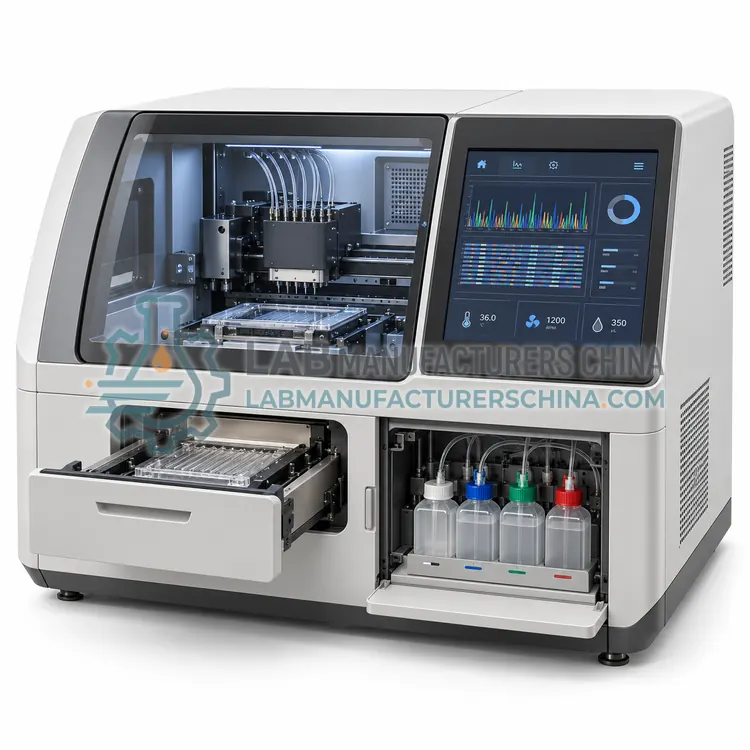
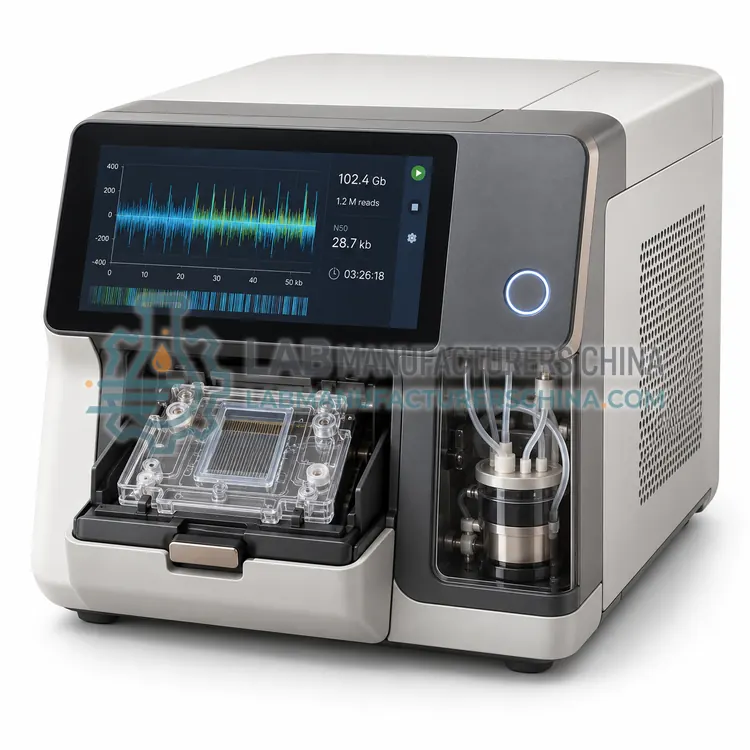
Long-Read Nanopore Sequencer
长读长纳米孔测序仪
- SKU DNS-0003
- DNA Sequencers
- CE (to be confirmed)
- ISO 9001 manufacturing (to be confirmed)
- IEC 61010-1 safety (to be confirmed)
Price on request — FOB / CIF quoted per order
Prices depend on configuration, quantity and destination port.
Key specifications
| Read length | 10 kb–100 kb typical, over 1 Mb maximum |
|---|---|
| Read accuracy | approx. 95–99% single read, higher with duplex |
| Output per flow cell | approx. 10–50 Gb |
| Run time | up to 72 h (real-time output) |
| Input DNA | 100 ng–1 µg (high molecular weight) |
| Input RNA | approx. 50–200 ng (direct RNA kit) |
Request a quote Download brochure · to be provided
By Lab Manufacturers China Technical TeamLast reviewed Standards: ISO 20395, ISO 22174, ISO 15189
What is the Long-Read Nanopore Sequencer?
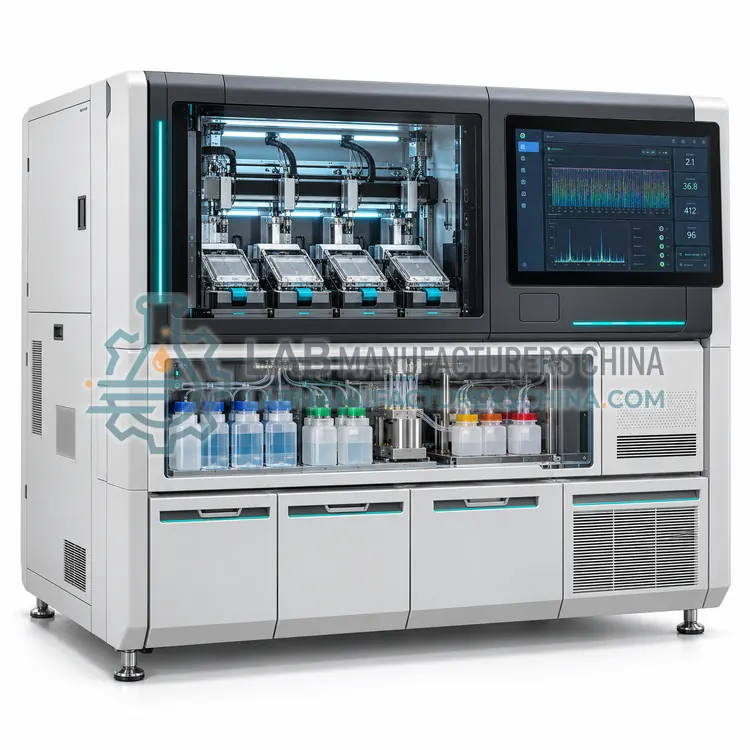
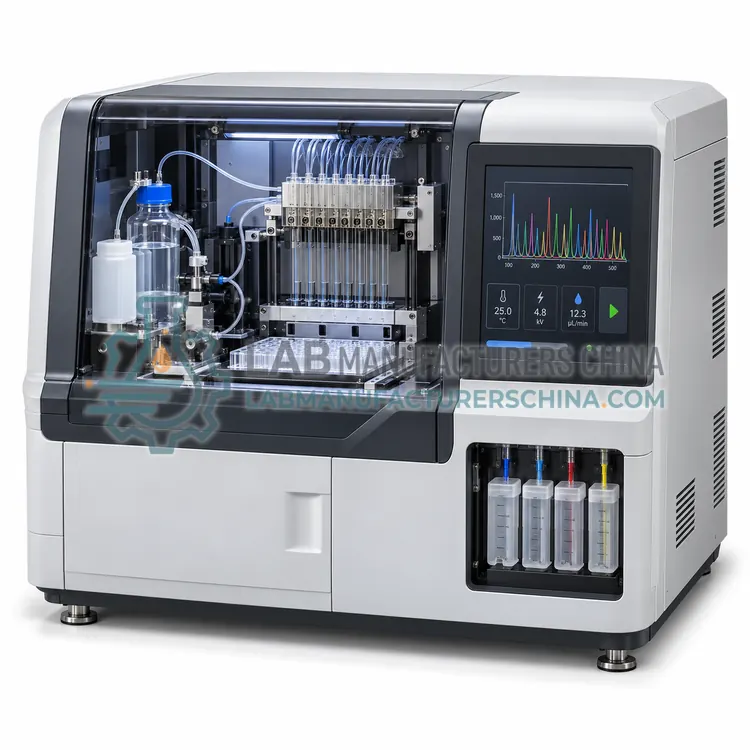
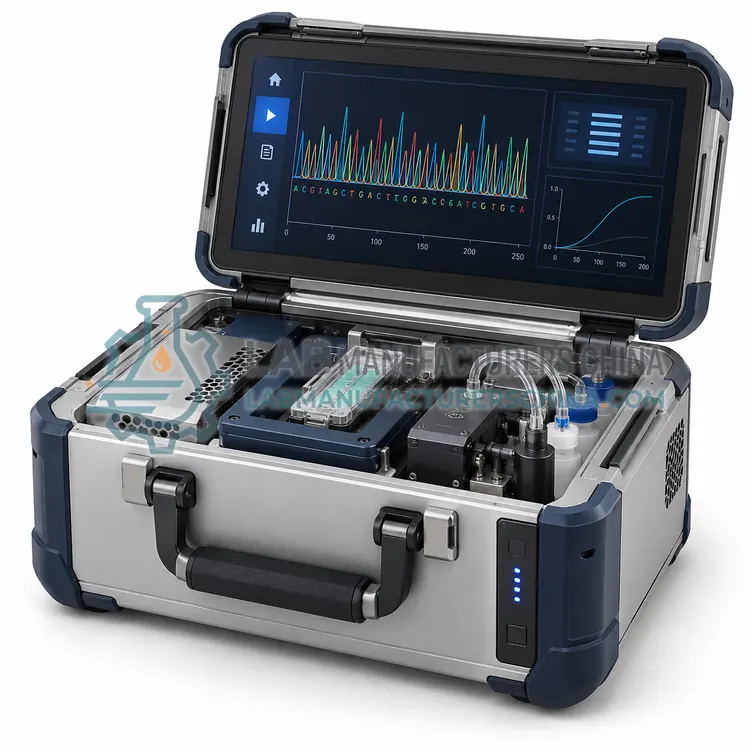
A long-read nanopore sequencer threads native DNA or RNA through protein pores and reads current changes, producing reads of tens to hundreds of kilobases. It resolves repeats, structural variants and full-length transcripts, and can detect native base modifications without extra chemistry.
What is the Long-Read Nanopore Sequencer?
A long-read nanopore sequencer threads native DNA or RNA through protein pores and reads current changes, producing reads of tens to hundreds of kilobases. It resolves repeats, structural variants and full-length transcripts, and can detect native base modifications without extra chemistry.
Overview
Nanopore sequencing avoids optical detection and PCR amplification. A motor protein feeds a single nucleic acid strand through a biological pore embedded in a synthetic membrane; as each base passes, it changes the ionic current in a characteristic way, and the instrument records that signal for base calling in software. Because the strand is read directly, read length is limited mainly by sample quality, and runs routinely produce reads of 10–100 kb with maximum lengths beyond 1 Mb. Native DNA methylation can be called from the same signal, removing the need for bisulfite conversion. Devices range from a pocket-sized unit with a single flow cell to benchtop instruments running multiple flow cells and producing tens to hundreds of gigabases. Raw accuracy is lower than synthesis-based platforms, but duplex reads and high coverage achieve consensus accuracy suitable for variant calling.
How does it work?
Most high-throughput sequencers use sequencing by synthesis. A library of adapter-tagged fragments is loaded onto a flow cell or bead surface, where clonal clusters are formed so that each local signal comes from many identical copies. Fluorescently labelled nucleotides with reversible terminators are incorporated one base at a time by a polymerase; after each cycle the instrument images the surface, records the base colour for every cluster, and cleaves the terminator so the next base can be added. Base calls are assembled into reads and aligned to a reference. Nanopore instruments instead pull a single strand through a protein pore and read characteristic current changes for each base. Sanger instruments label fragments with chain-terminating dideoxy nucleotides and separate them by capillary electrophoresis with laser-induced fluorescence detection.
What are the key features?
- Reads of tens to hundreds of kilobases from native DNA or RNA
- Direct detection of native methylation without bisulfite conversion
- No PCR required, avoiding amplification bias and GC dropout
- Real-time base calling with results available during the run
- Modular flow cells allow scaling from portable to benchtop use
- Sample preparation completed in about 10–60 minutes
What are the technical specifications?
A typical long-read nanopore sequencer configuration offers read length of 10 kb–100 kb typical, over 1 Mb maximum, read accuracy of approx. 95–99% single read, higher with duplex, output per flow cell of approx. 10–50 Gb, run time of up to 72 h (real-time output), input DNA of 100 ng–1 µg (high molecular weight) and input RNA of approx. 50–200 ng (direct RNA kit). Values are indicative of the product class; the exact figures for each configuration are confirmed on the quotation and the calibration documents supplied with the instrument.
Which applications is it used for?
The Long-Read Nanopore Sequencer is used in structural variant and repeat expansion analysis, full-length transcript and isoform sequencing, bacterial and viral genome assembly and methylation and epigenetics studies. Across the wider DNA Sequencers class, laboratories also deploy it for whole-genome and exome resequencing, RNA sequencing and gene expression profiling and pathogen whole-genome surveillance.
Which standards and certifications apply?
Relevant standards and methods include ISO 20395, ISO 22174, ISO 15189, CLSI MM09, IEC 61010-1 and ISO 17025. Certification candidates for this model are CE, ISO 9001 manufacturing and IEC 61010-1 safety; each is to be confirmed for the specific configuration before shipment, and certificates are supplied only where they have been issued.
Sequencing instruments need a stable bench, clean power and a room with controlled temperature and low dust, because optics and flow-cell surfaces are sensitive. Illumina-style platforms are typically installed with their own compute server and require a defined data path, backup policy and firewall rules. Budget for consumables per run, flow-cell shelf life and the storage of large sequence files, which often exceeds instrument cost within a few years. Decontaminate the instrument area and use separate pre-PCR and post-PCR rooms to avoid amplicon carry-over. Validate accuracy and reproducibility with a reference genome or control library at installation and after major service. Sequence data from human samples must be handled under local privacy rules and, in clinical use, under ISO 15189 accreditation.
How do I select the right Long-Read Nanopore Sequencer?
Select a nanopore sequencer when read length, native modification detection or rapid field use matters more than the lowest per-base cost. Specify flow cell output, expected read length distribution, input amount, duplex accuracy mode, base-calling hardware and whether real-time analysis software is included.
How does it compare with other DNA Sequencers variants?
Choose a sequencer by read length, output and accuracy rather than by headline specifications. For whole-genome resequencing, exomes, RNA sequencing and large amplicon panels, a benchtop short-read instrument with 15–150 Gb of output per run usually gives the lowest cost per sample and the simplest workflow. Production laboratories with many samples per week should compare cost per gigabase, run time and automated loading, and confirm whether indexes and flow cells are open or proprietary. Long-read platforms are decisive when repeats, structural variants, full-length transcripts or native DNA modifications matter. Keep a capillary sequencer for single-target confirmation, plasmid and amplicon checks where turnaround time dominates. Confirm the supported library kits, on-board or server analysis software, data storage and bioinformatics support before ordering.
Full specifications
| Read length | 10 kb–100 kb typical, over 1 Mb maximum |
|---|---|
| Read accuracy | approx. 95–99% single read, higher with duplex |
| Output per flow cell | approx. 10–50 Gb |
| Run time | up to 72 h (real-time output) |
| Input DNA | 100 ng–1 µg (high molecular weight) |
| Input RNA | approx. 50–200 ng (direct RNA kit) |
| Flow cells | 1–4 per instrument (model dependent) |
| Detection | Ionic current change through protein nanopore |
| Base modifications | Native methylation called from signal |
| Dimensions (W x D x H) | approx. 100 x 30 x 20 mm (portable unit) |
Indicative values for this product class. Final specifications are confirmed on the quotation and in the calibration documents supplied with the instrument.
Applications
- Structural variant and repeat expansion analysis
- Full-length transcript and isoform sequencing
- Bacterial and viral genome assembly
- Methylation and epigenetics studies
Key features
- Reads of tens to hundreds of kilobases from native DNA or RNA
- Direct detection of native methylation without bisulfite conversion
- No PCR required, avoiding amplification bias and GC dropout
- Real-time base calling with results available during the run
- Modular flow cells allow scaling from portable to benchtop use
- Sample preparation completed in about 10–60 minutes
Frequently asked questions about Long-Read Nanopore Sequencer
Read length follows the input DNA size. With high molecular weight DNA, typical reads are 10–100 kb and the longest can exceed 1 Mb. Degraded samples shorten reads sharply, so extraction methods that preserve long fragments are essential.
No. The standard ligation and rapid kits sequence native DNA directly, which removes amplification bias and enables detection of base modifications. PCR-based kits are available when input is very low or heavily degraded.
Single reads are less accurate than synthesis-based reads, but duplex reads and coverage of 30x or more reach the accuracy needed for germline and many somatic analyses. Clinical use still requires validation with reference material and, ideally, confirmation by a second method.
Short-read platforms read 75–300 bases per read with very high accuracy and low cost per base, which suits variant calling and expression profiling. Long-read platforms read thousands to millions of bases, resolving repeats and structural variants, but need more input DNA and cost more per base.
Requirements depend on the library method. Standard whole-genome libraries typically start from 100 ng to 1 µg of DNA, PCR-based amplicon methods need only 1–10 ng, and some tagmentation workflows accept as little as 10–50 ng. Degraded samples usually need more input.
Benchtop instruments often run base calling and secondary analysis on board or on a bundled computer, which is enough for small panels. Whole-genome or high-throughput work generally needs an external server or cluster for alignment, variant calling and storage of terabyte-scale data.