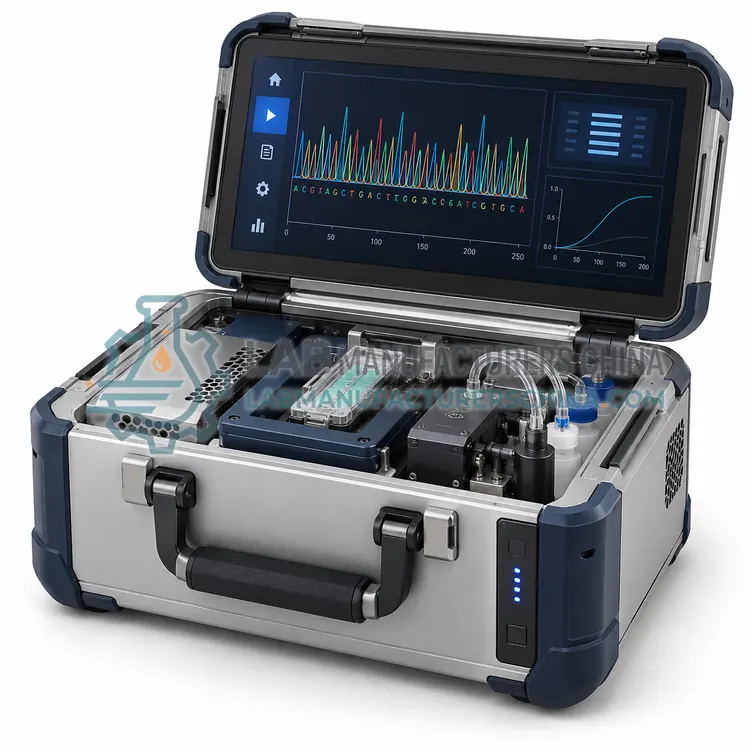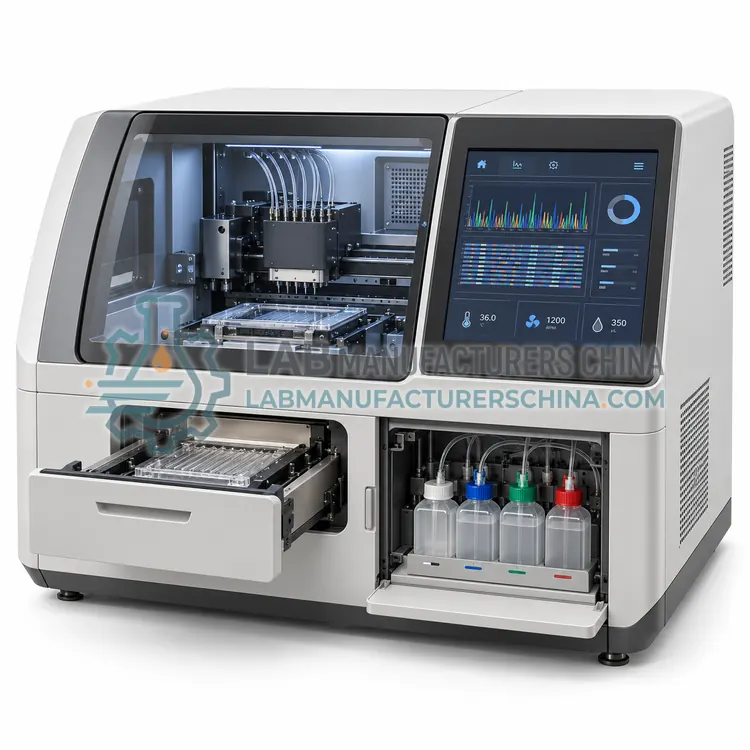
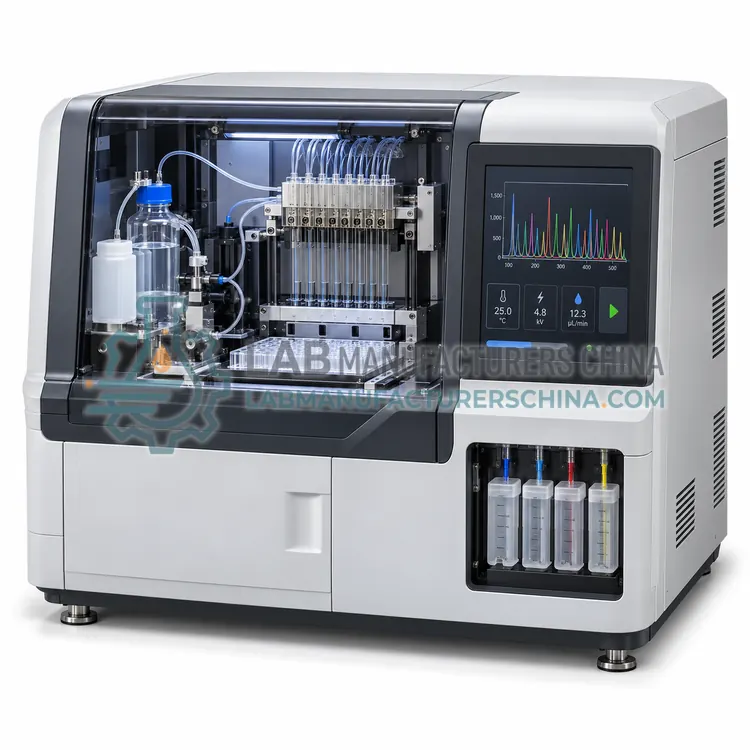
Sanger Capillary DNA Analyzer
桑格毛细管测序仪
- SKU DNS-0004
- DNA Sequencers
- CE (to be confirmed)
- ISO 9001 manufacturing (to be confirmed)
- IEC 61010-1 safety (to be confirmed)
Price on request — FOB / CIF quoted per order
Prices depend on configuration, quantity and destination port.
Key specifications
| Capillaries | 4, 8, 16 or 24 channels |
|---|---|
| Read length | up to 1,000 bases |
| Base calling accuracy | over 99% for first 600 bases (typical) |
| Run time | approx. 20–90 min |
| Sample format | 96-well plate or 8-strip tubes |
| Detection | Laser-induced fluorescence, 4–5 dyes |
Request a quote Download brochure · to be provided
By Lab Manufacturers China Technical TeamLast reviewed Standards: ISO 20395, ISO 22174, ISO 15189
What is the Sanger Capillary DNA Analyzer?
A Sanger capillary analyzer performs dideoxy chain-termination sequencing and fragment analysis by capillary electrophoresis with laser-induced fluorescence, confirming variants, verifying plasmids and clones, and sizing amplicons. It is the reference method for single-target sequence confirmation.
What is the Sanger Capillary DNA Analyzer?
A Sanger capillary analyzer performs dideoxy chain-termination sequencing and fragment analysis by capillary electrophoresis with laser-induced fluorescence, confirming variants, verifying plasmids and clones, and sizing amplicons. It is the reference method for single-target sequence confirmation.
Overview
The capillary analyzer separates fluorescently labelled DNA fragments by electrophoresis in a polymer-filled capillary array, typically 4, 8, 16 or 24 capillaries. Cycle sequencing with chain-terminating dideoxy nucleotides produces fragments of every length, each carrying a dye that identifies the terminal base. During electrophoresis the fragments pass a laser detection window, and the software converts the fluorescence trace into a base-called sequence with quality values. Read length is typically 600–1000 bases with accuracy above 99% for the first several hundred bases. The same instrument performs fragment analysis for microsatellite sizing and multiplex ligation-dependent probe amplification. Runs take 20–90 minutes depending on the polymer and capillary length, and a plate of 96 samples is processed in a few hours with minimal hands-on time.
How does it work?
Most high-throughput sequencers use sequencing by synthesis. A library of adapter-tagged fragments is loaded onto a flow cell or bead surface, where clonal clusters are formed so that each local signal comes from many identical copies. Fluorescently labelled nucleotides with reversible terminators are incorporated one base at a time by a polymerase; after each cycle the instrument images the surface, records the base colour for every cluster, and cleaves the terminator so the next base can be added. Base calls are assembled into reads and aligned to a reference. Nanopore instruments instead pull a single strand through a protein pore and read characteristic current changes for each base. Sanger instruments label fragments with chain-terminating dideoxy nucleotides and separate them by capillary electrophoresis with laser-induced fluorescence detection.
What are the key features?
- Capillary array of 4 to 24 channels for parallel sequencing
- Read length of 600–1000 bases with quality scores per base
- Same platform runs sequencing and fragment analysis applications
- Automated polymer and buffer exchange between runs
- Barcode and plate-based sample tracking with audit trail
- Laser-induced fluorescence detection for four or five dyes
What are the technical specifications?
A typical sanger capillary dna analyzer configuration offers capillaries of 4, 8, 16 or 24 channels, read length of up to 1,000 bases, base calling accuracy of over 99% for first 600 bases (typical), run time of approx. 20–90 min, sample format of 96-well plate or 8-strip tubes and detection of Laser-induced fluorescence, 4–5 dyes. Values are indicative of the product class; the exact figures for each configuration are confirmed on the quotation and the calibration documents supplied with the instrument.
Which applications is it used for?
The Sanger Capillary DNA Analyzer is used in variant confirmation after next-generation sequencing, plasmid and clone verification, amplicon sequencing for identification and microsatellite and fragment sizing. Across the wider DNA Sequencers class, laboratories also deploy it for whole-genome and exome resequencing, RNA sequencing and gene expression profiling and pathogen whole-genome surveillance.
Which standards and certifications apply?
Relevant standards and methods include ISO 20395, ISO 22174, ISO 15189, CLSI MM09, IEC 61010-1 and ISO 17025. Certification candidates for this model are CE, ISO 9001 manufacturing and IEC 61010-1 safety; each is to be confirmed for the specific configuration before shipment, and certificates are supplied only where they have been issued.
Sequencing instruments need a stable bench, clean power and a room with controlled temperature and low dust, because optics and flow-cell surfaces are sensitive. Illumina-style platforms are typically installed with their own compute server and require a defined data path, backup policy and firewall rules. Budget for consumables per run, flow-cell shelf life and the storage of large sequence files, which often exceeds instrument cost within a few years. Decontaminate the instrument area and use separate pre-PCR and post-PCR rooms to avoid amplicon carry-over. Validate accuracy and reproducibility with a reference genome or control library at installation and after major service. Sequence data from human samples must be handled under local privacy rules and, in clinical use, under ISO 15189 accreditation.
How do I select the right Sanger Capillary DNA Analyzer?
Select a capillary analyzer for confirmation work, clone screening and fragment sizing rather than for discovery sequencing. Specify capillary count, read length, polymer and consumable cost per run, supported dyes, analysis software and whether validation packages for clinical or forensic use are provided.
How does it compare with other DNA Sequencers variants?
Choose a sequencer by read length, output and accuracy rather than by headline specifications. For whole-genome resequencing, exomes, RNA sequencing and large amplicon panels, a benchtop short-read instrument with 15–150 Gb of output per run usually gives the lowest cost per sample and the simplest workflow. Production laboratories with many samples per week should compare cost per gigabase, run time and automated loading, and confirm whether indexes and flow cells are open or proprietary. Long-read platforms are decisive when repeats, structural variants, full-length transcripts or native DNA modifications matter. Keep a capillary sequencer for single-target confirmation, plasmid and amplicon checks where turnaround time dominates. Confirm the supported library kits, on-board or server analysis software, data storage and bioinformatics support before ordering.
Full specifications
| Capillaries | 4, 8, 16 or 24 channels |
|---|---|
| Read length | up to 1,000 bases |
| Base calling accuracy | over 99% for first 600 bases (typical) |
| Run time | approx. 20–90 min |
| Sample format | 96-well plate or 8-strip tubes |
| Detection | Laser-induced fluorescence, 4–5 dyes |
| Separation medium | Linear polymer, capillary array |
| Fragment sizing range | approx. 35–1,200 bp |
| Data output | Network export of FASTA, AB1 and PDF reports |
| Dimensions (W x D x H) | approx. 600 x 700 x 700 mm |
Indicative values for this product class. Final specifications are confirmed on the quotation and in the calibration documents supplied with the instrument.
Applications
- Variant confirmation after next-generation sequencing
- Plasmid and clone verification
- Amplicon sequencing for identification
- Microsatellite and fragment sizing
Key features
- Capillary array of 4 to 24 channels for parallel sequencing
- Read length of 600–1000 bases with quality scores per base
- Same platform runs sequencing and fragment analysis applications
- Automated polymer and buffer exchange between runs
- Barcode and plate-based sample tracking with audit trail
- Laser-induced fluorescence detection for four or five dyes
Frequently asked questions about Sanger Capillary DNA Analyzer
A 4- or 8-capillary instrument suits a research laboratory running a few dozen reactions per day. An 16- or 24-capillary system fits core facilities and clinical laboratories with plate-based workflows, because a full 96-well plate can be processed in a few hours.
Typical read length is 600–1000 bases, with quality scores above 20 for the first several hundred bases and overall accuracy above 99%. Quality declines towards the end of the read, so laboratories commonly trim the last 50–100 bases.
No gas supply is required, but the instrument needs a stable bench, AC power and ambient temperature of about 15–30 °C. Polymer and buffer containers should be stored as directed, and the instrument benefits from a dust-free room to protect the optics.
Short-read platforms read 75–300 bases per read with very high accuracy and low cost per base, which suits variant calling and expression profiling. Long-read platforms read thousands to millions of bases, resolving repeats and structural variants, but need more input DNA and cost more per base.
Requirements depend on the library method. Standard whole-genome libraries typically start from 100 ng to 1 µg of DNA, PCR-based amplicon methods need only 1–10 ng, and some tagmentation workflows accept as little as 10–50 ng. Degraded samples usually need more input.
Benchtop instruments often run base calling and secondary analysis on board or on a bundled computer, which is enough for small panels. Whole-genome or high-throughput work generally needs an external server or cluster for alignment, variant calling and storage of terabyte-scale data.
Related models