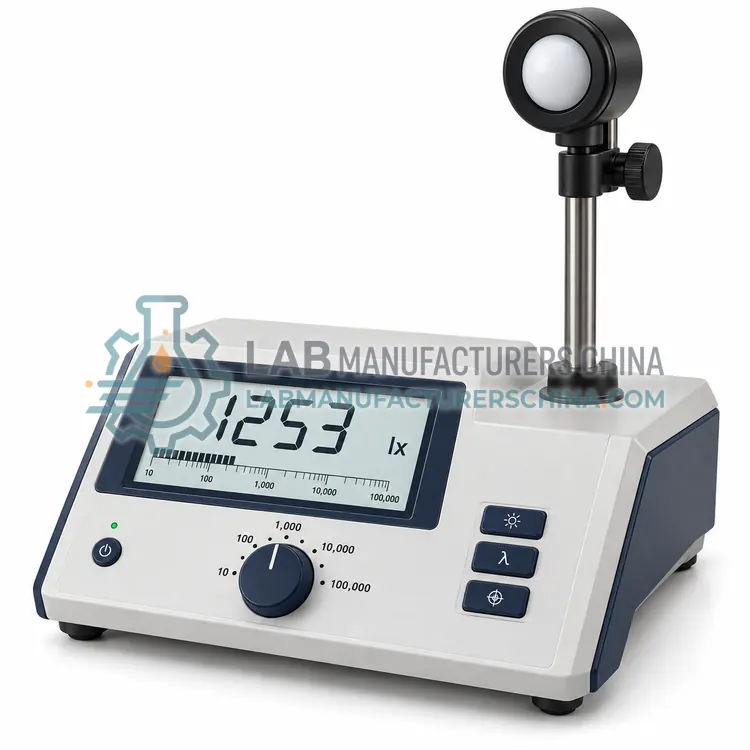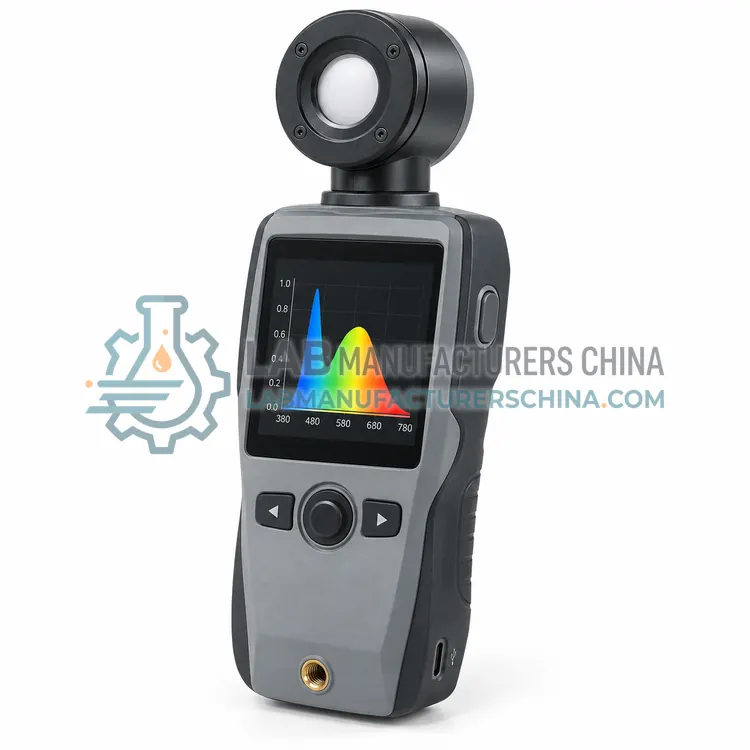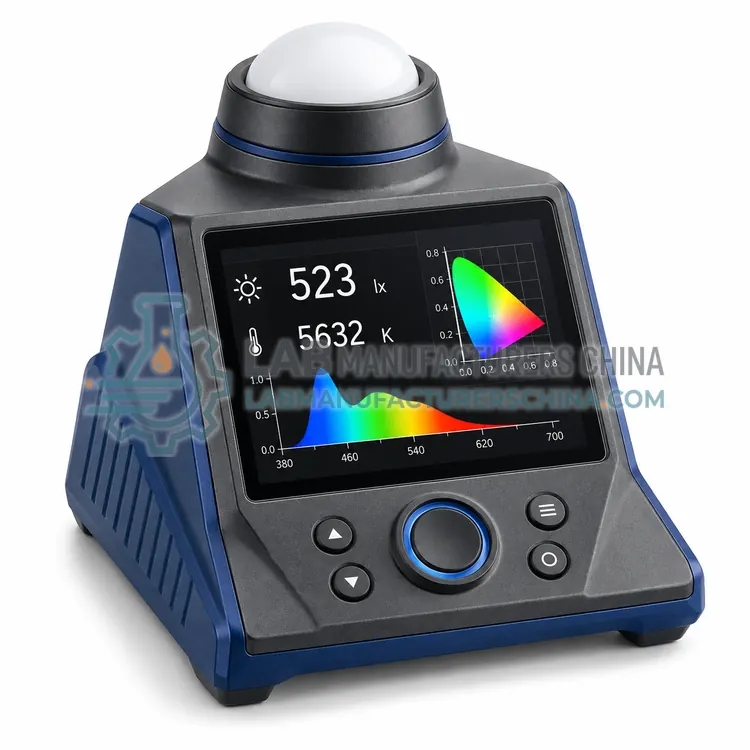
Data Logging Lux Meter
数据记录照度计
- SKU LUM-0003
- Lux Meters
- CE (to be confirmed)
- ISO 9001 manufacturing (to be confirmed)
Price on request — FOB / CIF quoted per order
Prices depend on configuration, quantity and destination port.
Key specifications
| Measurement range | 0–200,000 lx |
|---|---|
| Accuracy | ±3% of reading |
| Sensor | Remote photopic-filtered photodiode |
| Logging interval | 1 s to 24 h |
| Data storage | 32,000 readings |
| Protection class | IP54 |
Request a quote Download brochure · to be provided
By Lab Manufacturers China Technical TeamLast reviewed Standards: ISO/CIE 19476, DIN 5032-7, CIE S 025
What is the Data Logging Lux Meter?
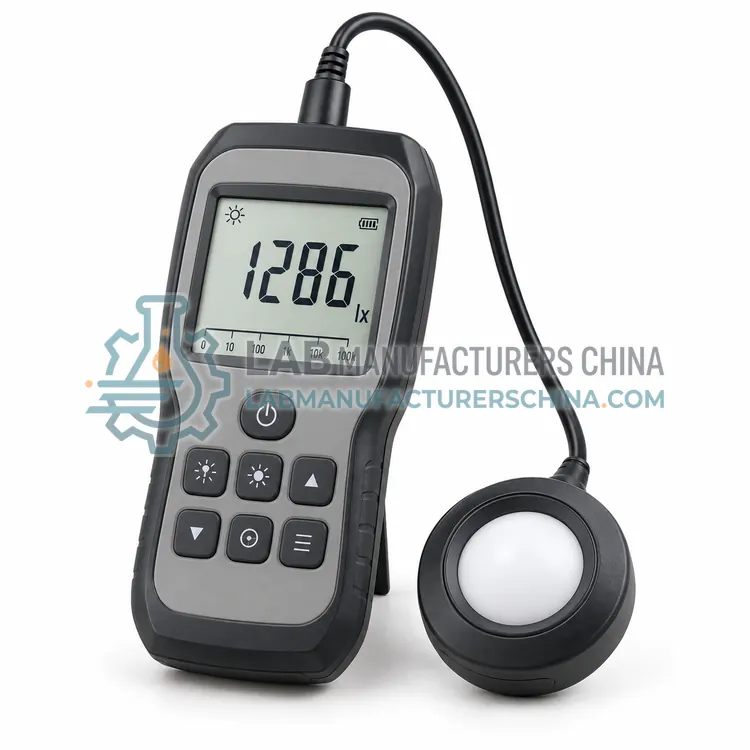
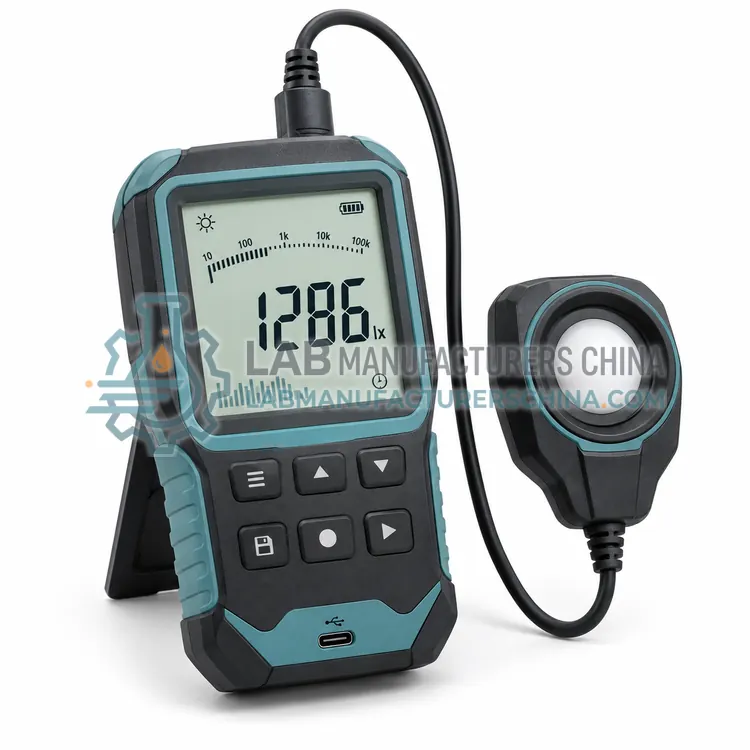
A data logging lux meter records illuminance over time at set intervals. It is used to monitor lighting trends, verify daylight availability and document compliance with lighting requirements over full working periods.
What is the Data Logging Lux Meter?
A data logging lux meter records illuminance over time at set intervals. It is used to monitor lighting trends, verify daylight availability and document compliance with lighting requirements over full working periods.
Overview
A data logging lux meter adds internal memory, a real-time clock and configurable logging intervals to a standard photometer. The sensor, often on a cable or a remote probe, is placed at the measurement location while the unit logs readings automatically from seconds to hours apart. Stored data can be downloaded to software that plots time series, calculates averages and exports reports. This makes the instrument suitable for occupancy and daylight studies, lighting commissioning and monitoring installations where a single reading would not be representative. Battery life, memory depth and clock accuracy determine long-term performance.
How does it work?
A lux meter converts incident light into a photocurrent with a silicon photodiode covered by a filter that approximates the CIE photopic response, which matches the sensitivity of the human eye. The signal is amplified and scaled to give illuminance in lux, equal to lumens per square meter. A diffuser and cosine corrector ensure the reading follows the cosine law of incidence and is independent of the angle of arriving light. Because the eye response peaks in the green region near 555 nm, the filter strongly attenuates ultraviolet and infrared radiation. Calibration against a reference lamp or standard photometer sets the absolute scale, and the meter is classified by accuracy and stability according to photometric standards. Temperature and stray light affect reading stability.
What are the key features?
- Internal memory for extended unattended logging
- Configurable logging interval from seconds to hours
- Remote probe for placement at the measurement point
- Software for time-series plots and report export
- Real-time clock for timestamped records
What are the technical specifications?
A typical data logging lux meter configuration offers measurement range of 0–200,000 lx, accuracy of ±3% of reading, sensor of Remote photopic-filtered photodiode, logging interval of 1 s to 24 h, data storage of 32,000 readings and protection class of IP54. Values are indicative of the product class; the exact figures for each configuration are confirmed on the quotation and the calibration documents supplied with the instrument.
Which applications is it used for?
The Data Logging Lux Meter is used in daylight and occupancy studies, lighting commissioning verification, museum and gallery light exposure monitoring and greenhouse supplemental lighting control. Across the wider Lux Meters class, laboratories also deploy it for workplace and occupational lighting surveys, display and monitor brightness verification and greenhouse and plant growth lighting control.
Which standards and certifications apply?
Relevant standards and methods include ISO/CIE 19476, DIN 5032-7, CIE S 025, CIE 13.3 and IEC 61010-1. Certification candidates for this model are CE and ISO 9001 manufacturing; each is to be confirmed for the specific configuration before shipment, and certificates are supplied only where they have been issued.
Keep the photopic filter and diffuser clean and free of scratches, because contamination changes the response and biases readings. Zero the instrument in darkness where required, and verify periodically against a calibrated reference lamp or a meter of known accuracy. Avoid shading the sensor and measure at the working plane, holding the sensor in the same orientation as the surface of interest. Note ambient temperature and allow thermal equilibrium. Store meters with the sensor capped, and follow the calibration interval defined by the quality system, often annually.
How do I select the right Data Logging Lux Meter?
Choose a data logging lux meter when illuminance must be monitored over time rather than spot-checked. Confirm the logging interval range, memory capacity and battery life suit the study duration, and that the software can export data for analysis. A remote probe and suitable sealing help when the sensor is placed away from the logger in a working environment.
How does it compare with other Lux Meters variants?
Choose a handheld lux meter for quick spot checks, surveys and field verification of lighting. Select a benchtop or logging model when measurements must be recorded, averaged or monitored over time. Match the measurement range to the space, since outdoor daylight can exceed 100,000 lux while corridors may be far below 100 lux. Confirm the cosine and colour correction, the stated accuracy class and the sensor calibration. For lighting design and colour work, a spectral illuminance meter adds colour temperature and colour rendering data. Check connectors or remote probes for hard-to-reach locations.
Full specifications
| Measurement range | 0–200,000 lx |
|---|---|
| Accuracy | ±3% of reading |
| Sensor | Remote photopic-filtered photodiode |
| Logging interval | 1 s to 24 h |
| Data storage | 32,000 readings |
| Protection class | IP54 |
| Battery life | About 1 year at 15 min interval |
| Clock accuracy | ±1 min per month |
| Data interface | USB |
| Operating temperature | −10 to 50 °C |
Indicative values for this product class. Final specifications are confirmed on the quotation and in the calibration documents supplied with the instrument.
Applications
- Daylight and occupancy studies
- Lighting commissioning verification
- Museum and gallery light exposure monitoring
- Greenhouse supplemental lighting control
Key features
- Internal memory for extended unattended logging
- Configurable logging interval from seconds to hours
- Remote probe for placement at the measurement point
- Software for time-series plots and report export
- Real-time clock for timestamped records
Frequently asked questions about Data Logging Lux Meter
Runtime depends on logging interval and battery type. At a fifteen-minute interval, many models run about a year on one battery, while one-second logging may last only days. Choose the interval and memory that cover the required study period with margin.
Place the sensor at the location whose illuminance matters, on the working plane or at a representative height, and shield it from unintended light sources and shadows. Keep the mounting consistent across measurement sessions so results can be compared meaningfully.
Yes, when the instrument is calibrated, the logging settings are documented and records are complete and tamper-evident. Many quality systems require the calibration certificate and a description of the measurement setup to accompany the exported time-series data.
Lumens measure the total light emitted by a source in all directions, while lux measure the light arriving per unit area at a surface. One lux equals one lumen per square meter. Illuminance depends on both the source output and the distance and geometry to the surface.
Light rarely arrives perpendicular to a surface. The cosine law predicts that illuminance falls with the cosine of the incidence angle. A cosine-corrected diffuser makes the meter follow this law, so readings remain accurate when the light arrives at an angle.
Photometric standards classify illuminance meters by properties such as response, cosine and linearity, from high-accuracy laboratory classes to general field classes. Laboratory work and compliance measurements need a higher class, while quick surveys can use a general class. State the required class in the specification.
Related models