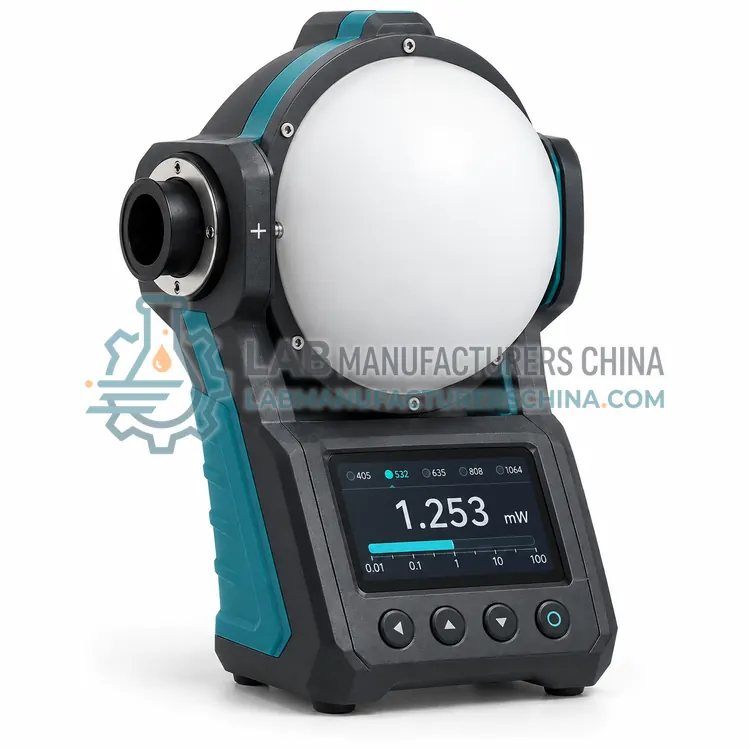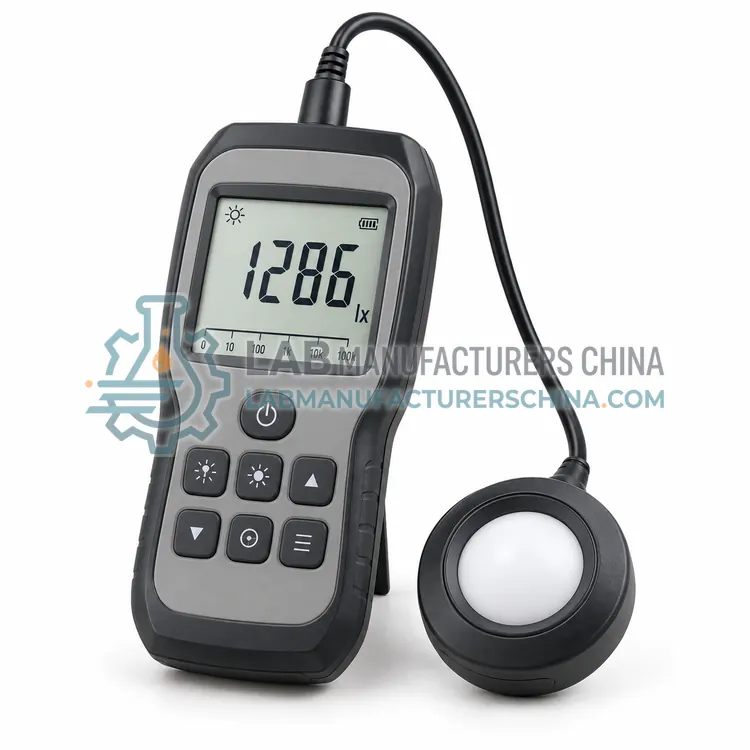
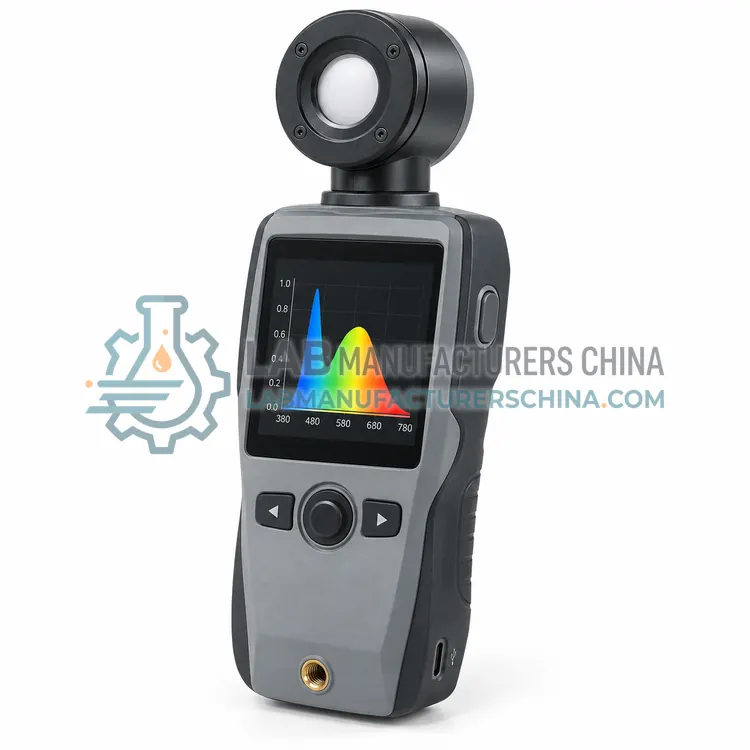
Spectral Illuminance Meter
光谱照度计
- SKU LUM-0004
- Lux Meters
- CE (to be confirmed)
- ISO 9001 manufacturing (to be confirmed)
Price on request — FOB / CIF quoted per order
Prices depend on configuration, quantity and destination port.
Key specifications
| Wavelength range | 380–780 nm |
|---|---|
| Spectral resolution | 1 nm |
| Detector | Linear CCD array |
| Illuminance range | 0.1–200,000 lx |
| Illuminance accuracy | ±4% of reading |
| Colour temperature range | 1,700–20,000 K |
Request a quote Download brochure · to be provided
By Lab Manufacturers China Technical TeamLast reviewed Standards: ISO/CIE 19476, DIN 5032-7, CIE S 025
What is the Spectral Illuminance Meter?
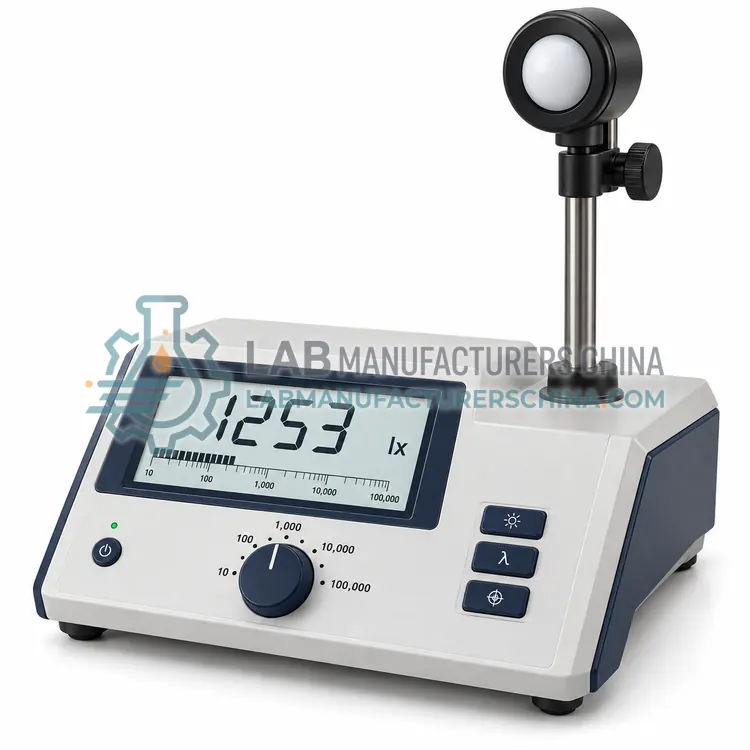
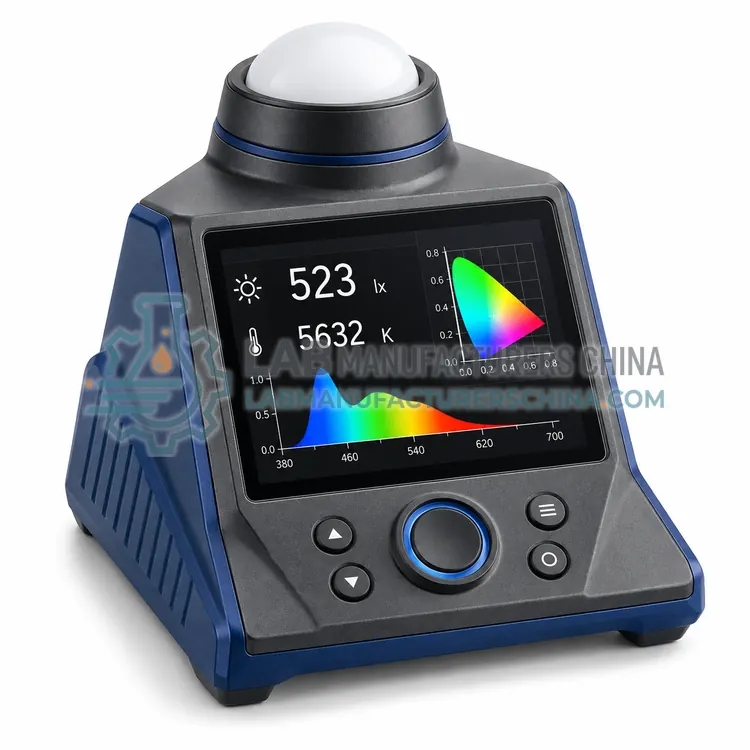
A spectral illuminance meter measures the full visible spectrum of incident light and computes illuminance, colour temperature and colour rendering. It is used where the spectral quality of light matters, not only its level.
What is the Spectral Illuminance Meter?
A spectral illuminance meter measures the full visible spectrum of incident light and computes illuminance, colour temperature and colour rendering. It is used where the spectral quality of light matters, not only its level.
Overview
A spectral illuminance meter disperses incoming light with a grating and records intensity across the visible range on a detector array. From the spectrum, software computes photometric illuminance by applying the photopic response, and derives colour coordinates, correlated colour temperature and colour rendering indices. Because it measures wavelength by wavelength, it can evaluate light-emitting diodes, displays and mixed sources whose spectra differ from the reference illuminant used by filtered meters. Spectral resolution, wavelength accuracy and stray light control determine data quality. The instrument is used in lighting development, display metrology and colour-critical inspection. Calibration is verified with emission lamps of known wavelength.
How does it work?
A lux meter converts incident light into a photocurrent with a silicon photodiode covered by a filter that approximates the CIE photopic response, which matches the sensitivity of the human eye. The signal is amplified and scaled to give illuminance in lux, equal to lumens per square meter. A diffuser and cosine corrector ensure the reading follows the cosine law of incidence and is independent of the angle of arriving light. Because the eye response peaks in the green region near 555 nm, the filter strongly attenuates ultraviolet and infrared radiation. Calibration against a reference lamp or standard photometer sets the absolute scale, and the meter is classified by accuracy and stability according to photometric standards. Temperature and stray light affect reading stability.
What are the key features?
- Full visible spectrum acquisition with array detector
- Computed illuminance, colour temperature and colour rendering
- Grating-based dispersion for wavelength accuracy
- Software for spectral analysis and reporting
- Suitable for LED, display and mixed-source evaluation
What are the technical specifications?
A typical spectral illuminance meter configuration offers wavelength range of 380–780 nm, spectral resolution of 1 nm, detector of Linear CCD array, illuminance range of 0.1–200,000 lx, illuminance accuracy of ±4% of reading and colour temperature range of 1,700–20,000 K. Values are indicative of the product class; the exact figures for each configuration are confirmed on the quotation and the calibration documents supplied with the instrument.
Which applications is it used for?
The Spectral Illuminance Meter is used in LED and luminaire development, display and monitor metrology, colour-critical lighting inspection and photobiological and circadian light studies. Across the wider Lux Meters class, laboratories also deploy it for workplace and occupational lighting surveys, display and monitor brightness verification and greenhouse and plant growth lighting control.
Which standards and certifications apply?
Relevant standards and methods include ISO/CIE 19476, DIN 5032-7, CIE S 025, CIE 13.3 and IEC 61010-1. Certification candidates for this model are CE and ISO 9001 manufacturing; each is to be confirmed for the specific configuration before shipment, and certificates are supplied only where they have been issued.
Keep the photopic filter and diffuser clean and free of scratches, because contamination changes the response and biases readings. Zero the instrument in darkness where required, and verify periodically against a calibrated reference lamp or a meter of known accuracy. Avoid shading the sensor and measure at the working plane, holding the sensor in the same orientation as the surface of interest. Note ambient temperature and allow thermal equilibrium. Store meters with the sensor capped, and follow the calibration interval defined by the quality system, often annually.
How do I select the right Spectral Illuminance Meter?
Choose a spectral illuminance meter when spectral quality, colour temperature or colour rendering must be measured, especially for LED and mixed sources. Confirm the wavelength range, spectral resolution and stray-light performance suit the task, and that the software computes the photometric and colorimetric quantities required. Wavelength calibration should be traceable and repeatable.
How does it compare with other Lux Meters variants?
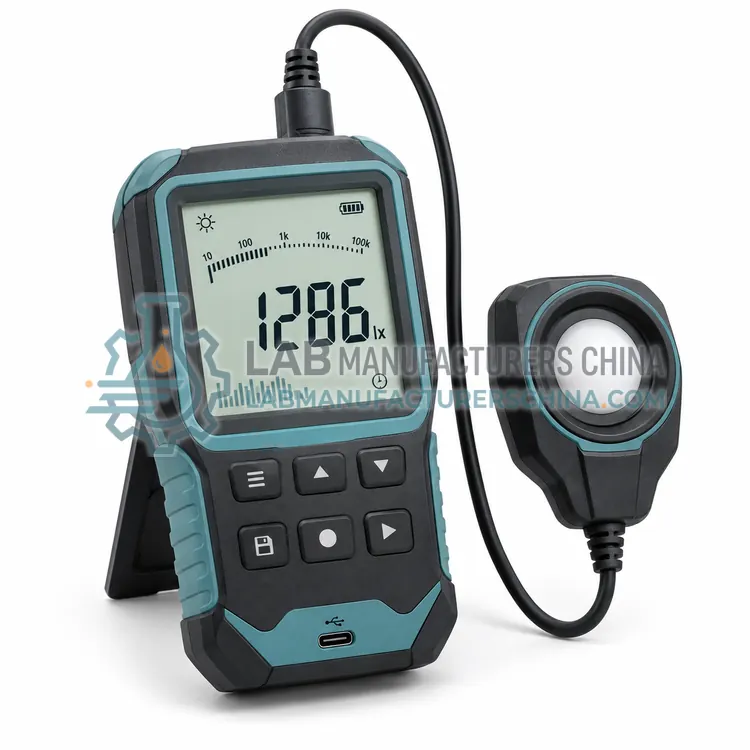
Choose a handheld lux meter for quick spot checks, surveys and field verification of lighting. Select a benchtop or logging model when measurements must be recorded, averaged or monitored over time. Match the measurement range to the space, since outdoor daylight can exceed 100,000 lux while corridors may be far below 100 lux. Confirm the cosine and colour correction, the stated accuracy class and the sensor calibration. For lighting design and colour work, a spectral illuminance meter adds colour temperature and colour rendering data. Check connectors or remote probes for hard-to-reach locations.
Full specifications
| Wavelength range | 380–780 nm |
|---|---|
| Spectral resolution | 1 nm |
| Detector | Linear CCD array |
| Illuminance range | 0.1–200,000 lx |
| Illuminance accuracy | ±4% of reading |
| Colour temperature range | 1,700–20,000 K |
| Wavelength accuracy | ±0.5 nm |
| Integration time | 10 ms to 5 s |
| Data interface | USB |
| Power supply | USB bus power or 12 V DC |
Indicative values for this product class. Final specifications are confirmed on the quotation and in the calibration documents supplied with the instrument.
Applications
- LED and luminaire development
- Display and monitor metrology
- Colour-critical lighting inspection
- Photobiological and circadian light studies
Key features
- Full visible spectrum acquisition with array detector
- Computed illuminance, colour temperature and colour rendering
- Grating-based dispersion for wavelength accuracy
- Software for spectral analysis and reporting
- Suitable for LED, display and mixed-source evaluation
Frequently asked questions about Spectral Illuminance Meter
Filtered meters assume the light spectrum resembles the reference illuminant and can misread sources with narrow or unusual spectra, such as LEDs. A spectroradiometer measures each wavelength directly and computes photometric and colorimetric values from the true spectrum, so results are more reliable for modern light sources.
One nanometre resolution is common and adequate for general photometric and colorimetric work. Narrow-band emitters such as coloured LEDs may need finer resolution or careful correction. Resolution, wavelength accuracy and stray light should be considered together.
The instrument is calibrated using emission lines from a mercury or argon lamp, or a laser, whose wavelengths are known. The measured peak positions are compared with the known values and the wavelength scale is corrected. Calibration is repeated at defined intervals.
Lumens measure the total light emitted by a source in all directions, while lux measure the light arriving per unit area at a surface. One lux equals one lumen per square meter. Illuminance depends on both the source output and the distance and geometry to the surface.
Light rarely arrives perpendicular to a surface. The cosine law predicts that illuminance falls with the cosine of the incidence angle. A cosine-corrected diffuser makes the meter follow this law, so readings remain accurate when the light arrives at an angle.
Photometric standards classify illuminance meters by properties such as response, cosine and linearity, from high-accuracy laboratory classes to general field classes. Laboratory work and compliance measurements need a higher class, while quick surveys can use a general class. State the required class in the specification.
Related models