HPLC/IC-ICP-MS Speciation System
HPLC/IC-ICP-MS 形态分析系统
- SKU IMS-0005
- ICP-MS
- CE (to be confirmed)
- ISO 9001 manufacturing (to be confirmed)
- IEC 61010-1 safety (to be confirmed)
Price on request — FOB / CIF quoted per order
Prices depend on configuration, quantity and destination port.
Key specifications
| LC pump pressure range | up to 400 bar (HPLC) or 210 bar (IC) |
|---|---|
| Flow rate | 0.1–2.0 mL/min |
| Transfer line dead volume | < 5 µL |
| Detection limit, As species | 0.01–0.05 µg/L |
| Detection limit, Hg species | 0.01–0.05 µg/L |
| Injection volume | 5–100 µL |
Request a quote Download brochure · to be provided
By Lab Manufacturers China Technical TeamLast reviewed Standards: USP <233> Elemental Impurities Procedures, ICH Q3D Elemental Impurities, EPA Method 200.8
What is the HPLC/IC-ICP-MS Speciation System?
An HPLC or ion chromatography system coupled to ICP-MS separates chemical forms of an element before detection, so species such as As(III), As(V), methylmercury, Cr(VI) and selenoamino acids are quantified individually. It is used when toxicity or bioavailability depends on the chemical form.
What is the HPLC/IC-ICP-MS Speciation System?
An HPLC or ion chromatography system coupled to ICP-MS separates chemical forms of an element before detection, so species such as As(III), As(V), methylmercury, Cr(VI) and selenoamino acids are quantified individually. It is used when toxicity or bioavailability depends on the chemical form.
Overview
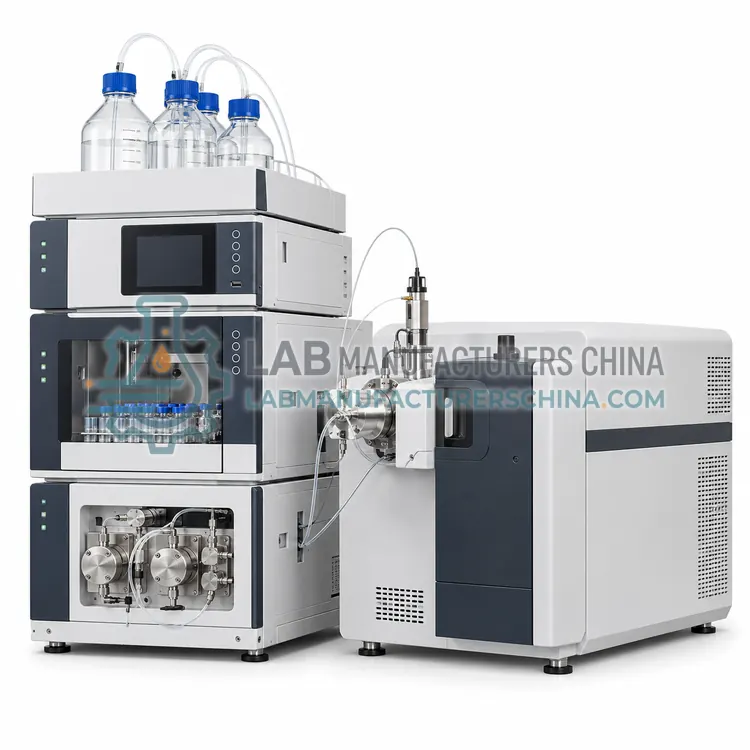
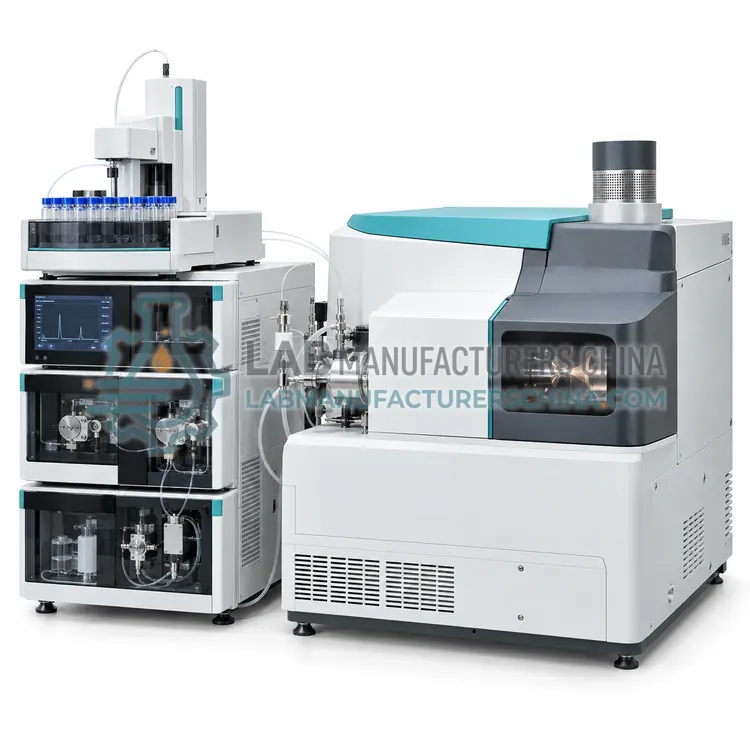
In a speciation system, an HPLC or ion chromatograph separates the species of an element in a sample extract, and the column effluent is directed through a biocompatible, low-dead-volume transfer line into the ICP-MS nebulizer. The ICP-MS serves as an element-specific detector, monitoring isotopes such as 75As, 202Hg, 52Cr or 78Se as a function of retention time. Anion-exchange, cation-exchange, reversed-phase ion-pairing and size-exclusion columns are typical. Mobile phases must be compatible with the plasma, so organic content is usually limited to a few percent, or the system uses desolvation, oxygen addition, and narrow injector torches. Detection limits in the low ng/L range enable analysis of inorganic arsenic in rice, methylmercury in fish and Cr(VI) in drinking water. Software synchronizes chromatography and MS acquisition to give time-resolved chromatograms and calibrated species concentrations.
How does it work?
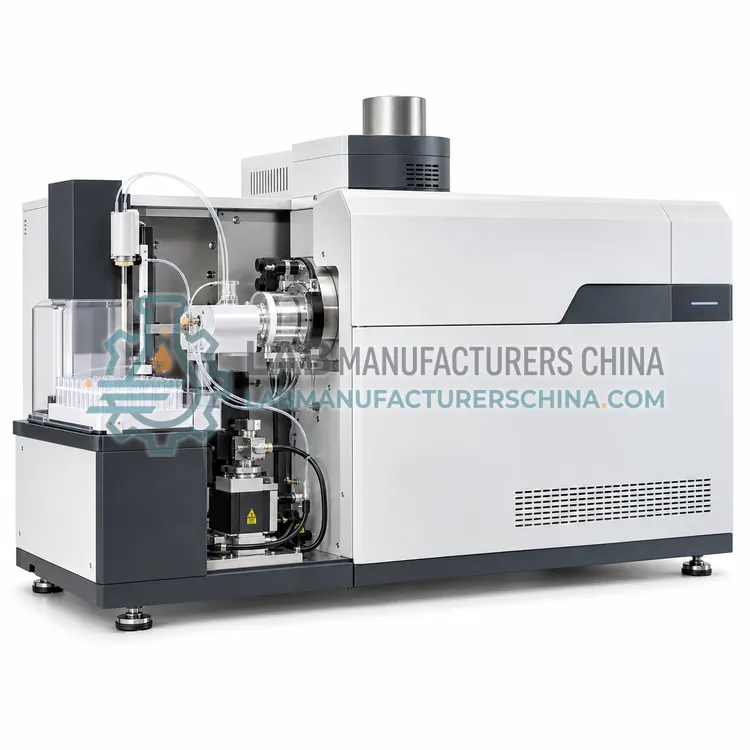
In ICP-MS, a liquid sample is nebulized into a fine aerosol, passes through a spray chamber, and is carried by argon into a plasma torch. A radio-frequency coil at 27 or 40 MHz sustains a plasma at about 6000 to 10000 K, which desolvates, atomizes and ionizes the analytes, mostly as singly charged ions. Ions are extracted through sampler and skimmer cones into a high-vacuum region, focused by ion lenses, and separated by a mass analyzer, most commonly a quadrupole. A collision or reaction cell removes polyatomic interferences such as 40Ar16O on 56Fe, using helium kinetic energy discrimination or reactive gases. An electron multiplier in pulse and analog modes counts ions across up to nine orders of magnitude.
What are the key features?
- Metal-free, biocompatible HPLC or IC flow path to prevent contamination and species conversion
- Low-dead-volume transfer line to ICP-MS preserving chromatographic resolution
- Time-resolved acquisition software synchronizing the LC and ICP-MS detection
- Collision cell operation to remove ArCl and other polyatomic interferences on arsenic and selenium
- Oxygen addition and Pt cones for organic mobile phases containing methanol or acetonitrile
- Support for isotope dilution speciation with species-specific enriched standards
What are the technical specifications?
A typical hplc/ic-icp-ms speciation system configuration offers LC pump pressure range of up to 400 bar (HPLC) or 210 bar (IC), flow rate of 0.1–2.0 mL/min, transfer line dead volume of < 5 µL, detection limit, As species of 0.01–0.05 µg/L, detection limit, Hg species of 0.01–0.05 µg/L and injection volume of 5–100 µL. Values are indicative of the product class; the exact figures for each configuration are confirmed on the quotation and the calibration documents supplied with the instrument.
Which applications is it used for?
The HPLC/IC-ICP-MS Speciation System is used in inorganic arsenic in rice and seafood, methylmercury in fish and biological samples, cr(VI) in drinking water and toys, selenium speciation in supplements and metalloprotein and metallodrug studies. Across the wider ICP-MS class, laboratories also deploy it for heavy metals in drinking water and wastewater, elemental impurities in pharmaceuticals and toxic elements in food and beverages.
Which standards and certifications apply?
Relevant standards and methods include USP <233> Elemental Impurities Procedures, ICH Q3D Elemental Impurities, EPA Method 200.8, EPA Method 6020B, ISO 17294-2, ASTM D5673, EN 15763, GB 5009.268, ISO/IEC 17025 and IEC 61010-1. Certification candidates for this model are CE, ISO 9001 manufacturing and IEC 61010-1 safety; each is to be confirmed for the specific configuration before shipment, and certificates are supplied only where they have been issued.
ICP-MS requires high-purity argon, typically 99.996 percent or better, with consumption around 15 to 20 L per minute, plus cooling water or a recirculating chiller, dedicated exhaust ventilation and stable power. Use trace-metal-grade acids, low-blank labware such as PFA or FEP, and ultrapure water at 18.2 MΩ·cm. Tune daily for sensitivity, oxide ratio (CeO/Ce below 2 percent) and doubly charged ratio (Ce++/Ce below 3 percent). Clean or replace cones, torch and nebulizer according to matrix load, and check the peristaltic pump tubing regularly. Use internal standards to correct drift. For pharmaceutical and regulated work, require software with audit trails and follow USP <233> and ICH Q3D method validation.
How do I select the right HPLC/IC-ICP-MS Speciation System?
Select a speciation system when regulation or toxicology depends on chemical form rather than total element, as with inorganic arsenic or methylmercury. Total-metal work needs only ICP-MS. In an RFQ, specify chromatography type (HPLC or IC), column chemistries, detection limits per species and compatible ICP-MS model.
How does it compare with other ICP-MS variants?
Choose the ICP-MS class by interference severity, detection limit and budget. A single quadrupole with a collision cell handles most water, food and clinical work at low cost. Triple quadrupole ICP-MS/MS adds mass-shift reaction chemistry for difficult interferences such as sulfur, phosphorus, arsenic in chloride and rare earth oxides. Sector-field instruments offer high resolution and the lowest background for semiconductor and geochemical work, and TOF systems capture the full mass spectrum for fast transient signals. Check matrix tolerance, for example total dissolved solids up to 0.2 percent or aerosol dilution options for higher levels, argon consumption, sample introduction kits, autosampler and software compliance features. Verify the detection limits and background equivalent concentrations in your own matrix rather than relying on deionized water values.
Full specifications
| LC pump pressure range | up to 400 bar (HPLC) or 210 bar (IC) |
|---|---|
| Flow rate | 0.1–2.0 mL/min |
| Transfer line dead volume | < 5 µL |
| Detection limit, As species | 0.01–0.05 µg/L |
| Detection limit, Hg species | 0.01–0.05 µg/L |
| Injection volume | 5–100 µL |
| Retention time reproducibility (RSD) | ≤ 1% |
| Peak area reproducibility (RSD) | ≤ 3% |
| ICP-MS mass range | m/z 2–260 |
| Organic solvent tolerance | up to ~10% methanol (with O2 addition) |
Indicative values for this product class. Final specifications are confirmed on the quotation and in the calibration documents supplied with the instrument.
Applications
- Inorganic arsenic in rice and seafood
- Methylmercury in fish and biological samples
- Cr(VI) in drinking water and toys
- Selenium speciation in supplements
- Metalloprotein and metallodrug studies
Key features
- Metal-free, biocompatible HPLC or IC flow path to prevent contamination and species conversion
- Low-dead-volume transfer line to ICP-MS preserving chromatographic resolution
- Time-resolved acquisition software synchronizing the LC and ICP-MS detection
- Collision cell operation to remove ArCl and other polyatomic interferences on arsenic and selenium
- Oxygen addition and Pt cones for organic mobile phases containing methanol or acetonitrile
- Support for isotope dilution speciation with species-specific enriched standards
Frequently asked questions about HPLC/IC-ICP-MS Speciation System
Toxicity depends on chemical form. Inorganic arsenic and methylmercury are toxic, while arsenobetaine in fish is essentially non-toxic, and Cr(VI) is carcinogenic but Cr(III) is an essential nutrient. Regulations increasingly specify limits for individual species rather than totals.
Use mild extraction such as dilute acid or water-methanol mixtures, avoid strong oxidants and high temperatures, analyze quickly, and store extracts cool and dark. Species-specific certified reference materials and spike recovery tests verify that conversion has not occurred.
Most modern ICP-MS systems can, provided they support a transfer connection, time-resolved analysis and adequate handling of organic mobile phases. A collision cell is advisable for arsenic and selenium. Software must synchronize chromatography and MS data for peak integration.
ICP-MS typically reaches low parts-per-trillion (ng/L) detection limits for most elements in clean aqueous solutions, and sub-ppt for some heavy elements. Real-world limits are higher because of sample dilution, blank contamination and matrix effects, so they must be established by method validation.
ICP-OES measures light emitted by excited atoms and ions, reaching ppb detection limits over a wide linear range and high matrix tolerance. ICP-MS measures ions by mass, reaching ppt limits, and provides isotope information, but it tolerates fewer dissolved solids and costs more to operate.
In helium kinetic energy discrimination mode, larger polyatomic ions collide more often with helium and lose more energy than analyte ions, so a bias voltage blocks them. Reactive gases such as oxygen or ammonia can instead convert the analyte or the interference to a different mass.
Related models
Linear MALDI-TOF Mass Spectrometer for Microbial Identification
用于微生物鉴定的线性 MALDI-TOF 质谱仪
- CE (to be confirmed)
- +3