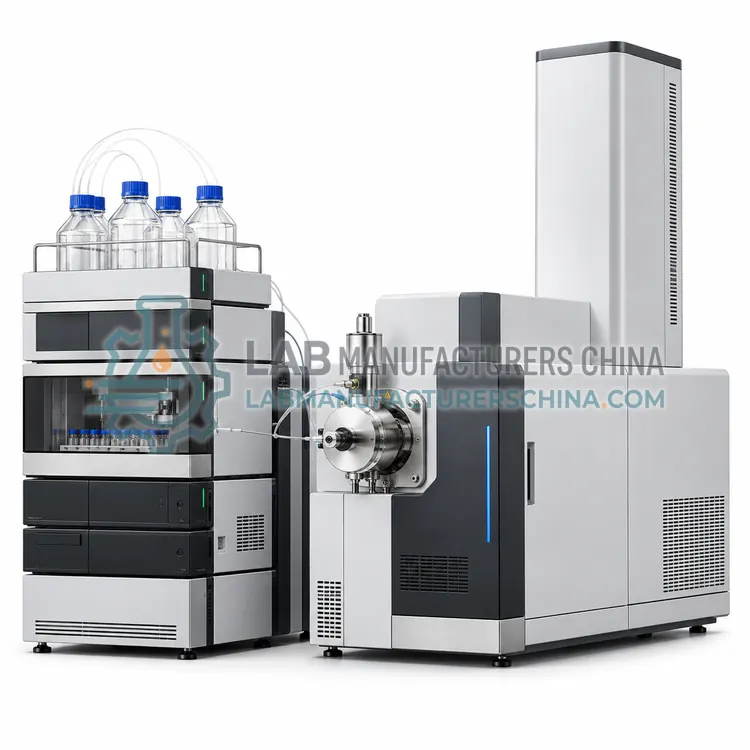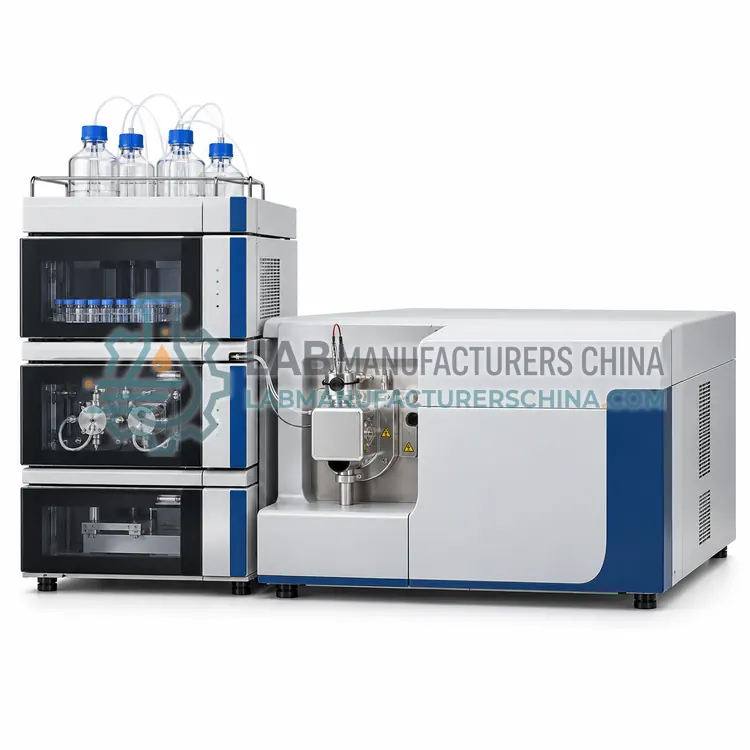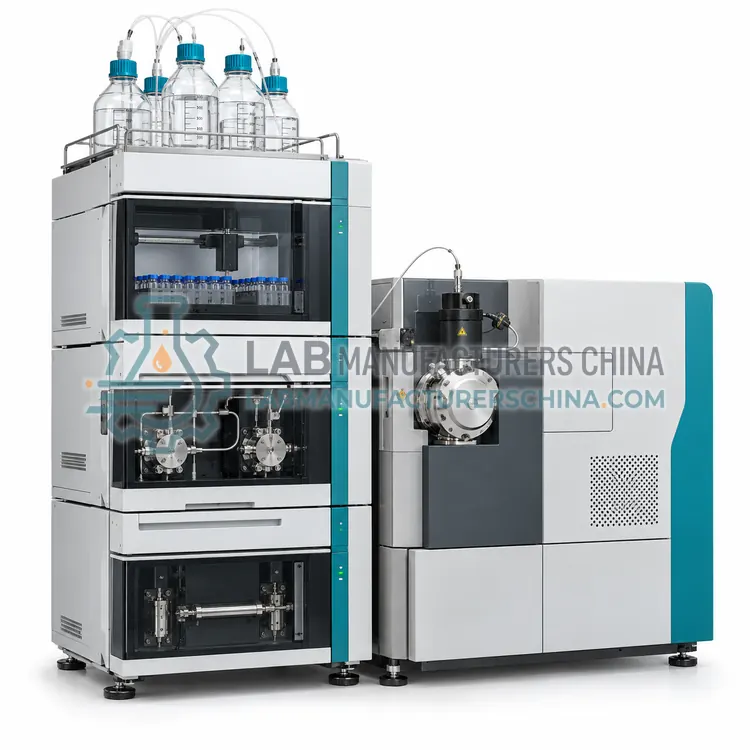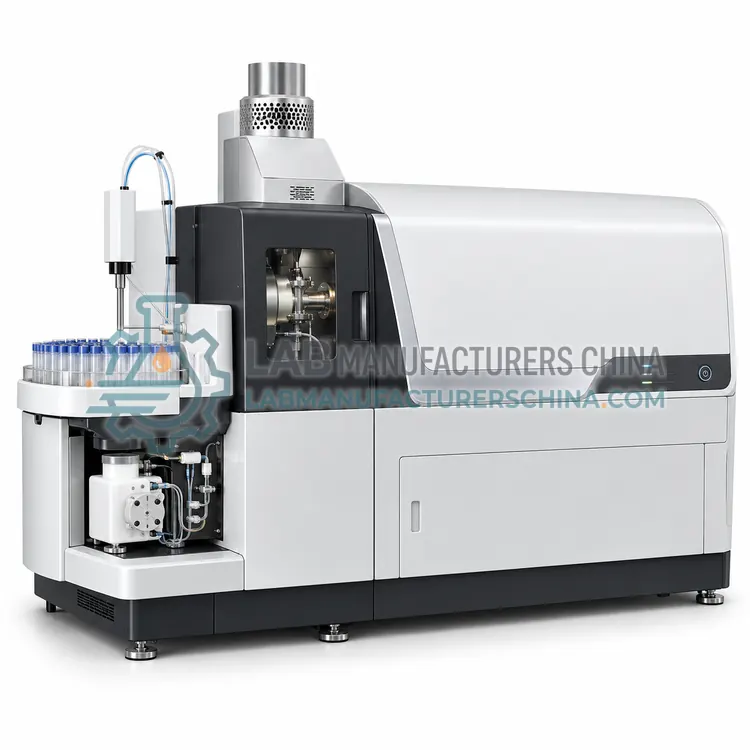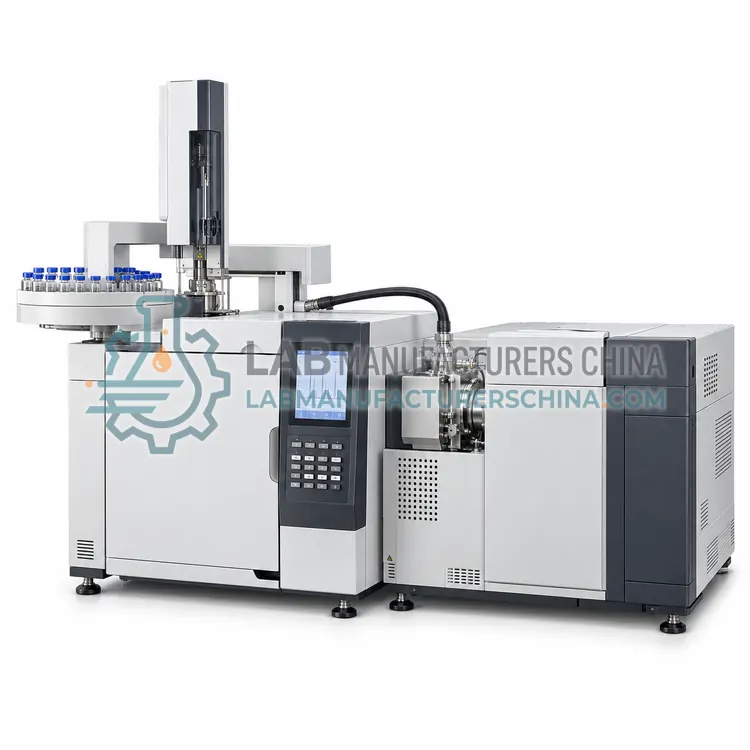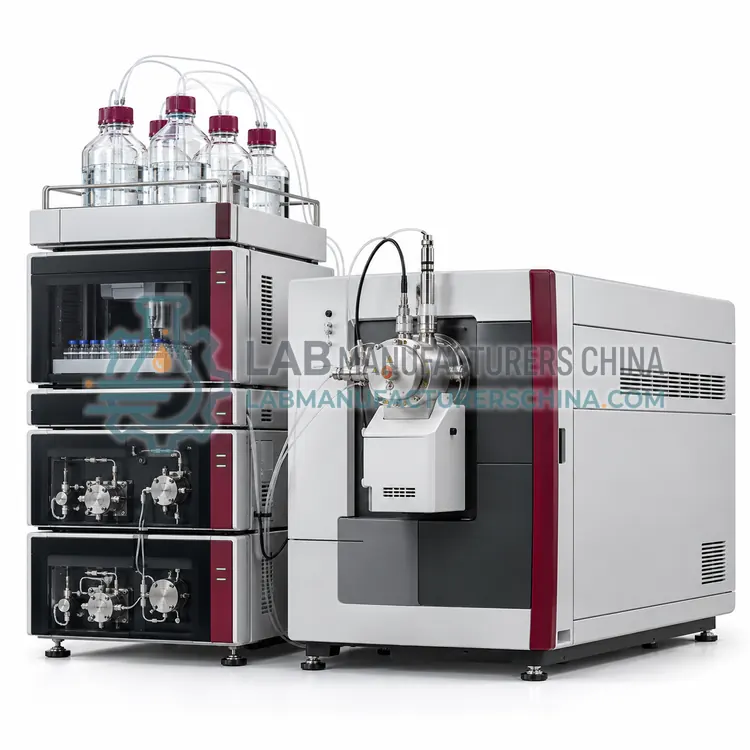
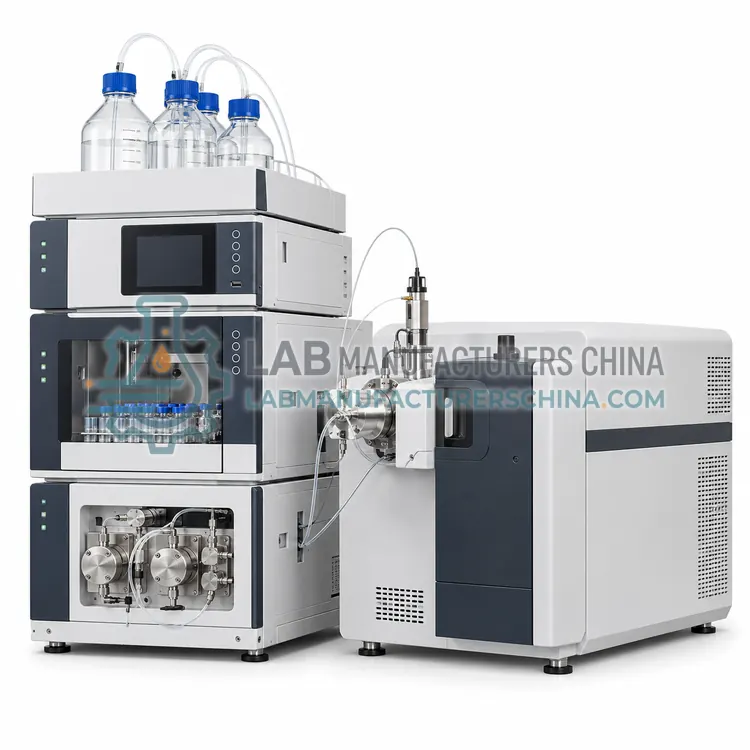
Single Quadrupole LC-MS System
单四极杆液质联用仪
- SKU LCM-0001
- LC-MS
- CE (to be confirmed)
- ISO 9001 manufacturing (to be confirmed)
- IEC 61010-1 safety (to be confirmed)
Price on request — FOB / CIF quoted per order
Prices depend on configuration, quantity and destination port.
Key specifications
| Mass range | m/z 50–2000 |
|---|---|
| Mass resolution | Unit (0.7 u FWHM) |
| Scan speed | up to 5000 Da/s |
| Polarity switching time | ≤ 25 ms |
| Ion sources | ESI, APCI (APPI optional) |
| Sensitivity (reserpine, 1 pg on column, ESI+ SIM) | S/N ≥ 100:1 (typical) |
Request a quote Download brochure · to be provided
By Lab Manufacturers China Technical TeamLast reviewed Standards: EPA Method 1633, EPA Method 537.1, EPA Method 533
What is the Single Quadrupole LC-MS System?
A single quadrupole LC-MS adds a compact mass detector to an HPLC or UHPLC, confirming molecular weight and supporting routine quantitation. It is the economical option for synthetic chemistry, peak tracking, purity confirmation and methods where unit-resolution selectivity is sufficient.
What is the Single Quadrupole LC-MS System?
A single quadrupole LC-MS adds a compact mass detector to an HPLC or UHPLC, confirming molecular weight and supporting routine quantitation. It is the economical option for synthetic chemistry, peak tracking, purity confirmation and methods where unit-resolution selectivity is sufficient.
Overview
A single quadrupole LC-MS uses one quadrupole mass filter behind an electrospray or APCI source. It operates in scan mode to provide molecular-weight confirmation of peaks seen on UV detection, and in selected ion monitoring for targeted quantitation with better sensitivity. Compact benchtop models occupy about the footprint of a column oven and often run with a small nitrogen generator and oil-free backing pump. Typical mass range is m/z 50 to 2000 with unit resolution and scan speeds of several thousand Da per second, sufficient for UHPLC peaks. Polarity switching within a few tens of milliseconds allows positive and negative ions in one run. The system cannot perform MS/MS, so selectivity depends on chromatography and on the single mass, making it less suitable for trace analysis in complex biological matrices.
How does it work?
In LC-MS, a high-pressure pump delivers a mobile phase through a column, typically C18, where analytes separate by their affinity for the stationary phase. The eluent, usually at 0.2 to 1 mL per minute, enters an atmospheric-pressure ion source. Electrospray ionization applies 3 to 5 kV to a nebulized stream so that charged droplets shrink and release gas-phase ions, while atmospheric-pressure chemical ionization uses a corona discharge for less polar compounds. Ions pass through a skimmer or capillary and ion guides into progressively lower-pressure regions, then into the mass analyzer. Quadrupole, ion trap, time-of-flight or hybrid analyzers then measure m/z. Mobile phases must be volatile, such as formic acid, acetic acid or ammonium formate, because non-volatile buffers foul the source.
What are the key features?
- Compact benchtop footprint designed for open-access use by synthetic chemists
- Electrospray and APCI sources with rapid positive and negative polarity switching
- Simultaneous scan and SIM acquisition for purity check plus targeted quantitation
- Oil-free or low-maintenance vacuum system to simplify routine operation
- Automated mass calibration and system check at startup with pass or fail reporting
- Integration with UV-PDA detection for complementary spectral and mass confirmation
What are the technical specifications?
A typical single quadrupole lc-ms system configuration offers mass range of m/z 50–2000, mass resolution of Unit (0.7 u FWHM), scan speed of up to 5000 Da/s, polarity switching time of ≤ 25 ms, ion sources of ESI, APCI (APPI optional) and sensitivity (reserpine, 1 pg on column, ESI+ SIM) of S/N ≥ 100:1 (typical). Values are indicative of the product class; the exact figures for each configuration are confirmed on the quotation and the calibration documents supplied with the instrument.
Which applications is it used for?
The Single Quadrupole LC-MS System is used in organic synthesis reaction monitoring, purity confirmation of drug substances, peptide and oligonucleotide mass confirmation, routine quantitation of additives and dyes and open-access lab analysis. Across the wider LC-MS class, laboratories also deploy it for drug impurity profiling and metabolite identification, bioanalysis of drugs in plasma and urine and pesticide and veterinary drug residue testing.
Which standards and certifications apply?
Relevant standards and methods include EPA Method 1633, EPA Method 537.1, EPA Method 533, USP <621> Chromatography, FDA Bioanalytical Method Validation Guidance, ICH M10 Bioanalytical Method Validation, EN 15662, CLSI C62-A, ISO/IEC 17025 and IEC 61010-1. Certification candidates for this model are CE, ISO 9001 manufacturing and IEC 61010-1 safety; each is to be confirmed for the specific configuration before shipment, and certificates are supplied only where they have been issued.
Provide a nitrogen supply of at least 99.5 percent purity, either from a generator delivering about 20 to 35 L per minute or from liquid supply, plus a fume extraction line for source exhaust. Use LC-MS grade solvents and additives, since impurities raise background and suppress ionization. Calibrate the mass scale regularly with the manufacturer's calibrant solution, and run system suitability injections before each batch. Clean the spray shield, capillary and ion transfer optics when sensitivity drops, and replace rotary pump oil on schedule. Monitor for ion suppression through post-column infusion during method development. Regulated laboratories need software with audit trails and electronic signatures compatible with 21 CFR Part 11, and instrument qualification to IQ, OQ and PQ protocols.
How do I select the right Single Quadrupole LC-MS System?
Choose a single quadrupole LC-MS when the need is molecular-weight confirmation, simple quantitation or shared open-access use, and when budget and space are limited. Move to triple quadrupole for trace bioanalysis. In an RFQ, specify mass range, scan speed, ion source types, compatible LC, and nitrogen supply arrangements.
How does it compare with other LC-MS variants?
The decisive choice is the mass analyzer. Single quadrupole LC-MS confirms molecular weight and performs simple quantitation at a modest cost. Triple quadrupole instruments deliver the best sensitivity for targeted quantitation in bioanalysis, residues and clinical assays. Q-TOF systems provide accurate mass and MS/MS of unknowns, suited to impurity profiling, metabolite identification and screening. Ion traps offer multi-stage fragmentation for structural work. Mass-directed purification systems add fraction collection. Then check the ion source options such as ESI, APCI and APPI, scan speed for UHPLC peaks below 3 seconds wide, polarity switching speed, and the robustness of the source with dirty matrices. Confirm compatibility with your LC pumps, available software for regulated work, and nitrogen consumption for sheath and drying gases.
Full specifications
| Mass range | m/z 50–2000 |
|---|---|
| Mass resolution | Unit (0.7 u FWHM) |
| Scan speed | up to 5000 Da/s |
| Polarity switching time | ≤ 25 ms |
| Ion sources | ESI, APCI (APPI optional) |
| Sensitivity (reserpine, 1 pg on column, ESI+ SIM) | S/N ≥ 100:1 (typical) |
| Mass accuracy | ±0.1 u |
| Flow rate compatibility | 0.05–2.0 mL/min |
| Gas supply | Nitrogen, ≥ 99.5%, ~20 L/min |
| Footprint (W × D) | ~35 × 65 cm |
Indicative values for this product class. Final specifications are confirmed on the quotation and in the calibration documents supplied with the instrument.
Applications
- Organic synthesis reaction monitoring
- Purity confirmation of drug substances
- Peptide and oligonucleotide mass confirmation
- Routine quantitation of additives and dyes
- Open-access lab analysis
Key features
- Compact benchtop footprint designed for open-access use by synthetic chemists
- Electrospray and APCI sources with rapid positive and negative polarity switching
- Simultaneous scan and SIM acquisition for purity check plus targeted quantitation
- Oil-free or low-maintenance vacuum system to simplify routine operation
- Automated mass calibration and system check at startup with pass or fail reporting
- Integration with UV-PDA detection for complementary spectral and mass confirmation
Frequently asked questions about Single Quadrupole LC-MS System
It can for higher concentrations, typically above 10 to 50 ng/mL, with good sample cleanup and an isotopically labeled internal standard. For sub-nanogram levels or complex matrices, a triple quadrupole's MRM selectivity is usually required to meet regulatory bioanalytical validation criteria.
Scan mode records the whole mass range to detect unknown peaks and confirm molecular weight. SIM monitors only selected m/z values, giving longer dwell times and sensitivity up to about one hundred times better for targeted compounds, but it will not detect unexpected ions.
Compact single quadrupole models occupy roughly 35 to 45 cm of bench width, plus space for the LC stack and a backing pump. A nitrogen generator can sit under the bench. Ensure clearance for ventilation of the source exhaust and adequate power outlets.
Electrospray ionization is the most common and suits polar and ionizable compounds from small molecules to proteins. APCI suits less polar, thermally stable analytes below about 1500 Da. APPI handles nonpolar compounds such as PAHs. Many sources allow switching or dual-mode operation.
Ion suppression is a reduction in analyte signal caused by co-eluting matrix components that compete for charge or disrupt droplet formation. It affects accuracy and sensitivity. It is managed with better sample cleanup, chromatographic separation, dilution and isotopically labeled internal standards.
Use volatile additives such as formic acid, acetic acid, ammonium formate, ammonium acetate and ammonium hydroxide, generally at 0.1 percent or 2 to 10 mM. Avoid non-volatile phosphate, borate and high concentrations of ion-pairing reagents, which contaminate the source and suppress ionization.
Related models