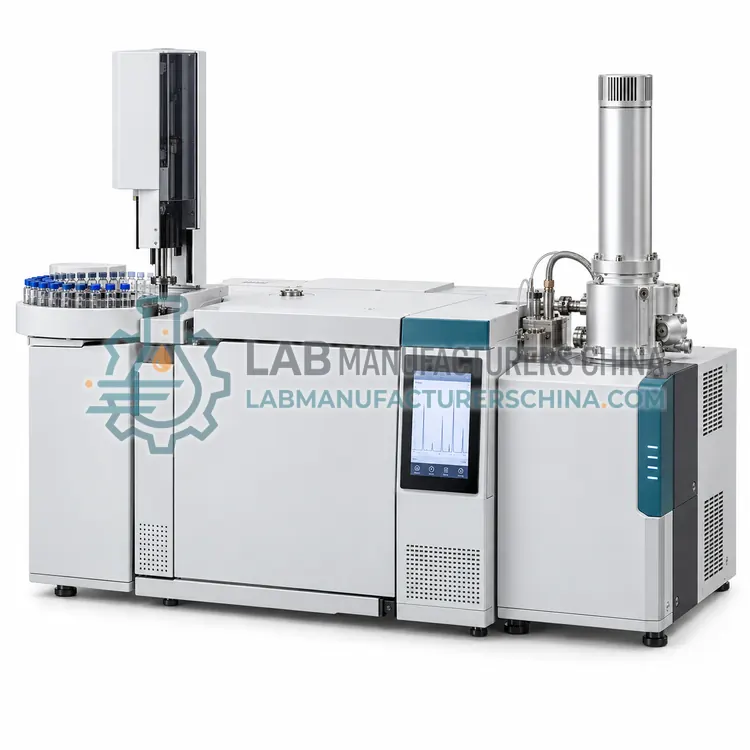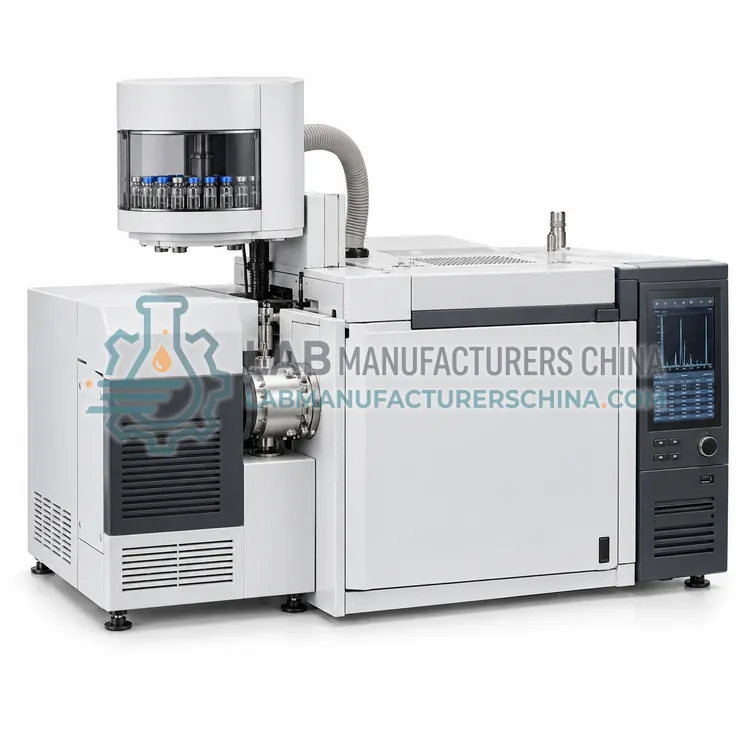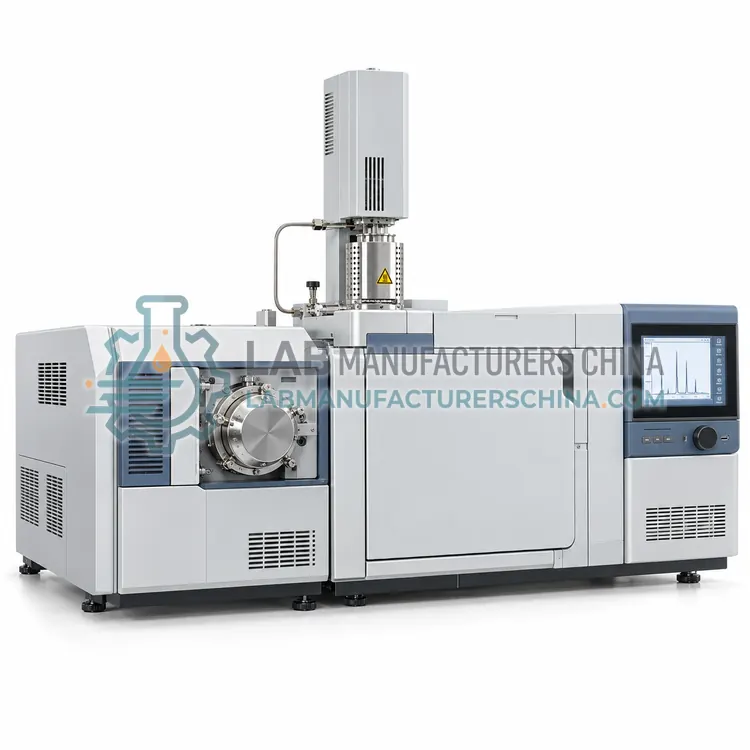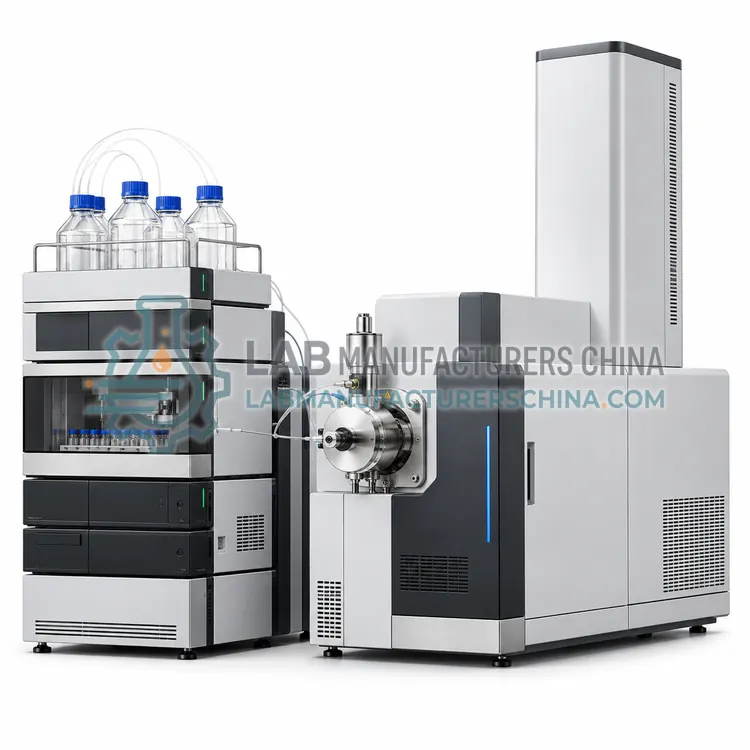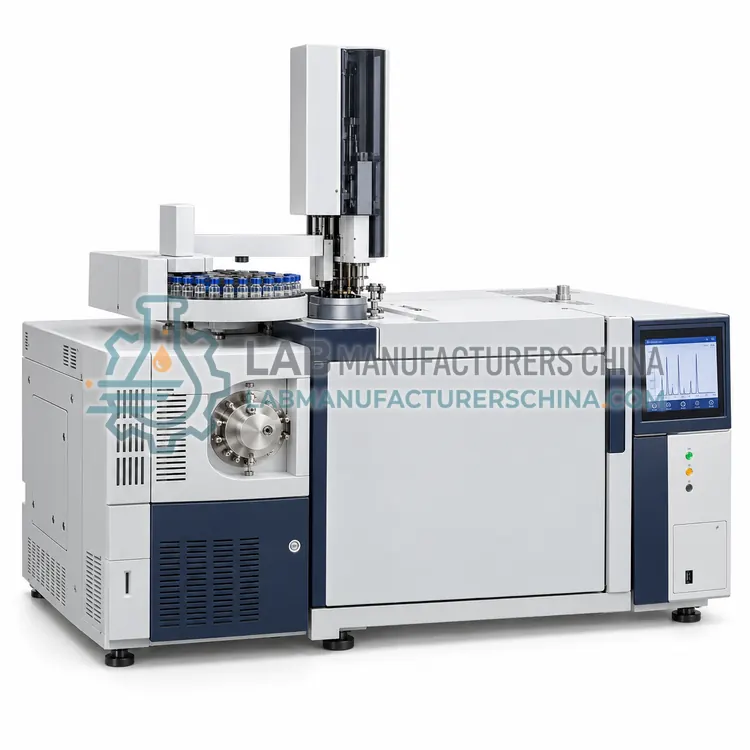
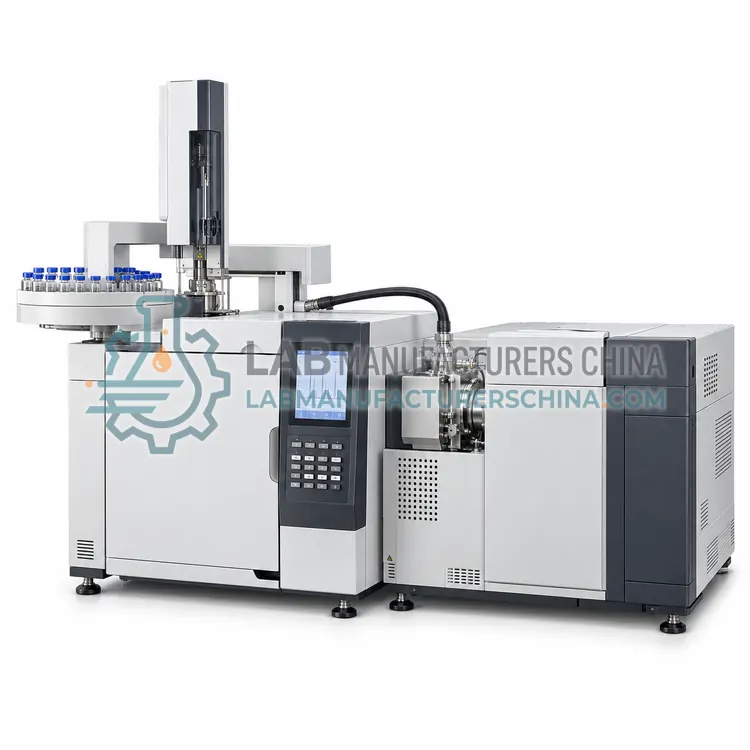
GC-Triple Quadrupole MS (GC-MS/MS) System
气相色谱三重四极杆串联质谱仪(GC-MS/MS)
- SKU GCM-0002
- GC-MS
- CE (to be confirmed)
- ISO 9001 manufacturing (to be confirmed)
- IEC 61010-1 safety (to be confirmed)
Price on request — FOB / CIF quoted per order
Prices depend on configuration, quantity and destination port.
Key specifications
| Mass range | m/z 1.2–1200 |
|---|---|
| Minimum MRM dwell time | 1 ms |
| Maximum MRM transitions per second | ≥ 500 |
| Instrument detection limit (OFN, MRM 272>222) | ≤ 1 fg (typical) |
| Ionization modes | EI; optional CI (methane, ammonia) |
| Collision gas | Nitrogen or argon, 99.999% |
Request a quote Download brochure · to be provided
By Lab Manufacturers China Technical TeamLast reviewed Standards: EPA Method 8270, EPA Method 524.2, EPA Method 8260
What is the GC-Triple Quadrupole MS (GC-MS/MS) System?
A GC-MS/MS system couples a gas chromatograph to a triple quadrupole, using multiple reaction monitoring to cut chemical noise. It is selected for trace quantitation of pesticides, dioxin-like compounds, PAHs and other analytes in complex matrices where single quadrupole selectivity is insufficient.
What is the GC-Triple Quadrupole MS (GC-MS/MS) System?
A GC-MS/MS system couples a gas chromatograph to a triple quadrupole, using multiple reaction monitoring to cut chemical noise. It is selected for trace quantitation of pesticides, dioxin-like compounds, PAHs and other analytes in complex matrices where single quadrupole selectivity is insufficient.
Overview
A GC-MS/MS uses three sections in series: a first quadrupole selects a precursor ion, a collision cell fragments it with argon or nitrogen, and a second quadrupole transmits a specific product ion. This multiple reaction monitoring mode removes most co-eluting matrix signals, giving signal-to-noise gains of one to two orders of magnitude over SIM for many analytes. Modern systems monitor hundreds of transitions per run with dwell times as short as 1 ms and use timed MRM windows to manage large panels. Electron ionization remains standard, so library search is possible in full-scan mode. Typical instrument detection limits fall in the sub-femtogram range for octafluoronaphthalene. The design suits regulated multi-residue and contaminant methods but costs more and requires more method development than a single quadrupole.
How does it work?
In GC-MS, a liquid or gas sample is vaporized in a heated inlet and carried by helium or hydrogen through a capillary column, typically 15 to 60 m long with a 0.25 mm internal diameter. Compounds separate according to boiling point and interaction with the stationary phase and elute at characteristic retention times. The column exit feeds an ion source, most often electron ionization at 70 eV, which produces reproducible fragmentation patterns that can be matched against libraries such as NIST. Ions are filtered by a mass analyzer, commonly a quadrupole, and counted by an electron multiplier. Acquisition can run in full scan for identification or selected ion monitoring for higher sensitivity. A turbomolecular pump maintains the high vacuum required in the analyzer.
What are the key features?
- Triple quadrupole with collision cell for multiple reaction monitoring with minimal crosstalk
- Timed MRM scheduling supporting 500 or more transitions in a single acquisition
- Dwell times down to 1 ms for fast chromatography and narrow peaks
- Full-scan and SIM modes retained for library identification and method development
- Collision gas control with nitrogen or argon and optional helium quench gas
- Ion source with extended-life design for dirty matrices and long sequences
What are the technical specifications?
A typical gc-triple quadrupole ms (gc-ms/ms) system configuration offers mass range of m/z 1.2–1200, minimum MRM dwell time of 1 ms, maximum MRM transitions per second of ≥ 500, instrument detection limit (OFN, MRM 272>222) of ≤ 1 fg (typical), ionization modes of EI; optional CI (methane, ammonia) and collision gas of Nitrogen or argon, 99.999%. Values are indicative of the product class; the exact figures for each configuration are confirmed on the quotation and the calibration documents supplied with the instrument.
Which applications is it used for?
The GC-Triple Quadrupole MS (GC-MS/MS) System is used in multi-residue pesticide analysis in food, dioxin-like PCB and PAH quantitation, environmental contaminant monitoring, doping control and anabolic agent testing and volatile nitrosamine analysis. Across the wider GC-MS class, laboratories also deploy it for environmental VOC and semi-volatile analysis, pesticide residue testing in food and forensic toxicology and drug screening.
Which standards and certifications apply?
Relevant standards and methods include EPA Method 8270, EPA Method 524.2, EPA Method 8260, ASTM D5769, USP <467> Residual Solvents, ISO 11423, EN 15662, ISO/IEC 17025 and IEC 61010-1. Certification candidates for this model are CE, ISO 9001 manufacturing and IEC 61010-1 safety; each is to be confirmed for the specific configuration before shipment, and certificates are supplied only where they have been issued.
Install the GC-MS on a level bench with a dedicated power outlet, a vented exhaust for the rotary pump, and stable room temperature. Use high-purity carrier gas of at least 99.999 percent with moisture and oxygen traps, since contamination shortens column and filament life. Perform an autotune with perfluorotributylamine before each batch and verify mass accuracy and isotope ratios. Routine maintenance includes replacing inlet liners, septa and gold seals, trimming the column, cleaning the ion source and changing pump oil. Keep leak checks in the daily routine, as air peaks at m/z 28 and 32 indicate a leak. Regulated laboratories should require audit trails, electronic signatures and access control that support 21 CFR Part 11.
How do I select the right GC-Triple Quadrupole MS (GC-MS/MS) System?
Select GC-MS/MS when single quadrupole SIM cannot reach required limits in complex matrices or when you run large panels such as 200 pesticides per injection. In an RFQ, specify the MRM capacity, minimum dwell time, OFN detection limit, collision gas, source type, and whether hydrogen carrier gas operation is required.
How does it compare with other GC-MS variants?
Select a GC-MS by matching the detector to the task. A single quadrupole is the economical choice for routine identification and quantitation of residues, volatiles and unknowns using library matching. A triple quadrupole configuration is needed when matrix interference limits sensitivity, as in pesticide multi-residue or dioxin-related work. Time-of-flight offers fast acquisition and accurate mass for non-targeted screening. Headspace and pyrolysis configurations suit specific sample types without solvent extraction. Check the scan speed, mass range, source cleanliness tolerance, and whether the ion source can be changed without venting. Verify support for helium alternatives such as hydrogen, autosampler capacity, and library and data-integrity software. Ask vendors for detection-limit data, such as octafluoronaphthalene instrument detection limit, measured on the exact configuration quoted.
Full specifications
| Mass range | m/z 1.2–1200 |
|---|---|
| Minimum MRM dwell time | 1 ms |
| Maximum MRM transitions per second | ≥ 500 |
| Instrument detection limit (OFN, MRM 272>222) | ≤ 1 fg (typical) |
| Ionization modes | EI; optional CI (methane, ammonia) |
| Collision gas | Nitrogen or argon, 99.999% |
| Mass resolution | Adjustable 0.4–2.0 u FWHM |
| Linear dynamic range | ≥ 10^5 |
| Ion source temperature | 150–350 °C |
| Vacuum pumping | Split-flow turbomolecular, 300 L/s typical |
Indicative values for this product class. Final specifications are confirmed on the quotation and in the calibration documents supplied with the instrument.
Applications
- Multi-residue pesticide analysis in food
- Dioxin-like PCB and PAH quantitation
- Environmental contaminant monitoring
- Doping control and anabolic agent testing
- Volatile nitrosamine analysis
Key features
- Triple quadrupole with collision cell for multiple reaction monitoring with minimal crosstalk
- Timed MRM scheduling supporting 500 or more transitions in a single acquisition
- Dwell times down to 1 ms for fast chromatography and narrow peaks
- Full-scan and SIM modes retained for library identification and method development
- Collision gas control with nitrogen or argon and optional helium quench gas
- Ion source with extended-life design for dirty matrices and long sequences
Frequently asked questions about GC-Triple Quadrupole MS (GC-MS/MS) System
MRM requires a compound to pass two mass filters, selecting both a precursor and a specific fragment. Co-eluting matrix ions rarely share both masses, so chemical background falls sharply. The result is a cleaner baseline and signal-to-noise improvements of ten to one hundred times for many analytes.
Modern systems handle several hundred transitions per run using timed windows. The practical limit depends on dwell time, peak width and the number of overlapping compounds. A typical multi-residue method monitors two transitions for each of 200 to 500 pesticides.
Yes. With electron ionization, the instrument can operate in full-scan mode, with the collision cell off, to produce standard spectra that match EI libraries. This lets one system handle both non-targeted identification and targeted MRM quantitation, though full-scan sensitivity is comparable to a single quadrupole.
GC-MS analyzes compounds that can be vaporized without decomposition, generally with molecular weights below about 500 Da. Examples are solvents, pesticides, hydrocarbons, fatty acid methyl esters, flavors and many drugs. Polar or non-volatile analytes can be made suitable by derivatization, for example silylation.
Full scan records the whole mass range, for example m/z 35 to 550, and gives spectra for library identification of unknowns. Selected ion monitoring records only chosen ions, which increases dwell time per ion and typically improves sensitivity by ten to one hundred times, but it loses information about unexpected compounds.
Yes, with conditions. Hydrogen gives faster separations and lower cost, but it can react with some analytes, change spectra in electron ionization sources, and requires safety measures. Many systems need a hydrogen-compatible ion source and method revalidation before replacing helium in regulated work.
Related models