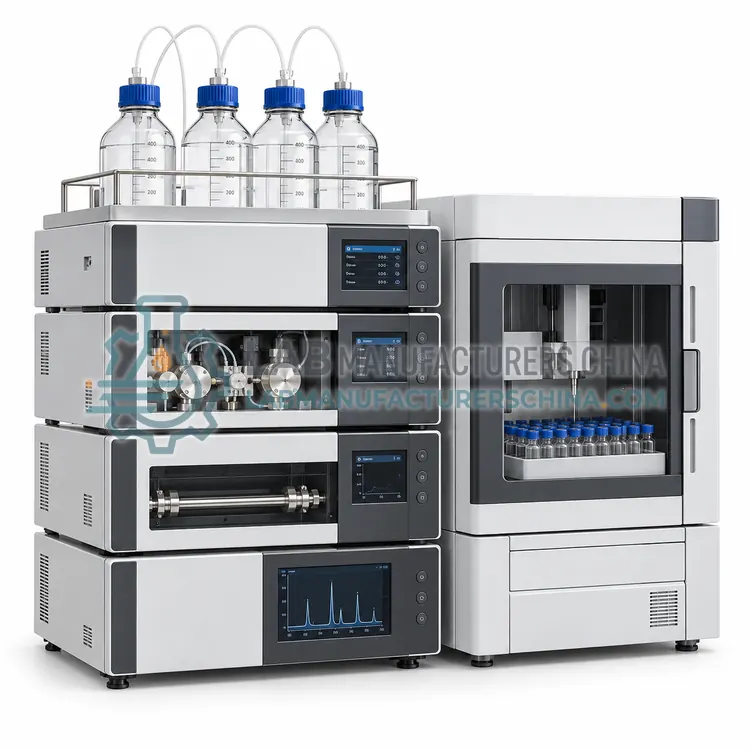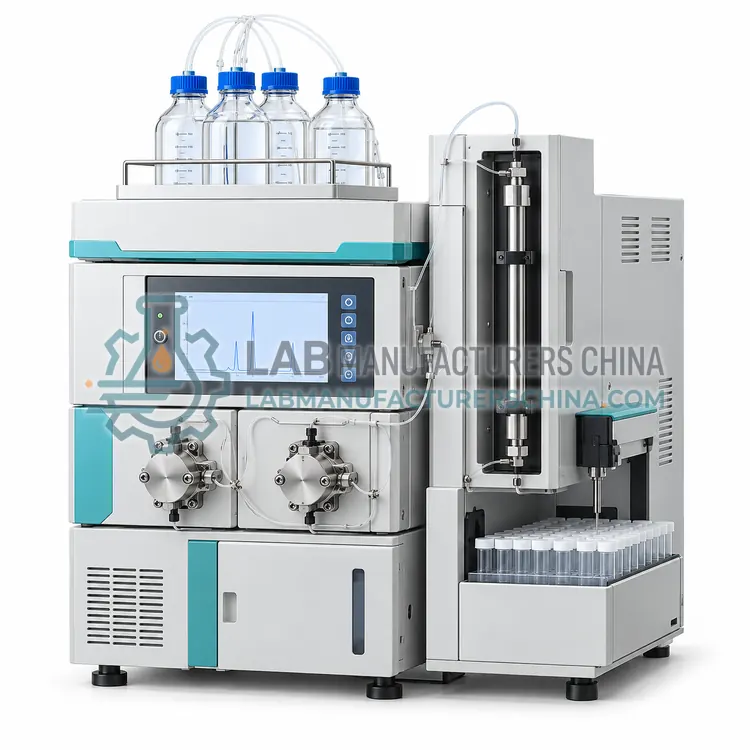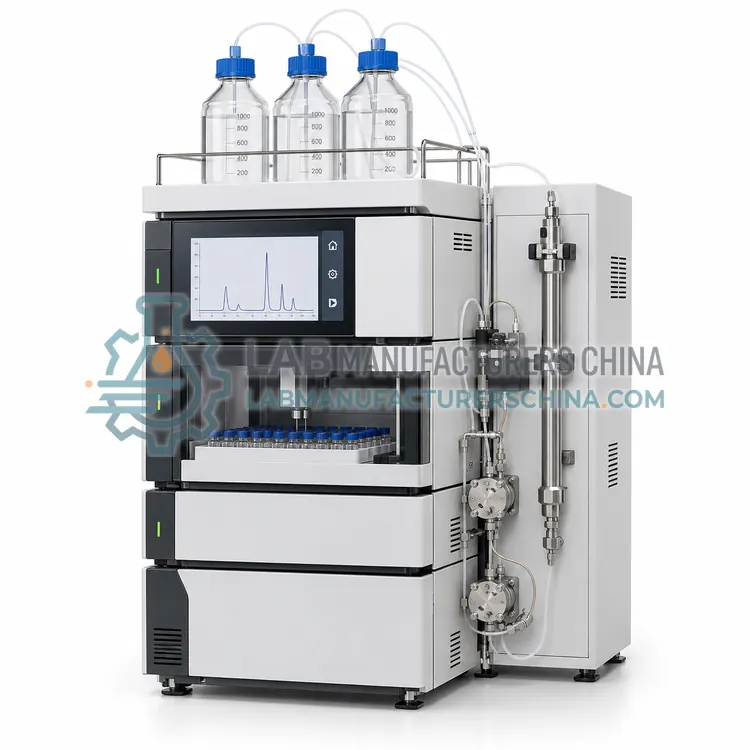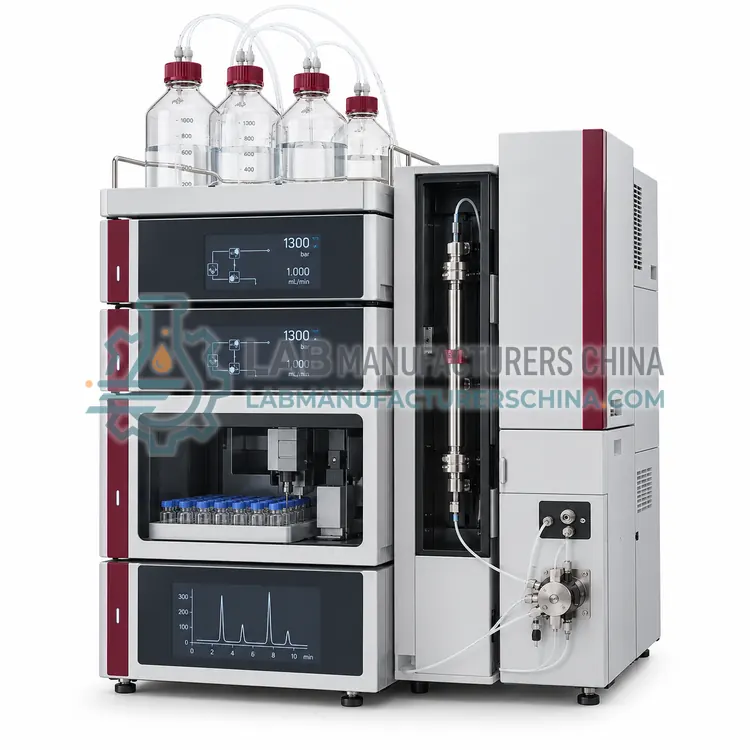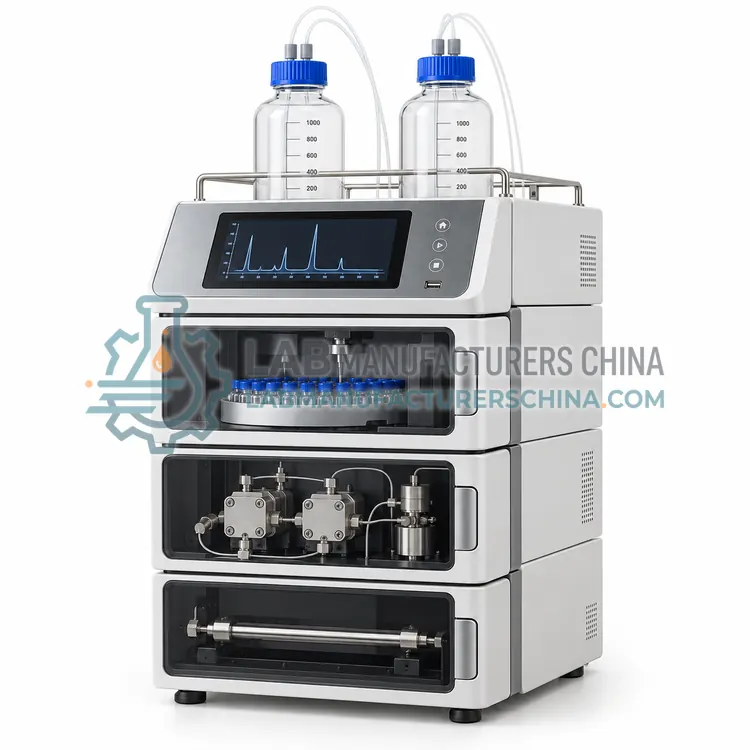
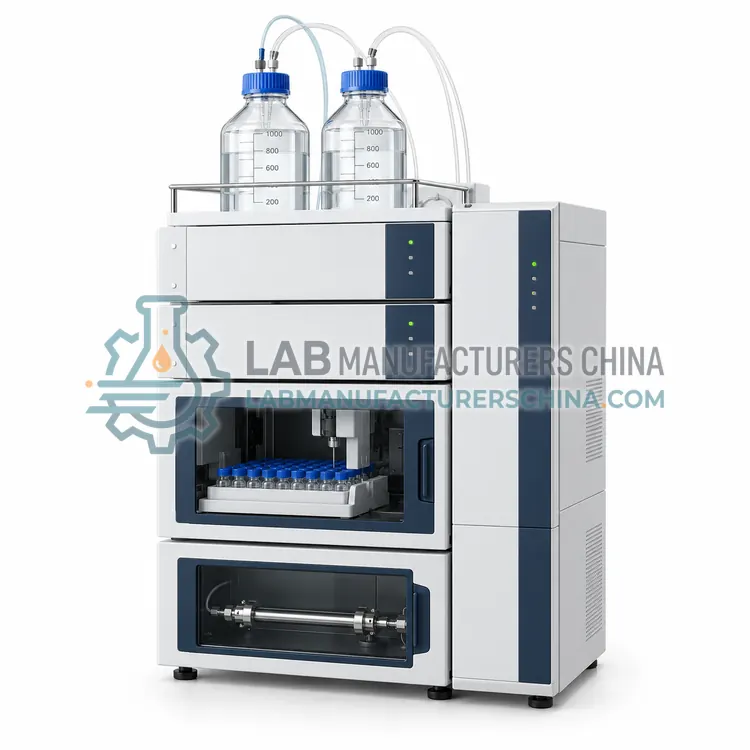
Binary Gradient HPLC System
二元梯度高效液相色谱系统
- SKU HPL-0002
- HPLC
- CE (to be confirmed)
- ISO 9001 manufacturing (to be confirmed)
- RoHS (to be confirmed)
Price on request — FOB / CIF quoted per order
Prices depend on configuration, quantity and destination port.
Key specifications
| Flow rate range | 0.001–5 mL/min |
|---|---|
| Maximum operating pressure | 60 MPa (600 bar) |
| Gradient composition accuracy | ±0.5% absolute |
| Gradient composition precision (RSD) | ≤0.15% |
| Dwell volume | 100–400 µL |
| Solvent channels | 2 (A/B), optional 2 per pump |
Request a quote Download brochure · to be provided
By Lab Manufacturers China Technical TeamLast reviewed Standards: USP <621>, Ph. Eur. 2.2.29, USP <1058>
What is the Binary Gradient HPLC System?
A binary gradient HPLC system uses two high-pressure pumps, or one dual-channel pump, to mix two solvents under programmed composition change. It is the standard configuration for impurity profiling, stability-indicating methods and general method development where two-solvent reversed-phase gradients cover most separations.
What is the Binary Gradient HPLC System?
A binary gradient HPLC system uses two high-pressure pumps, or one dual-channel pump, to mix two solvents under programmed composition change. It is the standard configuration for impurity profiling, stability-indicating methods and general method development where two-solvent reversed-phase gradients cover most separations.
Overview
In a binary high-pressure mixing design, each solvent has its own pump and the streams merge at a low-volume mixer after pressurization. This produces low dwell volume, typically 100–400 µL, so gradients reach the column quickly and transfer readily to and from UHPLC methods. The two-solvent limitation, usually aqueous buffer and organic modifier, is sufficient for most reversed-phase separations. Typical flow range is 0.001–5 mL/min with pressure to 600 bar, paired with a diode-array detector and a thermostatted autosampler for sample stability. Because gradient accuracy depends on each pump, regular verification of composition accuracy with a tracer such as caffeine or acetone is important. Binary systems do not offer automatic blending of four solvents, so pH scouting requires manual preparation of separate buffers.
How does it work?
An HPLC system pumps solvent through an injector and a packed column, typically 50–250 mm long with 3–5 µm particles. The sample is injected as a narrow band and analytes partition between the mobile phase and the stationary phase, most commonly bonded C18 silica in reversed-phase mode. Retention depends on polarity, pH, temperature and solvent strength. Isocratic operation keeps composition constant; gradient operation changes it over time to elute compounds with widely different retention. Key modules are the solvent delivery pump with degasser, the autosampler, the thermostatted column compartment and the detector, commonly UV-Vis, diode-array, fluorescence or refractive index. Chromatography data software integrates peaks, applies calibration curves and reports retention time, area, plate count and tailing factor for system suitability.
What are the key features?
- Two high-pressure pumps with low dwell volume of roughly 100–400 µL for fast gradient response
- Gradient composition accuracy of ±0.5% with precision of 0.15% across 5–95% B
- Diode-array detector option enabling peak purity assessment across 190–800 nm
- Thermostatted autosampler holding 4–40 °C for labile sample stability
- Compatible with columns from 2.1 mm to 4.6 mm internal diameter and 3–5 µm particles
What are the technical specifications?
A typical binary gradient hplc system configuration offers flow rate range of 0.001–5 mL/min, maximum operating pressure of 60 MPa (600 bar), gradient composition accuracy of ±0.5% absolute, gradient composition precision (RSD) of ≤0.15%, dwell volume of 100–400 µL and solvent channels of 2 (A/B), optional 2 per pump. Values are indicative of the product class; the exact figures for each configuration are confirmed on the quotation and the calibration documents supplied with the instrument.
Which applications is it used for?
The Binary Gradient HPLC System is used in impurity and related-substance profiling, stability-indicating methods, reversed-phase method development, pesticide and mycotoxin analysis and transfer of methods to UHPLC. Across the wider HPLC class, laboratories also deploy it for assay and purity testing of drug substances, food additive and vitamin analysis and environmental pollutant monitoring.
Which standards and certifications apply?
Relevant standards and methods include USP <621>, Ph. Eur. 2.2.29, USP <1058>, ICH Q2(R2), ChP 0512, IEC 61010-1, ISO/IEC 17025 and 21 CFR Part 11. Certification candidates for this model are CE, ISO 9001 manufacturing and RoHS; each is to be confirmed for the specific configuration before shipment, and certificates are supplied only where they have been issued.
Install the system on a stable bench away from drafts, with a steady power supply and ventilated solvent waste storage. Degas and filter mobile phases through 0.22–0.45 µm membranes to protect check valves and columns. Qualify the instrument (IQ/OQ/PQ) following USP <1058>, verifying flow accuracy, gradient composition accuracy, injection precision, detector linearity, wavelength accuracy and column oven temperature. Establish preventive maintenance for pump seals, piston washes, lamps and autosampler needle seats. Flush buffers with water before storing, and follow column manufacturer pH and pressure limits. For regulated work, configure audit trails and user roles in the data system.
How do I select the right Binary Gradient HPLC System?
Select a binary gradient system for most general-purpose and impurity methods using one aqueous and one organic phase. Choose quaternary instead when you routinely screen buffers or modifiers. In an RFQ state pressure rating, dwell volume limits, autosampler capacity and cooling, detector type, column oven range and whether 21 CFR Part 11 software features are required.
How does it compare with other HPLC variants?
Within a chromatography laboratory, HPLC configurations differ mainly in pump design, detector options and scale. Isocratic systems suit single-solvent routine assays at the lowest cost. Binary gradient systems cover most method development and impurity work, while quaternary systems add on-line solvent blending for screening and pH or modifier adjustment. Preparative systems are chosen when the goal is to isolate milligrams to grams of a compound, and bio-inert systems are needed when mobile phases contain high salt or extreme pH, or when proteins must not contact stainless steel. Decide on maximum pressure, flow range, dwell volume, autosampler capacity, detector types, column oven range and data-integrity features. Check that column dimensions in your validated methods are supported without extensive re-plumbing.
Full specifications
| Flow rate range | 0.001–5 mL/min |
|---|---|
| Maximum operating pressure | 60 MPa (600 bar) |
| Gradient composition accuracy | ±0.5% absolute |
| Gradient composition precision (RSD) | ≤0.15% |
| Dwell volume | 100–400 µL |
| Solvent channels | 2 (A/B), optional 2 per pump |
| Autosampler capacity | 100–200 vials |
| Injection precision (RSD) | ≤0.3% (10 µL) |
| Column oven range | 4–85 °C |
| Detector wavelength accuracy | ±1 nm |
Indicative values for this product class. Final specifications are confirmed on the quotation and in the calibration documents supplied with the instrument.
Applications
- Impurity and related-substance profiling
- Stability-indicating methods
- Reversed-phase method development
- Pesticide and mycotoxin analysis
- Transfer of methods to UHPLC
Key features
- Two high-pressure pumps with low dwell volume of roughly 100–400 µL for fast gradient response
- Gradient composition accuracy of ±0.5% with precision of 0.15% across 5–95% B
- Diode-array detector option enabling peak purity assessment across 190–800 nm
- Thermostatted autosampler holding 4–40 °C for labile sample stability
- Compatible with columns from 2.1 mm to 4.6 mm internal diameter and 3–5 µm particles
Frequently asked questions about Binary Gradient HPLC System
Dwell volume is the system volume between the point where solvents mix and the column inlet. It delays the arrival of the programmed gradient. Methods transferred between instruments with different dwell volumes can shift retention and resolution, so low and known dwell volume simplifies method transfer.
Only if one pump channel is premixed. For example, a premixed aqueous buffer with acetonitrile and methanol on separate pumps can approximate a ternary method, but it is less flexible than a quaternary system. Methods that require variable three- or four-solvent blending are better served by a quaternary pump.
Run a step gradient with a UV-absorbing tracer such as 0.1% acetone or caffeine in one channel and compare the measured step heights with theoretical values. Acceptance criteria are often ±1% absolute composition. Also check gradient linearity and noise as part of operational qualification.
A basic HPLC system comprises a solvent reservoir with degasser, a high-pressure pump, an autosampler or manual injector, a thermostatted column compartment, a packed column, a detector such as UV-Vis or diode-array, and a data system. Optional modules include fraction collectors and column switching valves.
Isocratic HPLC keeps the mobile phase composition constant throughout the run and suits simple mixtures with similar retention. Gradient HPLC changes the solvent ratio over time, which sharpens late-eluting peaks and separates compounds with widely different polarity within a practical run time.
Conventional HPLC methods on 3–5 µm columns run below about 300 bar, so systems rated to 400–600 bar have headroom. Methods with sub-2 µm particles or long columns need UHPLC hardware rated above 600 bar. Choose a rating based on your validated methods, not the maximum figure alone.
Related models