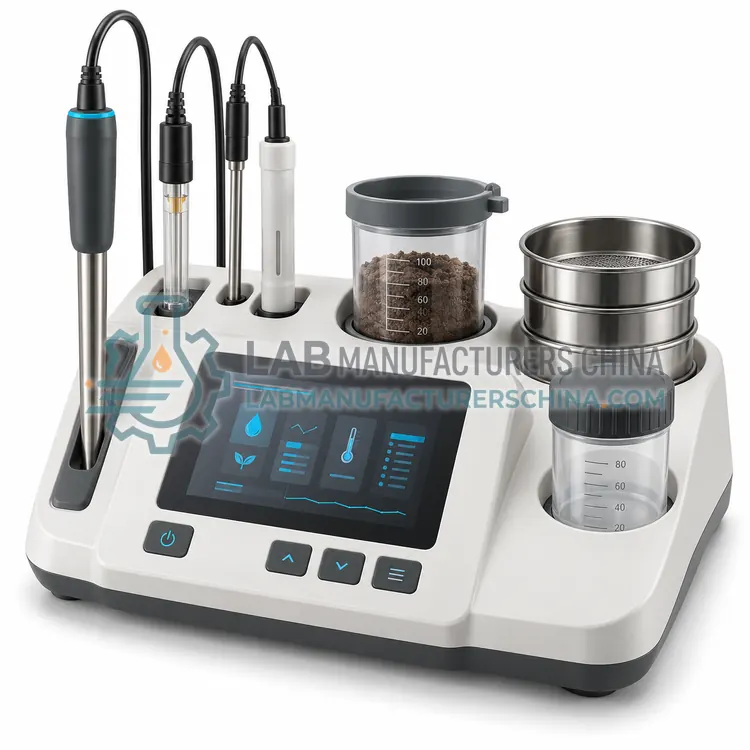
Near-Infrared Grain Quality Analyzer
近红外谷物品质分析仪
- SKU GRA-0001
- Grain Analysis
- CE (to be confirmed)
- RoHS (to be confirmed)
- ISO 9001 manufacturing (to be confirmed)
Price on request — FOB / CIF quoted per order
Prices depend on configuration, quantity and destination port.
Key specifications
| Measurement principle | Near-infrared reflectance and transmission |
|---|---|
| Wavelength range | 850–2500 nm |
| Measured components | Protein, moisture, oil, starch, fibre, ash |
| Measurement time | 10–60 s per sample |
| Sample type | Whole grain or ground meal |
| Sample volume | 100–600 g (whole grain) |
Request a quote Download brochure · to be provided
By Lab Manufacturers China Technical TeamLast reviewed Standards: ISO 712 (moisture), ISO 3093 (falling number), AACC Method 56-81B
What is the Near-Infrared Grain Quality Analyzer?
A spectrometer that predicts protein, moisture, oil, starch and other components from a grain spectrum in under a minute. It is the right choice for high-throughput intake grading, blending and process control.
What is the Near-Infrared Grain Quality Analyzer?
A spectrometer that predicts protein, moisture, oil, starch and other components from a grain spectrum in under a minute. It is the right choice for high-throughput intake grading, blending and process control.
Overview
The near-infrared grain analyzer shines light onto or through a grain sample and measures reflectance or transmission across many wavelengths, typically 850 to 2500 nm. Multivariate models, built from spectra of samples whose composition was determined by reference chemistry, convert the spectrum into protein, moisture, oil, starch, fibre and other predictions. Whole-grain instruments use a hopper or a rotating cup so no grinding is needed and throughput reaches hundreds of samples per hour, which suits elevator intake. Bench-top models may include a reference module or accept ground samples for higher accuracy. Calibration transfer and bias adjustment keep results aligned with the reference laboratory as new varieties appear. Results can be exported to a laboratory information system or a site controller, and the instrument stores the spectra for later model updates.
How does it work?
Grain analysis uses several techniques. Near-infrared instruments measure the reflectance or transmission of light at selected wavelengths, and multivariate calibration models relate the spectra to protein, moisture, oil and starch content. Capacitance moisture meters measure the dielectric constant of a grain sample, which rises with water content, and are calibrated per species and temperature. The falling number apparatus gelatinises a ground grain suspension in a boiling water bath and times the fall of a stirrer through the paste, giving a viscosity-related index of sprout damage and alpha-amylase activity. Gluten content is determined by washing a dough ball mechanically to remove starch, or by near-infrared prediction, and gluten index measures its elasticity. Test weight, or hectolitre weight, is the mass of grain filling a standard volume, measured by a filling hopper and a calibrated container.
What are the key features?
- Predicts multiple components from one measurement in under a minute.
- Whole-grain sampling avoids grinding and supports high throughput.
- Multivariate calibrations are developed with a reference laboratory.
- Bias adjustment keeps results aligned with wet chemistry.
- Spectra are archived for future calibration model updates.
- Results export to laboratory systems and site controllers.
What are the technical specifications?
A typical near-infrared grain quality analyzer configuration offers measurement principle of Near-infrared reflectance and transmission, wavelength range of 850–2500 nm, measured components of Protein, moisture, oil, starch, fibre, ash, measurement time of 10–60 s per sample, sample type of Whole grain or ground meal and sample volume of 100–600 g (whole grain). Values are indicative of the product class; the exact figures for each configuration are confirmed on the quotation and the calibration documents supplied with the instrument.
Which applications is it used for?
The Near-Infrared Grain Quality Analyzer is used in grain elevator intake grading, blending and load-out control, flour mill wheat selection and plant breeding quality screening. Across the wider Grain Analysis class, laboratories also deploy it for grain elevator intake grading, flour and semolina milling control and feed ingredient quality control.
Which standards and certifications apply?
Relevant standards and methods include ISO 712 (moisture), ISO 3093 (falling number), AACC Method 56-81B, ICC Standard 105/2, ISO 21415-2 (gluten) and GB/T 5498 (test weight). Certification candidates for this model are CE, RoHS and ISO 9001 manufacturing; each is to be confirmed for the specific configuration before shipment, and certificates are supplied only where they have been issued.
Keep near-infrared instruments clean and free of dust, and run the daily check sample supplied with the calibration to detect drift. Store reference samples for the grain species in use and send periodic samples to a reference laboratory for biased calibration updates. For capacitance meters, control sample temperature and fill volume exactly, since both affect readings. The falling number apparatus needs a boiling water bath at a stable rolling boil, correct grinding and accurate timing to meet the standard. Grain samples should be representative, taken with a proper divider, and stored dry to avoid moisture change before analysis. Record instrument settings, sample mass and results so that data can be traced to the method used.
How do I select the right Near-Infrared Grain Quality Analyzer?
Select the NIR analyzer when fast, multi-component grading is needed and the local variety and moisture ranges are covered by the calibration. For legally reported moisture alone, a calibrated capacitance meter may be cheaper. In an RFQ, specify species, components, accuracy targets and whether whole grain or ground sampling is required.
How does it compare with other Grain Analysis variants?
Start from the parameters and the reference method required by the trading contract or the internal specification. For rapid multi-parameter grading at intake, near-infrared analyzers give protein, moisture, oil and starch in under a minute and suit high throughput, but their calibrations must cover the grain species, variety groups and moisture ranges encountered. For legally reported moisture, use a capacitance or oven method calibrated to the applicable standard. Select the falling number apparatus when sprout damage or alpha-amylase activity matters for milling and baking. Choose a gluten analyzer when dough strength is the key quality parameter for flour. Confirm sample presentation, calibration maintenance, reference laboratory support and the ability to update models as new varieties are grown.
Full specifications
| Measurement principle | Near-infrared reflectance and transmission |
|---|---|
| Wavelength range | 850–2500 nm |
| Measured components | Protein, moisture, oil, starch, fibre, ash |
| Measurement time | 10–60 s per sample |
| Sample type | Whole grain or ground meal |
| Sample volume | 100–600 g (whole grain) |
| Calibration | Multivariate, species specific |
| Protein accuracy | ±0.3–0.5% vs reference method |
| Outputs | USB, Ethernet, RS-232, LIMS export |
| Operating temperature | 5–40 °C |
| Power supply | 100–240 VAC, 50/60 Hz |
Indicative values for this product class. Final specifications are confirmed on the quotation and in the calibration documents supplied with the instrument.
Applications
- Grain elevator intake grading
- Blending and load-out control
- Flour mill wheat selection
- Plant breeding quality screening
Key features
- Predicts multiple components from one measurement in under a minute.
- Whole-grain sampling avoids grinding and supports high throughput.
- Multivariate calibrations are developed with a reference laboratory.
- Bias adjustment keeps results aligned with wet chemistry.
- Spectra are archived for future calibration model updates.
- Results export to laboratory systems and site controllers.
Frequently asked questions about Near-Infrared Grain Quality Analyzer
No. Protein and moisture predictions depend on variety, growing region and season, so a global calibration gives wider error than local models. Most users maintain regional calibrations and add samples each season to keep them current.
Yes for calibration and ongoing verification. Reference values from Kjeldahl protein, oven moisture or Soxhlet oil are used to build and monitor the model. A small number of samples each season detects bias from new varieties or changed conditions.
Spectra are temperature sensitive, so instruments either measure sample temperature and correct the result or require samples to equilibrate to room temperature. Large temperature differences between grain and instrument are a common cause of error.
The falling number is the time in seconds for a stirrer to fall through a heated flour and water paste. A low value indicates high alpha-amylase activity and sprout damage, which reduces bread quality, while a high value indicates sound, un-sprouted grain.
The dielectric constant depends on grain structure and seed coat as well as water content, so wheat, maize, rice and oilseeds respond differently. Instruments therefore hold separate calibrations per species and often per variety group, and readings should be checked against an oven method.
With a calibration built for the local varieties and reference laboratory data, near-infrared protein predictions are typically within about 0.3 to 0.5 percent absolute of the reference method. Accuracy falls for varieties not represented in the calibration set.
Related models