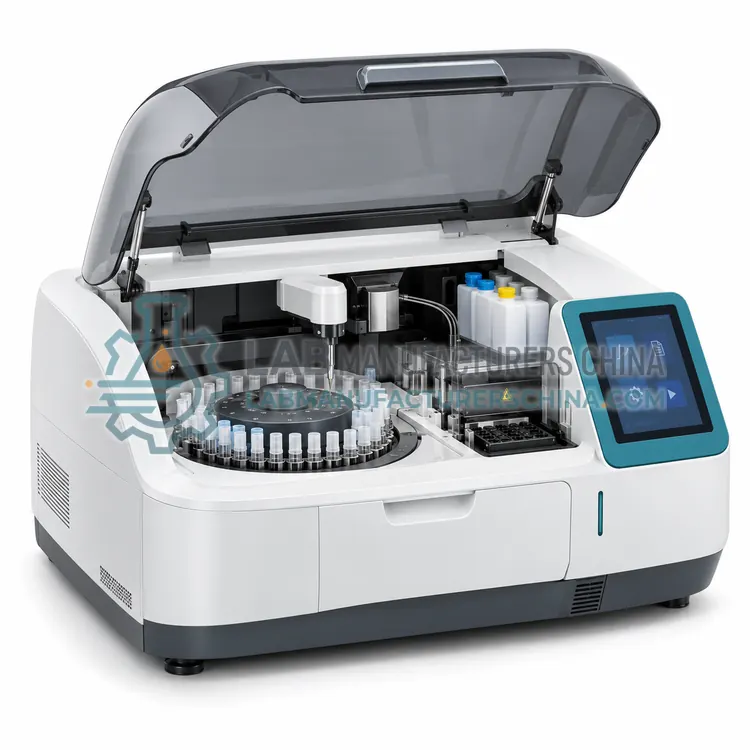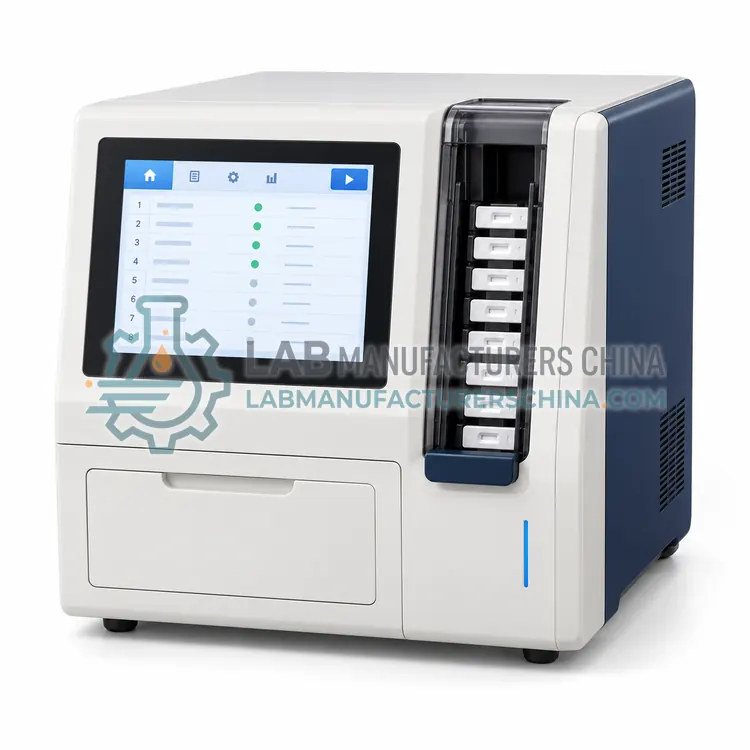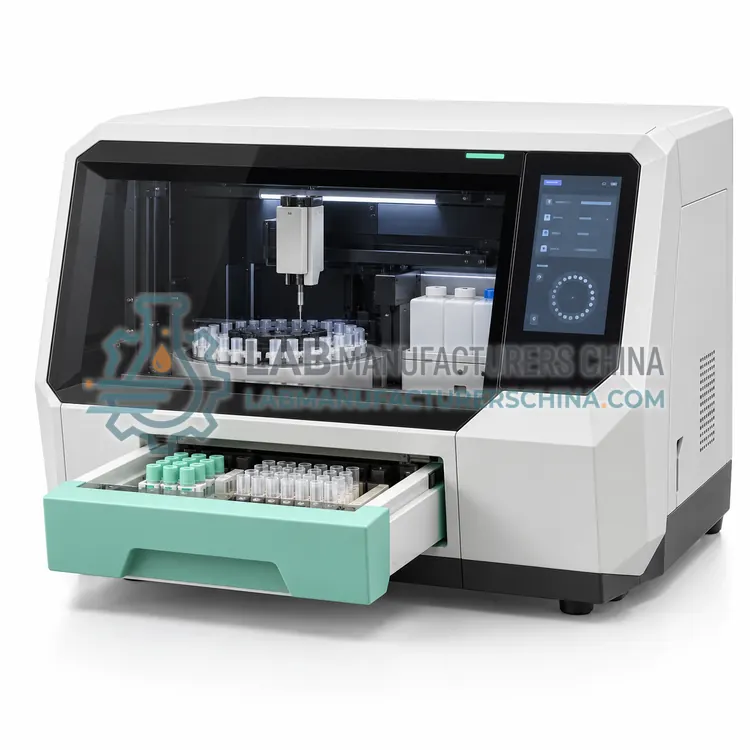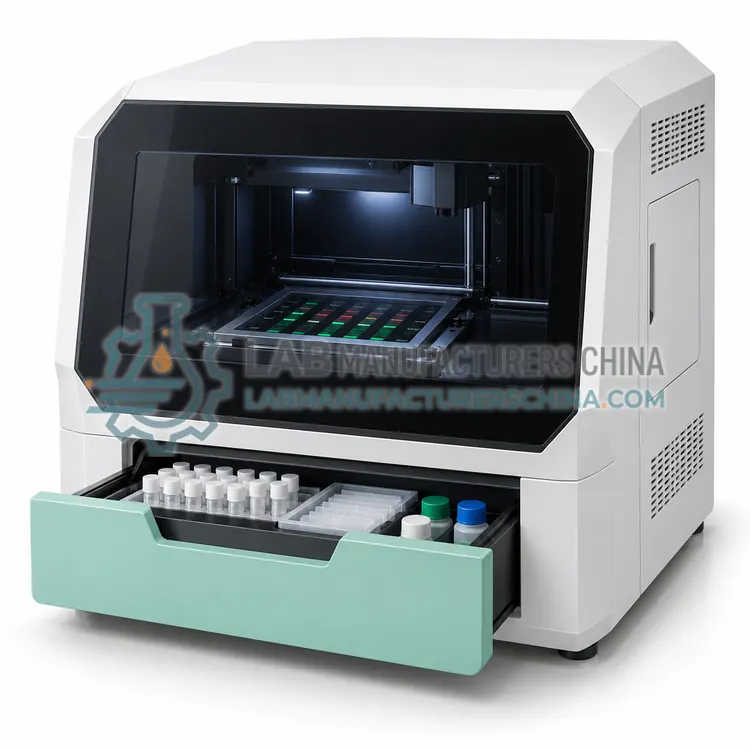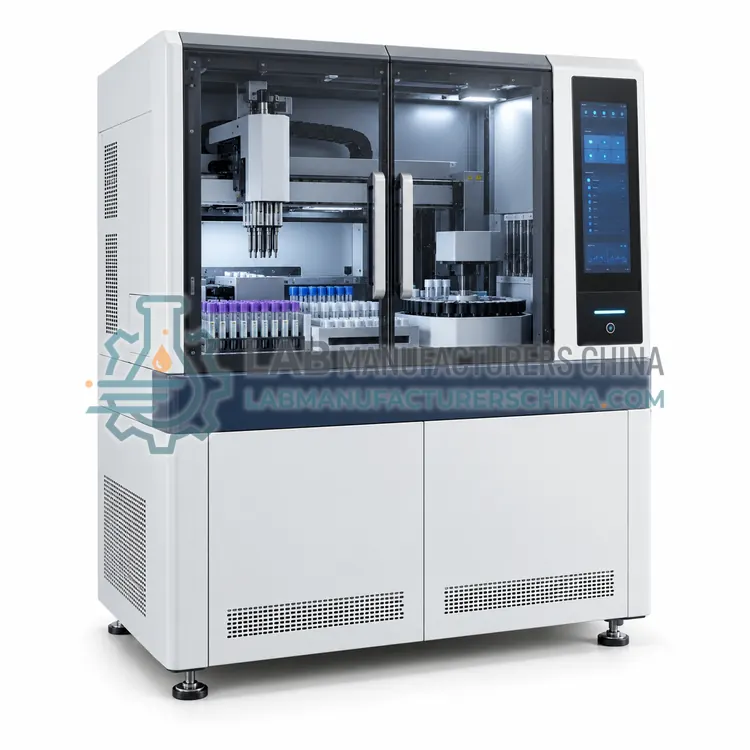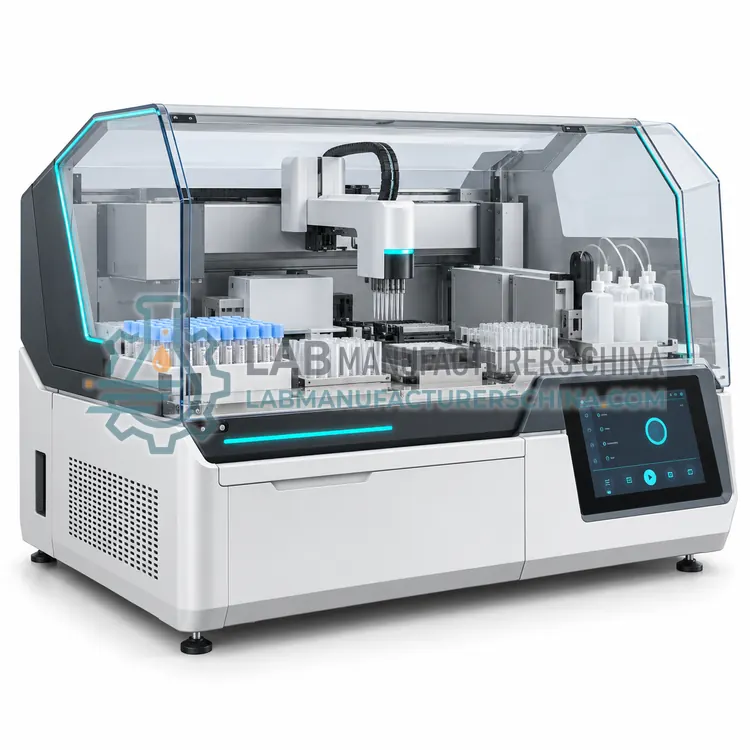
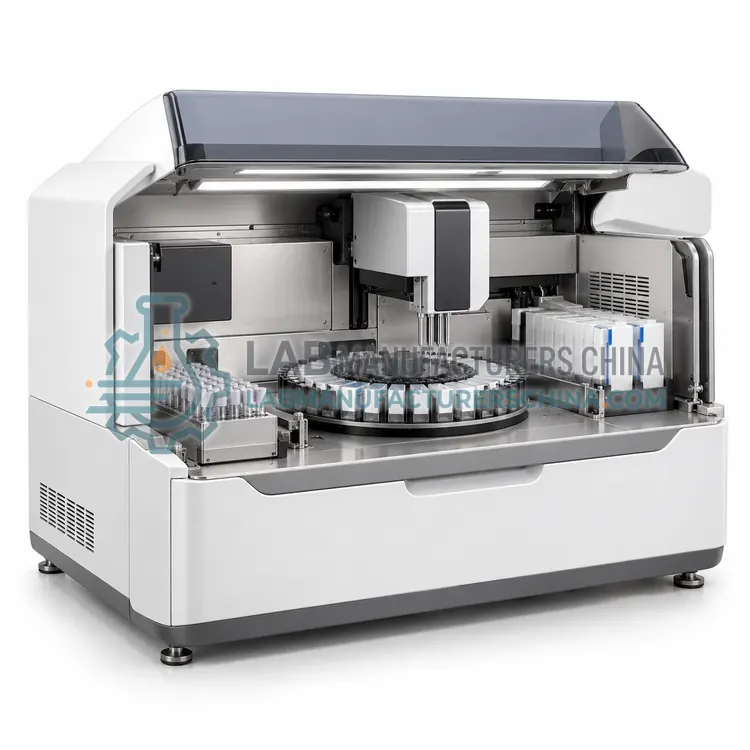
Automated Cartridge-Based Fluorescence Immunoassay Analyzer
卡盒式全自动荧光免疫分析仪
- SKU FLI-0004
- Fluorescence Immunoassay
- CE (to be confirmed)
- ISO 13485 manufacturing (to be confirmed)
- NMPA class II registration (to be confirmed)
Price on request — FOB / CIF quoted per order
Prices depend on configuration, quantity and destination port.
Key specifications
| Throughput | 30–80 tests/h |
|---|---|
| Time to result | 15–25 min per cartridge |
| Simultaneous cartridges | 5–20 positions |
| Sample volume | 20–100 µL per cartridge |
| Incubation temperature | 37 °C ±0.5 °C |
| Calibration | Lot-specific curve from cartridge chip or barcode |
Request a quote Download brochure · to be provided
By Lab Manufacturers China Technical TeamLast reviewed Standards: ISO 15189, CLSI EP05, CLSI EP15
What is the Automated Cartridge-Based Fluorescence Immunoassay Analyzer?
This analyzer processes sealed cartridges automatically, performing sample metering, reaction, washing and fluorescent reading inside a closed device. It suits laboratories and clinics that want walkaway operation and reduced biohazard exposure from open liquid handling.
What is the Automated Cartridge-Based Fluorescence Immunoassay Analyzer?
This analyzer processes sealed cartridges automatically, performing sample metering, reaction, washing and fluorescent reading inside a closed device. It suits laboratories and clinics that want walkaway operation and reduced biohazard exposure from open liquid handling.
Overview
Each cartridge contains the reaction chamber, dried or liquid reagents, a wash reservoir and the fluorescent strip or well. The analyzer meters a defined sample volume, moves fluids by pneumatic or syringe pressure, incubates at a controlled temperature, washes and reads the fluorescent signal. Because the reaction takes place in a sealed device, the operator never contacts patient material after sample application, and used cartridges can be discarded as a unit. Walkaway operation is typical: several cartridges can be loaded and processed in sequence or in parallel, and results are reported with cartridge lot and curve information. Time to result is usually fifteen to twenty-five minutes, and both single tests and small panels are supported depending on the platform and its registered menu.
How does it work?
Fluorescence immunoassay uses an antibody labelled with a fluorophore such as fluorescein, a europium chelate or a quantum dot. After the immune complex forms, the label is excited by light of one wavelength and emits light at a longer wavelength, and a photodetector measures the emission after optical filtering. The difference between excitation and emission wavelengths allows the instrument to separate the signal from the excitation light, and background fluorescence from sample components is reduced by careful filter selection, by washing away unbound label and, in time-resolved systems, by delaying the measurement until short-lived background fluorescence has decayed. Since the fluorescent signal is measured against a low background, sensitivity is generally better than absorbance-based enzyme immunoassay. Quantification relies on a calibration curve stored in the analyzer, and strip-based tests use a reader that scans the test and control lines.
What are the key features?
- Sealed cartridges containing reagents, wash reservoir and detection zone
- Automatic sample metering and fluid movement by pneumatic pressure
- Controlled incubation temperature inside the cartridge
- Walkaway processing of multiple cartridges
- Reduced operator exposure to patient material
- Results reported with cartridge lot and curve identifiers
What are the technical specifications?
A typical automated cartridge-based fluorescence immunoassay analyzer configuration offers throughput of 30–80 tests/h, time to result of 15–25 min per cartridge, simultaneous cartridges of 5–20 positions, sample volume of 20–100 µL per cartridge, incubation temperature of 37 °C ±0.5 °C and calibration of Lot-specific curve from cartridge chip or barcode. Values are indicative of the product class; the exact figures for each configuration are confirmed on the quotation and the calibration documents supplied with the instrument.
Which applications is it used for?
The Automated Cartridge-Based Fluorescence Immunoassay Analyzer is used in clinical laboratory rapid immunoassay testing, emergency and intensive care units, infectious disease antigen and antibody testing and outpatient clinics with walkaway needs. Across the wider Fluorescence Immunoassay class, laboratories also deploy it for point-of-care cardiac and inflammation testing, hormone and fertility testing in clinics and infectious disease antigen detection.
Which standards and certifications apply?
Relevant standards and methods include ISO 15189, CLSI EP05, CLSI EP15, CLSI EP17, CLSI POCT04, IEC 61010-1 and IEC 61010-2-101. Certification candidates for this model are CE, ISO 13485 manufacturing and NMPA class II registration; each is to be confirmed for the specific configuration before shipment, and certificates are supplied only where they have been issued.
Keep the instrument away from strong ambient light and place it on a stable bench, because stray light and vibration reduce fluorescence measurement precision. Verify performance at installation with the manufacturer's calibration material and with controls at two or three levels, and check the optical path and detector gain as specified. Daily tasks include control measurement and checking that the correct assay lot and curve are selected. Lateral flow readers require consistent sample application volume, controlled reading time after the reaction and careful handling of cartridges, since a delay of a few minutes can change the result near a cut-off. Store cartridges and reagents within their temperature range, use them before expiry, and treat all used devices as infectious waste.
How do I select the right Automated Cartridge-Based Fluorescence Immunoassay Analyzer?
Specify this variant when the laboratory wants automation without a wet reagent system, or when staff exposure to open sample handling must be minimized. In the RFQ confirm the registered menu, cartridge storage conditions and shelf life, positions available for simultaneous processing, and how lot changes and controls are managed by the software.
How does it compare with other Fluorescence Immunoassay variants?
Choose the format from the clinical setting: a strip or cartridge reader suits single tests at the point of care, while a plate or automated platform suits batch testing in a laboratory. Then check the assay menu and its regulatory status, because fluorescence platforms are kit specific and an instrument without the tests you need has no value. Compare sensitivity at the clinical decision point, measuring range, sample volume and time to result, which ranges from ten minutes for lateral flow to several hours for batch formats. For quantitative work, confirm that the analyzer stores calibration curves per lot and applies them automatically by reading a cartridge barcode. Consider whether fluorescence interference from bilirubin, haemoglobin or medication is documented for each assay, and whether controls and calibration material are available locally.
Full specifications
| Throughput | 30–80 tests/h |
|---|---|
| Time to result | 15–25 min per cartridge |
| Simultaneous cartridges | 5–20 positions |
| Sample volume | 20–100 µL per cartridge |
| Incubation temperature | 37 °C ±0.5 °C |
| Calibration | Lot-specific curve from cartridge chip or barcode |
| Waste handling | Sealed cartridges discarded as a unit |
| Data storage | 20,000 results with quality control records |
| Interfaces | LAN with HL7 or ASTM, USB |
Indicative values for this product class. Final specifications are confirmed on the quotation and in the calibration documents supplied with the instrument.
Applications
- Clinical laboratory rapid immunoassay testing
- Emergency and intensive care units
- Infectious disease antigen and antibody testing
- Outpatient clinics with walkaway needs
Key features
- Sealed cartridges containing reagents, wash reservoir and detection zone
- Automatic sample metering and fluid movement by pneumatic pressure
- Controlled incubation temperature inside the cartridge
- Walkaway processing of multiple cartridges
- Reduced operator exposure to patient material
- Results reported with cartridge lot and curve identifiers
Frequently asked questions about Automated Cartridge-Based Fluorescence Immunoassay Analyzer
Yes, washing happens inside the cartridge using fluid from an integrated reservoir, driven by the analyzer. Because the wash is performed in a defined volume and channel, carryover between samples is limited by the disposable cartridge rather than by instrument washing, which simplifies contamination control.
Most cartridges are stored at 2 to 8 degrees Celsius and reach operating temperature before use, with a defined shelf life and an onboard life measured in hours or days once inserted. Freezing is normally not permitted, and cartridges should be allowed to equilibrate before use to avoid temperature errors.
The analyzer usually detects abnormal fluid movement, pressure or signal and reports an error rather than a result. The cartridge and its lot number should be recorded, the test repeated with a new cartridge, and repeated failures reported to the supplier with the lot information.
It is well suited, because there is no wet reagent management, cartridges are stored refrigerated with a long shelf life, and the analyzer can run single tests without wasting reagents. The higher cost per test is usually accepted in exchange for simplified operations and reduced biosafety risk.
Fluorescent labels emit against a low background, so assays can detect lower concentrations than absorbance-based methods and often cover a wider measuring range. The trade-off is greater sensitivity to interference from sample fluorescence and to variations in optical alignment, which is why controls matter.
Time-resolved systems use lanthanide chelates with a long fluorescence lifetime, and the instrument waits a short interval after excitation before measuring. Short-lived background fluorescence from serum components decays during that delay, so the measured signal contains less interference and allows lower detection limits.
Yes, quantitative readers scan the intensity of the test line and compare it with a stored calibration curve, provided the sample volume and reading time are controlled. Precision is lower than laboratory platforms, so quantitative strip tests are usually validated against a laboratory method before clinical use.