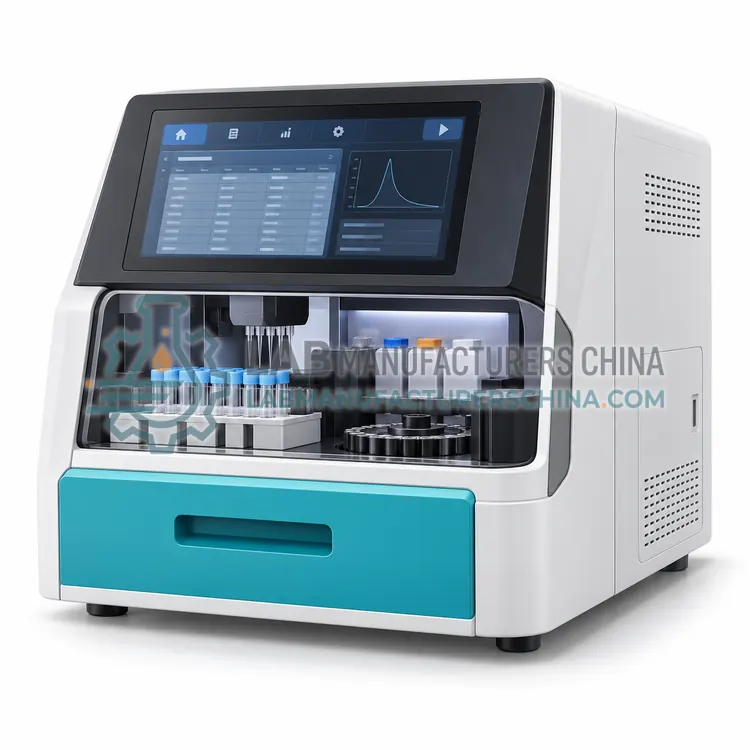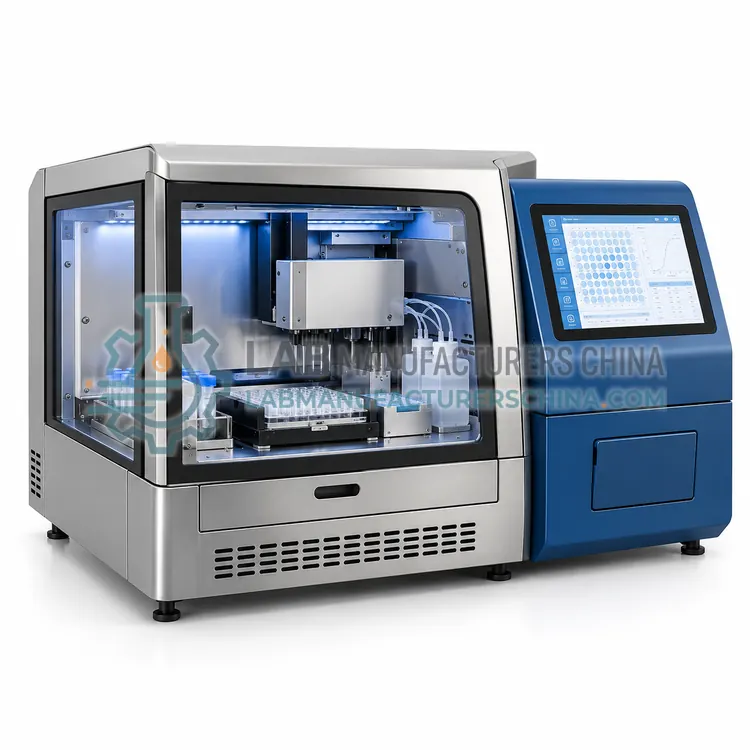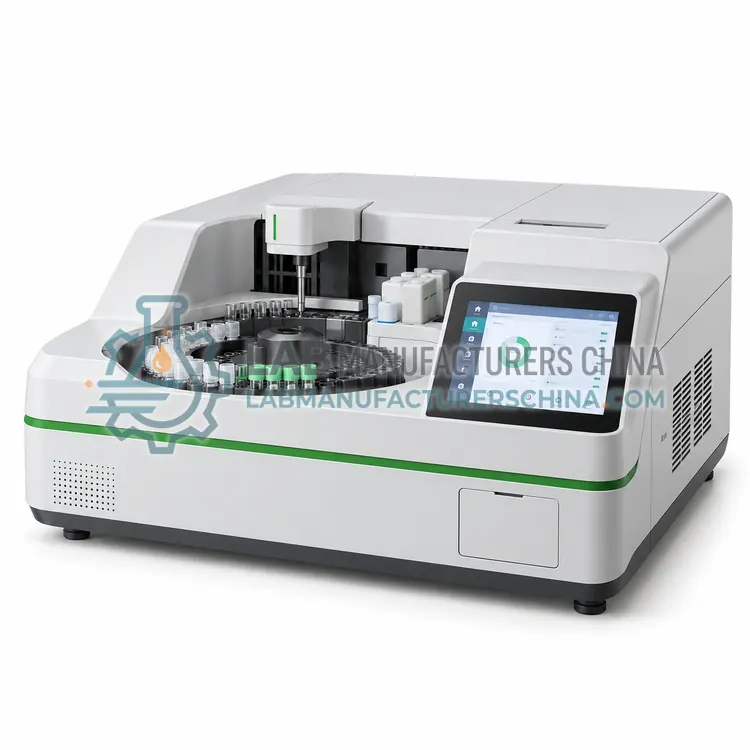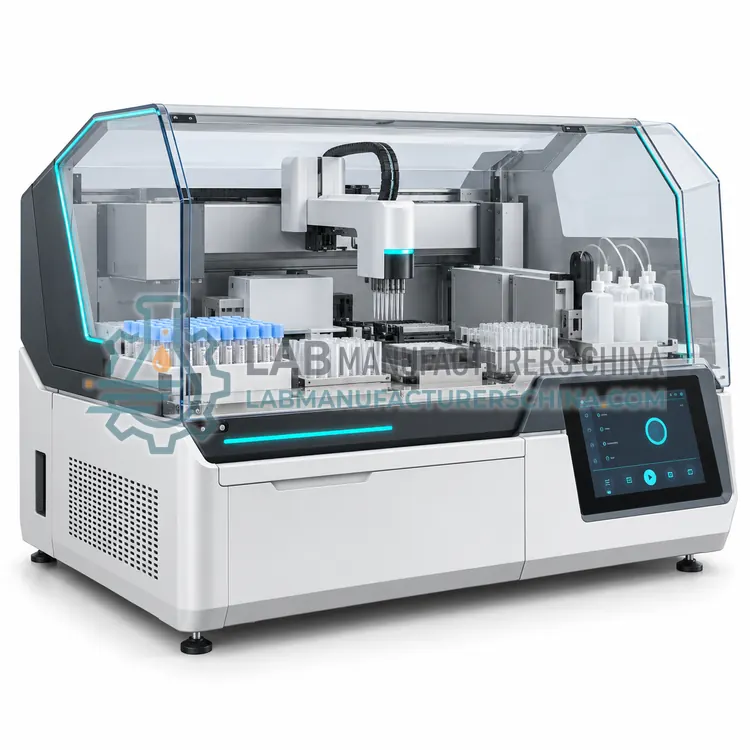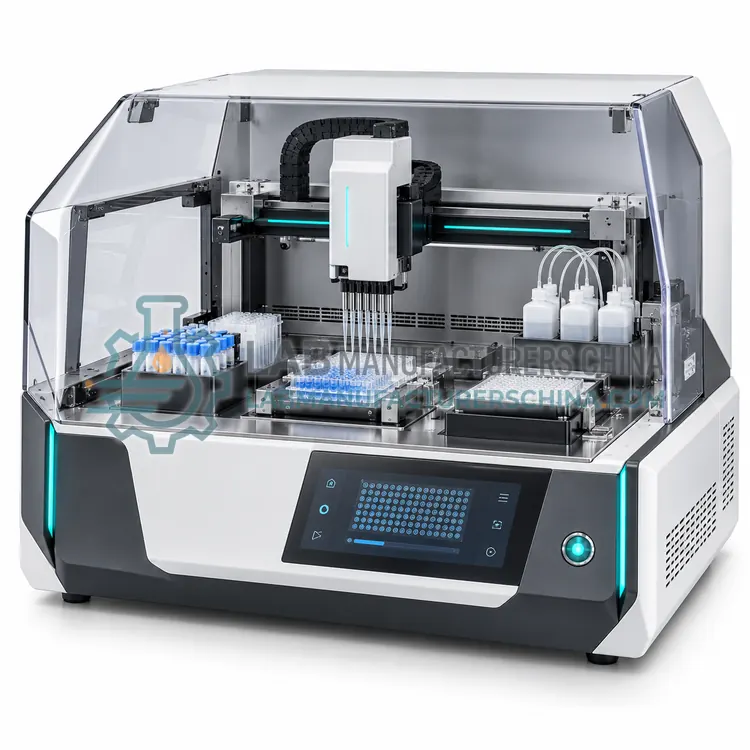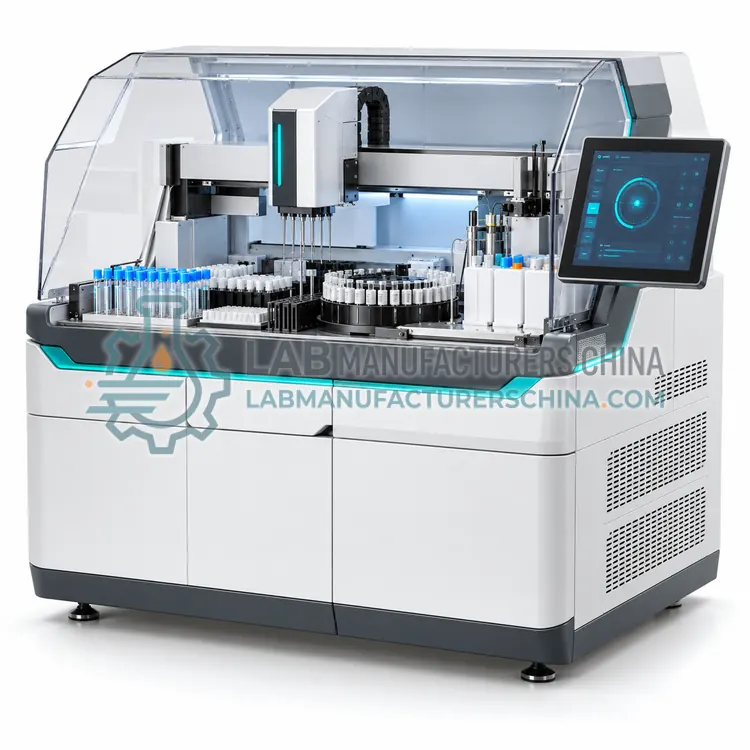
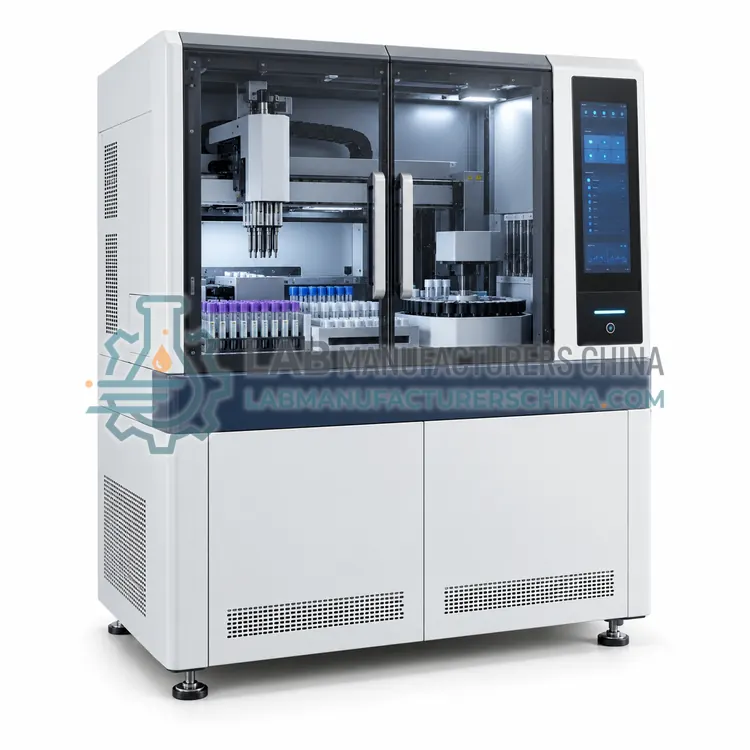
High-Throughput Chemiluminescence Immunoassay Analyzer
高通量化学发光免疫分析仪
- SKU CLI-0005
- CLIA Analyzers
- CE (to be confirmed)
- ISO 13485 manufacturing (to be confirmed)
- NMPA class II registration (to be confirmed)
Price on request — FOB / CIF quoted per order
Prices depend on configuration, quantity and destination port.
Key specifications
| Throughput | 300–600 tests/h |
|---|---|
| Reaction lines | 2–4 independent lines |
| Reagent capacity | Bulk containers for 500–1000 tests each |
| Sample loading | Continuous rack loading with barcode |
| First-result time | 15–20 min under full load |
| Calibration stability | 21–28 days per lot shared across lines |
Request a quote Download brochure · to be provided
By Lab Manufacturers China Technical TeamLast reviewed Standards: ISO 15189, CLSI EP05, CLSI EP15
What is the High-Throughput Chemiluminescence Immunoassay Analyzer?
A high-throughput CLIA analyzer processes 300 to 600 tests per hour with multiple reaction lines, bulk reagents and continuous loading. It suits large hospital core laboratories and reference laboratories where immunoassay volume is consolidated on one platform.
What is the High-Throughput Chemiluminescence Immunoassay Analyzer?
A high-throughput CLIA analyzer processes 300 to 600 tests per hour with multiple reaction lines, bulk reagents and continuous loading. It suits large hospital core laboratories and reference laboratories where immunoassay volume is consolidated on one platform.
Overview
The analyzer uses two or more independent reaction lines operating in parallel, bulk reagent containers with level monitoring, and continuous sample loading so the platform never idles between racks. Reaction lines share calibration data and quality control through one software, so a curve applies across lines and comparability is monitored. STAT positions allow urgent samples to enter a free line immediately, and the first-result time is usually kept at fifteen to twenty minutes even at high load. Because bulk reagents reduce packaging waste and cost per test, this configuration is economical at high volumes, but it requires continuous reagent consumption planning and reliable cold-chain supply. Downtime has a wide impact, so redundancy, service contracts and consumable stock levels need explicit planning.
How does it work?
In chemiluminescence immunoassay the label is a molecule, often an acridinium ester or a luminol derivative, that emits light when triggered by an oxidant or a catalyst. Capture antibody or antigen is immobilised on magnetic particles, a well or a tube. After sample binding and washing, the labelled detection reagent forms a sandwich or competes with the analyte, and a trigger solution initiates the light-emitting reaction. A photomultiplier tube measures the light flash, which is integrated over a fixed interval, and the signal is converted into concentration using a calibration curve, usually a four-parameter logistic or a master curve with a lot-specific adjustment. Because light emission is measured against a dark background rather than as a difference between two absorbance values, chemiluminescence gives a wider dynamic range and better sensitivity than chromogenic enzyme immunoassay, and magnetic separation simplifies washing and automation.
What are the key features?
- Two or more parallel reaction lines with shared curves
- Bulk reagent containers with level and expiry monitoring
- Continuous sample loading without rack idle time
- STAT entry to a free line at high load
- Comparability monitoring across reaction lines
- First result maintained in fifteen to twenty minutes
What are the technical specifications?
A typical high-throughput chemiluminescence immunoassay analyzer configuration offers throughput of 300–600 tests/h, reaction lines of 2–4 independent lines, reagent capacity of Bulk containers for 500–1000 tests each, sample loading of Continuous rack loading with barcode, first-result time of 15–20 min under full load and calibration stability of 21–28 days per lot shared across lines. Values are indicative of the product class; the exact figures for each configuration are confirmed on the quotation and the calibration documents supplied with the instrument.
Which applications is it used for?
The High-Throughput Chemiluminescence Immunoassay Analyzer is used in large hospital immunoassay core laboratories, reference laboratory high-volume testing, consolidated hormone and infectious disease screening and blood donor and antenatal screening programmes. Across the wider CLIA Analyzers class, laboratories also deploy it for hormone and fertility testing, cardiac marker measurement in emergency care and tumour marker monitoring.
Which standards and certifications apply?
Relevant standards and methods include ISO 15189, CLSI EP05, CLSI EP15, CLSI EP17, CLSI I/LA20, IEC 61010-1 and IEC 61010-2-101. Certification candidates for this model are CE, ISO 13485 manufacturing and NMPA class II registration; each is to be confirmed for the specific configuration before shipment, and certificates are supplied only where they have been issued.
Install the analyzer on a stable bench with controlled temperature and humidity, a grounded power supply and space for reagent and waste containers. Verify performance at installation with precision, linearity and method comparison studies for every assay you will report, following CLSI EP05, EP15 and EP17 where detection limits are relevant. Establish calibration and control intervals per assay and document the curve validity period. Daily work includes checking reagent volumes and waste, running controls and reviewing the calibration status; trigger solutions and wash buffers must be prepared or replaced as specified because deteriorated solutions cause erratic light signals. Replace tubing, syringes and photodetector-related parts on schedule, and treat all samples, controls and liquid waste as biohazardous.
How do I select the right High-Throughput Chemiluminescence Immunoassay Analyzer?
Specify a high-throughput platform when daily immunoassay volume exceeds about one thousand tests, when several analyzers currently run in parallel, or when a track consolidation project is planned. In the RFQ confirm throughput per reaction line, bulk reagent pack sizes, comparability data between lines, and the contingency plan if one line is unavailable.
How does it compare with other CLIA Analyzers variants?
Select a CLIA analyzer from the assay menu first, because registration of each test with the platform is the decisive constraint, then size throughput from daily and peak-hour demand plus about thirty percent headroom. Check the first-result time for emergency markers such as troponin and beta-hCG, since several platforms need twenty to thirty minutes. Compare sensitivity and linear range for the analytes that matter to your clinical service, the sample volume per test, and the calibration stability, which determines how often curves must be rebuilt. Decide between magnetic bead, coated tube and microplate formats according to menu size and acceptable hands-on time. Confirm onboard reagent capacity, refrigeration, STAT access, carryover control, LIS interface, and the availability of calibrators, controls and service support locally.
Full specifications
| Throughput | 300–600 tests/h |
|---|---|
| Reaction lines | 2–4 independent lines |
| Reagent capacity | Bulk containers for 500–1000 tests each |
| Sample loading | Continuous rack loading with barcode |
| First-result time | 15–20 min under full load |
| Calibration stability | 21–28 days per lot shared across lines |
| Quality control | Per-line controls with cross-line comparison |
| Water and waste | Drain and waste container required |
| Interfaces | LAN with HL7 or ASTM and optional track connection |
Indicative values for this product class. Final specifications are confirmed on the quotation and in the calibration documents supplied with the instrument.
Applications
- Large hospital immunoassay core laboratories
- Reference laboratory high-volume testing
- Consolidated hormone and infectious disease screening
- Blood donor and antenatal screening programmes
Key features
- Two or more parallel reaction lines with shared curves
- Bulk reagent containers with level and expiry monitoring
- Continuous sample loading without rack idle time
- STAT entry to a free line at high load
- Comparability monitoring across reaction lines
- First result maintained in fifteen to twenty minutes
Frequently asked questions about High-Throughput Chemiluminescence Immunoassay Analyzer
Calibration curves are shared across lines, and controls are run on each line with cross-line comparison charts reviewed regularly. If a line shows systematic bias, its calibration, optics and fluidics should be checked before results are reported from that line.
Bulk packs sized for five hundred to one thousand tests reduce cost per test and handling, but they have a limited onboard life after opening, so consumption must match pack size. Laboratories should match pack size to weekly volume rather than to the largest available format.
Not usually, because parallel lines and STAT entry keep first-result time stable, but long queues can build if a reagent is exhausted mid-run or if a line stops. Monitoring queue length, reagent inventory and line availability as key indicators helps prevent delays.
Keep a service contract with a defined response time, critical spare parts, and either a second platform or a smaller analyzer for urgent tests. Also maintain a minimum stock of consumables covering the supplier lead time, since reagent shortages stop the platform regardless of its reliability.
Chemiluminescence measures light emission against a dark background, giving a wider measuring range and lower detection limits than the absorbance difference measured in ELISA. It also automates more easily because magnetic separation replaces repeated plate washing, though reagent and instrument costs are usually higher.
Most assays use a stored master curve with a lot-specific calibration that remains valid for two to four weeks, with a full curve required at each new reagent lot or after major maintenance. Daily control results confirm that the calibration remains acceptable, and any shift triggers recalibration before reporting.
At extremely high analyte concentrations both capture and detection antibodies become saturated and the signal falls, which can produce a falsely low result. Most analyzers detect this by diluting and re-measuring samples above a defined concentration or by comparing the reaction rate with expected curve behaviour.
Related models