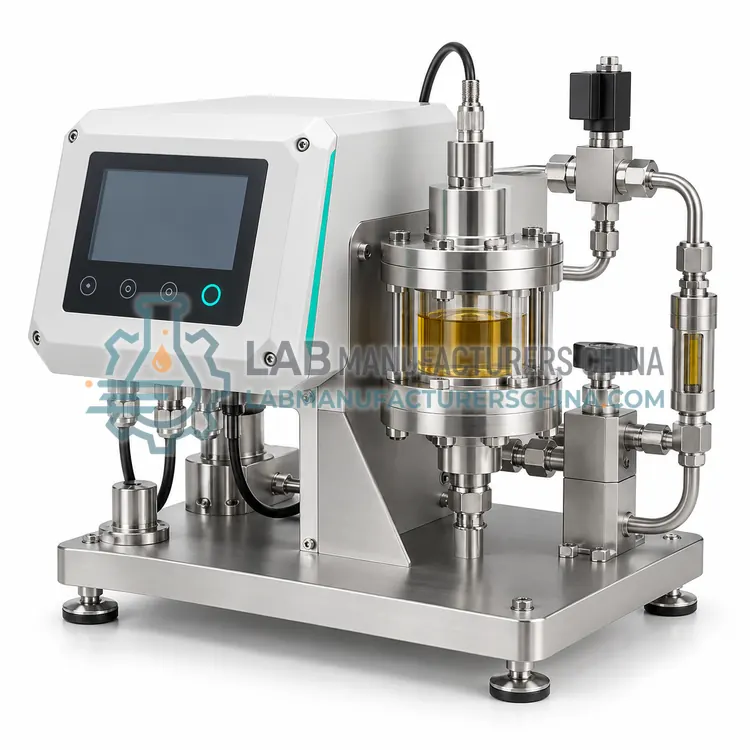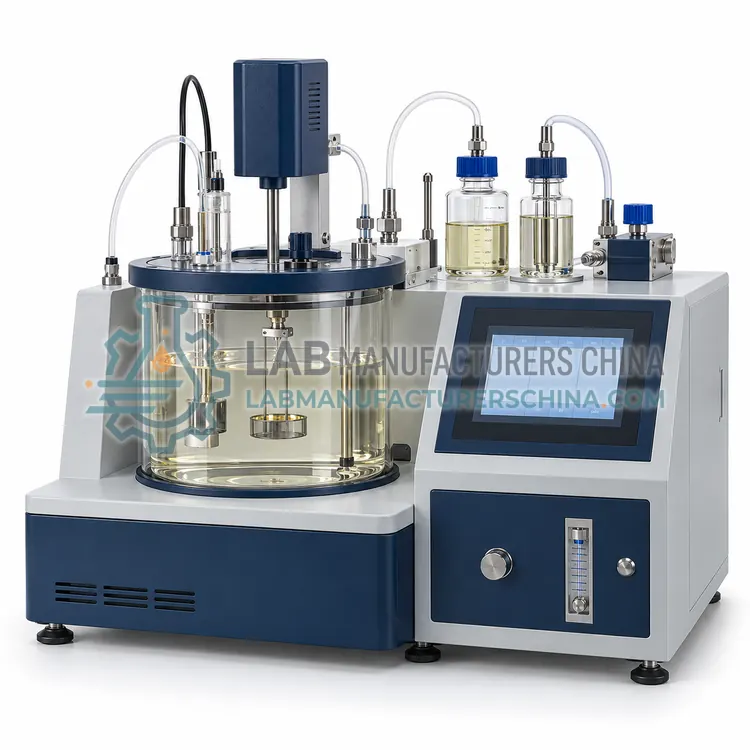
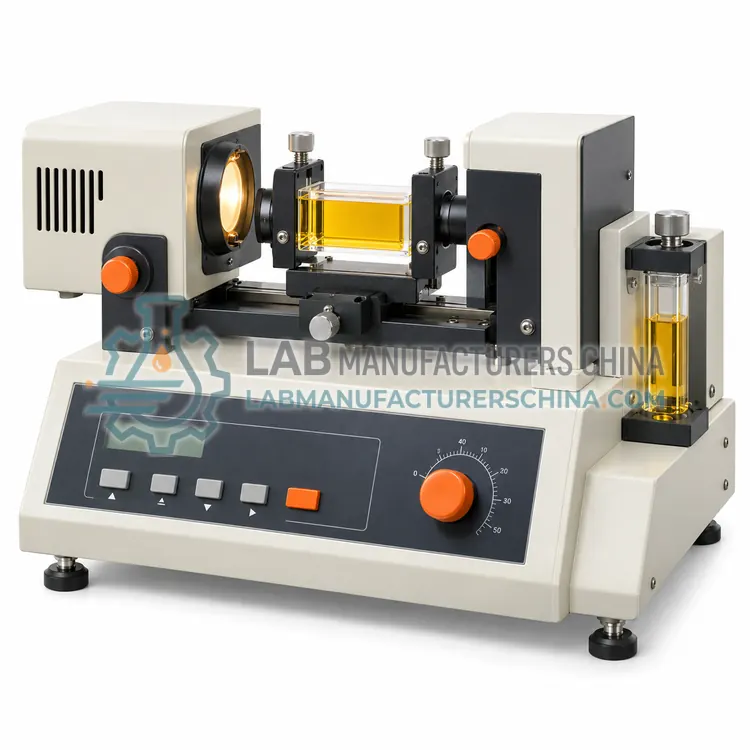
Edible Oil Colorimeter for Lovibond Color Grading
食用油 Lovibond 色泽测定仪
- SKU EOA-0004
- Edible Oil Analysis
- CE (to be confirmed)
- ISO 9001 manufacturing (to be confirmed)
Price on request — FOB / CIF quoted per order
Prices depend on configuration, quantity and destination port.
Key specifications
| Wavelength range | 400–700 nm |
|---|---|
| Lovibond range | Red 0–70, Yellow 0–70 |
| Cell path lengths | 5.25 in, 1 in, 0.5 in |
| Photometric accuracy | ± 0.5 %T |
| Sample temperature | Ambient to 60 °C |
| Measurement time | < 10 s |
Request a quote Download brochure · to be provided
By Lab Manufacturers China Technical TeamLast reviewed Standards: ISO 660, ISO 3960, ISO 6886
What is the Edible Oil Colorimeter for Lovibond Color Grading?
An edible oil colorimeter measures oil color by transmittance through a fixed cell and reports Lovibond red and yellow units or CIE values. It is used for refining control, bleaching efficiency checks and grading of crude and refined oils against trade specifications and customer contracts.
What is the Edible Oil Colorimeter for Lovibond Color Grading?
An edible oil colorimeter measures oil color by transmittance through a fixed cell and reports Lovibond red and yellow units or CIE values. It is used for refining control, bleaching efficiency checks and grading of crude and refined oils against trade specifications and customer contracts.
Overview
Oil color is measured with a light source, a glass cell of 5.25, 1 or 0.5 inch optical path and a detector system. Older visual methods compare the sample with calibrated Lovibond glass slides; modern automatic colorimeters measure spectral transmittance across the visible range, typically 400 to 700 nm, and compute Lovibond red and yellow values, Gardner or APHA equivalents, or CIE L*a*b* coordinates. The 5.25 inch cell is standard for refined oils under AOCS Cc 13j-97, while shorter cells suit dark crude oils. The sample must be clear and free of moisture, so oils are filtered and heated to dissolve crystals. Bleaching earth dosage, deodorization temperature and storage effects can all be tracked through color.
How does it work?
Edible oil quality is defined by hydrolytic, oxidative and compositional indicators. Free fatty acids are measured by titrating the oil dissolved in an ethanol-ether or isopropanol mixture with standard potassium hydroxide, and expressed as acid value in mg KOH/g. Peroxide value is determined by iodometric titration of the iodine liberated from potassium iodide by hydroperoxides, expressed in meq O2/kg. Fatty acid composition is obtained by converting triglycerides to methyl esters and separating them on a polar capillary GC column with flame ionization detection. Oxidative stability is tested by bubbling heated air through the oil and monitoring conductivity of volatile acids formed. Total polar compounds in frying oil are estimated from dielectric constant changes or measured by silica column chromatography. Color is graded by transmittance against Lovibond or CIE scales.
What are the key features?
- Automatic spectral measurement with Lovibond red/yellow output
- Selectable cells of 5.25, 1 and 0.5 inch path length
- Sample compartment with heating to maintain clarity
- CIE L*a*b*, Gardner and APHA conversion available
- Stored methods for crude, refined and bleached oils
What are the technical specifications?
A typical edible oil colorimeter for lovibond color grading configuration offers wavelength range of 400–700 nm, lovibond range of Red 0–70, Yellow 0–70, cell path lengths of 5.25 in, 1 in, 0.5 in, photometric accuracy of ± 0.5 %T, sample temperature of Ambient to 60 °C and measurement time of < 10 s. Values are indicative of the product class; the exact figures for each configuration are confirmed on the quotation and the calibration documents supplied with the instrument.
Which applications is it used for?
The Edible Oil Colorimeter for Lovibond Color Grading is used in refining and bleaching process control, grading against trade specifications and storage and fry discoloration studies. Across the wider Edible Oil Analysis class, laboratories also deploy it for oil refinery batch quality control, shelf-life and storage studies and frying oil change decisions in food service.
Which standards and certifications apply?
Relevant standards and methods include ISO 660, ISO 3960, ISO 6886, ISO 12966-2, ISO 6320, AOCS Cd 12b-92, AOCS Cd 20-91, GB 5009.229 and GB 5009.227. Certification candidates for this model are CE and ISO 9001 manufacturing; each is to be confirmed for the specific configuration before shipment, and certificates are supplied only where they have been issued.
Keep edible oil samples cool, dark and sealed, since light, air and metal contact accelerate oxidation and distort peroxide results. Use reagents of specified grade and prepare titrants fresh; standardize potassium hydroxide and sodium thiosulfate regularly. Electrodes for titration need conditioning for nonaqueous media. GC columns, septa and liners need routine replacement, and methylation reagents such as boron trifluoride require fume-hood handling. Oxidative stability testers need accurate heating-block temperature calibration and clean reaction vessels. Frying oil sensors should be verified against reference oil or column chromatography. Follow laboratory safety rules for solvents and food-sample hygiene.
How do I select the right Edible Oil Colorimeter for Lovibond Color Grading?
Select a colorimeter when color is a contractual parameter or is used to control bleaching and deodorization in a refinery. Specify the color scales required (Lovibond, Gardner, APHA, CIE), cell path lengths, heating needs and compliance with AOCS Cc 13j-97 or ISO 15305, and verify the instrument with reference glass filters.
How does it compare with other Edible Oil Analysis variants?
Decide first which decision the result supports. Refiners and oil mills need acid value, peroxide value, color and moisture for every batch; an automatic titrator reduces subjectivity compared with color-indicator titration. Frying operators need fast total polar compound readings at the fryer, where a handheld sensor is enough and a laboratory method confirms disputes. Shelf-life and formulation work need a conductometric oxidative stability tester that runs several samples at defined temperatures. Authenticity, nutritional labeling and trans-fat determination need GC fatty acid analysis. Match the instrument to the standard used in your market, such as ISO 660, ISO 3960, ISO 6886, ISO 12966 or GB 5009, and check sample throughput, detection limits, operator skill requirement and reagent costs.
Full specifications
| Wavelength range | 400–700 nm |
|---|---|
| Lovibond range | Red 0–70, Yellow 0–70 |
| Cell path lengths | 5.25 in, 1 in, 0.5 in |
| Photometric accuracy | ± 0.5 %T |
| Sample temperature | Ambient to 60 °C |
| Measurement time | < 10 s |
| Light source | LED or tungsten-halogen |
| Display | Color touchscreen |
| Power supply | 100–240 V AC, 50/60 Hz |
Indicative values for this product class. Final specifications are confirmed on the quotation and in the calibration documents supplied with the instrument.
Applications
- Refining and bleaching process control
- Grading against trade specifications
- Storage and fry discoloration studies
Key features
- Automatic spectral measurement with Lovibond red/yellow output
- Selectable cells of 5.25, 1 and 0.5 inch path length
- Sample compartment with heating to maintain clarity
- CIE L*a*b*, Gardner and APHA conversion available
- Stored methods for crude, refined and bleached oils
Frequently asked questions about Edible Oil Colorimeter for Lovibond Color Grading
Lovibond values express the color of oil by matching it with red and yellow glass standards. Refined oils are typically reported as a low red value and higher yellow value, for example 2.0 red and 20 yellow in a 5.25 inch cell.
Turbidity scatters light and makes oil look darker. Oils should be filtered and warmed to dissolve crystals and remove moisture so the reading represents pigment, not haze.
Many trade bodies accept automatic spectrophotometric methods that reproduce Lovibond results, provided the instrument is verified with reference glass filters. The AOCS recommended practice Cc 13j-97 and ISO 15305 define requirements.
Key parameters are acid value, peroxide value, moisture, color, fatty acid composition, oxidative stability and, for frying oil, total polar compounds. Each reflects hydrolysis, oxidation or composition, and together they show freshness, processing quality and suitability for consumption.
Acid value is the milligrams of potassium hydroxide needed to neutralize free fatty acids in one gram of oil. It rises as triglycerides hydrolyze, so it is used to monitor crude oil quality, refining efficiency and storage deterioration.
Frying oil is assessed by total polar compounds, typically discarded at 24 to 27 percent in many regulations. Handheld dielectric sensors give quick readings at the fryer, and column chromatography according to ISO 8420 provides the reference result.
Related models