
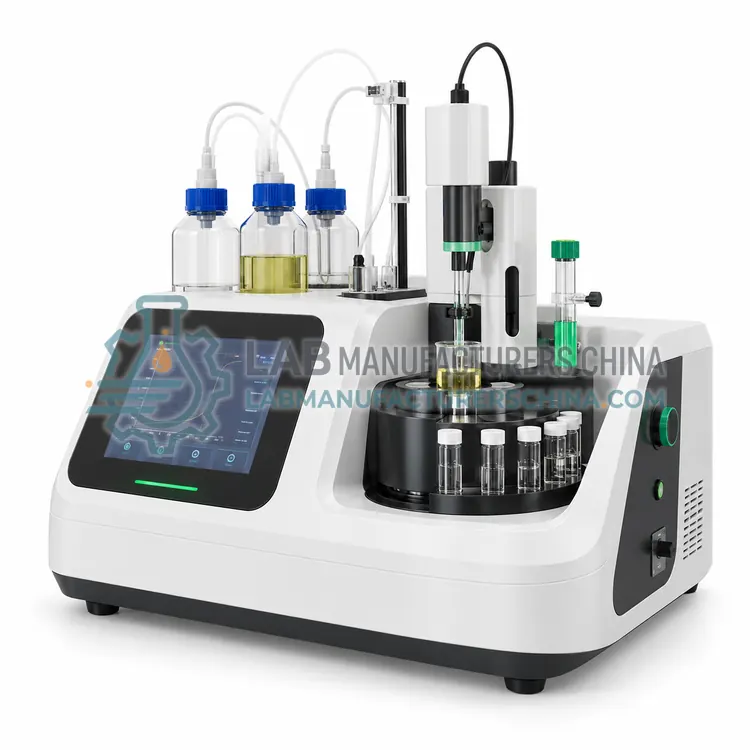
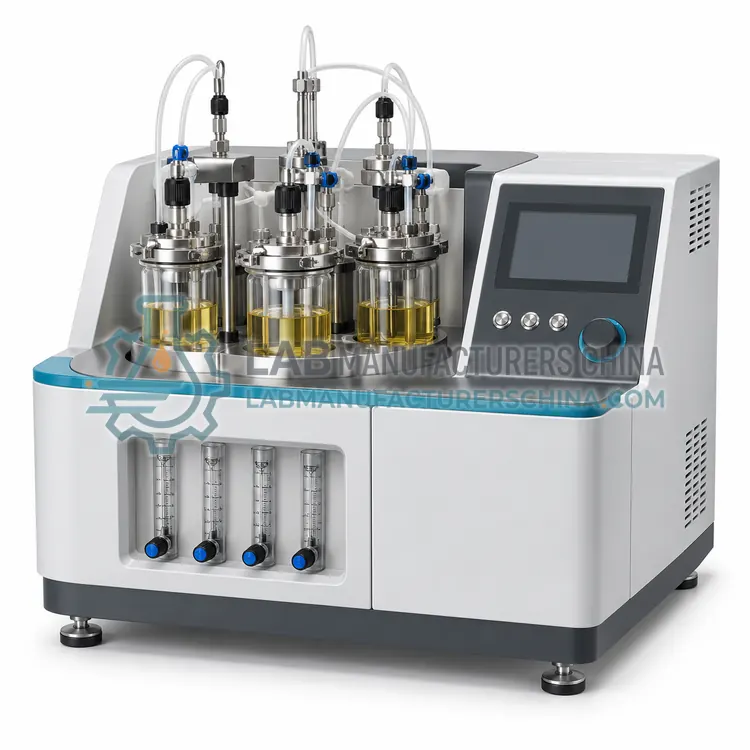
Conductometric Oxidative Stability Tester for Fats and Oils
油脂电导法氧化稳定性测定仪
- SKU EOA-0003
- Edible Oil Analysis
- CE (to be confirmed)
- ISO 9001 manufacturing (to be confirmed)
Price on request — FOB / CIF quoted per order
Prices depend on configuration, quantity and destination port.
Key specifications
| Number of positions | 2, 4, 6 or 8 |
|---|---|
| Temperature range | 50–220 °C |
| Temperature accuracy | ± 0.2 °C |
| Air flow rate | 7–25 L/h |
| Sample size | ≈ 3 g (oils), 5 g (fats) |
| Conductivity range | 0–400 µS/cm |
Request a quote Download brochure · to be provided
By Lab Manufacturers China Technical TeamLast reviewed Standards: ISO 660, ISO 3960, ISO 6886
What is the Conductometric Oxidative Stability Tester for Fats and Oils?
A conductometric oxidative stability tester ages oil samples under heat and airflow and detects the induction time at which volatile acids sharply raise water conductivity. It measures oxidation resistance and antioxidant effect for shelf-life prediction, storage comparison and formulation studies in oil and food laboratories.
What is the Conductometric Oxidative Stability Tester for Fats and Oils?
A conductometric oxidative stability tester ages oil samples under heat and airflow and detects the induction time at which volatile acids sharply raise water conductivity. It measures oxidation resistance and antioxidant effect for shelf-life prediction, storage comparison and formulation studies in oil and food laboratories.
Overview
A 3 g oil sample in a reaction vessel is heated in an aluminum block, typically at 110 degrees Celsius for vegetable oils, while purified air passes through it at 20 L/h. Oxidation produces volatile organic acids, mainly formic and acetic acid, which are carried into a measuring vessel of deionized water with a conductivity cell. The induction time is found from the inflection point of the conductivity curve; the longer it is, the more oxidation-resistant the oil. Stability at other temperatures is extrapolated using the typical 2.0 to 2.2 factor per 10 degrees Celsius. Multiple positions run in parallel, often 2, 4, 6 or 8. Methods are given in ISO 6886 and AOCS Cd 12b-92, and cover oils, fats, biodiesel and antioxidant trials.
How does it work?
Edible oil quality is defined by hydrolytic, oxidative and compositional indicators. Free fatty acids are measured by titrating the oil dissolved in an ethanol-ether or isopropanol mixture with standard potassium hydroxide, and expressed as acid value in mg KOH/g. Peroxide value is determined by iodometric titration of the iodine liberated from potassium iodide by hydroperoxides, expressed in meq O2/kg. Fatty acid composition is obtained by converting triglycerides to methyl esters and separating them on a polar capillary GC column with flame ionization detection. Oxidative stability is tested by bubbling heated air through the oil and monitoring conductivity of volatile acids formed. Total polar compounds in frying oil are estimated from dielectric constant changes or measured by silica column chromatography. Color is graded by transmittance against Lovibond or CIE scales.
What are the key features?
- Two to eight independent heating positions with individual vessels
- Temperature range 50–220 °C with calibrated heating block
- Air flow control at 7–25 L/h per position
- Automatic induction time detection and temperature extrapolation
- Conductivity cells with stirring-free measuring vessels
What are the technical specifications?
A typical conductometric oxidative stability tester for fats and oils configuration offers number of positions of 2, 4, 6 or 8, temperature range of 50–220 °C, temperature accuracy of ± 0.2 °C, air flow rate of 7–25 L/h, sample size of ≈ 3 g (oils), 5 g (fats) and conductivity range of 0–400 µS/cm. Values are indicative of the product class; the exact figures for each configuration are confirmed on the quotation and the calibration documents supplied with the instrument.
Which applications is it used for?
The Conductometric Oxidative Stability Tester for Fats and Oils is used in shelf-life prediction for oils and fatty foods, antioxidant efficacy evaluation and biodiesel oxidation stability. Across the wider Edible Oil Analysis class, laboratories also deploy it for oil refinery batch quality control, shelf-life and storage studies and frying oil change decisions in food service.
Which standards and certifications apply?
Relevant standards and methods include ISO 660, ISO 3960, ISO 6886, ISO 12966-2, ISO 6320, AOCS Cd 12b-92, AOCS Cd 20-91, GB 5009.229 and GB 5009.227. Certification candidates for this model are CE and ISO 9001 manufacturing; each is to be confirmed for the specific configuration before shipment, and certificates are supplied only where they have been issued.
Keep edible oil samples cool, dark and sealed, since light, air and metal contact accelerate oxidation and distort peroxide results. Use reagents of specified grade and prepare titrants fresh; standardize potassium hydroxide and sodium thiosulfate regularly. Electrodes for titration need conditioning for nonaqueous media. GC columns, septa and liners need routine replacement, and methylation reagents such as boron trifluoride require fume-hood handling. Oxidative stability testers need accurate heating-block temperature calibration and clean reaction vessels. Frying oil sensors should be verified against reference oil or column chromatography. Follow laboratory safety rules for solvents and food-sample hygiene.
How do I select the right Conductometric Oxidative Stability Tester for Fats and Oils?
Select this tester for shelf-life, antioxidant and formulation work, where comparing induction time between samples is the goal. Specify number of positions, temperature range, air supply and methods (ISO 6886, EN 15751 for biodiesel). Note that it reports an induction time only and does not determine acid value or peroxide value directly.
How does it compare with other Edible Oil Analysis variants?
Decide first which decision the result supports. Refiners and oil mills need acid value, peroxide value, color and moisture for every batch; an automatic titrator reduces subjectivity compared with color-indicator titration. Frying operators need fast total polar compound readings at the fryer, where a handheld sensor is enough and a laboratory method confirms disputes. Shelf-life and formulation work need a conductometric oxidative stability tester that runs several samples at defined temperatures. Authenticity, nutritional labeling and trans-fat determination need GC fatty acid analysis. Match the instrument to the standard used in your market, such as ISO 660, ISO 3960, ISO 6886, ISO 12966 or GB 5009, and check sample throughput, detection limits, operator skill requirement and reagent costs.
Full specifications
| Number of positions | 2, 4, 6 or 8 |
|---|---|
| Temperature range | 50–220 °C |
| Temperature accuracy | ± 0.2 °C |
| Air flow rate | 7–25 L/h |
| Sample size | ≈ 3 g (oils), 5 g (fats) |
| Conductivity range | 0–400 µS/cm |
| Induction time range | 0.1–100 h |
| Repeatability (RSD) | ≤ 3 % |
| Power supply | 220 V AC, 50 Hz |
Indicative values for this product class. Final specifications are confirmed on the quotation and in the calibration documents supplied with the instrument.
Applications
- Shelf-life prediction for oils and fatty foods
- Antioxidant efficacy evaluation
- Biodiesel oxidation stability
Key features
- Two to eight independent heating positions with individual vessels
- Temperature range 50–220 °C with calibrated heating block
- Air flow control at 7–25 L/h per position
- Automatic induction time detection and temperature extrapolation
- Conductivity cells with stirring-free measuring vessels
Frequently asked questions about Conductometric Oxidative Stability Tester for Fats and Oils
Induction time is the period before oxidation accelerates sharply, detected when volatile acid formation increases conductivity. Longer induction times show greater resistance to oxidation and better expected storage stability at the test temperature.
Results rank samples and estimate relative stability, but actual shelf life also depends on light, packaging, oxygen and storage temperature. Induction times at 110 degrees Celsius are usually extrapolated with validated factors and confirmed by real-time studies.
Oxidation rate depends on oxygen supply, so flow rate must be identical across positions. Flow controllers and calibrated flowmeters ensure repeatable induction times, while clean tubing and vessels prevent contamination that shortens results.
Key parameters are acid value, peroxide value, moisture, color, fatty acid composition, oxidative stability and, for frying oil, total polar compounds. Each reflects hydrolysis, oxidation or composition, and together they show freshness, processing quality and suitability for consumption.
Acid value is the milligrams of potassium hydroxide needed to neutralize free fatty acids in one gram of oil. It rises as triglycerides hydrolyze, so it is used to monitor crude oil quality, refining efficiency and storage deterioration.
Frying oil is assessed by total polar compounds, typically discarded at 24 to 27 percent in many regulations. Handheld dielectric sensors give quick readings at the fryer, and column chromatography according to ISO 8420 provides the reference result.
Related models
Dielectric Loss Tangent and Volume Resistivity Tester for Insulating Oil
绝缘油介质损耗及体积电阻率测试仪
- CE (to be confirmed)
- +1