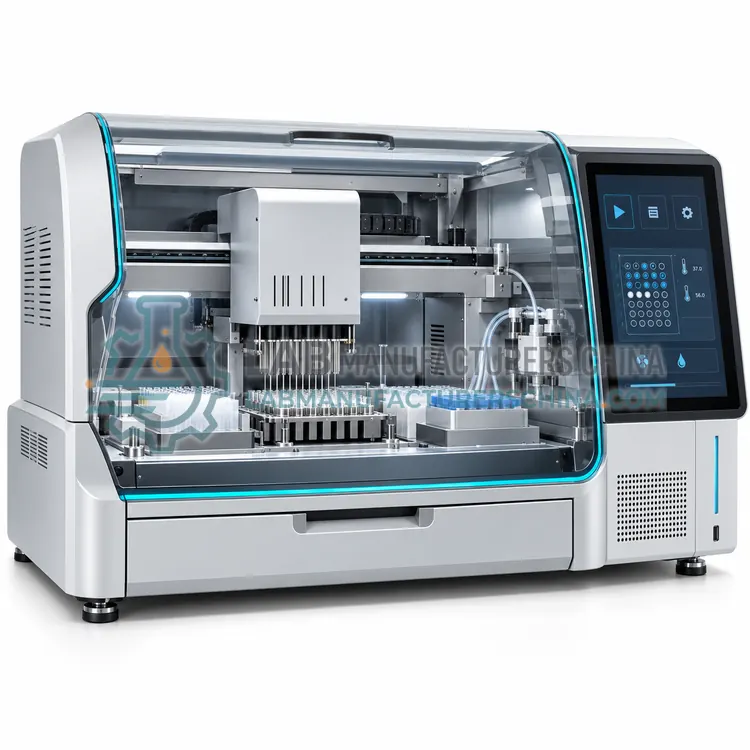
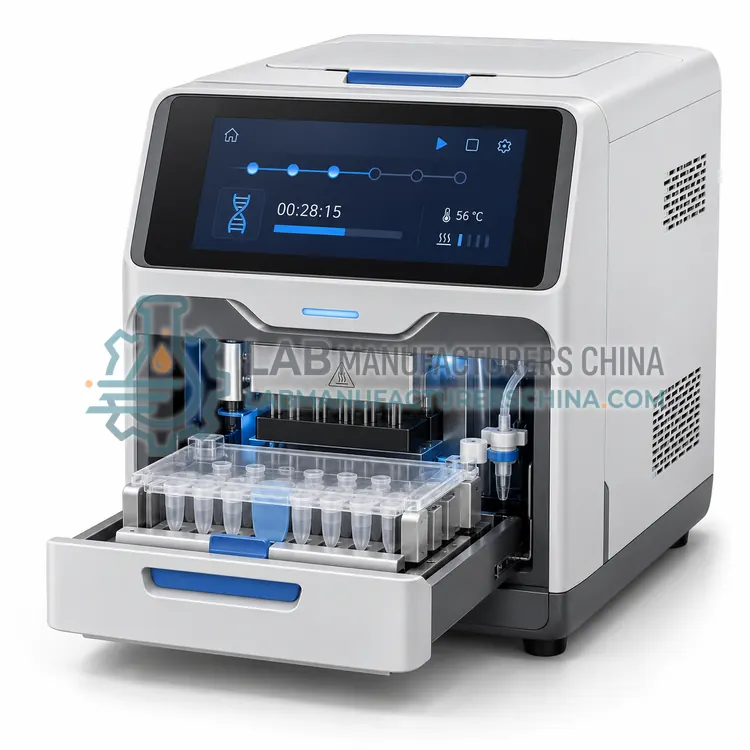
Cartridge-Based Point-of-Care Nucleic Acid Extractor
卡盒式即时核酸提取仪
- SKU DRE-0005
- DNA/RNA Extraction
- CE (to be confirmed)
- ISO 13485 manufacturing (to be confirmed)
- IVDR (EU) 2017/746 (to be confirmed)
Price on request — FOB / CIF quoted per order
Prices depend on configuration, quantity and destination port.
Key specifications
| Sample capacity | 1-8 cartridges per run |
|---|---|
| Sample volume | 100-1,000 µL |
| Processing time | 15-45 min |
| Elution volume | 20-100 µL |
| Heating range | Ambient to 100 °C |
| Magnetic capture | Integrated magnetic actuators |
Request a quote Download brochure · to be provided
By Lab Manufacturers China Technical TeamLast reviewed Standards: ISO 13485 manufacturing, ISO 15189, CLSI MM13-A
What is the Cartridge-Based Point-of-Care Nucleic Acid Extractor?
A compact instrument that performs extraction entirely inside a sealed single-use cartridge, so the sample never contacts the instrument. It suits near-patient testing, field stations and clinical settings without a molecular laboratory on site.
What is the Cartridge-Based Point-of-Care Nucleic Acid Extractor?
A compact instrument that performs extraction entirely inside a sealed single-use cartridge, so the sample never contacts the instrument. It suits near-patient testing, field stations and clinical settings without a molecular laboratory on site.
Overview
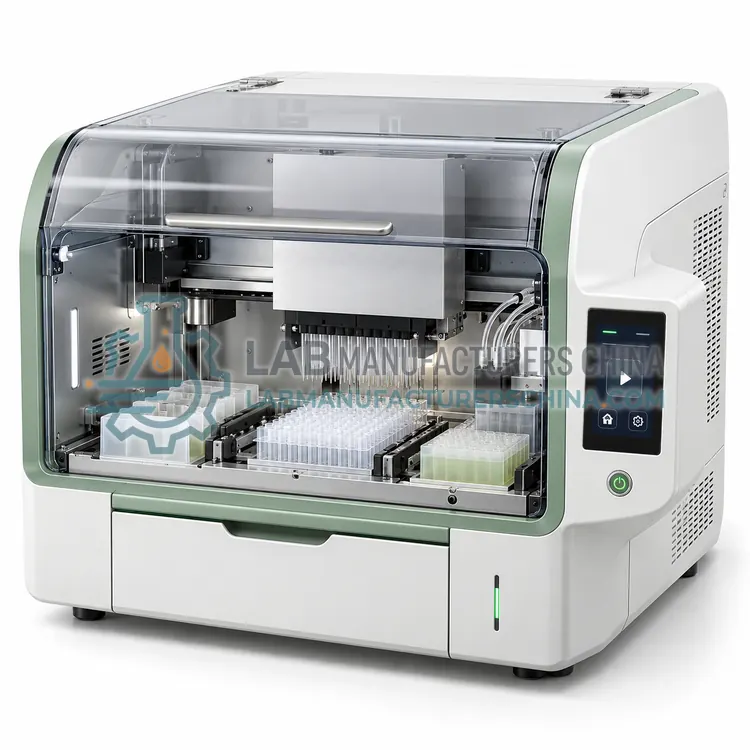
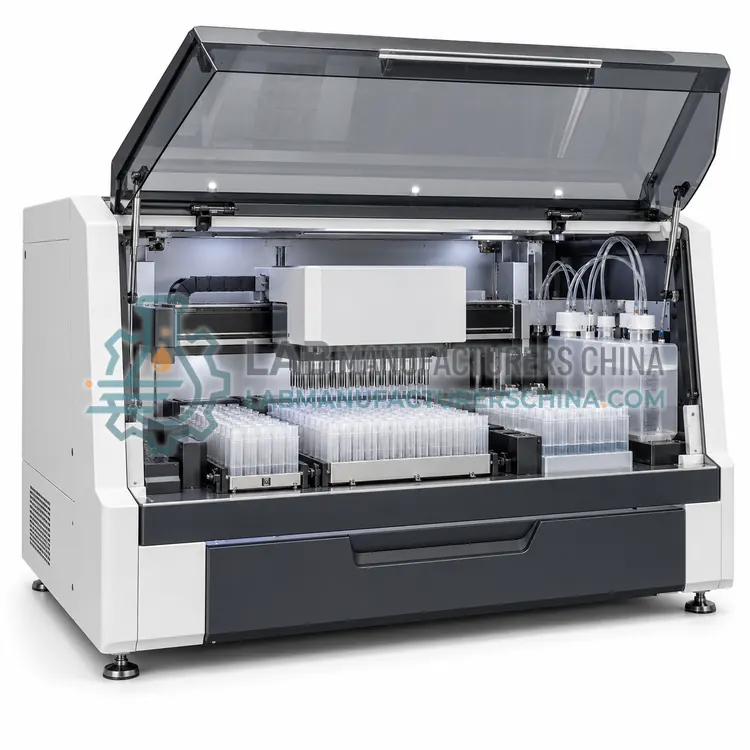
The cartridge-based extractor loads a sealed plastic cartridge containing the lysis, wash and elution chambers, plus magnetic beads or a silica matrix. After the sample is added and the cartridge is closed, the instrument moves liquids and beads with internal actuators, applying heat for lysis and elution. Because all liquid paths are disposable, cross-contamination risk is low and the instrument needs only surface cleaning between runs. Typical processing takes 15 to 45 minutes for one to eight cartridges, and many instruments integrate a real-time PCR module so extraction continues directly into amplification in the same cartridge. Reagent storage may be at room temperature, which simplifies transport. Cartridges are usually dedicated to a target group such as respiratory viruses, enteric pathogens or tuberculosis.
How does it work?
Extraction begins with lysis, which uses chaotropic salts, detergents and often proteinase K to break cell membranes and denature nucleases. Nucleic acids then bind to a solid phase, either silica in the presence of high salt or magnetic beads with a silica or carboxyl surface. Washing removes proteins, salts and inhibitors, and elution in a low-salt buffer or nuclease-free water releases purified nucleic acid. Automated instruments move magnetic particles with a magnetic rod, or pipette liquid through a filter plate, following a program that controls lysis time, mixing, bead collection, wash steps and heated elution. Yield and purity are checked by absorbance at 260, 280 and 230 nm or by fluorescent dyes. Carryover between samples and cross-contamination are controlled by tip changes, sealed consumables and controlled airflow.
What are the key features?
- Sealed single-use cartridge keeps samples off instrument surfaces.
- Integrated lysis, wash and elution chambers in one consumable.
- Processing time of 15 to 45 minutes per cartridge.
- One to eight cartridges per run for near-patient use.
- Optional integrated real-time PCR module.
- Room-temperature reagent storage options for transport.
What are the technical specifications?
A typical cartridge-based point-of-care nucleic acid extractor configuration offers sample capacity of 1-8 cartridges per run, sample volume of 100-1,000 µL, processing time of 15-45 min, elution volume of 20-100 µL, heating range of Ambient to 100 °C and magnetic capture of Integrated magnetic actuators. Values are indicative of the product class; the exact figures for each configuration are confirmed on the quotation and the calibration documents supplied with the instrument.
Which applications is it used for?
The Cartridge-Based Point-of-Care Nucleic Acid Extractor is used in near-patient infectious disease testing, field and mobile laboratory testing, veterinary point-of-care diagnostics and food and water pathogen screening. Across the wider DNA/RNA Extraction class, laboratories also deploy it for clinical pathogen nucleic acid testing, cancer genomics and mutation analysis and next-generation sequencing library preparation.
Which standards and certifications apply?
Relevant standards and methods include ISO 13485 manufacturing, ISO 15189, CLSI MM13-A, IEC 61010-1 and IVDR (EU) 2017/746. Certification candidates for this model are CE, ISO 13485 manufacturing and IVDR (EU) 2017/746; each is to be confirmed for the specific configuration before shipment, and certificates are supplied only where they have been issued.
Keep extraction and amplification areas physically separate, use dedicated pipettes and filter tips, and clean surfaces with fresh hypochlorite or a validated decontaminant. Note that guanidine-based lysis waste must not be mixed with bleach, because toxic gas can form; collect and dispose of it separately under local rules. Wear gloves and change them frequently, since skin and breath carry nucleases and amplification products. Run negative controls in every batch and monitor extraction efficiency with a known standard. Calibrate heating blocks, pipetting accuracy and any magnetic rod height at fixed intervals. Validate each new sample matrix for yield, purity and inhibitor carryover before routine use, and keep lot records of reagents.
How do I select the right Cartridge-Based Point-of-Care Nucleic Acid Extractor?
Select the cartridge system when samples arrive where no molecular laboratory exists, when contamination risk must be minimized or when staff have limited molecular training. Confirm cartridge availability for your target organisms, storage conditions, processing time and whether an integrated amplification module is needed. Check the required sample types and volumes before committing.
How does it compare with other DNA/RNA Extraction variants?
Start with the sample: whole blood, tissue, swabs, plasma, plant material or environmental samples each need a different lysis protocol, and input volume drives consumable and platform choice. Next set throughput, whether a few samples per run or several hundred per day, because this decides between manual manifolds, small benchtop instruments and 96-well platforms. Consider the elution volume and concentration required by the downstream assay, since quantitative PCR and sequencing have different sensitivity to inhibitors and RNA integrity. Check contamination controls such as sealed cartridges, UV decontamination, tip management and negative controls. Confirm that the reagents, plasticware and software are supplied continuously, and ask for validated protocols for each matrix you intend to process.
Full specifications
| Sample capacity | 1-8 cartridges per run |
|---|---|
| Sample volume | 100-1,000 µL |
| Processing time | 15-45 min |
| Elution volume | 20-100 µL |
| Heating range | Ambient to 100 °C |
| Magnetic capture | Integrated magnetic actuators |
| Integrated PCR | Optional real-time module, 2-4 channels |
| Reagent storage | 2-8 °C or room temperature by kit |
| Result output | Ct or qualitative result with run log |
| Power supply | 100-240 V, 50/60 Hz, 50-150 W |
Indicative values for this product class. Final specifications are confirmed on the quotation and in the calibration documents supplied with the instrument.
Applications
- Near-patient infectious disease testing
- Field and mobile laboratory testing
- Veterinary point-of-care diagnostics
- Food and water pathogen screening
Key features
- Sealed single-use cartridge keeps samples off instrument surfaces.
- Integrated lysis, wash and elution chambers in one consumable.
- Processing time of 15 to 45 minutes per cartridge.
- One to eight cartridges per run for near-patient use.
- Optional integrated real-time PCR module.
- Room-temperature reagent storage options for transport.
Frequently asked questions about Cartridge-Based Point-of-Care Nucleic Acid Extractor
Because all liquid handling happens inside a sealed cartridge that is discarded after use, and the instrument never touches the sample. Surface cleaning between runs is still required, and external amplicon areas must remain separate.
Some models include a real-time PCR module and continue directly from elution to amplification in the same cartridge, giving a result in about an hour. Others output purified nucleic acid for a separate analyser.
Each sample consumes one cartridge containing all reagents, so the cost per test is higher than bulk reagents but includes lysis, wash and elution solutions. Budget for cartridges, quality controls and periodic service.
It lyses cells or tissue, captures nucleic acid on magnetic beads, silica columns or cartridges, washes away protein and inhibitors, and elutes purified DNA or RNA in a defined volume for PCR, sequencing or storage.
Check yield, purity and integrity. DNA with an A260/280 near 1.8 and RNA near 2.0 is generally acceptable, A260/230 shows carryover of salts or phenols, and downstream amplification from a standard template confirms that inhibitors were removed.
Often yes, but each matrix needs its own validated protocol. Blood, tissue, swabs, plasma and plant material differ in lysis resistance, inhibitor content and expected yield, so ask the supplier for matrix-specific protocols and verify performance in your laboratory.