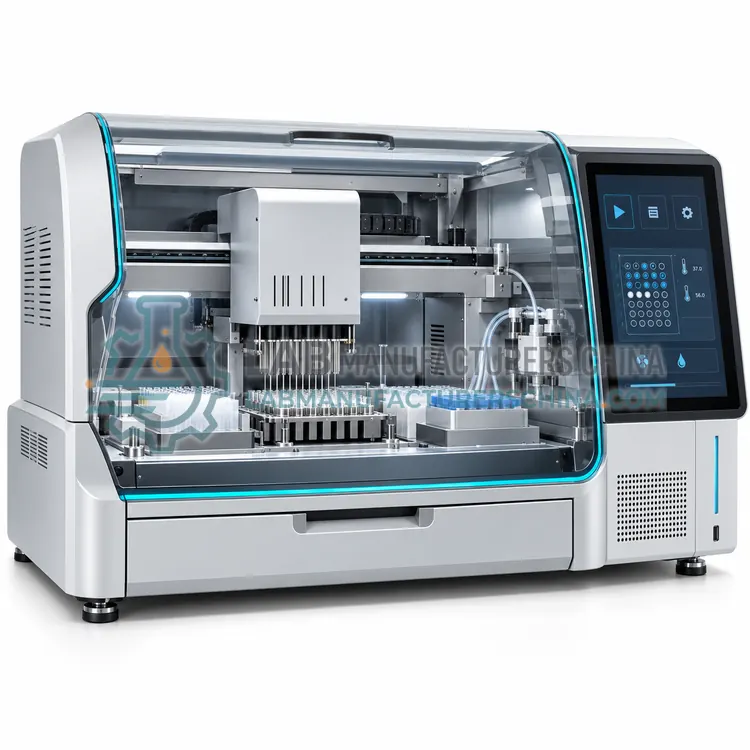
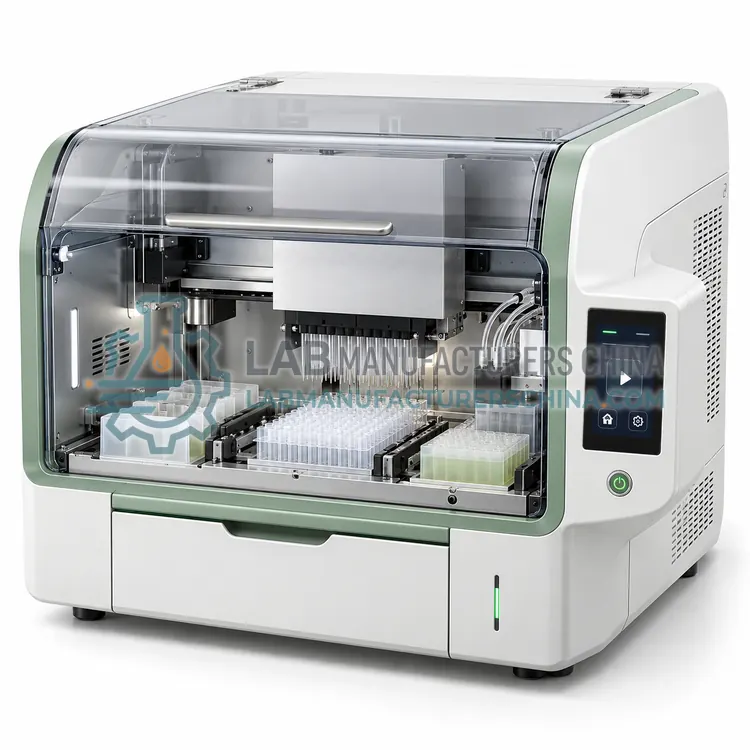
96-Well High-Throughput Nucleic Acid Extraction Platform
96 孔高通量自动核酸提取平台
- SKU DRE-0002
- DNA/RNA Extraction
- CE (to be confirmed)
- ISO 13485 manufacturing (to be confirmed)
- IVDR (EU) 2017/746 (to be confirmed)
Price on request — FOB / CIF quoted per order
Prices depend on configuration, quantity and destination port.
Key specifications
| Format | 96-well plates |
|---|---|
| Throughput | 96-384 samples per hour |
| Sample volume | 50-500 µL |
| Elution volume | 30-150 µL |
| Heating range | Ambient to 105 °C |
| Plate positions | 6-12 positions with hotels |
Request a quote Download brochure · to be provided
By Lab Manufacturers China Technical TeamLast reviewed Standards: ISO 13485 manufacturing, ISO 15189, CLSI MM13-A
What is the 96-Well High-Throughput Nucleic Acid Extraction Platform?
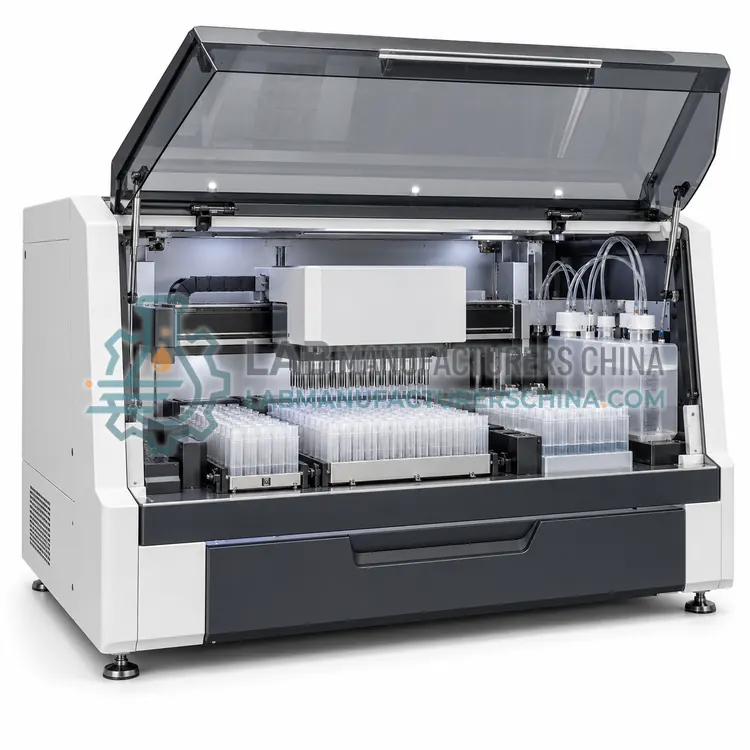
A fully automated platform that prepares 96 samples per plate with robotic pipetting, magnetic bead separation, heating and an integrated plate handler. It suits clinical testing and screening laboratories with sustained high daily volumes.
What is the 96-Well High-Throughput Nucleic Acid Extraction Platform?
A fully automated platform that prepares 96 samples per plate with robotic pipetting, magnetic bead separation, heating and an integrated plate handler. It suits clinical testing and screening laboratories with sustained high daily volumes.
Overview
The high-throughput platform performs nucleic acid extraction in 96-well format, with a robotic arm or an integrated pipetting head transferring lysates, wash buffers and beads between plates. A magnetic plate separator collects the beads, and heating blocks or a thermocycler module control lysis and elution temperatures, some units also performing lysis-only or full extraction with optional DNase treatment. Plate hotels and barcode reading allow up to several plates to be queued unattended, and typical throughput is 96 to 384 samples per hour for simple protocols. Software tracks protocols, reagent lots and plate maps and produces run reports for review. Tip disposal, liquid-level detection and clog detection reduce the risk of cross-contamination and failed runs, which matters in diagnostic use.
How does it work?
Extraction begins with lysis, which uses chaotropic salts, detergents and often proteinase K to break cell membranes and denature nucleases. Nucleic acids then bind to a solid phase, either silica in the presence of high salt or magnetic beads with a silica or carboxyl surface. Washing removes proteins, salts and inhibitors, and elution in a low-salt buffer or nuclease-free water releases purified nucleic acid. Automated instruments move magnetic particles with a magnetic rod, or pipette liquid through a filter plate, following a program that controls lysis time, mixing, bead collection, wash steps and heated elution. Yield and purity are checked by absorbance at 260, 280 and 230 nm or by fluorescent dyes. Carryover between samples and cross-contamination are controlled by tip changes, sealed consumables and controlled airflow.
What are the key features?
- 96-well format with robotic pipetting and magnetic separation.
- Plate hotels and barcode reading for unattended runs.
- Programmable lysis, wash and elution temperatures.
- Throughput of 96 to 384 samples per hour.
- Liquid-level and tip-clog detection to protect runs.
- Software records for protocols, reagents and plate maps.
What are the technical specifications?
A typical 96-well high-throughput nucleic acid extraction platform configuration offers format of 96-well plates, throughput of 96-384 samples per hour, sample volume of 50-500 µL, elution volume of 30-150 µL, heating range of Ambient to 105 °C and plate positions of 6-12 positions with hotels. Values are indicative of the product class; the exact figures for each configuration are confirmed on the quotation and the calibration documents supplied with the instrument.
Which applications is it used for?
The 96-Well High-Throughput Nucleic Acid Extraction Platform is used in high-volume clinical nucleic acid testing, blood donor screening, population and epidemiological studies and large-scale plant or seed genotyping. Across the wider DNA/RNA Extraction class, laboratories also deploy it for clinical pathogen nucleic acid testing, cancer genomics and mutation analysis and next-generation sequencing library preparation.
Which standards and certifications apply?
Relevant standards and methods include ISO 13485 manufacturing, ISO 15189, CLSI MM13-A, IEC 61010-1 and IVDR (EU) 2017/746. Certification candidates for this model are CE, ISO 13485 manufacturing and IVDR (EU) 2017/746; each is to be confirmed for the specific configuration before shipment, and certificates are supplied only where they have been issued.
Keep extraction and amplification areas physically separate, use dedicated pipettes and filter tips, and clean surfaces with fresh hypochlorite or a validated decontaminant. Note that guanidine-based lysis waste must not be mixed with bleach, because toxic gas can form; collect and dispose of it separately under local rules. Wear gloves and change them frequently, since skin and breath carry nucleases and amplification products. Run negative controls in every batch and monitor extraction efficiency with a known standard. Calibrate heating blocks, pipetting accuracy and any magnetic rod height at fixed intervals. Validate each new sample matrix for yield, purity and inhibitor carryover before routine use, and keep lot records of reagents.
How do I select the right 96-Well High-Throughput Nucleic Acid Extraction Platform?
Select this platform when daily sample numbers are high and consistent, and when documentation and traceability are required. Compare the number of plate positions, whether barcode reading and liquid-level detection are standard, and how the software integrates with your laboratory information system. Ask for throughput figures under your own protocol rather than the vendor's fastest assay.
How does it compare with other DNA/RNA Extraction variants?
Start with the sample: whole blood, tissue, swabs, plasma, plant material or environmental samples each need a different lysis protocol, and input volume drives consumable and platform choice. Next set throughput, whether a few samples per run or several hundred per day, because this decides between manual manifolds, small benchtop instruments and 96-well platforms. Consider the elution volume and concentration required by the downstream assay, since quantitative PCR and sequencing have different sensitivity to inhibitors and RNA integrity. Check contamination controls such as sealed cartridges, UV decontamination, tip management and negative controls. Confirm that the reagents, plasticware and software are supplied continuously, and ask for validated protocols for each matrix you intend to process.
Full specifications
| Format | 96-well plates |
|---|---|
| Throughput | 96-384 samples per hour |
| Sample volume | 50-500 µL |
| Elution volume | 30-150 µL |
| Heating range | Ambient to 105 °C |
| Plate positions | 6-12 positions with hotels |
| Liquid handling accuracy | CV below 3 percent at 100 µL |
| Contamination control | Filter tips, UV lamp, HEPA-filtered enclosure option |
| Data output | Run reports, plate maps, LIS-compatible export |
| Power supply | 220 V, 50 Hz, 1-2 kW |
Indicative values for this product class. Final specifications are confirmed on the quotation and in the calibration documents supplied with the instrument.
Applications
- High-volume clinical nucleic acid testing
- Blood donor screening
- Population and epidemiological studies
- Large-scale plant or seed genotyping
Key features
- 96-well format with robotic pipetting and magnetic separation.
- Plate hotels and barcode reading for unattended runs.
- Programmable lysis, wash and elution temperatures.
- Throughput of 96 to 384 samples per hour.
- Liquid-level and tip-clog detection to protect runs.
- Software records for protocols, reagents and plate maps.
Frequently asked questions about 96-Well High-Throughput Nucleic Acid Extraction Platform
Depends on plate positions and reagent volumes, but six to twelve positions are common, giving several hours of walk-away time. Tip capacity and waste container size usually limit the number of plates more than plate storage does.
No. Yield consistency, contamination control, elution flexibility and software traceability often matter more in regulated work. A slower platform with barcode tracking and reliable liquid detection can be the better choice.
Dedicated deep-well plates, magnetic plates or rods, filter tips, reagent reservoirs and lysis buffers matched to the platform. Confirm the supply chain and that open consumables from other suppliers are permitted if you want flexibility.
It lyses cells or tissue, captures nucleic acid on magnetic beads, silica columns or cartridges, washes away protein and inhibitors, and elutes purified DNA or RNA in a defined volume for PCR, sequencing or storage.
Check yield, purity and integrity. DNA with an A260/280 near 1.8 and RNA near 2.0 is generally acceptable, A260/230 shows carryover of salts or phenols, and downstream amplification from a standard template confirms that inhibitors were removed.
Often yes, but each matrix needs its own validated protocol. Blood, tissue, swabs, plasma and plant material differ in lysis resistance, inhibitor content and expected yield, so ask the supplier for matrix-specific protocols and verify performance in your laboratory.
Related models