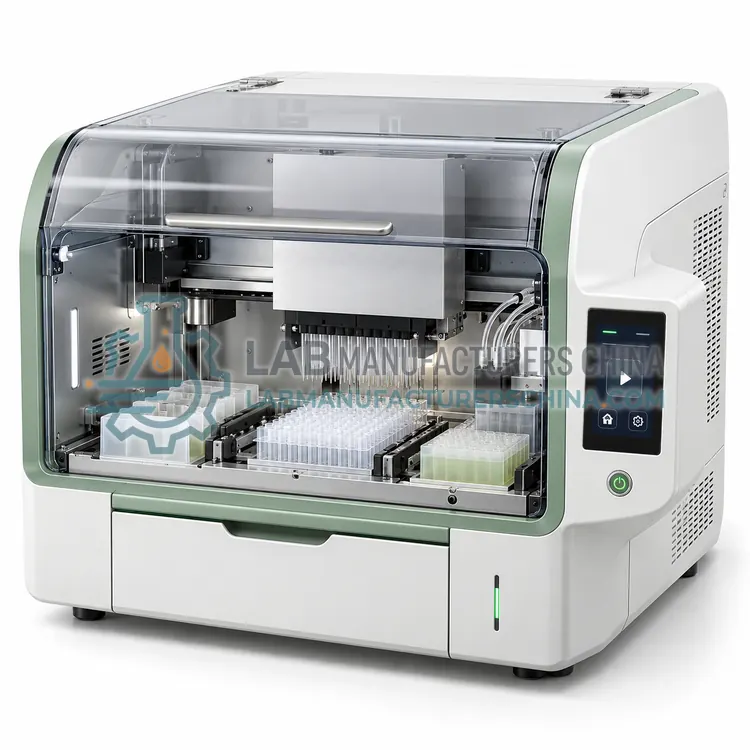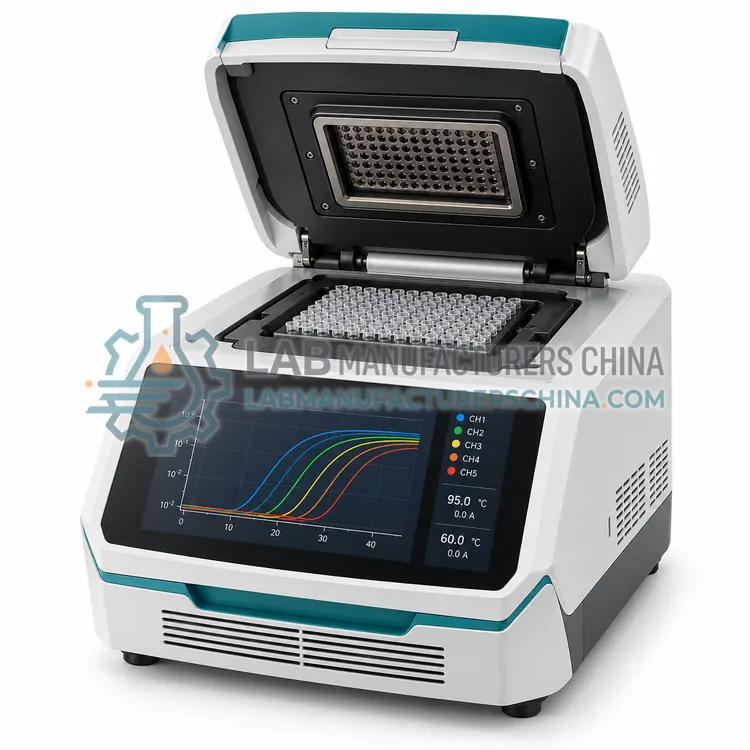
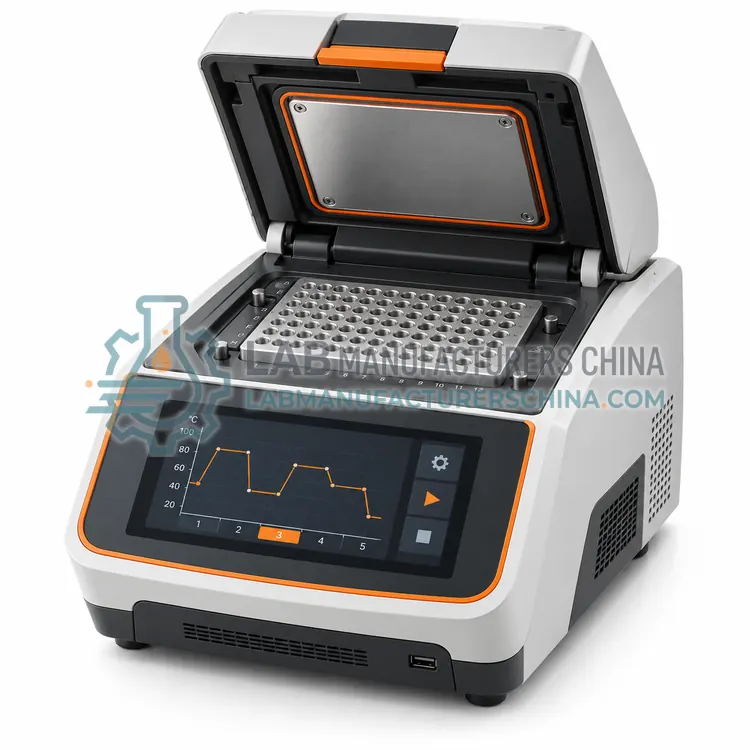
Endpoint PCR Thermal Cycler
终点法 PCR 热循环仪
- SKU PCR-0001
- PCR
- CE (to be confirmed)
- ISO 9001 manufacturing (to be confirmed)
- IEC 61010-1 test report (to be confirmed)
Price on request — FOB / CIF quoted per order
Prices depend on configuration, quantity and destination port.
Key specifications
| Block format | 96 x 0.2 mL, 384-well or 0.5 mL options |
|---|---|
| Temperature range | 4-99 °C |
| Maximum ramp rate | 3-5 °C per second |
| Temperature uniformity | ±0.3-0.5 °C at 72 °C |
| Temperature accuracy | ±0.2 °C |
| Gradient range | 30-99 °C, up to 12 rows |
Request a quote Download brochure · to be provided
By Lab Manufacturers China Technical TeamLast reviewed Standards: ISO 13485 manufacturing, MIQE guidelines, CLSI MM03-A2
What is the Endpoint PCR Thermal Cycler?
A thermal cycler that runs amplification and leaves the product for later analysis by gel or capillary electrophoresis. It is the economical workhorse for routine detection, colony screening and template preparation before sequencing.
What is the Endpoint PCR Thermal Cycler?
A thermal cycler that runs amplification and leaves the product for later analysis by gel or capillary electrophoresis. It is the economical workhorse for routine detection, colony screening and template preparation before sequencing.
Overview
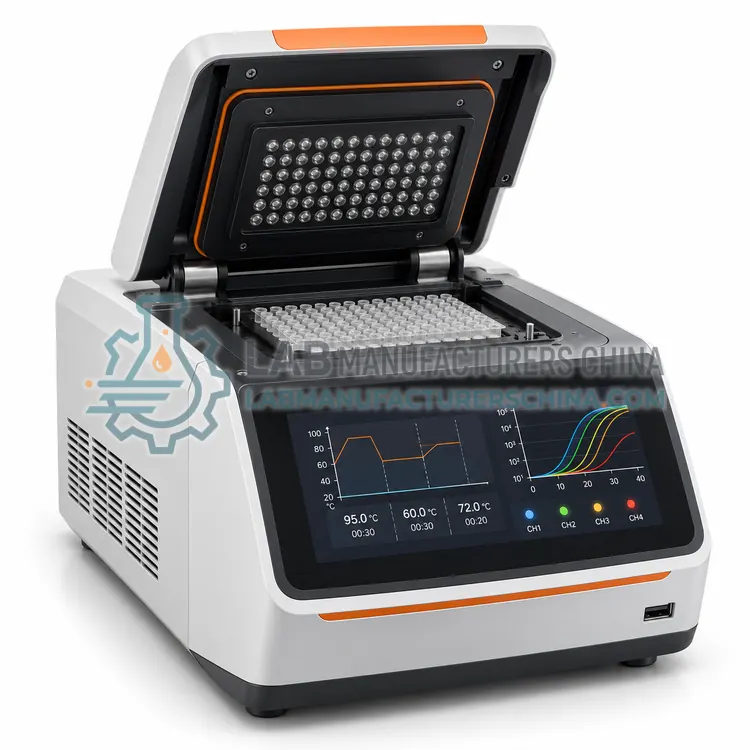
The endpoint thermal cycler holds a sample block of 96 wells of 0.2 mL tubes or a 384-well plate, or in some models a 0.5 mL format for larger reactions. Peltier elements heat and cool the block under control of a lid heater, which pressurizes heated lids to stop condensation. Programmable ramps of 1 to 5 °C per second, gradient rows for primer optimisation and extended high-temperature holds support standard and touch-down protocols. Reproducibility depends on block temperature uniformity, typically ±0.3 to 0.5 °C, and on well-to-well consistency of ramp rate. After the run, products are loaded onto an agarose gel with a size marker or analysed on a capillary system. Software stores programs, records run logs and often supports USB export for documentation.
How does it work?
PCR copies a target sequence with a thermostable DNA polymerase such as Taq, two primers that flank the target, deoxynucleoside triphosphates and a buffer. A thermal block cycles the reaction from about 95 °C, where double-stranded DNA separates, to 50 to 65 °C for primer annealing, then 72 °C for extension. Repeating 25 to 45 cycles doubles the product each round, so amplification is exponential while reagents last. Endpoint cyclers read the product afterwards on a gel or capillary system, while real-time instruments measure fluorescence each cycle using an intercalating dye or a hydrolysis probe, and the cycle threshold reflects the starting template amount. Quantitative results need a standard curve or reference gene, and melting curve analysis checks product specificity or detects sequence variants by high-resolution melting. Reverse transcription adds a step for RNA targets.
What are the key features?
- 96-well 0.2 mL block with optional 384-well or 0.5 mL formats.
- Peltier heating with heated, pressurized lid.
- Programmable ramp rates of 1 to 5 °C per second.
- Gradient block for primer annealing optimisation.
- Temperature uniformity of about ±0.3 to 0.5 °C.
- Program storage and USB run-log export.
What are the technical specifications?
A typical endpoint pcr thermal cycler configuration offers block format of 96 x 0.2 mL, 384-well or 0.5 mL options, temperature range of 4-99 °C, maximum ramp rate of 3-5 °C per second, temperature uniformity of ±0.3-0.5 °C at 72 °C, temperature accuracy of ±0.2 °C and gradient range of 30-99 °C, up to 12 rows. Values are indicative of the product class; the exact figures for each configuration are confirmed on the quotation and the calibration documents supplied with the instrument.
Which applications is it used for?
The Endpoint PCR Thermal Cycler is used in routine target amplification, colony and clone screening, template preparation for sequencing and genotyping with restriction digest. Across the wider PCR class, laboratories also deploy it for gene expression analysis and transcript quantification, pathogen detection in clinical and food samples and genotyping and mutation screening.
Which standards and certifications apply?
Relevant standards and methods include ISO 13485 manufacturing, MIQE guidelines, CLSI MM03-A2, CLSI MM06-A2, IEC 61010-1 and IVDR (EU) 2017/746. Certification candidates for this model are CE, ISO 9001 manufacturing and IEC 61010-1 test report; each is to be confirmed for the specific configuration before shipment, and certificates are supplied only where they have been issued.
Keep pre-amplification and post-amplification work in separate areas with dedicated pipettes and filter tips, because carryover of amplicon is the main cause of false positives. Clean surfaces and equipment with fresh hypochlorite or a validated decontaminant, use UV where available and change gloves often. Calibrate block temperature and optical channels annually with a reference thermometer and dye plate, and check uniformity across the block. Verify performance with positive and negative controls and a standard curve in every run, and record Ct, efficiency and melt temperatures. Store primers and probes in small aliquots at the recommended temperature to avoid repeated freeze-thaw cycles, and protect fluorescent probes from light.
How do I select the right Endpoint PCR Thermal Cycler?
Select the endpoint cycler when you only need qualitative detection and already have gel or capillary detection capacity. Compare block format, ramp rate, uniformity and gradient options, and check that the heated lid pressure suits the tube or plate you use. Specify tube type, plate format, program capacity and whether a gradient block is required for assay development.
How does it compare with other PCR variants?
Decide first whether you need qualitative detection, relative or absolute quantification, or sequence variant discrimination, because that separates endpoint cyclers from real-time and melt systems. Next, set the number of optical channels, since multiplex panels need two to six channels and matching filter sets. Throughput follows the plate format: 96 wells suits most laboratories, while 384-well plates and automation fit high-volume screening. Check block type, maximum ramp rate, temperature uniformity and gradient capability, which help with new primer sets. For field work, consider size, power options and tolerance of ambient temperature. Confirm analysis software, export formats, primer and probe support, and the validation documentation your quality system requires.
Full specifications
| Block format | 96 x 0.2 mL, 384-well or 0.5 mL options |
|---|---|
| Temperature range | 4-99 °C |
| Maximum ramp rate | 3-5 °C per second |
| Temperature uniformity | ±0.3-0.5 °C at 72 °C |
| Temperature accuracy | ±0.2 °C |
| Gradient range | 30-99 °C, up to 12 rows |
| Heated lid | 100-110 °C, adjustable pressure |
| Programs stored | 100 or more |
| Typical run time | 60-120 min for 35 cycles |
| Power supply | 220 V, 50 Hz, 600-900 W |
Indicative values for this product class. Final specifications are confirmed on the quotation and in the calibration documents supplied with the instrument.
Applications
- Routine target amplification
- Colony and clone screening
- Template preparation for sequencing
- Genotyping with restriction digest
Key features
- 96-well 0.2 mL block with optional 384-well or 0.5 mL formats.
- Peltier heating with heated, pressurized lid.
- Programmable ramp rates of 1 to 5 °C per second.
- Gradient block for primer annealing optimisation.
- Temperature uniformity of about ±0.3 to 0.5 °C.
- Program storage and USB run-log export.
Frequently asked questions about Endpoint PCR Thermal Cycler
Only if you develop or troubleshoot primer sets, because it lets you test several annealing temperatures in one run. Laboratories that run validated assays with fixed conditions can save cost with a single-zone block.
Fast ramps of 4 to 5 °C per second shorten runs but can reduce specificity for some primer pairs. Moderate rates of 2 to 3 °C per second are a common compromise, and ramp rate can be programmed per step.
Droplets on the tube wall change the reaction volume and concentration, which reduces yield and consistency. A heated lid at 100 to 110 °C with even pressure keeps the reaction at the bottom of the tube.
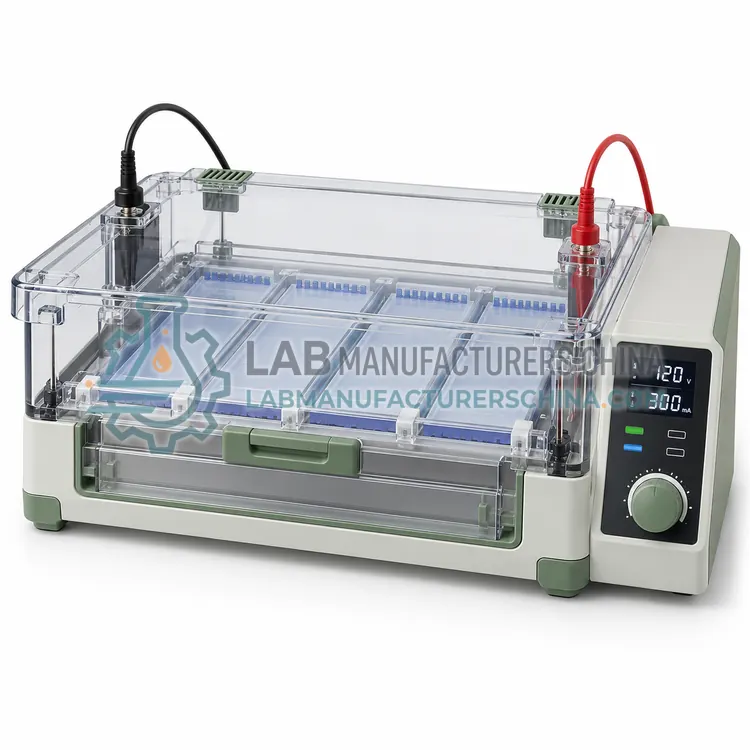
Endpoint PCR amplifies the target and the product is analysed afterwards, usually by gel electrophoresis. Real-time PCR measures fluorescence during each cycle, which gives quantitative data, a cycle threshold value and a melting curve without opening the tube.
Most protocols use 25 to 45 cycles. Fewer cycles are used for abundant targets or quantitative work, while more may be needed for low-copy templates. Excess cycles increase non-specific products and background fluorescence.
Wells at different temperatures amplify at different rates, which shifts cycle threshold values between replicates. Uniformity within about ±0.3 to 0.5 °C across the block keeps replicates comparable and improves quantitative accuracy.
Related models