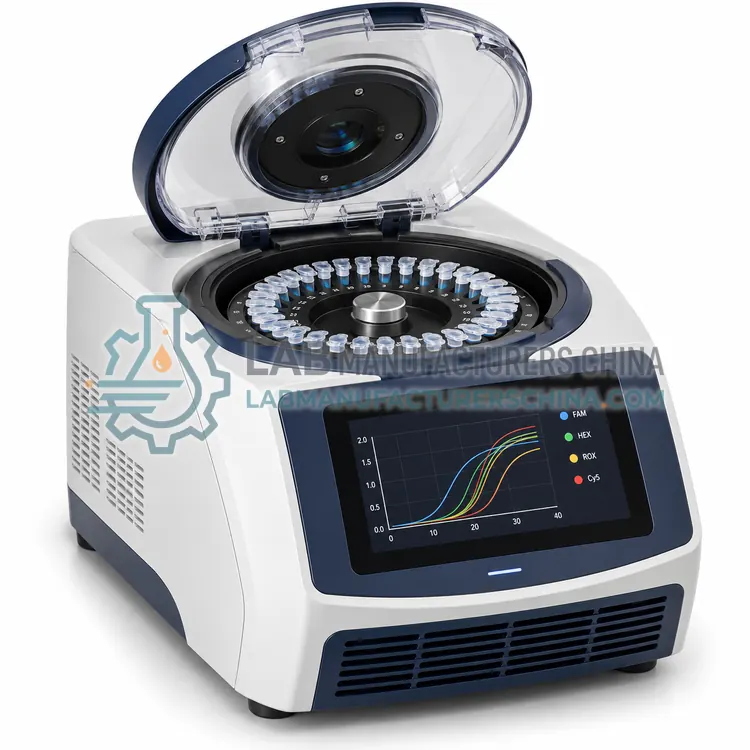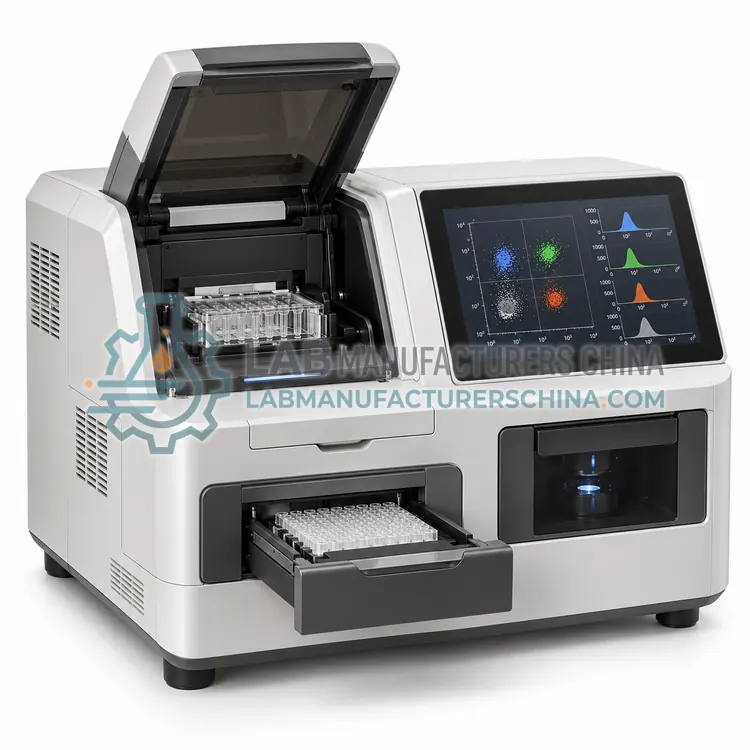
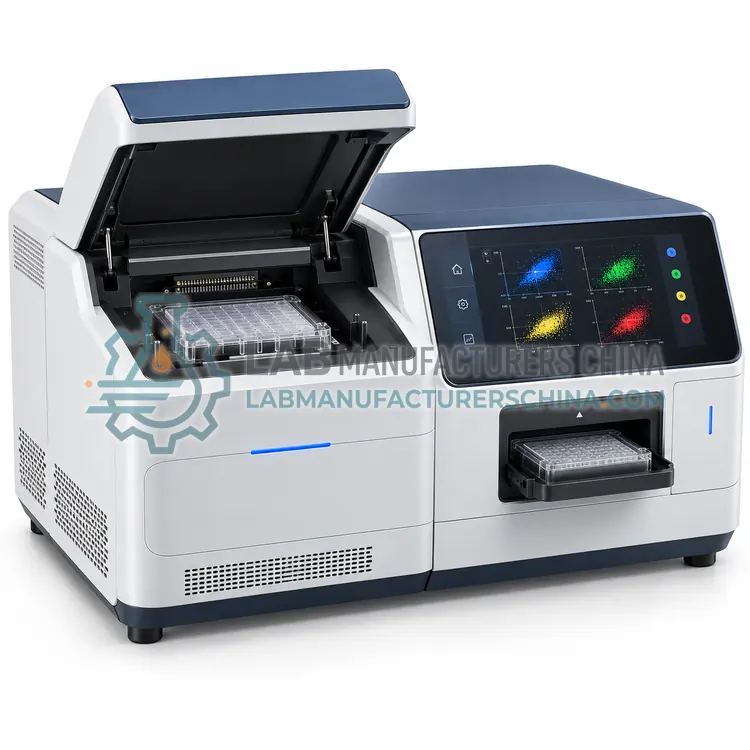
Chip-Based Microchamber Digital PCR System
芯片式微腔室数字 PCR 系统
- SKU DPC-0003
- Digital PCR
- CE (to be confirmed)
- ISO 9001 manufacturing (to be confirmed)
Price on request — FOB / CIF quoted per order
Prices depend on configuration, quantity and destination port.
Key specifications
| Partition type | fixed microchambers on chip |
|---|---|
| Partitions per chip | about 20,000 |
| Chamber volume | about 0.8 nL |
| Sample input | 10–15 µL |
| Detection channels | 2 to 4 |
| Dynamic range | about 4–5 logs |
Request a quote Download brochure · to be provided
By Lab Manufacturers China Technical TeamLast reviewed Standards: ISO 20395, ISO 22174, CLSI MM19
What is the Chip-Based Microchamber Digital PCR System?
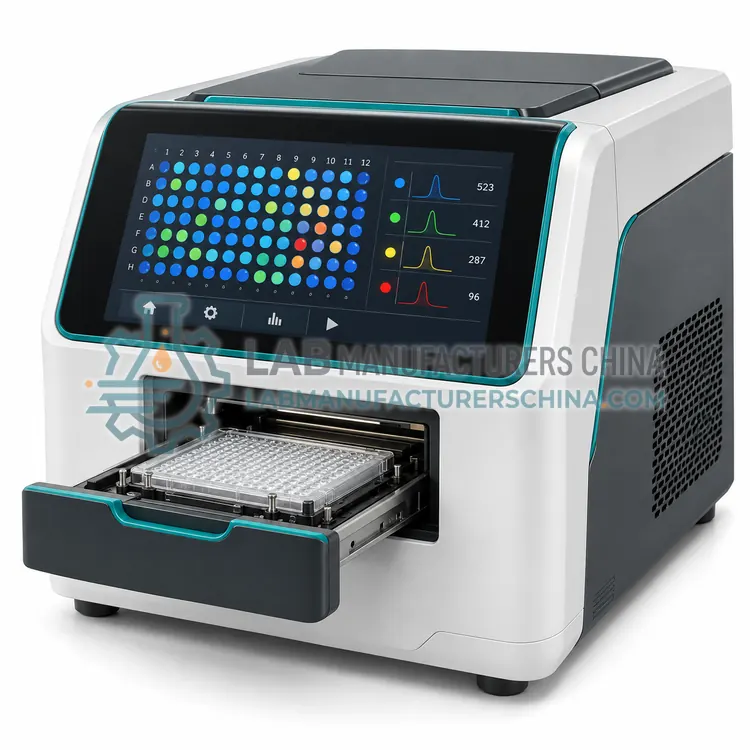
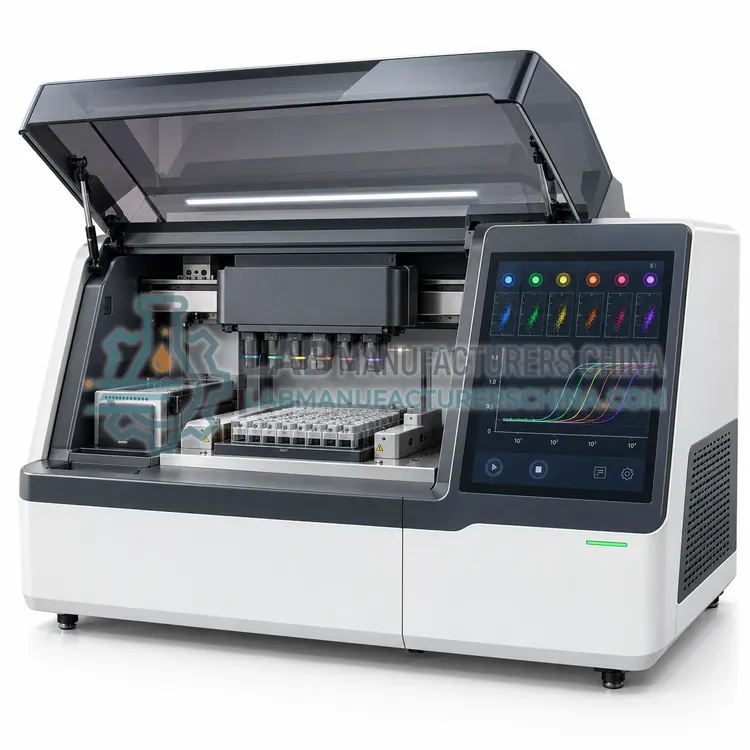
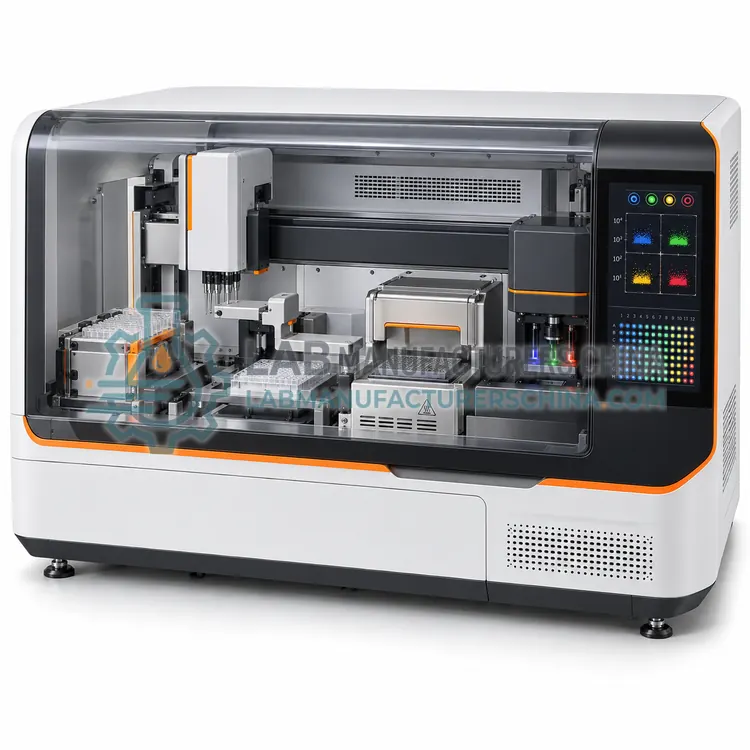
A chip-based microchamber digital PCR system distributes each sample through microfluidic channels into thousands of fixed microchambers on a disposable chip, then cycles and images it. It is the right choice for laboratories wanting low sample consumption, reliable partitioning and simple instrument operation.
What is the Chip-Based Microchamber Digital PCR System?
A chip-based microchamber digital PCR system distributes each sample through microfluidic channels into thousands of fixed microchambers on a disposable chip, then cycles and images it. It is the right choice for laboratories wanting low sample consumption, reliable partitioning and simple instrument operation.
Overview
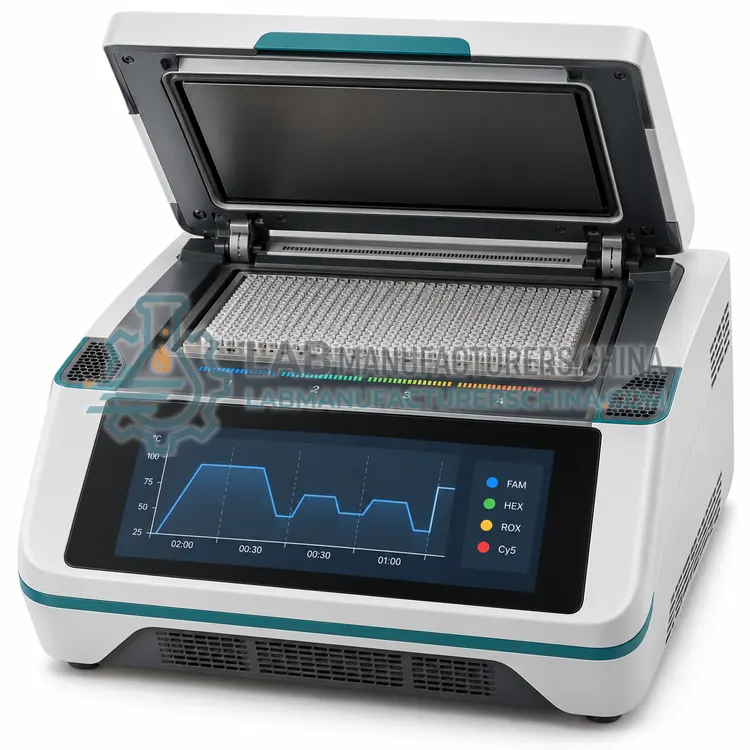
In a chip-based system the sample is pushed into microchambers by vacuum or pneumatic pressure, filling a fixed array, commonly 20,000 chambers of about 0.8 nL, and is sealed with oil or valves. The chip is cycled on a flat-plate heater and imaged by a fluorescence camera, often in a single integrated instrument. Because chamber volume is defined by photolithography, partition volume is tightly controlled and measurement precision is high. Typical input is 10–15 µL per chip. Two to four color channels are available. Chips are single-use and a batch processes one to 24 chips at a time. Advantages include simplicity and minimal cross-contamination, while limitations are fixed chamber count and the cost of chips.
How does it work?
In digital PCR the sample and master mix are partitioned into many independent reactions, as water-in-oil droplets, nanoliter wells on a plate, or microchambers on a chip. Partitions are thermally cycled to end point, and a fluorescence reader classifies each as positive or negative. If λ is the average number of copies per partition, the fraction of negative partitions equals e^−λ, so concentration follows from the count of negatives, partition volume and dilution. Because quantification relies on counting rather than amplification kinetics, it is less affected by inhibitors and efficiency differences and offers high precision at low copy number. Key components are the partitioning unit, a thermal cycler, a multi-color optical reader and analysis software with threshold setting.
What are the key features?
- Photolithographically defined chambers give uniform partition volume
- Vacuum or pneumatic loading minimizes pipetting steps
- Integrated heating and imaging in a compact instrument
- Low sample input of 10–15 µL per chip
- Two to four color channels
- Sealed chip format minimizes cross-contamination
What are the technical specifications?
A typical chip-based microchamber digital pcr system configuration offers partition type of fixed microchambers on chip, partitions per chip of about 20,000, chamber volume of about 0.8 nL, sample input of 10–15 µL, detection channels of 2 to 4 and dynamic range of about 4–5 logs. Values are indicative of the product class; the exact figures for each configuration are confirmed on the quotation and the calibration documents supplied with the instrument.
Which applications is it used for?
The Chip-Based Microchamber Digital PCR System is used in copy-number variation, low-input sample quantification, food and GMO traceability and pathogen detection research. Across the wider Digital PCR class, laboratories also deploy it for rare mutation and liquid biopsy detection, absolute quantification of viral load and copy-number variation analysis.
Which standards and certifications apply?
Relevant standards and methods include ISO 20395, ISO 22174, CLSI MM19, dMIQE guidelines (research reporting), IEC 61010-1 and IEC 61010-2-101. Certification candidates for this model are CE and ISO 9001 manufacturing; each is to be confirmed for the specific configuration before shipment, and certificates are supplied only where they have been issued.
Place the system on a stable bench, and keep sample preparation, partitioning and post-amplification steps in separate areas to limit amplicon contamination. Use the consumables and oil specified by the supplier, and avoid bubbles during droplet or plate loading. Include no-template and positive controls in every run and set fluorescence thresholds consistently. Verify partition volume and optical performance at installation and periodically with reference materials. Droplet generators and readers need routine cleaning and cartridge inspection. Plan for software validation, data retention and audit trail if results are used for clinical or regulated decisions, and establish the acceptable range of partitions per sample.
How do I select the right Chip-Based Microchamber Digital PCR System?
Select the chip-based system when sample volume is limited and simple operation matters more than partition count. It gives fewer partitions than large droplet runs but very uniform volumes. In an RFQ, specify chamber number, chamber volume, chips per run, channels, required sample volume, consumable supply, software features and whether on-site training is included.
How does it compare with other Digital PCR variants?
The decisive parameters are partition number and volume, which set dynamic range and precision, and the number of fluorescence colors, which set multiplexing. Droplet systems offer high partition counts at relatively low consumable cost, nanoplate and chip formats offer simpler, more automated workflows and lower contamination risk. Consider sample throughput, hands-on time, and whether partitioning, cycling and reading are integrated or separate instruments. Check software for rare-event calling, copy-number variation and Poisson confidence intervals. For clinical or reference-material work, ask about lot traceability of consumables and validation guidance such as the dMIQE recommendations. Account for consumable cost per sample, which often exceeds qPCR.
Full specifications
| Partition type | fixed microchambers on chip |
|---|---|
| Partitions per chip | about 20,000 |
| Chamber volume | about 0.8 nL |
| Sample input | 10–15 µL |
| Detection channels | 2 to 4 |
| Dynamic range | about 4–5 logs |
| Chips per run | 1 to 24 |
| Cycling time | about 90 min |
| Interfaces | USB, Ethernet |
| Power supply | 100–240 V AC, 50/60 Hz, about 400 W |
Indicative values for this product class. Final specifications are confirmed on the quotation and in the calibration documents supplied with the instrument.
Applications
- Copy-number variation
- Low-input sample quantification
- Food and GMO traceability
- Pathogen detection research
Key features
- Photolithographically defined chambers give uniform partition volume
- Vacuum or pneumatic loading minimizes pipetting steps
- Integrated heating and imaging in a compact instrument
- Low sample input of 10–15 µL per chip
- Two to four color channels
- Sealed chip format minimizes cross-contamination
Frequently asked questions about Chip-Based Microchamber Digital PCR System
No. Chips are single-use to avoid carry-over between samples. Store them as directed and check expiry dates before use, since chamber sealing and surface coatings can degrade over time.
Commonly 10–15 µL of reaction mix per chip, including template and master mix. Confirm the minimum fill volume specified for the chip type before preparing samples.
Bubbles can block chambers and reduce valid partition count, which widens confidence intervals. Degas reagents, avoid vigorous pipetting, and use the software flag that reports filled chambers.
Digital PCR divides a sample into thousands of tiny partitions, amplifies each to end point, and counts positive and negative partitions. Poisson statistics then give absolute copy number per microliter without a calibration curve, with high precision at low target levels.
Real-time PCR infers quantity from the cycle at which fluorescence crosses a threshold and needs a standard curve. Digital PCR counts positive partitions at end point, giving absolute quantity, better tolerance of inhibitors and better precision for small fold differences.
More partitions extend dynamic range and improve precision at low copy number. Systems range from about 10,000 to over 20,000 partitions per sample in droplet formats, and from a few thousand to tens of thousands in plate or chip formats.
Related models