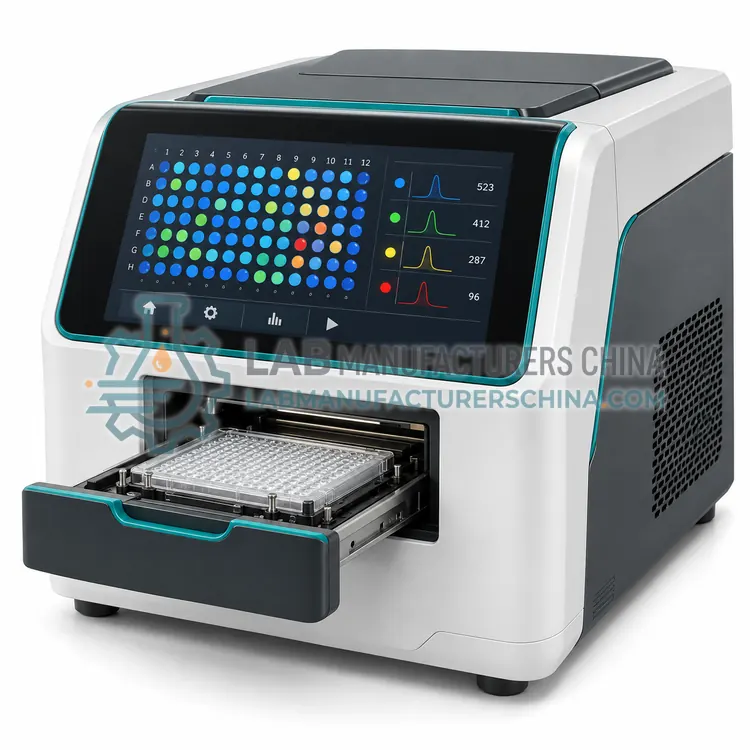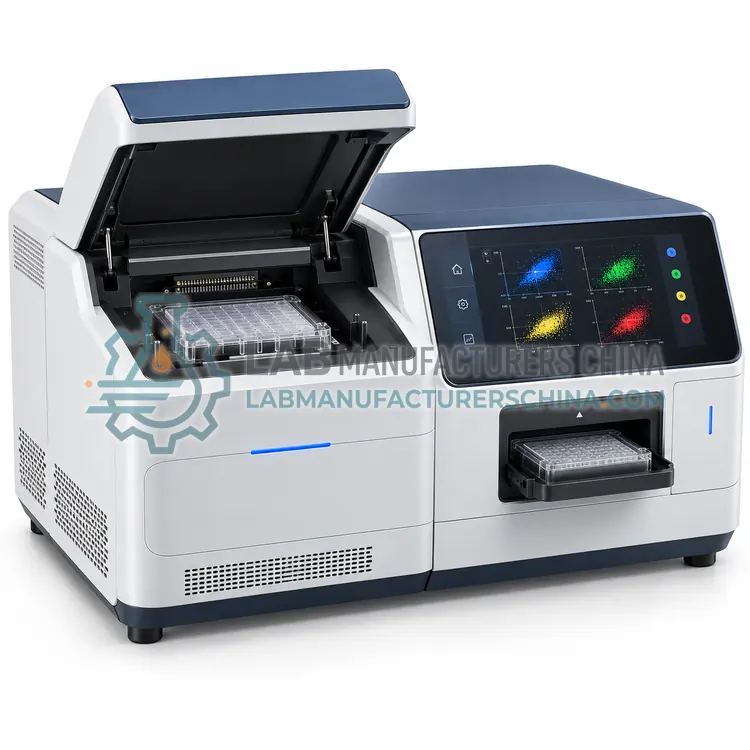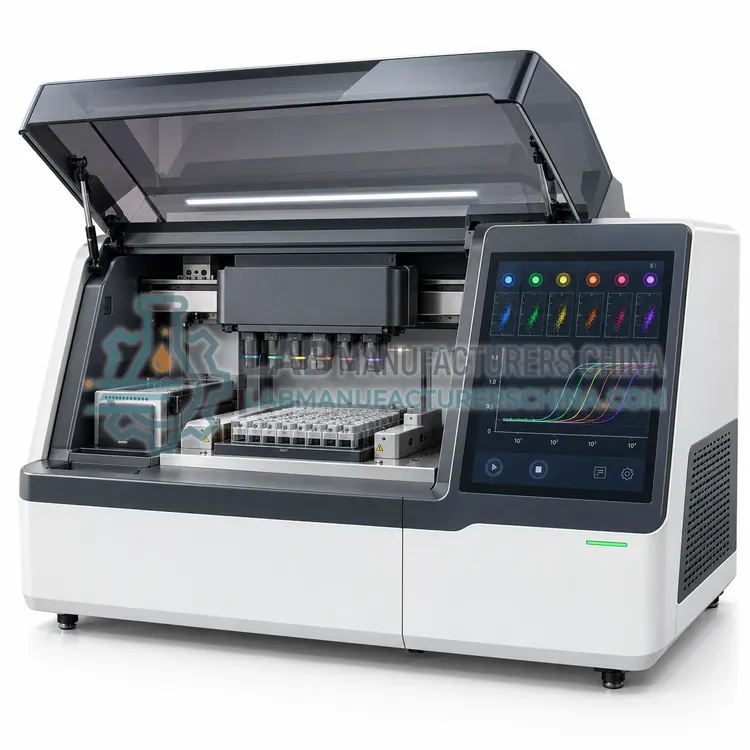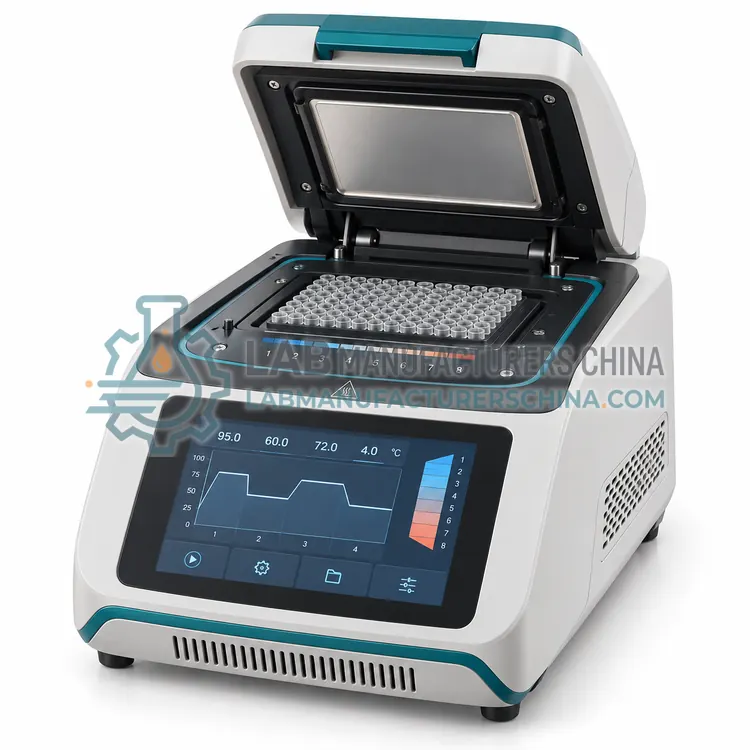
Automated Droplet Digital PCR Workstation
全自动微滴式数字 PCR 工作站
- SKU DPC-0005
- Digital PCR
- CE (to be confirmed)
- ISO 9001 manufacturing (to be confirmed)
Price on request — FOB / CIF quoted per order
Prices depend on configuration, quantity and destination port.
Key specifications
| Partitions per sample | about 20,000 |
|---|---|
| Reaction volume | 20–22 µL |
| Detection channels | 2 to 5 |
| Plate capacity per batch | 4–8 plates (384–768 samples) |
| Daily throughput | ≥ 1,000 samples (continuous) |
| Hands-on time per batch | < 30 min |
Request a quote Download brochure · to be provided
By Lab Manufacturers China Technical TeamLast reviewed Standards: ISO 20395, ISO 22174, CLSI MM19
What is the Automated Droplet Digital PCR Workstation?
An automated droplet digital PCR workstation integrates droplet generation, plate sealing, thermal cycling and droplet reading with a robotic arm, processing 96 to 384 samples with little manual handling. It is the right choice for high-volume service laboratories and pharmaceutical groups that need traceable, unattended digital PCR.
What is the Automated Droplet Digital PCR Workstation?
An automated droplet digital PCR workstation integrates droplet generation, plate sealing, thermal cycling and droplet reading with a robotic arm, processing 96 to 384 samples with little manual handling. It is the right choice for high-volume service laboratories and pharmaceutical groups that need traceable, unattended digital PCR.
Overview
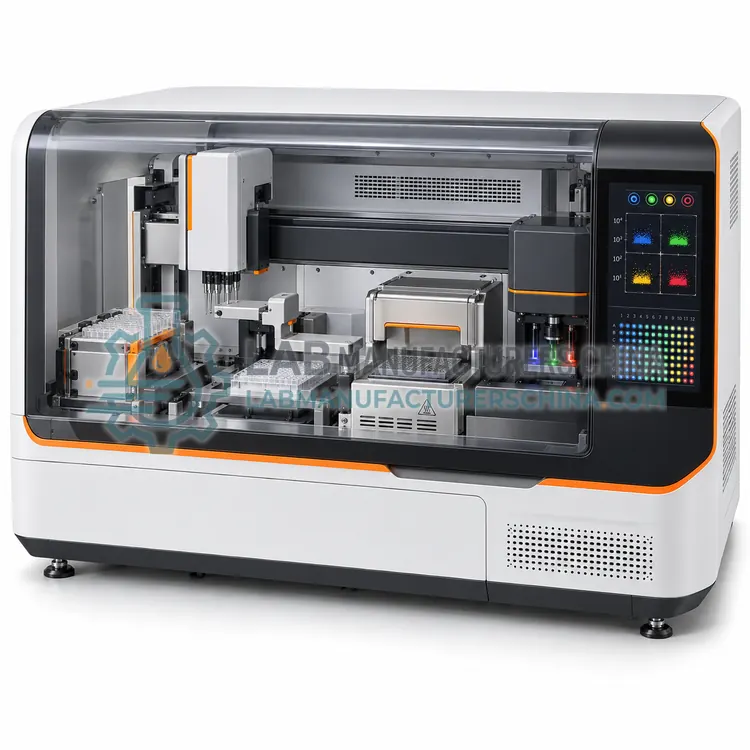
The workstation combines a liquid handler, a droplet generator, a plate sealer, one or more thermal cyclers and a droplet reader on a common deck controlled by scheduling software. Plates pass between modules through a robotic arm, so droplets are generated, sealed, cycled and read with minimal intervention. Barcoding tracks each sample and consumable lot. Typical capacity is 4 to 8 plates per batch, and continuous operation allows 1,000 or more samples per day. The system offers the same partition counts as standalone droplet systems, about 20,000 per sample, with two to five channels. Footprint is large, often 2–3 m of bench, and installation needs validation of each module, plus a service contract.
How does it work?
In digital PCR the sample and master mix are partitioned into many independent reactions, as water-in-oil droplets, nanoliter wells on a plate, or microchambers on a chip. Partitions are thermally cycled to end point, and a fluorescence reader classifies each as positive or negative. If λ is the average number of copies per partition, the fraction of negative partitions equals e^−λ, so concentration follows from the count of negatives, partition volume and dilution. Because quantification relies on counting rather than amplification kinetics, it is less affected by inhibitors and efficiency differences and offers high precision at low copy number. Key components are the partitioning unit, a thermal cycler, a multi-color optical reader and analysis software with threshold setting.
What are the key features?
- Robotic arm links droplet generation, sealing, cycling and reading
- Barcode tracking of samples, plates and consumable lots
- Scheduling software for unattended batch operation
- Capacity of 4 to 8 plates per batch
- Audit trail and LIMS integration
- Two to five detection channels
What are the technical specifications?
A typical automated droplet digital pcr workstation configuration offers partitions per sample of about 20,000, reaction volume of 20–22 µL, detection channels of 2 to 5, plate capacity per batch of 4–8 plates (384–768 samples), daily throughput of ≥ 1,000 samples (continuous) and hands-on time per batch of < 30 min. Values are indicative of the product class; the exact figures for each configuration are confirmed on the quotation and the calibration documents supplied with the instrument.
Which applications is it used for?
The Automated Droplet Digital PCR Workstation is used in contract research laboratories, pharmaceutical biomarker studies, large cohort liquid biopsy research and viral vector quantification. Across the wider Digital PCR class, laboratories also deploy it for rare mutation and liquid biopsy detection, absolute quantification of viral load and copy-number variation analysis.
Which standards and certifications apply?
Relevant standards and methods include ISO 20395, ISO 22174, CLSI MM19, dMIQE guidelines (research reporting), IEC 61010-1 and IEC 61010-2-101. Certification candidates for this model are CE and ISO 9001 manufacturing; each is to be confirmed for the specific configuration before shipment, and certificates are supplied only where they have been issued.
Place the system on a stable bench, and keep sample preparation, partitioning and post-amplification steps in separate areas to limit amplicon contamination. Use the consumables and oil specified by the supplier, and avoid bubbles during droplet or plate loading. Include no-template and positive controls in every run and set fluorescence thresholds consistently. Verify partition volume and optical performance at installation and periodically with reference materials. Droplet generators and readers need routine cleaning and cartridge inspection. Plan for software validation, data retention and audit trail if results are used for clinical or regulated decisions, and establish the acceptable range of partitions per sample.
How do I select the right Automated Droplet Digital PCR Workstation?
Select the automated workstation when daily volumes exceed a few hundred samples and traceability is required. It cuts hands-on time but needs space, service and validation. In an RFQ, specify throughput per day, module list, barcode and LIMS interfaces, required channels, data-integrity features, installation qualification and operational qualification support, and service response time.
How does it compare with other Digital PCR variants?
The decisive parameters are partition number and volume, which set dynamic range and precision, and the number of fluorescence colors, which set multiplexing. Droplet systems offer high partition counts at relatively low consumable cost, nanoplate and chip formats offer simpler, more automated workflows and lower contamination risk. Consider sample throughput, hands-on time, and whether partitioning, cycling and reading are integrated or separate instruments. Check software for rare-event calling, copy-number variation and Poisson confidence intervals. For clinical or reference-material work, ask about lot traceability of consumables and validation guidance such as the dMIQE recommendations. Account for consumable cost per sample, which often exceeds qPCR.
Full specifications
| Partitions per sample | about 20,000 |
|---|---|
| Reaction volume | 20–22 µL |
| Detection channels | 2 to 5 |
| Plate capacity per batch | 4–8 plates (384–768 samples) |
| Daily throughput | ≥ 1,000 samples (continuous) |
| Hands-on time per batch | < 30 min |
| Dynamic range | about 5 logs |
| Integration | LIMS, barcode, scheduling software |
| Footprint | about 2–3 m bench length |
| Power supply | 200–240 V AC, 50/60 Hz, about 2000 W |
Indicative values for this product class. Final specifications are confirmed on the quotation and in the calibration documents supplied with the instrument.
Applications
- Contract research laboratories
- Pharmaceutical biomarker studies
- Large cohort liquid biopsy research
- Viral vector quantification
Key features
- Robotic arm links droplet generation, sealing, cycling and reading
- Barcode tracking of samples, plates and consumable lots
- Scheduling software for unattended batch operation
- Capacity of 4 to 8 plates per batch
- Audit trail and LIMS integration
- Two to five detection channels
Frequently asked questions about Automated Droplet Digital PCR Workstation
Yes, but consumable use and time per sample rise. Scheduling software usually allows partial plates, though confirm minimum fill requirements for droplet generation cartridges in advance.
Expect 2–3 meters of bench or a dedicated floor-standing deck, plus clearances for the robotic arm, waste and oil supplies. The supplier should provide a site-preparation drawing before delivery.
Yes. With multiple integrated modules, scheduled preventive maintenance and calibration are important. Ask for response times, spare-part availability and remote diagnostics in the service agreement.
Digital PCR divides a sample into thousands of tiny partitions, amplifies each to end point, and counts positive and negative partitions. Poisson statistics then give absolute copy number per microliter without a calibration curve, with high precision at low target levels.
Real-time PCR infers quantity from the cycle at which fluorescence crosses a threshold and needs a standard curve. Digital PCR counts positive partitions at end point, giving absolute quantity, better tolerance of inhibitors and better precision for small fold differences.
More partitions extend dynamic range and improve precision at low copy number. Systems range from about 10,000 to over 20,000 partitions per sample in droplet formats, and from a few thousand to tens of thousands in plate or chip formats.
Related models