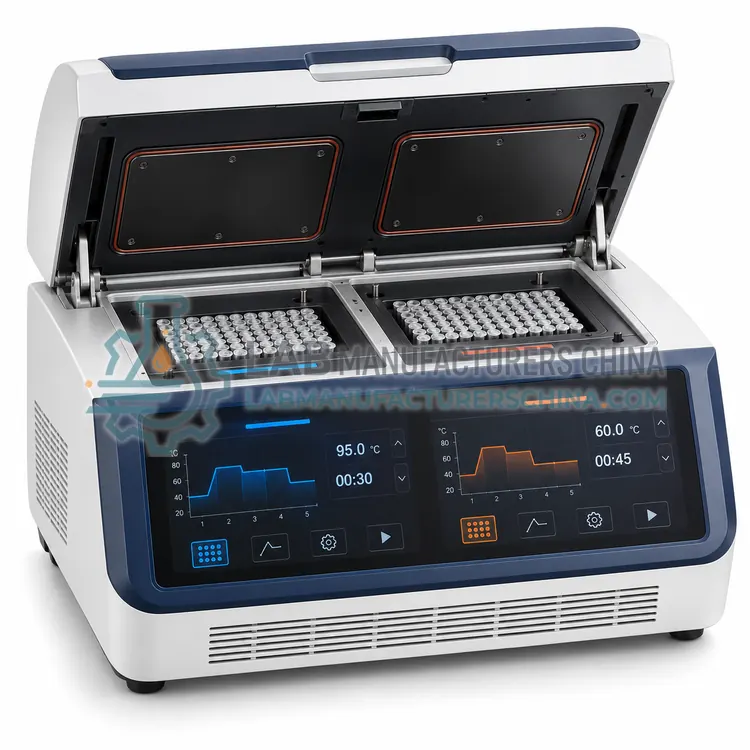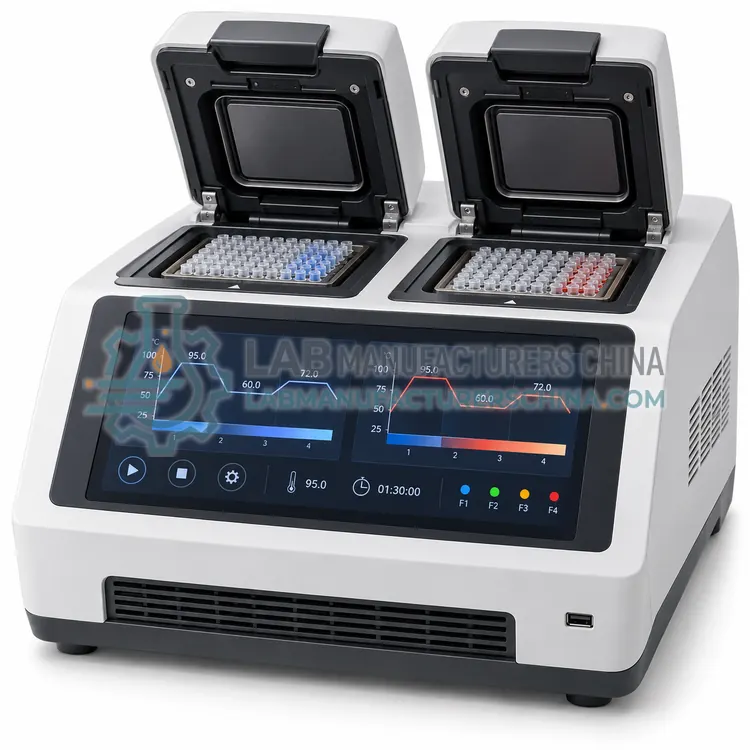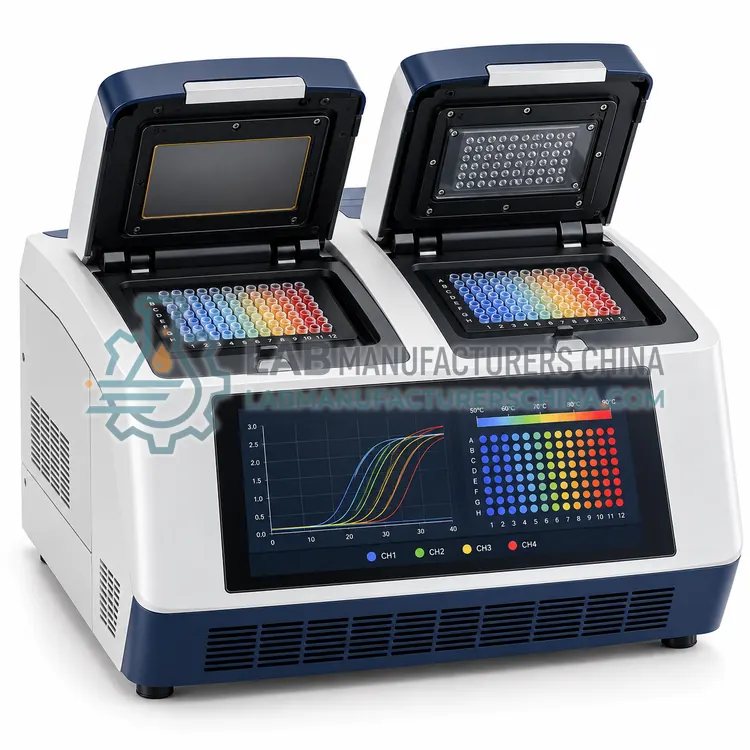
384-Well Gradient Thermal Cycler
384 孔梯度热循环仪
- SKU GRP-0004
- Gradient PCR
- CE (to be confirmed)
- ISO 9001 manufacturing (to be confirmed)
Price on request — FOB / CIF quoted per order
Prices depend on configuration, quantity and destination port.
Key specifications
| Block format | 384-well plate |
|---|---|
| Gradient span | 1–20 °C |
| Gradient resolution | 24 columns |
| Max ramp rate | 1.5–3 °C/s |
| Block uniformity | ±0.4 °C |
| Gradient accuracy | ±0.4 °C |
Request a quote Download brochure · to be provided
By Lab Manufacturers China Technical TeamLast reviewed Standards: IEC 61010-1, IEC 61010-2-010, ISO 20395
What is the 384-Well Gradient Thermal Cycler?
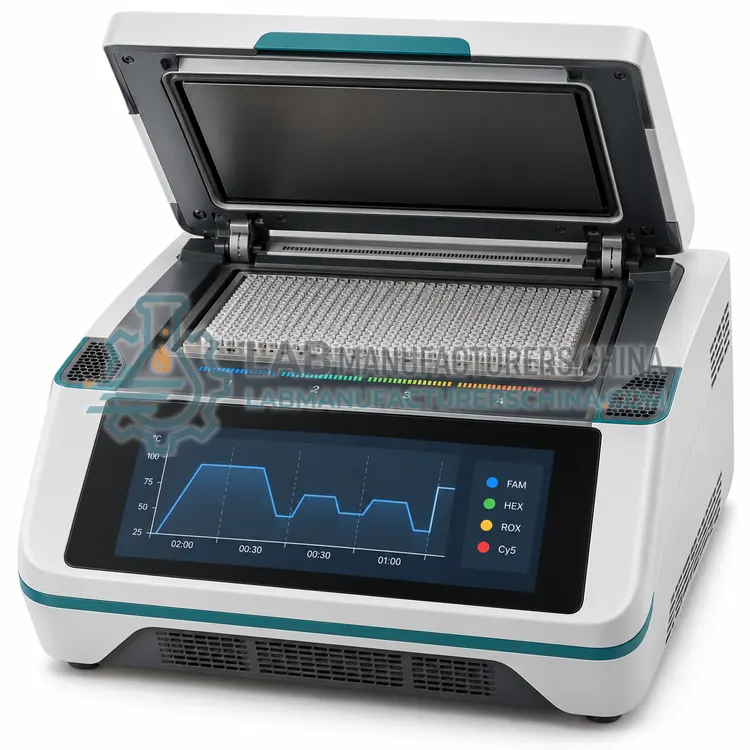
A 384-well gradient thermal cycler applies a linear temperature gradient across 24 columns of a 384-well block, allowing annealing optimisation of many primer sets in microliter volumes. It is the right choice for high-throughput assay development with automated liquid handling.
What is the 384-Well Gradient Thermal Cycler?
A 384-well gradient thermal cycler applies a linear temperature gradient across 24 columns of a 384-well block, allowing annealing optimisation of many primer sets in microliter volumes. It is the right choice for high-throughput assay development with automated liquid handling.
Overview
The 384-well gradient unit uses a large Peltier block with independent heating of opposite sides, creating a linear gradient across 24 columns. The gradient span is typically 1–20 °C. Reaction volumes of 5–20 µL reduce reagent consumption. Because of thermal mass, ramp rates are 1.5–3 °C/s and uniformity is ±0.4 °C. The instrument is commonly paired with a liquid handler to fill the plate, and a motorized lid with high closing force keeps small wells sealed. One plate can test 24 annealing temperatures for 16 primer pairs, for example. The larger format increases the demands on thermal calibration and on edge-well evaporation control, so validation with representative assays is needed.
How does it work?
A gradient cycler uses a Peltier block with independently controlled heating and cooling at each end, or multiple thermal zones, to establish a linear temperature profile across the block. A typical range is 1–30 °C, so a 96-well block with 12 columns can test 12 different annealing temperatures in one run, for example 50–65 °C. Temperature sensors along the block feed back to a controller, and the software calculates the actual temperature of every column. Alternative designs use three to six independently controlled zones, which give a defined temperature in each zone rather than a continuous gradient, and improve accuracy of the set points. After the run, amplicons are compared by gel electrophoresis or melt curve to identify the annealing temperature with the highest specific yield.
What are the key features?
- Linear gradient across 24 columns of a 384-well block
- Low reaction volume of 5–20 µL for reagent saving
- High-force motorized lid for small well sealing
- Suitable for automated plate filling
- Displays calculated temperature per column
- Edge well compensation to limit evaporation
What are the technical specifications?
A typical 384-well gradient thermal cycler configuration offers block format of 384-well plate, gradient span of 1–20 °C, gradient resolution of 24 columns, max ramp rate of 1.5–3 °C/s, block uniformity of ±0.4 °C and gradient accuracy of ±0.4 °C. Values are indicative of the product class; the exact figures for each configuration are confirmed on the quotation and the calibration documents supplied with the instrument.
Which applications is it used for?
The 384-Well Gradient Thermal Cycler is used in high-throughput assay optimisation, primer library screening, automated method development and reagent formulation studies. Across the wider Gradient PCR class, laboratories also deploy it for primer annealing temperature optimisation, polymerase and buffer comparison and multiplex PCR development.
Which standards and certifications apply?
Relevant standards and methods include IEC 61010-1, IEC 61010-2-010, ISO 20395, ISO 22174 and CLSI MM19. Certification candidates for this model are CE and ISO 9001 manufacturing; each is to be confirmed for the specific configuration before shipment, and certificates are supplied only where they have been issued.
Gradient performance should be verified at installation with a multi-point probe at several set gradients, since accuracy at the ends of the block can differ from the center. Keep the block clean and ensure all tubes and plates are fully seated to maintain thermal contact. Use the same plate type for optimisation and routine runs, as wall thickness affects actual well temperature. Record the optimal annealing temperature and the column where it occurred. After optimisation, transfer the protocol to the routine cycler and verify that performance matches, because different blocks may differ slightly. Maintain pre-PCR and post-PCR separation and run no-template controls for every temperature tested.
How do I select the right 384-Well Gradient Thermal Cycler?
Select a 384-well gradient cycler when optimising many primer sets or conditions at low volume with liquid handling. It is slower per cycle than 96-well formats. In an RFQ, specify gradient span, columns resolved, plate type, lid force, automation interfaces and whether edge-well validation data is available.
How does it compare with other Gradient PCR variants?
Choose between true linear gradient and multi-zone designs. Linear gradients suit simple primer optimisation with 8 or 12 temperatures, while independent zones give more precise set points and let you run different protocols in different zones. Check the gradient span, maximum temperature difference, number of gradient steps, and whether gradient is available on every cycle step, including denaturation and extension. Consider block format, ramp rate and whether a real-time optical module is needed so melt curves can confirm specificity. Also look at software that displays calculated column temperatures and lets you save gradient conditions with protocols. For shared laboratories, dual-block gradient units add capacity. Verify gradient accuracy with a calibrated multi-point probe.
Full specifications
| Block format | 384-well plate |
|---|---|
| Gradient span | 1–20 °C |
| Gradient resolution | 24 columns |
| Max ramp rate | 1.5–3 °C/s |
| Block uniformity | ±0.4 °C |
| Gradient accuracy | ±0.4 °C |
| Reaction volume | 5–20 µL |
| Temperature range | 4–99 °C |
| Heated lid range | 30–110 °C |
| Power supply | 100–240 V AC, 50/60 Hz, about 900 W |
Indicative values for this product class. Final specifications are confirmed on the quotation and in the calibration documents supplied with the instrument.
Applications
- High-throughput assay optimisation
- Primer library screening
- Automated method development
- Reagent formulation studies
Key features
- Linear gradient across 24 columns of a 384-well block
- Low reaction volume of 5–20 µL for reagent saving
- High-force motorized lid for small well sealing
- Suitable for automated plate filling
- Displays calculated temperature per column
- Edge well compensation to limit evaporation
Frequently asked questions about 384-Well Gradient Thermal Cycler
Yes, it runs standard uniform protocols too. However, 96-well units are more convenient for small batches, and 384-well blocks are best when you have hundreds of reactions.
A 30-cycle protocol takes about 1.5–2.5 hours due to thermal mass. Gradient runs take the same time as non-gradient runs since the gradient is applied during the same annealing step.
Use optical-grade or pressure-sensitive sealing films, a high-force heated lid, and check edge-well volumes after the run. Run validation plates with water or dye to confirm loss is negligible.
It runs different annealing temperatures across the columns of one block in a single experiment, so you can find the temperature giving the most specific and abundant product without running multiple separate cycles.
Typical gradient spans are 1–30 °C across the block, within a total range of about 30–100 °C. Wider spans are useful for unknown primers but reduce resolution between columns. For fine tuning, use a narrower gradient.
Yes. Gradient capability does not affect normal operation, and most gradient cyclers also run standard protocols. Many laboratories use one gradient unit for optimisation and several standard units for routine work.
Related models