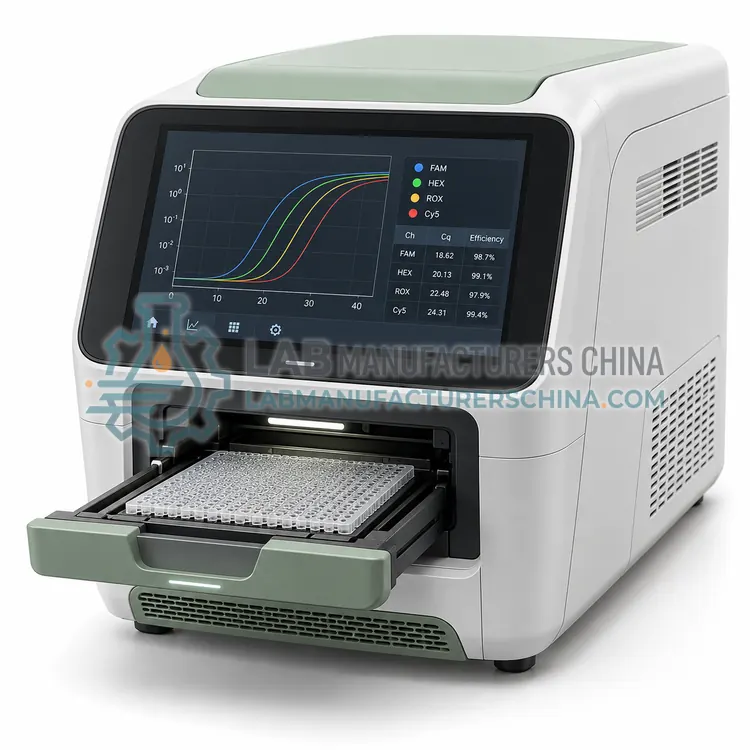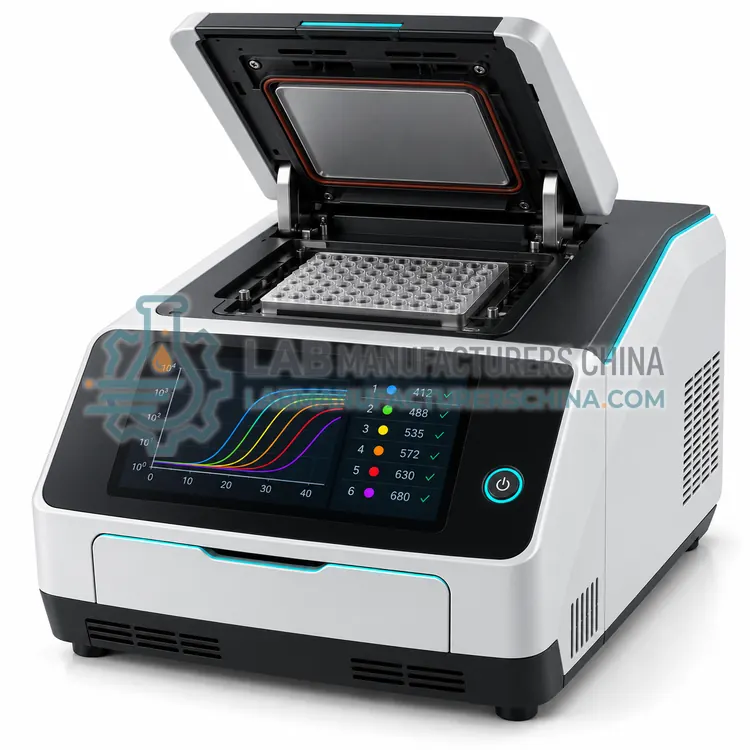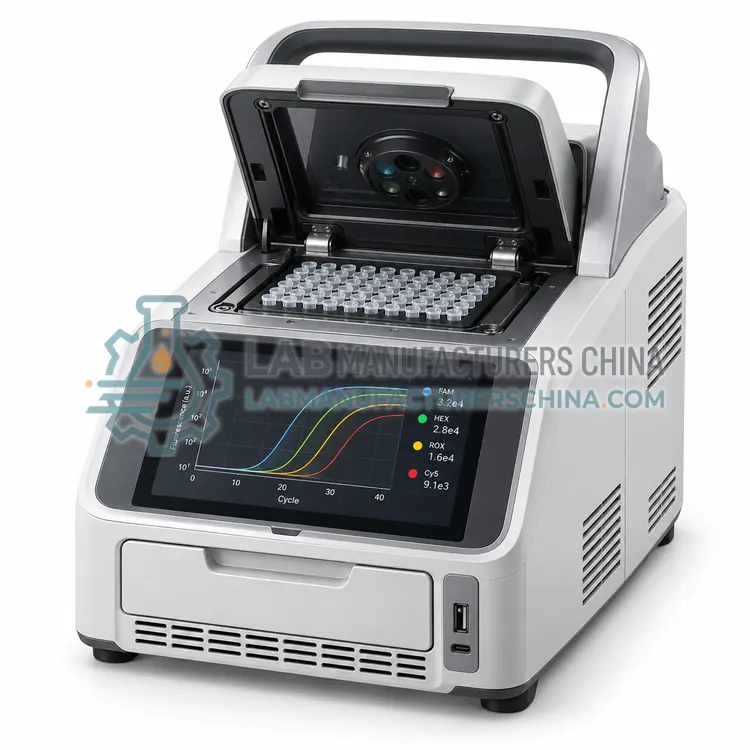
Rotor-Type Real-Time PCR Cycler
转子式实时荧光定量 PCR 仪
- SKU RTP-0004
- Real-Time PCR
- CE (to be confirmed)
- ISO 9001 manufacturing (to be confirmed)
Price on request — FOB / CIF quoted per order
Prices depend on configuration, quantity and destination port.
Key specifications
| Tube format | 36, 72 or 100 tubes (0.1/0.2 mL strips) |
|---|---|
| Optical channels | 4 to 6 |
| Temperature range | 35–99 °C |
| Max ramp rate (chamber) | 10–15 °C/s |
| Temperature uniformity | ±0.25 °C |
| Reaction volume | 10–25 µL |
Request a quote Download brochure · to be provided
By Lab Manufacturers China Technical TeamLast reviewed Standards: ISO 20395, ISO 22174, CLSI MM06
What is the Rotor-Type Real-Time PCR Cycler?
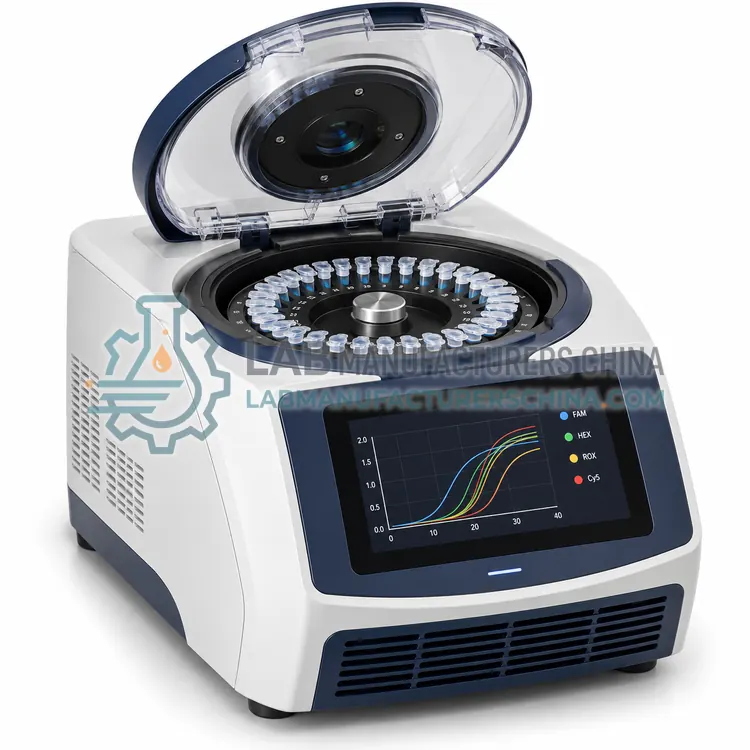
A rotor-type real-time PCR cycler spins 36 to 100 tubes in a circular rotor heated and cooled by air, reading each tube as it passes the optical head. It is the right choice for small to medium batches needing fast ramping and identical optical path for every tube.
What is the Rotor-Type Real-Time PCR Cycler?
A rotor-type real-time PCR cycler spins 36 to 100 tubes in a circular rotor heated and cooled by air, reading each tube as it passes the optical head. It is the right choice for small to medium batches needing fast ramping and identical optical path for every tube.
Overview
In a rotor-type cycler, tubes sit in a carousel that rotates at about 400 rpm inside a chamber heated by a resistive element and cooled by ambient airflow. Because the air surrounds every tube equally and every tube passes the same optical detector, well-to-well variation is very low, with temperature uniformity near ±0.25 °C and identical optical path length. Air-based heating gives ramp rates of 10–15 °C/s in the chamber, so a 40-cycle run may finish in 30–45 minutes. Rotor capacities of 36, 72 or 100 tubes are common, using 0.1 or 0.2 mL strip tubes. Reaction volumes are 10–25 µL. The design has no plate format, so it suits batches of a few dozen samples rather than high-throughput plate screening.
How does it work?
A real-time PCR system pairs a Peltier or air-heated thermal block with an excitation source, filters and a detector. Reactions contain a fluorescent reporter: either an intercalating dye such as SYBR Green that binds double-stranded DNA, or sequence-specific probes such as hydrolysis (TaqMan-type) or molecular beacon probes. Excitation light from LEDs or halogen lamps passes through a filter set, and emission is read by a photodiode, PMT or CCD at the end of each annealing or extension step. The software plots fluorescence against cycle number and assigns a quantification cycle, Cq or Ct, where the signal crosses a threshold. Cq relates inversely to the logarithm of starting copy number, enabling standard-curve or relative quantification. Melt curve analysis adds product specificity checks.
What are the key features?
- Air-heated chamber with ramp rates of 10–15 °C/s
- Single optical head reads every tube along the same path
- Rotor capacities of 36, 72 or 100 tubes
- Low-volume 10–25 µL reactions in strip tubes
- Fast 30–45 minute runs for 40 cycles
- Four to six channel options for multiplexing
What are the technical specifications?
A typical rotor-type real-time pcr cycler configuration offers tube format of 36, 72 or 100 tubes (0.1/0.2 mL strips), optical channels of 4 to 6, temperature range of 35–99 °C, max ramp rate (chamber) of 10–15 °C/s, temperature uniformity of ±0.25 °C and reaction volume of 10–25 µL. Values are indicative of the product class; the exact figures for each configuration are confirmed on the quotation and the calibration documents supplied with the instrument.
Which applications is it used for?
The Rotor-Type Real-Time PCR Cycler is used in rapid pathogen detection, small-batch gene expression studies, high-resolution melt genotyping and food and environmental testing. Across the wider Real-Time PCR class, laboratories also deploy it for clinical pathogen nucleic acid testing, gene expression analysis by RT-qPCR and food and GMO testing.
Which standards and certifications apply?
Relevant standards and methods include ISO 20395, ISO 22174, CLSI MM06, CLSI MM19, IEC 61010-1, IEC 61010-2-101 and MIQE guidelines (research reporting). Certification candidates for this model are CE and ISO 9001 manufacturing; each is to be confirmed for the specific configuration before shipment, and certificates are supplied only where they have been issued.
Install the instrument on a level, vibration-free bench away from sunlight, with ambient temperature of 15–30 °C and stable mains. Perform optical calibration with the supplier's dye or ROX calibration plates at installation and after lamp or LED replacement. Verify thermal uniformity annually. Use optically clear, low-fluorescence plates and seals that match the well format, and avoid fingerprints on the seal. Keep pre- and post-PCR areas separate and never open amplified plates near the instrument. Clinical laboratories should plan for software validation, access control and audit trail in line with their quality system, and keep backups of run files and melt-curve data.
How do I select the right Rotor-Type Real-Time PCR Cycler?
Select a rotor-type cycler for small batches that value speed and optical consistency, such as daily clinical or food samples. It does not use plates, so automation is limited compared with block systems. In an RFQ, specify rotor capacity, tube type, channel number, run time for a reference protocol, high-resolution melt capability and whether the supplier can provide tube and ring-locking accessories.
How does it compare with other Real-Time PCR variants?
Decide first on throughput and format: 96-well suits most laboratories, 384-well suits high-volume screening, and rotor or portable designs suit small batches. Then match the number of optical channels to your multiplex needs, since four channels cover most dual- or triplex assays with an internal control, while five or six channels support larger panels. Check that the excitation and emission filters fit your dyes, including FAM, HEX/VIC, ROX and Cy5. Compare thermal uniformity and ramp rate, detection sensitivity at low copy number, and software features such as absolute quantification, melt curves and gene-expression analysis. For regulated diagnostics, confirm audit trail, user levels and data-export options, and ask whether IVD registration support exists.
Full specifications
| Tube format | 36, 72 or 100 tubes (0.1/0.2 mL strips) |
|---|---|
| Optical channels | 4 to 6 |
| Temperature range | 35–99 °C |
| Max ramp rate (chamber) | 10–15 °C/s |
| Temperature uniformity | ±0.25 °C |
| Reaction volume | 10–25 µL |
| Rotor speed | about 400 rpm |
| Excitation source | LED |
| Dynamic range | ≥ 7 logs |
| Typical 40-cycle run time | 30–45 min |
| Power supply | 100–240 V AC, 50/60 Hz, about 600 W |
Indicative values for this product class. Final specifications are confirmed on the quotation and in the calibration documents supplied with the instrument.
Applications
- Rapid pathogen detection
- Small-batch gene expression studies
- High-resolution melt genotyping
- Food and environmental testing
Key features
- Air-heated chamber with ramp rates of 10–15 °C/s
- Single optical head reads every tube along the same path
- Rotor capacities of 36, 72 or 100 tubes
- Low-volume 10–25 µL reactions in strip tubes
- Fast 30–45 minute runs for 40 cycles
- Four to six channel options for multiplexing
Frequently asked questions about Rotor-Type Real-Time PCR Cycler
Every tube sits in the same circulating air stream and passes the same optical head, so each sample sees nearly identical temperature and light path. This reduces well-to-well variation typical of plate blocks.
Not directly. They are designed for tubes held in a rotor. Some vendors offer adapters for small plates, but for routine plate-based workflows a block-type cycler is usually more convenient.
Use optically clear 0.1 mL or 0.2 mL strip tubes with caps specified by the manufacturer. Incorrect tube wall thickness or caps can change heat transfer and optical signal.
It measures fluorescence from a dye or probe every cycle and records the cycle at which signal crosses a threshold, the Cq value. Lower Cq means more starting template. Comparing Cq with a standard curve or reference gene gives absolute or relative quantity.
Dye-based qPCR, for example SYBR Green, binds any double-stranded DNA and is low cost but less specific, so melt curves are needed. Probe-based qPCR uses sequence-specific probes, gives higher specificity, and allows multiplexing in different fluorescence channels.
Most single-target assays with an internal control need two to four channels. Panels covering several pathogens in one well may need five or six. Match the channel number and filter set to the dyes you use and the multiplex level you plan.
Related models